Tuesday, February 9, 2016

What Is The Gold Standard?

Published here: http://www.zerohedge.com/news/2016-02-08/what-gold-standard


What Is The Gold Standard? 

Written by Jeff Nielson (CLICK HERE FOR FULL WHITE PAPER)


What is “the gold standard?” Many readers would consider this a simple question and perhaps even an obsolete one. It is for precisely this reason that a mere definition is inadequate as an answer. A definition conveys no understanding and thus does nothing to eliminate the many misconceptions surrounding this concept.

In order to provide sufficient context so that the definition provides meaning to readers, it is necessary to explore several, tangential subjects. As such, this discussion will contain:

 1) A brief review of the abolition of our gold standard.

 2)    An examination (and assessment) of the criticisms of the gold standard, past and present.

 3)    An examination of the monetary system that resulted from the abolition of the gold standard.

 4)    An examination of the financial system that resulted from the abolition of the gold standard.

 5)    A chronicling and explanation of the extreme price suppression of the gold market, a situation which has persisted for most of the post-gold standard era.


In its simple definition, a gold standard a monetary system based upon the “hard” backing of our currencies – that is, backing them with gold. It is a “standard” in that the price of gold is fixed, and thus all currencies, and (by implication) all goods are valued in relation to that fixed price.


The “gold standard” in its modern form was a monetary system that existed for roughly a century. While many nations (and empires) have based their monetary systems upon precious metals, this was most often done directly, via the usage of gold and/or silver money.

Real “money” is distinct from currency because, among other reasons, money preserves the wealth of the holder, while currency does not. Thus, we get our first inkling of why any nation would want to use a gold standard as their monetary system: to preserve and protect the wealth of the citizens of that nation, and thus the nation itself.


The End of an Era

On August 15th, 1971, the Nixon administration “closed the gold window,” which effectively put an end to the last vestige of our gold standard. Further elaboration is necessary. In the final decades of our “gold standard,” we no longer had a full gold standard, but rather only “partial convertibility” in our monetary system. What does that mean?

With a true, hard gold standard, where official currency is fully and directly backed by gold, these (paper) currencies can be fully converted into gold at the option of the currency-holder. However, in the Bretton Woods Agreement of 1944, the global monetary system was officially altered.

It became a system of partial convertibility, with the U.S. dollar as “reserve currency,” meaning that only one currency – the U.S. dollar – was still convertible to gold. Thus the only mechanism to convert paper to gold was for nations to exchange their U.S. dollars with the U.S. government in exchange for some of its gold reserves. Therefore, when the U.S. government “closed the gold window” in 1971, it defaulted on its gold obligations to the rest of the world, and the requirement that it convert U.S. dollars to gold at the option of the currency-holder. What caused this system to implode?

Here it is essential for readers to grasp that, in a monetary system of perfect integrity, there would have been zero incentive for other nations to redeem or convert their U.S. dollars into gold; each would be equally valuable. Only one possible factor could have provided nations with an incentive to engage in such conversion: the fear (and knowledge) that the system had lost its integrity.

In order to finance the war in Vietnam, the U.S. government had been printing too many U.S. dollars for several years. This meant it was expanding the supply of money beyond the corresponding size of its gold reserves.

U.S. dollars were officially convertible to gold, but because of this deliberate over-supply they were no longer fully “backed” by gold. The currency was being debauched, so the gold was worth significantly more than the actual value of the U.S. dollar. It was effectively monetary fraud. As the fraud became larger and more apparent, the drain on the U.S.’s gold reserves relentlessly grew.

This left only two options for the U.S. government: re-impose monetary discipline (on itself) and thus restore the integrity of the U.S. dollar, or default on its international obligations. The U.S. government chose the latter.


It is important to note that former Federal Reserve Chairman Paul Volcker has since stepped forward to claim personal credit for abolishing the gold standard. It is here where readers are introduced to the love/hate relationship between central bankers and gold.


This was one of history’s most emphatic (and prophetic) warnings against monetary crime. But what, precisely, does it mean?


Here readers must first forget everything they think they know about the word “inflation.” “Inflation” (verb: to inflate) means to expand, or inflate, the supply of money. This is the correct, economic definition of that term.


What most people think of as “inflation,” the increase in the price of goods, is simply the inevitable consequence of inflating the supply of money. It is very important that readers never forget this crucial distinction. As an academic, Alan Greenspan was fully cognizant of the correct definition of inflation, and was using it in that context.

There is no way to protect the confiscation of savings (theft of wealth) via an increase in the supply of money. Why? As more, new currency is printed, all existing currency is worth less, effectively confiscating some of the wealth of those existing currency-holders. This is nothing more than the concept of dilution.

If you add water to lemonade, you dilute all the lemonade, and each unit of lemonade is worth less. If a company prints more shares, it dilutes its share structure, and each share is worth less, and some of the wealth of existing shareholders has been “confiscated.” More importantly, it is the company that prints these new shares that has confiscated that shareholder wealth. This is why the (corporate) concept of “dilution” is utterly despised by shareholders.

If a government (i.e., central bank) prints new currency, thus diluting the money supply, each existing unit of currency is worth less. The principle is identical. Each time our central banks print more “money” (i.e., our paper), they dilute the value of all existing currency and confiscate some of the wealth of existing currency-holders.

When we go to the supermarket and pay $2 or $3 more for a dozen eggs, it’s still the same dozen eggs. The eggs haven’t changed. It’s the paper currency in our wallets that has lost half of its value due to “inflation” – the inflation of the supply of money, and the dilution (in value) that must accompany it.

Where does this confiscated wealth go? How and why is this confiscation of our wealth (via inflating the supply of money) an act of theft? It’s very simple. When our central banks print new currency, they don’t distribute it evenly amongst the entire population. They hand every single unit of that new currency (virtually for free) to the Big Bank syndicate.

Give me control of a nation’s money supply, and I care not who makes the laws.

-         

Mayer Amschel Rothschild, banker  (1744 – 1812)

Our monetary system has been criminalized. Instead of a tool of commerce, our monetary system is now a weapon used to systemically plunder the wealth of our populations (as per Greenspan’s warning). This weapon is then placed into the hands of the recipients of all this new, central bank funny money: the Big Banks.

When new currency is printed, it reduces the value of all existing currency. All of this new currency is handed to the Big Banks (by the central banks). These Big Banks then “lend” roughly 30 times that amount of currency to us (via “fractional-reserve banking”) at usurious rates of interest, which dilutes and reduces the value of all existing currency even further (thus increasing the rate of theft).

This is but the tip of the iceberg when it comes to the financial crime that has been unleashed upon us as a direct result of the abolition of the gold standard. How could we have sacrificed our only “protection” from such systemic, monetary crime?

Thank the critics of the gold standard. It is their attacks (which are relentlessly repeated by the corporate media oligopoly) on the one possible form of Honest Money that made possible first the abolition of the gold standard, and then the collective refusal (by corrupted governments) to reinstitute the only legitimate form of monetary system.


Future Chapters:

Criticisms of the Gold Standard

Fiat Currency Ponzi Scheme

Crime in Banking

Post-Gold Standard Price Suppression

Conclusion


This whitepaper is 23 pages and over 8,300 words long. Please CLICK HERE to read the rest and find the entire file.


For questions on this article or precious metals, please contact HERE

Gold Up 12%, Silver Up 11% YTD As Stocks Crash ... Again

Published here: http://www.zerohedge.com/news/2016-02-09/gold-12-silver-11-ytd-stocks-crash-again

Gold Up 12%, Silver Up 11% YTD As Stocks Crash ... Again

Gold jumped 2 percent to a 7-1/2-month high yesterday, briefly touching the psychological level of $1,200 an ounce. Falling bank shares and stock markets and worries over global economic growth and a new financial crisis prompted investors to seek the safety of gold.

After surging over 5% last week, gold and silver continue to move higher as concerns about the U.S. and global economy saw more sharp stock market falls and reduced expectations of the Fed increasing interest rates.

gold_USD_1year

Gold finished the week at $1,173.40 an ounce and has built on those gains today rising another 0.4% to $1,178.10 an ounce – taking its year-to-date gain to 11 per cent.

Stocks had another torrid week with the S&P 500 falling 3.1% and the Nasdaq down 5.4% while gold rose by 5.04% and silver by 5.4%. Gold had its best week since July 2013.

Technically, gold is looking better and better and the gains last week were the third consecutive week of gains. The weekly higher close above the 200 day moving average ($1,129/oz) is leading to increasing conviction that gold prices have bottomed and we are in the early stages of a new bull market.

Momentum buyers and trend following funds are again making the “trend their friend.” This is seen in the increase in gold ETF holdings which have increased now for 15 consecutive days as retail and institutional investors diversify into gold to protect from increasing market volatility and concerns of new bear markets in stocks.

Gold has seen similar gains in euro and larger gains in sterling terms (+13% year to date) again showing gold’s currency hedging properties.


LBMA Gold Prices

8 Feb: USD 1,173.40, EUR 1,050.16 and GBP 810.44 per ounce
5 Feb: USD 1,158.50, EUR 1,035.58 and GBP 797.40 per ounce
4 Feb: USD 1,146.25, EUR 1,027.29 and GBP 782.16 per ounce
3 Feb: USD 1,130.00, EUR 1,034.04 and GBP 781.25 per ounce
2 Feb: USD 1,123.60, EUR 1,029.65 and GBP 780.01 per ounce

Gold and Silver News and Commentary – Click here


by Mark O'Byrne


www.GoldCore.com 

They Broke the Silver Fix

Published here: http://www.zerohedge.com/news/2016-02-09/they-broke-silver-fix

Last Thursday, January 28, there was a flash crash on the price chart for silver. Here is a graph of the price action.

silver
   The Price of Silver, Jan 28 (All times GMT)

If you read more about it, you will see that there was an irregularity around the silver fix. At the time, the spot price was around $14.40. The fix was set at $13.58. This is a major deviation.

Many silver bugs are up in arms about how unfair the new silver fix is. That’s nothing new. They were up in arms about the old one. The old one was supposedly manipulated

One thing is for sure, tactical manipulations can occur. A gold trader in London was found to have pushed the price down in the gold fixing by a few pennies. He had sold a multimillion dollar option, and he wanted it to expire worthless to avoid having to pay. Right after the fix, he bought back the gold he sold, pushing the price back up to where it was. He took a loss on the round trip of the gold, of course, but saved millions on the option which he did not have to pay.

This is not the long-sought proof that nefarious forces are keeping gold from attaining $20,000.

Anyways, because the silver and gold fixes were deemed to be benchmarks by regulatory changes post the LIBOR manipulations, a new process for the gold and silver fixes was implemented. Before we look at what changed, let’s consider why there is a fix price. Couldn’t they just take the price at 12:00 noon?

No, it wouldn’t work because in a live market there is not just one price. There are always two prices: bid and offer. Which would you use as the benchmark? Either price could misrepresent the current state of the market. What’s more, those prices are just quotes, not executed trades.

To be useful as a benchmark—a price that third party contracts and derivatives can be based on—there has to be a single price based on real executed trades. So they need to get buyers and sellers together, and find the price at which the most metal clears. If there is a better way than that, it hasn’t been discovered yet.

This leads to a question. How do two prices that are supposed to track each other actually, you know, stay matched? This occurs in Exchange Traded Funds that move with an index of stocks (such as SPX or GLD). It occurs in gold futures and spot.

It should also occur between the fixing process and the spot market. What use is a silver fix at $13.58 while the spot price was $14.40? We’ll get back to market action on that day, in a bit. First, we need to look at the force that keeps two prices close to each other.

It is arbitrage. Let’s use GLD as an example. Each share represents a known quantity of gold. Suppose the price of the share rises relative to the price of gold metal in the spot market, and the metal in a share of GLD is $1 per ounce higher. The arbitrageur buys gold metal, creates shares of GLD, and sells them. This tends to pull up the price of gold metal, and mostly pushes down the price of GLD.

Note that the arbitrageur takes no price risk. He is simply acting to profit from a spread (usually a very small one). Arbitrageurs will keep doing this trade, until GLD and gold metal get close enough that the small remaining profit is not worth the effort.

The arbitrageur is motivated, of course, by profit. He is as greedy as the next guy (admit it, if you could demand a 300% raise from your boss, you would). However, his activity is self-limiting. The more he puts on his trade, the more he compresses the spread. In our example, the arbitrageur buys some gold metal and sells some GLD shares, to make $1. That is the initial profit. However, he compresses that spread, perhaps to 50 cents. He can have another go, but then the spread narrows to 25 cents. Soon enough, he walks away (these are illustrative numbers only for this example).

It's a textbook case of the Invisible Hand described by Adam Smith. The arbitrageur, seeking his own profit, ends up serving other market participants. He keeps two different prices locked tightly together. Everyone else can take for granted that GLD works as it’s supposed to.

For example, suppose you run a small gold coin store. You need to hedge your inventory just as a large dealer does. However, you sell gold one ounce at a time. Big dealers might use 100-ounce gold futures, but you use GLD. You can thank the actions of this arbitrageur.

Now let’s get back to the fix. The old process was conducted by the major market makers in each metal. They got together in one room, and each had major clients on various phone lines. The chairman would put out a price, and the market makers would talk to their clients to determine who wanted to sell at that price and who wanted to buy. Then they add up all selling and buying, and see if there’s a close match. They would keep moving the price until selling matched buying within tolerance. That was the fix price.

There was just one problem, at least so far as the gold bugs were concerned: the market maker. Since the first market maker walked into a coffee house in London where shares were being traded, most people have misunderstood the market maker. Back in the coffee house days, all potential sellers would line up on one side of the room, in order from lowest offer price to highest. On the other side, buyers would line up, from highest bid to lowest.

If one had to sell, that meant taking the best bid presented in the room. Likewise, if one wanted to buy right now, one paid the best offer price. As you would imagine, the bid-ask spread could get pretty wide, and perhaps worse yet, it was unpredictable.

Until the market maker walked in. Unlike all the others, he was both a potential buyer and a potential seller. He had an inventory of both shares and cash. He published a better price if you wanted to buy or sell and as it turns out, he was the only one who could consistently buy at the bid price and sell at the ask price.

Of course, the guy with the best bid price—or what had been the best price until the market maker strolled into the room—was upset. Who is this dodgy bloke? Why is he allowed to mess about like this? Surely it’s unethical, immoral, and maybe even illegal?

In fact, he is serving all market participants (except the few who hoped to sell and make a buyer pay a premium and the equally small few who hoped to buy from someone desperate to raise cash). The market maker is motivated by profit, sure, but in making money he is narrowing the bid-ask spread whilst also reducing its volatility.

Today, the market maker is aka High Frequency Trader, and he uses technology that the coffee house fellows could not have imagined. Nevertheless, he too encounters the same exact suspicion, if not resentment, if not envy and anger.

Now let’s tie this to the silver fix. In the old fixing process, bullion bank dealers could place orders in the spot market during the fix. For example, if the fix price looked like it might settle at $14.30, but the spot price was $14.34, the dealers would buy the fix and sell spot, happy to make four cents.

Many objected to this because it looked like information was leaking into the market. They claimed it’s so unfair, perhaps even a gateway drug to insider trading? If other market participants can’t have this privilege, the bullion banks shouldn’t have it either. And besides, they’re supposed to be just brokers and not trading their own proprietary positions. The truth was that there was nothing stopping other market participants from also trading in the spot market during the fixing process, it was just that the bullion banks’ dealers were more efficient at being market maker.

Well, in part due to the agitation of the gold and silver bugs, government regulators came down on the market makers. They fixed it so that market makers were no longer allowed to arbitrage the fix to the spot and futures markets.

Before you think “yeah, this is what we want,” let’s revisit one of our favorite and recurrent themes, namely: be careful what you wish for.

As it stands today, if the fix price is starting to deviate from the market price, the market makers’ hands are tied. Ross Norman, CEO of bullion dealer Sharps Pixley in London, expressed his frustration with this. “The real problem as we see it is that banks are increasingly unwilling or unable to place corresponding orders where they perceive a mis-pricing because of fears of being accused of abusing a situation and facing the wrath of the regulator or their compliance departments.”

The big clients who participate in the fixing process may be freer to trade. However, they don’t have the same information. Market making is hard because you’re playing for pennies or fractions of a penny, but if you screw up you can lose dollars. The clients may know how many rounds into the fixing process they are, and the order imbalance of each round. But they can’t react as quickly as the bullion banks who are making markets in the spot, futures, and ETF markets, and they don’t know as much about market conditions either. They can’t arbitrage a few pennies. They need a much bigger spread.

A wider spread, much less an unpredictable spread, is to no one’s benefit. For example, the mining companies often sell at the fix price, rather than try to time it (or be accused of breach of fiduciary duty by their shareholders if they mis-time it). How much deviation of the fix price will it take before miners are forced to embrace the next-best solution?

“The large discrepancy between the spot price and the fix is very alarming to us especially that it happened twice in a row,” KGHM head of market risk Grzegorz Laskowski told FastMarkets.

The next best solution, by definition, is less advantageous than the best.


Read on in Part II (free registration required) for a damning graph plus our analysis drilling down into what happened last Thursday just after high noon in London.


© 2016 Monetary Metals

Monday, February 8, 2016

Silver Prices: Major Economic Indicators Suggest Silver Could Soar

Published here: http://www.profitconfidential.com/silver/silver-prices-major-economic-indicators-suggest-silver-could-soar/

What a difference three months can make. Currently trading near $15.00 an ounce, silver prices are up almost nine percent since the beginning of the year and at their highest levels since November. While silver bulls may see the current surge in silver prices as a great time to sell, the fact is that silver could surge significantly higher.
Silver Prices Surge on Weak Stock Market
Silver prices have been bullish in 2016, up nine percent since the beginning of the year and at its highest levels in three months. Silver prices are getting a boost from an unstable stock market,.

The post Silver Prices: Major Economic Indicators Suggest Silver Could Soar appeared first on Profit Confidential.

Sunday, February 7, 2016

Possible Silver U-Turn Report, 7 Feb, 2016

Published here: http://www.zerohedge.com/news/2016-02-08/possible-silver-u-turn-report-7-feb-2016

Wow, did the dollar move down this week! It dropped more than it has in quite a while. It fell 1.3mg gold, or 0.1g silver.

Gold and silver bugs of course are excited, as they look at it as the prices of the metals going up $55 and 72 cents respectively. The collapse of what most think of as money—including especially said gold and silver bugs—is great fun and profitable. At least if you’re short the dollar.

By the way, when we say the dollar fell we do not mean in terms of its derivatives such as euro, pound, yuan, and so on. We’re well aware that the dollar index fell from 99.6 to 97. The euro and other currencies are no more suitable for measuring the dollar, than, well the dollar is to measuring gold. And for the same reason. You can’t measure the something by reference to things derived from it.

Last week, we said:

“It’s far too early to call a bottom in the silver price. However, the movement on Thu and Fri is the sort of action we should expect to see more of if silver is to return to a bull market. It will take more action like this before we change our position on the white metal, but it is worth reporting on what we see when we see it.”

Read on for an update on the gold and perhaps more interestingly the silver supply and demand fundamentals…

But first, here’s the graph of the metals’ prices.

       The Prices of Gold and Silver
prices

We are interested in the changing equilibrium created when some market participants are accumulating hoards and others are dishoarding. Of course, what makes it exciting is that speculators can (temporarily) exaggerate or fight against the trend. The speculators are often acting on rumors, technical analysis, or partial data about flows into or out of one corner of the market. That kind of information can’t tell them whether the globe, on net, is hoarding or dishoarding.

One could point out that gold does not, on net, go into or out of anything. Yes, that is true. But it can come out of hoards and into carry trades. That is what we study. The gold basis tells us about this dynamic.

Conventional techniques for analyzing supply and demand are inapplicable to gold and silver, because the monetary metals have such high inventories. In normal commodities, inventories divided by annual production (stocks to flows) can be measured in months. The world just does not keep much inventory in wheat or oil.

With gold and silver, stocks to flows is measured in decades. Every ounce of those massive stockpiles is potential supply. Everyone on the planet is potential demand. At the right price, and under the right conditions. Looking at incremental changes in mine output or electronic manufacturing is not helpful to predict the future prices of the metals. For an introduction and guide to our concepts and theory, click here.

Next, this is a graph of the gold price measured in silver, otherwise known as the gold to silver ratio. The ratio was volatile this week, first up and then down, but it ended down but a smidge. 

The Ratio of the Gold Price to the Silver Price
ratio

For each metal, we will look at a graph of the basis and cobasis overlaid with the price of the dollar in terms of the respective metal. It will make it easier to provide brief commentary. The dollar will be represented in green, the basis in blue and cobasis in red.

Here is the gold graph.

       The Gold Basis and Cobasis and the Dollar Price
gold

The red cobasis line (i.e. scarcity) is overall tracking the price of the dollar in gold (i.e. the inverse of the gold price). In other words, as the price of gold rises, the metal becomes less scarce. However, notice that move up on Friday. The cobasis did not close much below last Friday’s level, despite the price of gold moving up sharply.

The fundamental price of gold moved up this week, though not as much as the market price. The fundamental remains a hundred bucks above market. Gold is still offered on discount.

Now let’s look at silver.

The Silver Basis and Cobasis and the Dollar Price
silver

Whoa. Unfortunately for silver speculators, the cobasis fell dramatically. Silver is simply more abundant to the market at this higher price.

To our comment last week, one can either take hope or despair. The hopeful part is that the fundamental price did move up about 30 cents. That makes two weeks in a row for strengthening fundamentals.

The not-so-hopeful bit is that the fundamentals did not move nearly so much as the market. Less than half as much, in fact.

This action could be consistent with a durable turn in the market. It could also be consistent with the same old pattern we’ve had for a long time: volatility in the basis along with volatility in the price.

What gives us pause (aside from the magnitude of the drop in silver price, both in terms of calendar time as well as dollars) is that there seems to be such pervasive expectations in the precious metals community. If the horse is to remain firmly in front of the horse, it is the hoarders that have to come in with sizeable and lasting demand first. Then, and only then, will the speculators have their long-awaited opportunity to front-them amidst a market price than only wants to go up.

What gives us reason for hope of rising prices is that surely defaults are coming. Crude oil may be up from $26 to $31, but we doubt that is going to save many commodity producers. Meanwhile, the price of transporting bulk dry goods has collapsed to a fresh new low that’s about half of the post-2009 low (and a small fraction of the level before the crisis hit in 2008). How are shipping companies going to service their debts? And what about the other commodity producers who used to hire these ships to send their goods? What about smelters, refiners, sheet manufacturers, and for that matter automakers and construction firms? More layoffs are coming, which will mean repossessed cars, foreclosed homes, evicted tenants, and all of the other wreckage familiar from 2008.

The rising dollar itself is a threat to many borrowers worldwide, as they have income in their national currencies which are falling (notwithstanding the action this week) against the dollar. In other words, their monthly payments are going up.

Gold, and to a lesser extent silver, are the only financial assets that provide a haven in a debt default storm.

We shall see. The markets are offering more excitement than they have in quite a while. Look tomorrow for our analysis of the silver fix fiasco that occurred last week.


© 2016 Monetary Metals

Is Deutsche Bank Signaling A New Banking Crisis?

Published here: http://www.zerohedge.com/news/2016-02-07/deutsche-bank-signaling-new-banking-crisis

Deutsche Bank Image

The earnings season has started, and several major banks in the Eurozone have already reported on how they performed in the fourth quarter of 2015, and the entire financial year. Most results were quite boring, but unfortunately Deutsche Bank once again had some bad news.

Just one week before it wanted to release its financial results, it already issued a profit warning to the markets, and the company’s market capitalization has lost in excess of 5B EUR since the profit warning, on top of seeing an additional 18B EUR evaporate since last summer. Deutsche Bank is now trading at less than 50% of the share price it was trading at in July last year.

Deutsche Bank chart

Source: stockcharts.com

And no, the market isn’t wrong about this one. The shit is now really hitting the fan at Deutsche Bank after having to confess another multi-billion euro loss in 2015 on the back of some hefty litigation charges (which are expected to persist in the future). And to add to all the gloom and doom, even Deutsche Bank’s CEO said he didn’t really want to be there . Talk about being pessimistic!

Right after Germany’s largest bank (and one of the banks that are deemed too big to fail in the Eurozone system) surprised the market with these huge write-downs and high losses, the CDS spread  (‘Credit Default Swap’) started to increase quite sharply. Back in July of last year, when Deutsche Bank’s share price reached quite a high level, the cost to insure yourself reached a level of approximately 100, but as you can see in the next image, the CDS spread started to increase sharply since the beginning of this year. It reached a level of approximately 200  in just the past three weeks, indicating the market is becoming increasingly nervous about Deutsche’s chances to weather the current storm.

CDS Deutsche Bank

Source: Boursorama.com

Let’s now take a step back and explain why the problems at Deutsche Bank could have a huge negative impact on the world economy. Deutsche has a huge exposure to the derivatives market, and it’s impossible, and then we mean LITERALLY impossible for any government to bail out Deutsche Bank should things go terribly wrong. Keep in mind the exposure of Deutsche Bank to its derivatives portfolio is a stunning 55B EUR, which is almost 20 times (yes, twenty times) the GDP of Germany and roughly 5 times the GDP of the entire Eurozone! And to put things in perspective, the TOTAL government debt of the US government is less than 1/3rd of Deutsche Bank’s exposure.

Oops.

Indeed, oops. And the worst part of all of this, is the fact the problems at Deutsche Bank are slowly penetrating the other major financial institutions. Have a look at the CDS spread of Banco Santander (from 109 in December to 170 now).

CDS Banco Santander Deutsche Bank

Source: ibidem

And Intesa Sanpaolo? From 82 in November to 147 right now.

CDS Intesa Deutsche Bank

Source: Ibidem

Something is rumbling in Europe’s intestines, and Deutsche Bank is leading the pack towards another huge financial crisis. The CDS spreads of literally ALL major European banks have posted huge changes in the past 3-4 weeks, and if you throw in the most recent messages from Citibank, stating the world economy is trapped in a death spiral, you might want to think about protecting yourself against yet another financial meltdown.

>>> Protect Your Wealth: Download our Exclusive Gold Report

Secular Investor offers a fresh look at investing. We analyze long lasting cycles, coupled with a collection of strategic investments and concrete tips for different types of assets. The methods and strategies are transformed into the Gold & Silver Report and the Commodity Report.

Follow us on Facebook @SecularInvestor [NEW] and Twitter @SecularInvest

Saturday, February 6, 2016

Silver Prices: Analyst Reveals 1 Simple Reason to Be Bullish on Silver

Published here: http://www.profitconfidential.com/silver/silver-prices-analyst-reveals-1-simple-reason-to-be-bullish-on-silver/

This Could Spark a Rally in Silver Prices
Famous Dutch economist and investor Willem Middelkoop is forecasting silver prices to shoot up for one simple reason. In one of his latest interviews, the investor-cum-fund manager presented a solid bullish case on silver prices. It could help shape your silver price forecast for 2016.

Middelkoop pointed out the fact that many zinc mining companies are shutting down operations due to low precious metal prices. Silver is mostly a byproduct of zinc and lead mining. In fact, a third of the world’s silver comes from zinc and lead.

The post Silver Prices: Analyst Reveals 1 Simple Reason to Be Bullish on Silver appeared first on Profit Confidential.

Friday, February 5, 2016

Gold And Silver Best Performing Assets – Up 9% and 8% YTD

Published here: http://www.zerohedge.com/news/2016-02-05/gold-and-silver-best-performing-assets-%E2%80%93-9-and-8-ytd

Gold And Silver Best Performing Assets – Up 9% and 8% YTD

Gold is 3.6% higher this week and is now over 9% higher year to date. The dollar saw sharp falls this week on growing doubts that the Federal Reserve will be able to raise interest rates. The gains this week were due to increasing concerns about the U.S. and global economy.

gold_performance_ytd_2016
GoldCore and Finviz.com

The increasingly uncertain U.S. and global economic outlook has led to an increase in demand for gold and silver bullion. Sharp falls in stock markets globally (S&P down 6% and DAX down over 12% ytd), the Chinese slowdown and the collapse in oil prices (-0.9%), has seen safe haven demand for the precious metals.

Gold rose 5.3% in January and has now seen a further 3.6% gain in the first week of February. This has led to the precious metals being the best performing assets year-to-date, with gains of over 9 percent and 8% for gold and silver respectively.

Silver is 4% higher this week and silver buyers continue to accumulate silver in the belief that it remains great value at less than $15 per ounce. We share this view given the fact that silver remains nearly 70% below the nominal high near $50 per ounce in 1980 and again in 2011.

Also, the gold-silver ratio at 77 ($1,160/$15 per ounce) shows that silver remains great value at less than $15 per ounce.

silver_chart_10year
Silver In USD – 10 Years (GoldCore)

Recent economic news has been poor with the U.S. Unemployment Claims disappointing after it climbed to 285,000. Manufacturing numbers were mixed, as Preliminary Unit Labor Costs posted a gain of 4.5%, well above the forecast. However, U.S. Factory Orders posted a decline of 2.9%, badly missing expectations.

In the heady days following the Fed’s rate hike, there was bullish talk of up to four rate hikes in 2016. We said this was highly unlikely and recent data and deteriorating economic conditions confirms this. We have been contending in recent months that the U.S. economy is much weaker than believed. Recent data has confirmed this weakness.

We continue to see a sharp recession as inevitable – both in the U.S. and globally. The question is more regarding the severity of the recession and the nature of the recession and whether it will be deflationary or stagflationary. Deflation remains the primary risk given the $200 trillion debt laden global economy.

Gold prices have been moving higher for most of the week, and have climbed above the $1150 line for the first time since the end of October.

All eyes are now on the Nonfarm Payrolls report later today. The markets are now expecting a drop compared to the previous reading and markets could react negatively and send gold prices even higher. However, a lower unemployment number may already be priced into gold and we may see a “buy the rumour, sell the news” reaction from gold.

Gold has broken above the 200-day moving average (1,129/oz) and is set to close above this important level on a weekly basis today. This is bullish from a technical perspective. Were it to close above this level this week, it would suggest we may see further gains in February.

At the same time, the scale of gold’s gains in a short period of time, could mean a correction and retracement in the short term. Weakness will allow value buyers to accumulate on the dip. Those seeking to allocate funds to precious metals should geometrically cost average into position by front loading their initial allocation.

LBMA Gold Prices

5 Feb: USD 1,158.50, EUR 1,035.58 and GBP 797.40 per ounce
4 Feb: USD 1,146.25, EUR 1,027.29 and GBP 782.16 per ounce
3 Feb: USD 1,130.00, EUR 1,034.04 and GBP 781.25 per ounce
2 Feb: USD 1,123.60, EUR 1,029.65 and GBP 780.01 per ounce
1 Feb: USD 1,122.00, EUR 1,032.86 and GBP 785.60 per ounce

Gold and Silver News and Commentary – Click here

Follow GoldCore on TwitterFacebookLinkedIn

Gold, Gold Stocks, and the End Game

Published here: http://goldsilverworlds.com/gold-silver-experts/gold-gold-stocks-and-the-end-game/

We have seen the bottom in the gold market and gold stocks.
Evidence:

1. Examine the 30+ year chart of the monthly XAU (gold stock Index) to Gold ratio. You can see that the downtrend in the ratio has lasted about 20 years – since 1996. The ratio is now at all-time lows in the form of a contracting triangle. The triangle appears broken to the upside.

X-XAU_Gold_Mo

2. In the last 20 years gold has moved upward from under $300 to $1,100 per ounce yet the XAU index has not kept pace, as shown by the ratio dropping from about 0.35 down to 0.03.

X-Gold Weekly

3. Gold hit a multi-year low in December at about $1,045. As of February 4, about 1.5 months later gold prices have rallied off the lows by over $100 and gold has broken out to the upside.

4. The XAU to Gold ratio on a daily chart clearly shows a breakout to the upside. This indicates that the XAU is moving higher more rapidly than gold, a common indicator of gold market bottoms. Expect higher gold prices and much higher XAU prices.

X-XAU_Gold-daily

5. Another important ratio is the Gold to S&P 500 Index. The following chart shows 30+ years of Gold/S&P ratio and clearly shows a declining ratio from 1980 to about 2001, and a climbing ratio from 2001 thereafter. However, since 2011, the peak in gold prices, the ratio has collapsed back to 2007 levels. The next major moves should be up in gold and down in the S&P.

X-Gold_SP

6. The gold to S&P ratio shows the broad trend of investor preference. From 1980 to 2001 investors shunned gold and wanted paper – stocks and bonds, so the ratio declined. From 2001 to 2011 investors preferred gold and the ratio rose, but since 2011 bonds and stocks have moved higher and gold has fallen. The ratio shows a declining triangle that usually resolves with an upward movement. Expect higher gold prices and lower S&P prices.

A few questions:

  1. Would you prefer to own a bond that pays 6% per year guaranteed by a solid government with minimal debt, or gold which pays no interest and costs money to store it safely? Righto – most people would prefer the bond. But those days are long gone!
  2. Would you prefer to own a bond that extracts negative interest from your principal every year, locks up your capital for five years, and is guaranteed by an insolvent government with massive debt, slowly growing revenues, and rapidly growing expenses – or gold? Righto – gold looks better and better in an era of insolvent governments, zero or negative interest rates, bail-ins, and increasingly expensive and pervasive global wars.
  3. It is pretty clear that:
  1. Stocks (S&P, Dow, Nikkei, DAX, Shanghai etc.) are now in a period of declining prices, like 2008. (Look out below!)
  2. Bonds are nearing the end of a multi-decade bull market and can only be repaid by governments issuing new debt. (Not sustainable.)
  3. Gold and silver prices in the paper markets have been crushed for nearly five years and have recently broken out of declining triangle patterns. (Higher prices ahead!)
  4. The gold stock index (XAU) has fallen hard for 20 years and hit its lowest price ever (since 1984) in January, even lower than in the year 2000 when gold was under $300 per ounce. The capitulation crash has occurred and higher prices are ahead. (Finally!)
  5. If investors can get 8% yield from a safe bond they are likely to choose that bond instead of gold. But today the yield is next to nothing, and even negative for over $5 Trillion in bonds, gold has bottomed and will rally substantially 2016 – 2020. Eventually that realization will impact money managers, investors, and small investors. The Chinese and Russians already understand it!

CONCLUSIONS:

  • Gold prices have bottomed. The XAU index of gold stocks has bottomed.
  • Central banks and politicians will talk, borrow, and spend but they will not save economies or protect your purchasing power. Gold and silver will protect your purchasing power and might help you sleep at night.
  • Gold stocks will rally and are excellent speculations.

Read what Bob Moriarty and James Flanagan have to say regarding a bottom in gold and the XAU here. (Thanks for their insights.)

Read what Graham Summers has to say regarding “The End Game For Central Banks has Begun.

Read what Bill Holter has to say about “The Great Credit Unwind.

Read what Michael Snyder has to say about Global Economic Turmoil

Gold Thrives, Paper Dies!
Gary Christenson
The Deviant Investor

Thursday, February 4, 2016

The Dethroning of Cash: Discouraged, Penalized, Even Banned?

Published here: http://goldsilverworlds.com/gold-silver-experts/the-dethroning-of-cash-discouraged-penalized-even-banned/

Stock market gyrations and deteriorating global economic conditions in the early goings of 2016 sent investors fleeing for safety. Or at least what is commonly thought to be safety.

Many in the financial media are now trotting out the bromide that “cash is king.” A sampling of recent headlines illustrates how pervasive the thinking is:

But how can cash be king when central banks around the world are working diligently and creatively to PUNISH holders of cash?

The latest country to take the plunge into negative interest rates is Japan. On January 29, the Bank of Japan pushed its deposit rate into negative territory.

And our own Federal Reserve just asked U.S. banks this week make sure they, too, are ready for negative interest rates.

Central bankers have proven that 0% is no floor when it comes to interest rates. But negative interest rates create some peculiar problems. In theory, assessing interest on deposits rather than paying it out encourages funds to flow back into the economy. Negative rates make banks more apt to lend and consumers more likely to spend.

People Herded into Electronic Accounts So Negative Interest Rates Can Be Imposed

Unfortunately for the banks, though, negative rates encourage withdrawals of cash for hoarding. After all, dollar bills that pay 0% interest have a higher yield than savings accounts that charge interest!

The government surely doesn’t want to encourage a flight to physical cash. It drains the banks of their liquidity. And when cash transactions take place outside the banking system, authorities can’t track them, and that makes tax collectors jealous.

Of course, government officials have a solution in the works: Ban coins and paper currency notes altogether. That’s the end-game of their war on cash.

Central Planners Smear Cash as “Dirty and Dangerous”

In the cashless society of tomorrow, bank depositors won’t be able to escape negative interest rates because they won’t be able to withdraw any actual cash to stuff under the mattress. Cash won’t be king anymore. It will be dethroned digitally. And when that happens, financial privacy will largely be a thing of the past.

War on Cash

This isn’t wild conspiracy theorizing on my part. The abolition of cash is being planned by bureaucrats and openly cheered on by elites in finance and their mouthpieces in the establishment media.

The editorial board of BloombergView put out an opinion piece on January 31, 2016 titled, “Bring On the Cashless Future.”

In it, they bash cash as “dirty and dangerous.” They envisage a glorious future in which governments can electronically thwart “tax evasion” and central banks can “impose significantly negative interest rates” knowing that bank depositors won’t be able to escape them – at least not by withdrawing cash.

Alternatives to Cash Will Be King

In the cashless society of the future, the most viable alternatives to cash will be king.

Bitcoin and other underground digital currencies will play a role for some people in some types of commerce. But even prominent Bitcoin proponents admit that the government could disable the crypto-currency. Moreover, since Bitcoin has no legal tender or intrinsic value, the price of Bitcoin could conceivably go to any number, including zero.

On the other hand, tangible alternative currencies such as gold and silver bullion coins will never go to zero.

Gold is known as the Midas metal because it is the money of kings. It is also the king of money. Why? Because gold has the longest running history of being used as money and still to this day serves an important role in the monetary system. Perhaps crypto-currencies that are backed by gold will emerge to solve some of the shortcomings and vulnerabilities of Bitcoin.

In the meantime, the digital currency revolution risks being co-opted by governments that like the idea of herding the masses into all-electronic transactions. China is now looking into establishing a digital currency for everyday commerce.

As much as governments would like to create a “cloud” economy, the reality is that if even if they succeed in abolishing cash, they can’t eliminate barter and trade conducted through alternative tangible instruments. Gold and silver will always have a market value in terms of dollars or digital dollars or crypto-currency units. So it’s a simple matter to determine how much metal to offer or accept for any given transaction. The upshot: Government agencies cannot track the movements of pure precious metals bullion coins, rounds, and bars.

Investors who have rotated out of the stock market and into cash recently would be wise to consider rotating from cash to precious metals. Gold and silver prices have risen modestly amidst the downdraft in equities. The metals have the potential to show more significant gains in the months ahead. And with negative interest rates approaching, they will have a higher yield as well.

By contrast, cash offers no real upside. It offers only the opportunity to avoid losses in other assets (by being out of them). But as the war on cash intensifies – whether through a devaluation of the dollar, negative interest rates, or an outright end to coin and paper bill circulation – holding cash in any form figures to become a lot riskier.

stefan-gleason-presidentStefan Gleason is President of Money Metals Exchange, the national precious metals company named 2015 “Dealer of the Year” in the United States by an independent global ratings group. A graduate of the University of Florida, Gleason is a seasoned business leader, investor, political strategist, and grassroots activist. Gleason has frequently appeared on national television networks such as CNN, FoxNews, and CNBC, and his writings have appeared in hundreds of publications such as the Wall Street Journal, TheStreet.com, Seeking Alpha, Detroit News, Washington Times, and National Review.

Bizarre Gold & Silver Movements Occurring Behind-the-Scenes…

Published here: http://goldsilverworlds.com/gold-silver-experts/bizarre-gold-silver-movements-occurring-behind-the-scenes/

Keeping an Eye on Bullion Supply and Demand

A lot is riding on the demand side of the equation when it comes to metals’ price performance this year. Demand is the bigger wildcard with signals thus far being mixed in gold and silver bullion markets. The outlook for supply is more certain, and it isn’t pretty.

Endeavor Silver, one of the largest primary silver mining companies, announced last week that it expects to reduce production of the white metal by roughly 30%. The company’s El Cubo mine is not profitable despite efforts to reduce costs. Endeavor plans to halt development and exploration at the mine and process accessible ore only. By year end, the mine will be placed on “care and maintenance.”

Steve St. Angelo of SRS Rocco Report reviewed the company’s third quarter 2015 financial reports, which revealed the all-in sustaining costs at El Cubo at $18.48 per ounce. There will need to be a significant recovery in silver prices before the mine can operate profitably. Investors should expect other miners to announce similar plans to taper production in the coming months.

COMEX Gold Stockpiles Drop 73% in a Single Day

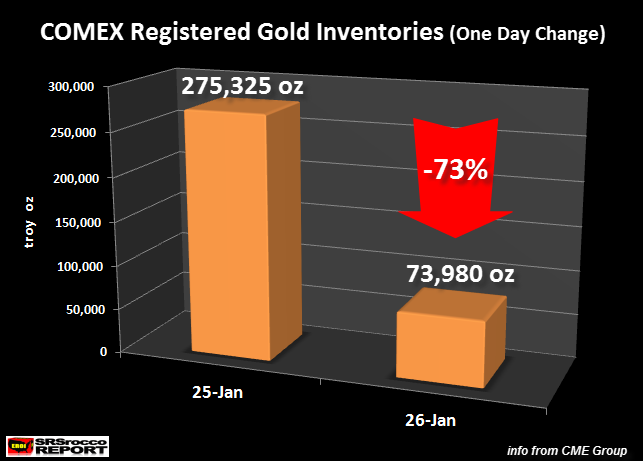
The drop in COMEX inventories of gold and silver may also contribute to supply problems in the bullion markets. Registered gold inventories had recovered very modestly from record low levels in December. However, last week stockpiles dropped an alarming 73% in a single day. 201,345 of the available 275,325 ounces of registered gold were reclassified from registered to eligible on Tuesday, rendering those ounces unavailable for delivery – at least until converted back. COMEX silver inventories also continue to fall.

It is true the declining inventory of registered metal isn’t necessarily a problem. Holders can very easily switch metal from one category to the other. But registered stocks of gold have never been this low, and certainly have never held this low for such an extended period of time. We may be seeing a genuine reluctance among holders of COMEX metal to let more go at current prices.

On the demand front, the data is conflicting. Bullion dealers, including Money Metals, are reporting relatively subdued buying activity compared to several months ago. Investors loaded up last summer and during early fall and now appear to be waiting for the prices to make a move. Range bound prices aren’t providing much motivation to act.

U.S. Mint Reports High Silver Eagle Sales in January, but Here’s the REAL REASON Demand Remains High…

However, the month of January was extraordinary when it comes to demand for silver and gold American Eagles. The U.S. Mint sold nearly 6 million silver coins in the month. It was 7.7% increase versus January 2015 – the prior record. Sales of gold Eagles hit 124,000 compared to 81,000 ounces a year ago – a 50% jump year over year.

Our sources indicate the demand is likely a result of dealers replenishing inventories which were hard hit in recent months. And there is another little-known reason…

Direct purchases from the U.S. Mint for Silver Eagles remain high because Authorized Purchasers (APs) have been reluctant to take anything less than their full allotment for fear of losing some ability to obtain supply when demand returns.

Last summer and fall the APs were left scrambling for Silver Eagle inventory when soaring physical demand depleted stockpiles at the wholesale and retail levels. That resulted in long delays and increased premiums for the world’s most popular silver bullion coin.

Therefore it makes sense for wholesalers to stock up on Eagles now while they can get their hands on them and save them for a rainy day.

There may also be some large scale buying on behalf of bullion banks. Some analysts, including Ted Butler, speculate that institutions such as JPMorgan Chase began building positions in the popular coins last year.

Clint Siegner is a Director at Money Metals Exchange, the national precious metals company named 2015 “Dealer of the Year” in the United States by an independent global ratings group. A graduate of Linfield College in Oregon, Siegner puts his experience in business management along with his passion for personal liberty, limited government, and honest money into the development of Money Metals’ brand and reach. This includes writing extensively on the bullion markets and their intersection with policy and world affairs.

Silver Prices: This Indicator Says Silver Prices Could Soar 572%

Published here: http://www.profitconfidential.com/silver/silver-prices-this-indicator-says-silver-prices-could-soar-572-percent/

Are Silver Prices About to Hit $100.00?
Since the beginning of the year, silver prices have been trending higher. In fact, the gray precious metal is one of only a few assets that are up in value. Be on the lookout, big gains could be ahead.

Before going into any details, please look at the chart below of the gold-to-silver ratio. At the core, this ratio tells us how many ounces of silver it takes to buy an ounce of gold. This ratio is usually used to value silver.
Gold-to-Silver Ratio Signaling Big Gains Ahead
If the gold-to-silver ratio is higher, it means silver prices are.

The post Silver Prices: This Indicator Says Silver Prices Could Soar 572% appeared first on Profit Confidential.

Craig Hemke: Unhinged Silver Fix and S&P Death Candle

Published here: http://www.zerohedge.com/news/2016-02-04/craig-hemke-unhinged-silver-fix-and-sp-death-candle


Craig Hemke: Unhinged Silver Fix and S&P Death Candle

Posted with permission and written by Rory Hall, The Daily Coin (CLICK FOR ORIGINAL)


I sat down with Craig Hemke, TFMetals Report to get a much-needed update on the S&P Death Candle and to get his take on what happened with silver last Thursday.

Ponzi schemes are as old as time.

We live in unprecedented times. In 2012 the U.S. government legalized propaganda and since then the lies and deceit we are fed have become common place, not to mention more disconnected from reality than ever before. If we look at the outrageous unemployment number, being 5% when reported on January 8th, 2016, anyone with a brain knows that something is out of balance. The labor participation rate is somewhere around 1950’s level. I ask you, has the population of the U.S. grown since the mid 1950’s? If the answer is yes, then something is wrong with the unemployment number being reported.

Turning our attention to something only slightly larger, like the S&P 500, NASDAQ and DOW Jones Industrial Average we see, once again, nothing but fantasy. These “markets”, which represent a vast amount of wealth held by the average American, have been rigged, for the past five years, with currency provided by the Federal Reserve through their program of Quantative Easing (QE). Corporate stock buy backs have been at all time highs for several years, in direct correlation to QE. This is now coming to an end. All ponzi’;s end the same way – when there are no more people to put more currency into the scheme it crashes.

In 2001 the stock market experienced its first big crash since 1987. There was approximately a 49% down turn in the S&P. In 2008, when we were sold a bill of goods by the Federal Reserve, Congress and the Treasury Dept., the S&P crashed again and experienced a 56% down turn and the joke “my 401k is now a 201k” was born. This is no laughing matter. The markets are currently set up with the exact same pattern as both 2001 and 2008. If, by the end of February the S&P closes below 1920, it is currently at 1940, the patterns that were unleashed in 2001 and 2008 will be in full view. I am not a financial advisor and I am not offering financial advice, I am merely pointing out patterns that Craig Hemke identified a few months ago. These patterns can be seen in the chart below:

EVENING AND WEEKEND AVAILABILITY (installation, handyman, wardrobe, bed, dresser) * I am a professional 10 yr experienced assembler & installer who provides quality and quick services to put together/assemble your new items. * VERY competitive pricing. Do not pay the overhead from a large company. * Any brand can be done. Most cabinet, TV mounting, curtains and blinds as well. * Full ID presented and am open to providing any other info/documents to help you feel more comfortable in the process. FOR BEST SERVICE ACCURATE QUOTES PLEASE SIMPLY: --- 1) Call or Text or Email --- 2) Product names AND/OR model numbers OR a copy of store receipt --- 3) Your address or intersection. 416-985-1447 ------ 123assembly@gmail.com

image/TFMetals Report

This is presented to keep this idea in the front of your mind. The criminals at the Federal Reserve, the “too big to jail” banks and the federal government are all gunning for your wealth. Are you doing what you can to protect your wealth or are you allowing someone working for commissions to manage your wealth for you?

If we turned to one of the most rigged, manipulated markets on planet earth we see there was, yet, another anomaly on Thursday January 28, 2016. Most people are completely unaware of this situation happening as there was almost no coverage provided by the mainstream media.

Did you know there was a complete disconnect between the silver price and silver futures price by 0.80$ per ounce? Did you know the “market” was held open for an additional 14 minutes while the criminals, I mean the people setting the “fix”, scrambled to try and figure out what happened? Do we know what happened? Absolutely not. No one is saying what happened and there has been no one to press the issue. Silver on the COMEX dropped from $14.45/ounce to $14.25/ounce in about a second. Once again, no explanation.

This is what we do know, as reported by Bullion Desk

“Unfortunately, it’s not [a mistake],” Ole Hansen, head of commodity strategy for Saxo Bank, told FastMarkets. “This could be the end of the fix. It took 14 minutes to find a fix – they obviously found a fix way off of the market.”
Another source also suggested that the continued existence of the fix has been put in jeopardy by the huge discrepancy in today’s price, adding that many producers – who still use the price as their daily reference – may have lost significant amounts of money if any contracts have been settled according to the fix.
“A huge number of contracts are still settled on that price,” another said. “This will no doubt cause significant problems.”

These are interesting words, and a very interesting situation, as they come on the heels of the Chinese stating their new physical gold/gold futures market will be online within the next 60 days. We have been hearing this for some time and to this I say – we will see. Personally, I have little faith the Chinese will be bringing this new market online in the timeframe they describe. They have already missed two “deadlines”.

The Chinese also, this past week, announced they would no longer be publishing the Shanghai Gold Exchange volume of gold moving through the Exchange! This makes the vast majority of physical gold movement completely opaque to the world. Very interesting timing of all these events/announcements taking place.

I would strongly suggest listening all the way through as your wealth could possibly be in jeopardy at this very moment.


Rory Hall, Editor-in-Chief of The Daily Coin, has written over 700 articles and produced more than 200 videos about the precious metals market, economic and monetary policies as well as geopolitical events since 1987. His articles have been published by Zerohedge, SHTFPlan, Sprott Money, GoldSilver and Silver Doctors, SGTReport, just to name a few. Rory has contributed daily to SGTReport since 2012. He has interviewed experts such as Dr. Paul Craig Roberts, Dr. Marc Faber, Eric Sprott, Gerald Celente and Peter Schiff, to name but a few. Visit The Daily Coin website and The Daily Coin YouTube channels to enjoy original and some of the best economic, precious metals, geopolitical and preparedness news from around the world.


Craig Hemke, Our Weekly Wrap-Up and Ask The Expert interviewer began his career in financial services in 1990 but retired in 2008 to focus on family and entrepreneurial opportunities. Since 2010, he has been the editor and publisher of the TF Metals Report found at TFMetalsReport.com, an online community for precious metal investors.


Tuesday, February 2, 2016

WMD – Weapons of Mass Destruction

Published here: http://goldsilverworlds.com/gold-silver-experts/wmd-weapons-of-mass-destruction/

“WMD” also is “Wasteful Monetary Devastation.”

WASTEFUL: We all know that governments spend money in wasteful ways and compensate with higher taxes, deficits, huge debt, “printed currencies” and inflation. “Bridges to nowhere,” various wars, and “giveaways” benefit a few at the expense of many.

MONETARY: Printing and digitally creating many trillions of dollars, euros, yen, or pounds may temporarily bail out banks and governments but in the big picture they destroy capital and weaken the economies of the nations which are deluding themselves.

DEVASTATION: Overwhelm governments, corporations, and individuals with debt, cut interest rates, devastate pension returns, punish savers, trash economies, blow more unsustainable bubbles, drink another bottle of delusion, and announce, “mission accomplished.”

From John Rubino regarding negative interest rates in Europe and now Japan:

This is a resounding admission of failure. Over the past seven years the world’s central banks have cut interest rates to levels not seen since the Great Depression and flooded their banking systems with newly-created currency, while national governments have borrowed unprecedented sums (in the US case doubling the federal debt). Yet here we are in the early stages of a global deflationary collapse. Commodity prices have followed interest rates to historic lows, while growth is anemic and may soon be nonexistent.”

Flooding banking systems with newly created currencies and massively increasing debt are wasteful uses of monetary resources. The consequences of such nonsense are devastated global economies – as they fall deeper into a global deflationary collapse.

Commodity indexes are at 40 year lows, the Baltic Dry Index is at an all-time low, and over $5 Trillion in government debt yields “negative interest” (crazy) and debt is spiraling out of control – global debt exceeds $200 Trillion (even crazier).

The above craziness suggests a massive failure by central banks and western governments, not global economic health.

I repeat: WMD also indicates Wasteful Monetary Devastation.

Do you trust?

  • Bonds issued by insolvent governments which can only repay their debts by issuing new and ever larger debt instruments.
  • Politicians who promise to spend more as they increase already unpayable debt.
  • Bankers who profit personally at the expense of individuals, pension plans, insurance companies, and savers.
  • Paper currencies backed by the full faith and credit of sovereign governments which are rapidly destroying both the faith of their citizens and their credit ratings. By the way, unbacked paper money always fails.

Or

Gold and silver which have no counter-party risk, no risk of default (physical metal, not the paper stuff), and a very long history as a store of value.

WMD – Wasteful Monetary Devastation will destroy unbacked paper currencies, the global bond market, and economies dependent upon financial engineering and paper pushing.

The Derivative Bubble – AKA the Weapons of Mass Financial Destruction – will make the coming global deflationary collapse, and the central bank “money printing” reaction, even more devastating.

You may find value in the following:
Bob Moriarty We’ve Seen the Bottom in Gold
John Rubino Welcome to the Currency War
Graham Summers Ignore Stocks, the Real Crisis is …
Andy Hoffman Japanese NIRP
Investing Haven 4 out of 5 Risk Indicators Flashing Green

Gary Christenson
The Deviant Investor

TWTR Stock: If Jack Dorsey Pulls This Off, Twitter Inc Could Skyrocket

Published here: http://www.profitconfidential.com/stock/twtr-stock-if-jack-dorsey-pulls-this-off-twitter-inc-could-skyrocket/

This Could Be a Big Deal for TWTR Stock
Twitter Inc’s (NYSE:TWTR) next deal could create overnight millionaires. But owners of TWTR stock need to understand this has nothing to do with social media.

Twitter shares popped on Monday on rumors private equity investors may be looking to scoop up the social media company on the cheap. According to a report published in Bloomberg, Marc Andreessen and private equity fund Silver Lake might be interested in investing in the firm. (Source: “.

The post TWTR Stock: If Jack Dorsey Pulls This Off, Twitter Inc Could Skyrocket appeared first on Profit Confidential.

Gerald Celente: Get Prepped For Global Systemic Collapse

Published here: http://www.zerohedge.com/news/2016-02-01/gerald-celente-get-prepped-global-systemic-collapse


Hold your real assets outside of the banking system in a private international facility  -->  http://www.321gold.com/info/053015_sprott.html 


Gerald Celente: Get Prepped For Global Systemic Collapse

Posted with permission from Rory Hall, The Daily Coin (CLICK FOR ORIGINAL)


More ridiculous predictable market action today. The worse things become in the real world the more frantic the stupidity becomes. The American authorities are clearly terrified that their world role as hegemon is being threatened and it is not beyond the realm of possibility that your fears of war will turn out to be a reality. – John Embry

It was reported last week that a Government panel is recommending that all adults over the age of 18 should be screened for “depression” – LINK. Nothwithstanding the fact that the term “depression” is a subjective concept, it exemplifies the move in the Government to control the population. It’s a frightening movement toward Totalitarianism that has been in motion since the formation of the Federal Reserve and the ratification of the16th Amendment, giving the Federal Government authority to enact an income tax. Both events occurred in 1913.

Make no mistake about it, the Government panel’s recommendation, if it finds its way somehow through Congress, is an underhanded way for the Government to implement gun control. We can’t have depressed people running around with guns in their possession. In addition, there’s no doubt that one of the big drug or hospital corporations has devised some sort of “depression screening” protocol which generates very high margin profits. Even better if the testing is covered by Medicare and Medicaid so the taxpayers can fill yet another big trough from which corporate America feeds.

The irony in the Totalitarian creep of the Federal Government is that humans don’t like the idea that they can’t control their immediate lives and living environment. Thus, they want to believe with surprising adamance that their vote matters – that they can control the outcome of an election with their “participation” in the process. Of course, nothing could be farther from the truth. The fact of the matter is that the modern Presidential process has become little more than the political version of “The Jerry Springer Show.” It’s like watching a slow motion train wreck repetitively with the now-frequent “debates” and “town hall” meetings.

Sorry. Maybe if you could vote for each of the well-funded 25 lobbyists per elected House Rep and Senator your participation in the process might matter. The only part of an election campaign that matters is the amount of money that gets apportioned by Wall Street financial firms, big pharmaceutical companies and the defense industry. Democrats who think Big Labor matters better think again – just look at the scale of the de-industrialization of America which has converted the majority of the U.S. manufacturing workforce into Walmart greeters and bartenders.

Perhaps the only safe refuge from this insanity and from the systemic destruction headed our way is to move as much of your wealth out of the fiat currency based financial system and into the safe haven of precious metals. Of course, Wall Street and the Government-controlled propaganda disseminators – otherwise known as mainstream financial media – are doing their best to discourage investors from even learning how to spell “gold.” It’s the barbarous relic of cavemen which you can’t eat and doesn’t earn interest. It’s about as useful as a Pet Rock.

What they won’t show you is this graph:

EVENING AND WEEKEND AVAILABILITY (installation, handyman, wardrobe, bed, dresser) * I am a professional 10 yr experienced assembler & installer who provides quality and quick services to put together/assemble your new items. * VERY competitive pricing. Do not pay the overhead from a large company. * Any brand can be done. Most cabinet, TV mounting, curtains and blinds as well. * Full ID presented and am open to providing any other info/documents to help you feel more comfortable in the process. FOR BEST SERVICE ACCURATE QUOTES PLEASE SIMPLY: --- 1) Call or Text or Email --- 2) Product names AND/OR model numbers OR a copy of store receipt --- 3) Your address or intersection. 416-985-1447 ------ 123assembly@gmail.com

This graph shows the performance of gold (red line) vs. the British pound, euro, yen, Swiss franc and commodity index since Jan 2000. The elitists running our system don’t want you see that graph because that graph embodies the truth about the deteriorating economic, political and geopolitical condition of both the U.S. and the world. Better to have you focused on Trump vs. Cruz or Trump vs. Clinton. And Obama clearly doesn’t care because he now spends most of his time golfing in Hawaii and staying at his future $10 million enclave – paid for by the Pritzker Family and Company.

The Shadow of Truth hosted Gerald Celente for what we believe may be his best podcast interview in quite some time. It borders on cerebral and we presented Mr. Celente with several thought-provoking questions – we think you will enjoy this side of the world’s foremost trends forecaster:


When people lose everything and they have nothing to lose, they “lose it.” – Gerald Celente on the Shadow of Truth. 


Gerald Celente: Get Prepped For Global Systemic Collapse

Posted with permission from Rory Hall, The Daily Coin (CLICK FOR ORIGINAL)


Rory Hall, Editor-in-Chief of The Daily Coin, has written over 700 articles and produced more than 200 videos about the precious metals market, economic and monetary policies as well as geopolitical events since 1987. His articles have been published by Zerohedge, SHTFPlan, Sprott Money, GoldSilver and Silver Doctors, SGTReport, just to name a few. Rory has contributed daily to SGTReport since 2012. He has interviewed experts such as Dr. Paul Craig Roberts, Dr. Marc Faber, Eric Sprott, Gerald Celente and Peter Schiff, to name but a few. Visit The Daily Coin website and The Daily Coin YouTube channels to enjoy original and some of the best economic, precious metals, geopolitical and preparedness news from around the world.


Monday, February 1, 2016

COMEX Registered Gold Inventories Plummet 73% In One Day

Published here: http://www.zerohedge.com/news/2016-01-31/comex-registered-gold-inventories-plummet-73-one-day


COMEX Registered Gold Inventories Plummet 73% In One Day

Posted with permission and written by Steve St Angelo, SRSrocco (CLICK FOR ORIGINAL)


Looks like something big is about to take place on the Comex as Registered Gold inventories declined a whopping 73% in one day. This is a very suprising update as Comex Gold inventories haven’t experienced much movement over the past few months.

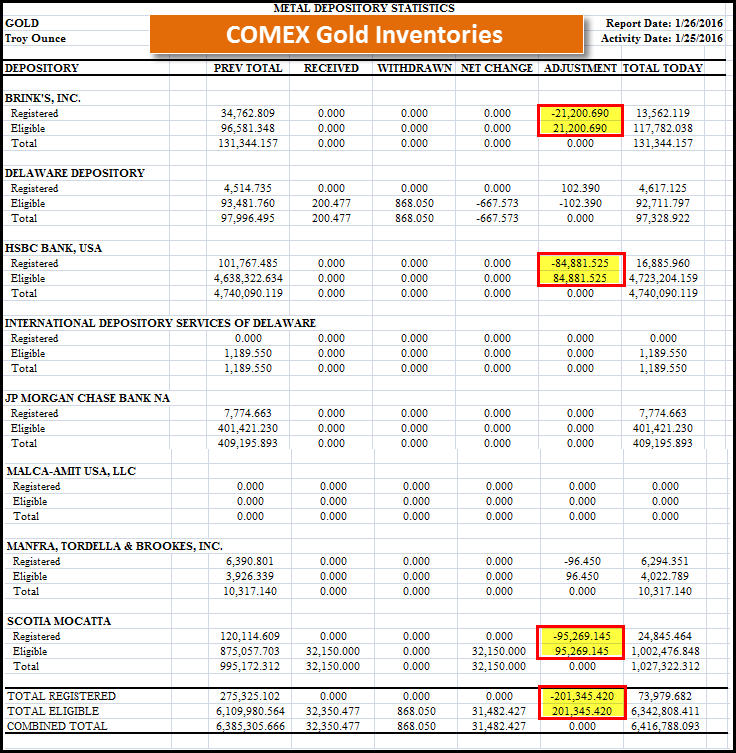
Well, this all changed today as a stunning 201,345 oz (73%) of the total 275,325 oz of Registered Gold was transferred to the Eligible Category today:


As we can see, 21,200 oz was transferred from Brinks Registered Inventories, 84,881 transferred from HSBC and 95,269 from Scotia Mocatta. There are only 73,980 oz of Registered Gold remaining in the Comex inventories:


This is the lowest level of Registered Gold inventories on the Comex for more than 20 years. There are now only 2.3 metric tons of Registered Gold remaining at the Comex.

This has to be one of the most surprising movements of Comex Registered Gold inventories ever. It will be interesting to see what happens over the next few months as the broader stock markets continue to crash while precious metal physical investment surges.It seems to me that this huge decline of Registered Gold Inventories suggests that the end of the Comex Exchange as a price setting mechanism is now even closer at hand.


For questions on this article or precious metals, please contact HERE


COMEX Registered Gold Inventories Plummet 73% In One Day

Posted with permission and written by Steve St Angelo, SRSrocco (CLICK FOR ORIGINAL)


Independent researcher Steve St. Angelo (SRSrocco) started to invest in precious metals in 2002. Later on in 2008, he began researching areas of the gold and silver market that, curiously, the majority of the precious metal analyst community have left unexplored. These areas include how energy and the falling EROI – Energy Returned On Invested – stand to impact the mining industry, precious metals, paper assets, and the overall economy.

You can find many of Steve’s articles on many noteworthy sites. Visit Steve at https://srsroccoreport.com.