Wednesday, April 20, 2016

Why Are The Chinese Stockpiling Silver? Big Price Move Coming?

Published here: http://www.zerohedge.com/news/2016-04-20/why-are-chinese-stockpiling-silver-big-price-move-coming

SRSrocco Report

By The SRSrocco Report

It looks like something big may happen to the silver market and the Chinese are preparing for it.  After China launched it's new Yuan Gold Fix today, the prices of the precious metals surged.  At one point today, silver was up 5%.  Silver is now trading at the $17 level, a price not seen in over a year.

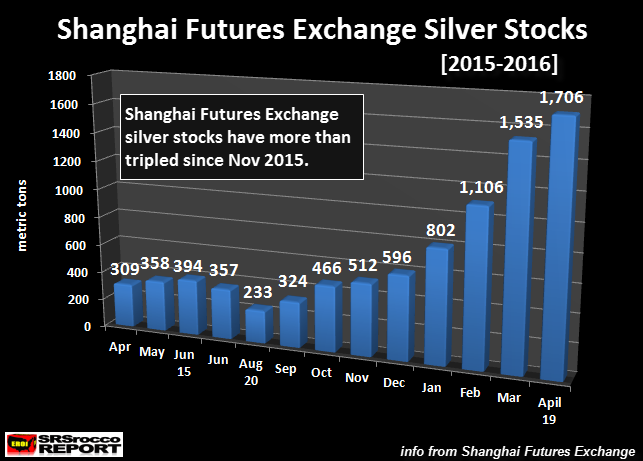
Even though gold has taken center stage today due to Chinese rolling out there new Yuan Gold fix, something quite interesting has been taking place in the silver market over the past six months.  While Comex silver inventories have been declining from a peak of 184 million oz (Moz) in July 2015 to 154 Moz today, silver stocks at the Shanghai Futures Exchange have been doing the exact opposite.  And in a BIG WAY:

Shanghai Futures Exchange Silver Stocks

Shanghai Futures Exchange (SHFE) silver inventories bottomed on August 20th 2015 at 233 metric tons (mt), or 7.5 Moz.  However, silver inventories at the SHFE began to really pick up in 2016 as they surged to 802 mt in Jan from 596 mt in December.  This continued at a more rapid pace during the next few months reaching a staggering 1,706 mt today (54.7 Moz).

CHECK OUT our new PRECIOUS METALS INVESTING PAGE at the SRSrocco Report.

Thus, silver inventories at the SHFE have more than tripled in less than six months.  Why have the Shanghai Futures Exchange silver inventories jumped this much in such a short time? Do the Chinese know something we don't?

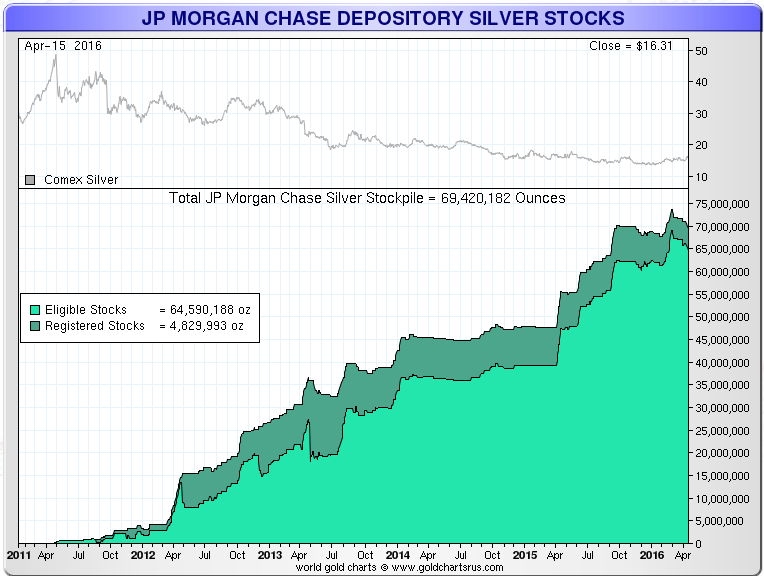
To give you an idea just how much the SHFE silver inventories have grown, let's compare it to largest bullion bank Comex silver inventories in the world... JP Morgan.  There's been a lot of talk about the huge buildup of silver on JP Morgan's Comex inventories.  Here a chart of JP Morgan's Comex silver inventories, courtesy of Nick Laird at Sharelynx.com:

JP Morgan Silver Inventories

JP Morgan started accumulating silver right at the price of silver topped at $50 in 2011.  In April 2012, JP Morgan had about 4 Moz of silver in its inventories.  JP Morgan's silver inventories continued to grow as the price of silver declined to a low of $14.  Today, JP Morgan holds 69.4 Moz of silver in its Comex warehouses.

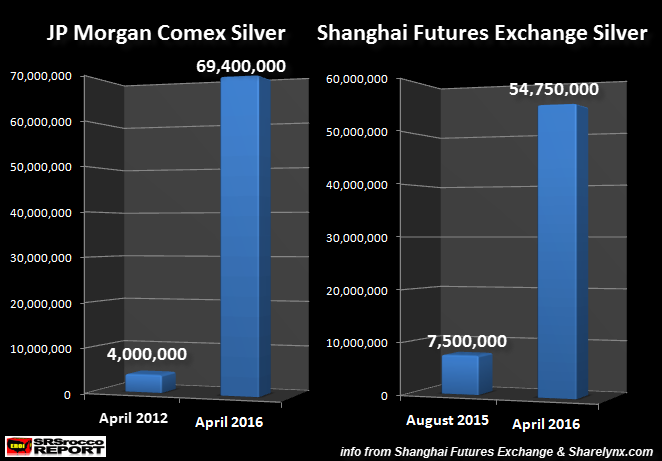
However, the Shanghai Futures Exchange silver inventories surged at a much more rapid rate.  If we take a look at the chart below, you will see what I mean:

JP Morgan vs SHFE Silver stocks

It took four years for JP Morgan to build their silver inventories from 4 Moz to 69.4 Moz today, whereas the SHFE silver stocks jumped from 7.5 Moz to 54.7 Moz in only eight months.  And remember, most of the silver inventory gains at the SHFE came in the past four months.

Part of the reason for the increased silver stocks at the Shanghai Futures Exchange was probably due to the Chinese government abolishing the ban on silver concentrate imports in November 2015.  According to the article, China abolishes ban on silver concentrate ore imports, unwrought bismuth exports:

China has abolished its ban on imports of silver concentrate ore and its refined concentrates, as well as exports of unwrought bismuth effective November 10, the Ministry of Commerce said in a directive posted on its website Tuesday.


MOC said the abolition is due to those products having complied with the country's industrial policy, do not belong to high-energy consuming and high polluting sectors, as well as having comparatively high technological content.

Regardless, the Shanghai Future Exchange silver inventories have never been this high before.  The highest level they reached was 1,143 metric tons back in May 2013.  For whatever reason, the SHFE is accumulating a lot of silver, and quickly.

Global Solar Installed

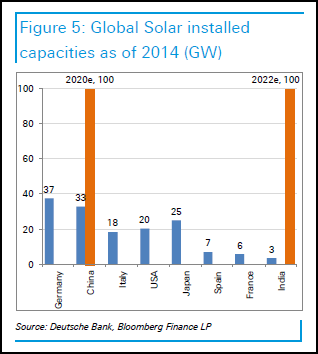
As I mentioned in my previous article, Record Breaking Silver Factors In 2015 Can Make 2016 Quite Interesting:

India and China plan on adding a lot of Solar Power by 2020-2022.  India plans to reach 100 gigawatts by 2022 and China 100 gigawatts by 2020.  That will take a lot of silver.

Either way, China is accumulating a lot of silver compared to the net exports years ago.  If the new Chinese yuan gold fix is going to put a lot of pressure on the U.S. Dollar in the future, mainstream investors may need to start protecting themselves now before it may be too late to acquire silver at a reasonable price.

Please check back for new articles and updates at the SRSrocco Report.  You can also follow us at Twitter below:

SRSrocco Report Twitter

Bill Murphy: Silver All about the Physical Market; Takin These Bums Out!

Published here: http://www.zerohedge.com/news/2016-04-19/bill-murphy-silver-%E2%80%93-all-about-physical-market-takin%E2%80%99-these-bums-out


Bill Murphy: Silver – All about the Physical Market; Takin’ These Bums Out!

Posted with permission and written by Rory Hall, The Daily Coin (CLICK FOR ORIGINAL)


Bill Murphy: Silver – All about the Physical Market; Takin’ These Bums Out! - The Daily Coin


When you dedicate yourself to a project for 17 years, as Bill Murphy, GATA and LeMetropole Cafe, has, it must to be a joyous occasion to see the beginning steps of justice being served.

On April 14 Deutche Bank (DB) admitted, in a court of law, their precious metals desk had been rigging the silver market and as the information began to surface it was also discovered that DB had been rigging the gold market as well. This is only the beginning.

The members of GATA, namely Bill Murphy and Chris Powell, have been presenting evidence of precious metals market rigging, to the world, for close to two decades and now we find that one of the largest banks in the world has been participating in this market rigging scheme. The real question is: will justice be served? Or will DB simply pay a fine, as Goldman Sachs did for the out-right theft and fraud that created the mortgage crisis that began in 2008? Only time will tell, but for now, the facts are on the table and the precious metals market rigging can no longer be denied by anyone.

They’re manipulating the silver market and then gold market; they’re going to turn on the other banks…the rats are cornered and it really could be quiet exciting. What it will really mean? You gotta wonder because of the way silver is trading so differently. Something is going on. Bill Murphy

One of the more interesting aspects of all this is the timing. I no longer believe in coincidences so the timing is very curious. On April 19, 2016 the Shanghai Gold Exchange (SGE) will begin offering physical gold, at spot price, but instead of the contract being settled in dollars it will be settled in yuan (Renminbi), the Chinese national currency. This will provide an alternative for companies and bullion traders around the world to acquire physical gold at the current stated spot price. This has huge implications for the current gold and silver markets that operate in London and Chicago. These two markets, over the course of the next year, will be impacted as more people begin using the new SGE physical gold market. We can only hope the impacts is a tipping point for the precious metals markets.

The big deal will be them turning on each other and what comes out publicly and what reaches in the public domain and so on. Five years the CFTC looked in to what Morgan, what was going on in the United States. What did they find? Nothing. What’s going here, pick a number, 10, 50 times bigger than what Deustche Bank has been cited for. It is off the charts what is being done here. Bill Murphy

In October 2015 the Yuan was added to the International Monetary Funds (IMF) fiat currency basket, Special Drawing Rights (SDR). This allows the yuan a global presence and allows other nations to trade yuan currency like the Euro, Dollar, French Franc, etc. As you can see currencies, gold (gold is money) and silver (silver has been money longer than gold) are experiencing massive changes in a highly compressed timeframe.


As the ramifications continue unfolding let’s celebrate this victory with all the other tinfoil hatters who have supported GATA, Bill Murphy, Chris Powell and all the others, as the world now knows their money (gold and silver) have been rigged by the banking cartel. Another blow to the banksters. These criminal organizations have duped us long enough and it is high time these criminals began serving prison time for their crimes against humanity. Maybe one day justice will be served and these people will know what it means for their entire families wealth to be evaporated as they have done to so many around the world.


Please email with any questions about this article or precious metals HERE


Bill Murphy: Silver – All about the Physical Market; Takin’ These Bums Out!

Posted with permission and written by Rory Hall, The Daily Coin (CLICK FOR ORIGINAL)


Government Officials Admit to ECONOMIC False Flag Operations

Published here: http://www.zerohedge.com/news/2016-04-20/government-officials-admit-economic-false-flag-operations

False flag attacks don’t just involve physical deaths and wars …

They also involve faked economic events and financial casualties.

For example, two officials of the International Monetary Fund said last month that they needed the threat of an imminent financial catastrophe to force other players into accepting its measures such as cutting Greek pensions and working conditions, and – as the Greek government put it (via Bloomberg) – the IMF was “considering a plan to cause a credit event in Greece and destabilize Europe.”

High-level officials also admitted to intentionally destroying their own nations’ economies in order to “justify” structural economic reforms.

For example, Japanese Prime Minister Junichiro Koizumi and Japanese central bank officials admitted that they kept Japan’s economy in a deflationary crisis to promote “structural reform” which would allow the Japanese economy to be looted by foreign interests. Japanese central bank officials admitted the same thing.

Japan Times noted in 2003:

Official statements by BOJ executives [reveal]: The BOJ can be helpful by not being helpful. The princes recognized that such structural change was so opposed to the special and general interests of most Japanese — citizens, businessmen, bureaucrats and politicians — that it could be achieved only by crippling the economy and preventing its recovery.

Something similar happened in Thailand and the EU.

Indeed, the former head of the Bank of England said  last month that the depression in the EU was more or less a “deliberate” policy choice.

And an economist at insurance giant AIG – and former head of the European Commission’s unit responsible for the European Monetary System and monetary policies – said in 2008 that what European leaders wanted was to create a crisis to force introduction of “European economic government.”

Indeed, Greece (more), Italy, Ireland (and here) and other European countries have all lost their national sovereignty to the ECB and the other members of the Troika.

ECB head Mario Draghi said in 2012:

The EU should have the power to police and interfere in member states’ national budgets.


***


“I am certain, if we want to restore confidence in the eurozone, countries will have to transfer part of their sovereignty to the European level.”


***


“Several governments have not yet understood that they lost their national sovereignty long ago. Because they ran up huge debts in the past, they are now dependent on the goodwill of the financial markets.”

Threats of Economic Terrorism

The Saudis said they would sell $750 billion in U.S. treasury securities and other assets in the United States if an investigation of Saudi involvement in 9/11 is allowed to occur. This sound like the mafioso who asks: “We wouldn’t want anybody to get hurt, now would you?”

American banks have carried out the same type of terrorist blackmail. For example, the Tarp bank bailouts in the U.S. were passed using apocalyptic – and false – threats. And they were not used for the stated purpose.

As I’ve previously reported:

The New York Times wrote last year:

In retrospect, Congress felt bullied by Mr. Paulson last year. Many of them fervently believed they should not prop up the banks that had led us to this crisis — yet they were pushed by Mr. Paulson and Mr. Bernanke into passing the $700 billion TARP, which was then used to bail out those very banks.

Indeed, Congressmen Brad Sherman and Paul Kanjorski and Senator James Inhofe all say that the government warned of martial law if Tarp wasn’t passed:


That is especially interesting given that the financial crisis had actually been going on for a long time, but – instead of dealing with it – Paulson and the rest of the crew tried to cover it up and pretend it was “contained”, and that it was obvious to world leaders months earlier that it was not a liquidity crisis, but a solvency crisis (and see this).


Bait And Switch


The Tarp Inspector General has said that Paulson misrepresented the big banks’ health in the run-up to passage of TARP. This is no small matter, as the American public would have not been very excited about giving money to insolvent institutions.


And Paulson himself has said:

During the two weeks that Congress considered the [Tarp] legislation, market conditions worsened considerably. It was clear to me by the time the bill was signed on October 3rd that we needed to act quickly and forcefully, and that purchasing troubled assets—our initial focus—would take time to implement and would not be sufficient given the severity of the problem. In consultation with the Federal Reserve, I determined that the most timely, effective step to improve credit market conditions was to strengthen bank balance sheets quickly through direct purchases of equity in banks.

So Paulson knew “by the time the bill was signed” that it wouldn’t be used for its advertised purpose – disposing of toxic assets – and would instead be used to give money directly to the big banks?

Senator McCain also says that Paulson pulled a bait-and-switch:

Sen. John McCain of Arizona … says he was misled by then-Treasury Secretary Henry Paulson and Federal Reserve Chairman Ben Bernanke. McCain said the pair assured him that the $700 billion Troubled Asset Relief Program would focus on what was seen as the cause of the financial crisis, the housing meltdown.


“Obviously, that didn’t happen,” McCain said in a meeting Thursday with The Republic‘s Editorial Board, recounting his decision-making during the critical initial days of the fiscal crisis. “They decided to stabilize the Wall Street institutions, bail out (insurance giant) AIG, bail out Chrysler, bail out General Motors. . . . What they figured was that if they stabilized Wall Street – I guess it was trickle-down economics – that therefore Main Street would be fine.”

Even the New York Times called Paulson a liar in 2008:

“First [Paulson’s Department of Treasury] says it has to have $700 billion to buy back toxic mortgage-backed securities. Then, as Mr. Paulson divulged to The Times this week, it turns out that even before the bill passed the House, he told his staff to start drawing up a plan for capital injections. Fearing Congress’s reaction, he didn’t tell the Hill about his change of heart.Now, he’s shifted gears again, and is directing Treasury to use the money to force bank acquisitions. Sneaking in the tax break isn’t exactly confidence-inspiring, either.”

What tax breaks is the Times talking about? The article explains:

A new tax break [pushed by Treasury], worth billions to the banking industry, that has only one purpose: to encourage bank mergers. As a tax expert, Robert Willens, put it: “It couldn’t be clearer if they had taken out an ad.”

The giant banks also essentially threatened to blow up the American economy if any of them were prosecuted for their massive, economy-destroying fraud.

Tuesday, April 19, 2016

The Next Round of QE is Just Around the Corner

Published here: http://www.zerohedge.com/news/2016-04-19/next-round-qe-just-around-corner

NIRP has proven to be a dud as far as monetary policy goes.

Europe has implemented FOUR NIRP cuts since June 2014. Throughout this period, EU inflation has barely flat-lined.

The story is similar for Japan, which implemented NIRP at the end of February 2016. Since then the Yen has surged.

While Japanese inflation is trending down:

Mr Kuroda often points to signs of stronger inflation in goods prices, with the BoJ adopting a new version of the CPI that leaves out energy but includes processed food. However, the trend has slowed in the past few months.

According to Nowcast, a company that uses supermarket scanner data to track inflation ahead of the official figures, this kind of “core-core” CPI fell from a year-on-year rise of 1.42 per cent in December to 1.31 per cent in January, 1.21 per cent in February and 1.16 per cent in March.

            Source: Financial Times

Put simply, NIRP is not effective in any way at generating significant inflation. The reason is that NIRP is in fact DE-flationary as it frightens savers and investors into hoarding cash.

Psychologically people are more afraid of losing what they have than they are of missing out on potential gains. NIRP is a guarantee that you will lose some of what you have. As such, it has a hugely deflationary on consumers.

Look for Central Banks to shift further from NIRP in the coming months. The political consequences are too great and the policy too controversial to remain en vogue for much longer.

This leaves QE as the last viable Central Bank monetary policy.

Indeed, both the Bank of Japan and the European Central Bank are prepping markets for another round of QE.

The Bank of Japan was flirting with the idea as far back as Japan before it implemented NIRP. Given the fallout from the latter policy, expect more QE from Japan in the near future:

A summary of the Bank of Japan's January meeting underlined that central bank officials are open to enlarging their massive quantitative easing program.

The minutes released Friday of the Jan. 28-29 policy meeting showed that officials explored an expansion of already-massive asset purchases and an introduction of negative rates before they decided to move with the latter option. The new insight will likely add to expectations that the central bank may unleash additional monetary stimulus through both channels as early as next month to revitalize its efforts to combat deflation…

One was an "expansion of QQE that consists of an acceleration in the paces of increase in the monetary base and asset purchases," the minutes said. QQE is short for "quantitative and qualitative easing," an asset-buying program through which the BOJ has pumped cash into the banking system at an annual pace of Y80 trillion since October 2014 in efforts to spur inflation.

Source: Marketwatch

Meanwhile in Europe, plans are underway to expand QE to include asset buying by national Central banks as well as the ECB:

In its implementation of the public sector purchase programme (PSPP), the Eurosystem intends to conduct purchases in a gradual and broad-based manner, aiming to achieve market neutrality in order to avoid interfering with the market price formation mechanism.

In principle, purchases of nominal marketable debt instruments at a negative yield to maturity are permissible as long as the yield is above the deposit facility rate.

According to the configuration of the PSPP, substitute purchases are conducted if purchases of marketable debt instruments issued by the central government and agencies need to be complemented to implement the relevant NCB’s share of purchases through the end of the APP. Given the extension of the APP until March 2017 and the increase in the monthly purchase pace to EUR 80 bn, some further NCBs are now expected to participate in substitute purchases. [translation= more national banks to participate in the program]

Source: ECB Europa

In short, both the ECB and Bank of Japan are preparing to expand their QE programs shortly. This is why both Gold and Silver are breaking out of long-term wedge patterns.

Central Banks are prepping the printing presses. Look for inflation hedges to hit lift off shortly.

On that note…

We just published a Special Investment Report concerning a secret back-door play on Gold that gives you access to 25 million ounces of Gold that the market is currently valuing at just $273 per ounce.

The report is titled The Gold Mountain: How to Buy Gold at $273 Per Ounce

We are giving away just 100 copies for FREE to the public.

To pick up yours, swing by:

https://www.phoenixcapitalmarketing.com/goldmountain.html


Best Regards

Graham Summers

Chief Market Strategist

Phoenix Capital Research

Our FREE e-letter: http://gainspainscapital.com/

Follow us on Twitter: http://twitter.com/GainsPainsCapit


Marc Faber: Messiah Central Banks Currency Printing Will Not End Well

Published here: http://www.zerohedge.com/news/2016-04-19/marc-faber-%E2%80%9Cmessiah%E2%80%9D-central-banks-currency-printing-%E2%80%9Cwill-not-end-well%E2%80%9D

Marc Faber: “Messiah” Central Banks Currency Printing “Will Not End Well”

Marc Faber has warned that a new financial crisis is coming and will be worse than the 2008 one and told Bloomberg TV that the “messiah” central banks “helicopter money ” policies “will not end well.”


Gold_Faber

Marc Faber


Faber warns that ultimately “you cannot grow an economy by just throwing money at people” and that “QE for the people” will be like “throwing gasoline on a fire.”

Faber is entertaining, has a good chuckle at the central banks and IMF’s monetary policies and laughs at the idiocy of the IMF’s recent counterfactual statement when Lagarde said the world economy would be worse off without negative interest rates:

… they will always say, if we hadn’t done this and hadn’t done that, it would be much worse. They have no proof for this assertion. In my view, it would have been better to let the crisis, already the first one in 2000, run its course and prevent the colossal credit bubble that was built up that then led to an even bigger crisis, and now they’re doing the same mistake.

According to Faber, credit as a percent of the global economy is up “very strongly” since 2007.

“[M]ost of the credit is now for transfer payments, and that is very negative for long term structural economic growth because it allows, actually, the government to become bigger and bigger and to have more regulations,” Faber said. “And I can tell you, I’m in the financial sector and I talk to people in the financial sector. Half the time is nowadays consumed with filling out forms by regulators.”

The financial crises in 2000 and 2008 would have been better if central banks hadn’t intervened, Faber said. He warns against the upcoming “helicopter money” policies:

“… the magicians at central banks, they always come out with a new trick and these negative interest rates that we have today, this is for the first time in recorded human history from the times of Babylon up to today that we have negative interest rates, and it’s not going to end well. That, I can tell you. But the sequence of how it will not end well, I’m not so sure. But they still have a lot of ammunition. What they can do is helicopter money. In other words, they can send you and Mr. Bloomberg and me and everybody, say a check for $10,000, and that is like throwing gasoline into a fire…. will it help the economy? That is the question. It won’t help in the long run. You cannot grow an economy by just throwing money at people.”

“… the less policies, the better it would be. We all learned at school that the free market and the capitalistic system is the best allocator of resources, and now what we have is the worst allocation of resources because it’s the government that tells you how these resources are allocated and they continuously expand their interventions, and I can tell you, I started to work in 1970. In the 70’s and early 1980’s, central banks actually never came up in discussions. They have now become like the messiah, and everybody watches what the central banks do and in the end, in my view, they will have, from a long term perspective, no impact whatsoever. Now can they move markets short term? Yes, but maybe not in the direction they want to.”

Faber recently told GoldCore in a webinar how he will “never sell his gold”, he buys “more every month” and believes owning gold in vaults in Singapore “is safest.”

Faber’s interview with Bloomberg (recorded 18/03/16) can be watched here

Faber’s interview with GoldCore and storing gold in Singapore can be watched here


Gold Prices (LBMA)
18 April: USD 1,240.30, EUR 1,101.04 and GBP 874.96 per ounce 
15 April: USD 1,229.75, EUR 1,092.16 and GBP 867.46 per ounce
14 April: USD 1,240.30, EUR 1,101.04 and GBP 874.96 per ounce
13 April: USD 1,245.75, EUR 1,100.37 and GBP 875.33 per ounce
12 April: USD 1,259.20, EUR 1,102.15 and GBP 880.18 per ounce

Silver Prices (LBMA)
18 April: USD 16.20, EUR 14.33 and GBP 11.41 per ounce 
15 April: USD 16.17, EUR 14.33 and GBP 11.40 per ounce
14 April: USD 16.13, EUR 14.32 and GBP 11.39 per ounce
13 April: USD 15.98, EUR 14.14 and GBP 11.21 per ounce
12 April: USD 15.96, EUR 13.98 and GBP 11.15 per ounce


Gold News and Commentary
Gold Advances on Haven Demand as Oil, Shares Retreat After Doha (Bloomberg)
Safe-haven bids buoy gold as oil slides on failure to freeze output (Reuters)
Asian shares drop, crude tumbles after Doha deal fails (Reuters)
Doha oil-freeze pact fails as Saudis insist that Iran participate (Marketwatch)
Funds Are Betting the Gold Rally Isn’t Over Yet (Bloomberg)

Silver overtakes gold as best precious metal – Up 17% YTD (Mineweb via Bloomberg)
Silver Hasn’t Flashed This “Buy” Signal in Almost a Decade (Casey Research)
“Monetary Bankruptcy, Groupthink & Hubris of Central Banks (Price of Everything)
Wishes Aside, Gold Is Going To Fly (Zero Hedge)
Gold “Is Not Overpriced Enough” – Dizard (FT)

Read More Here

silver_britannias
Buy Silver Coins VAT Free In UK and EU


www.Goldcore.com 

Monday, April 18, 2016

Joke Of The Week: Italy’s Bank Rescue Fund

Published here: http://www.zerohedge.com/news/2016-04-18/joke-week-italy%E2%80%99s-bank-rescue-fund

Italian Banks Bank of Italy

Source: assets.bwbx.io

Italian banks have been facing rough seas for quite a while now as the total amount of non-performing loans and bad debt is piling up now. The Italian state has been trying to find a solution for this increasingly important problem as all of its banks continue to report high write-downs on the value of their assets, which is undermining the health of the entire financial system in the country.

Italy had to do something which would keep the European bureaucrats happy (as any financial support would have to be injected without being seen as some sort of state aid). Previous media reports discussed the possibility of the European Central Bank acting as ‘saving grace’ of the Italian financial system, but the ‘whatever it takes’ adage seems to be another bold statement turning out to be hollow words. Of course, a central bank should not buy non-performing loans as that’s most definitely not a part of its mandate, but it also tells you that the ‘whatever it takes’ shout-out does come with some caveats.

ITalian Banks Impairment Charges

Source: Financial Times

The Italian state had to find a solution on its own, and the proposed way out of the current vicious circle is just laughable. Italy has proposed to start a bad-bank fund called Atlante, which would focus on buying distressed assets from the Italian banks to help them to improve their balance sheets once again. Theoretically that’s an excellent plan, but the size of the new fund is just laughable. Italy’s bad bank fund will have a total available cash resource of 5B EUR.

Italian Banks Bad Debt

Source: Financial Times via Thomson Reuters

Sure, 5 billion Euros sounds like a pretty decent amount of money, but you need to put things in perspective. According to the most recent estimates, the Italian financial system was holding in excess of 200 billion Euro of non-performing loans (‘NPL’) on the balance sheet, whilst at least the same (gross) amount could be described as ‘questionable’. So, the new fund has the size of less than 3% of the total amount of NPL’s in the sector and just over 1% of the total amount of bad loans.

That’s most definitely not sufficient as almost 40% of the funds will immediately be used to rescue the Banca Popolare di Vicenza which needs an injection of 1.8B EUR as soon as humanly possible to keep its balance sheet issues under control. And the other Italian banks will also be quite happy as they saw their share prices slide since the beginning of this year. Unicredit saw its share price fall by almost 50% since the end of last year, whilst Intesa Sanpaolo experienced a 25% drop in its share price.

Italian Bank Performance

Source: Financial Times

Italy thinks the 5B EUR will be sufficient to cover a lot of the expected losses as it says the banks have already recorded impairment charges on the value of their bad loans and this has been confirmed by the CEO of Intesa Sanpaolo a few months ago. He claims there’s close to zero risk of the banks collapsing, but we have heard this before.

But hey, let’s not worry. Italy has got this all figured out!

>>> Do you really trust the clowns who are running our financial system? No? Read our Guide to Gold RIGHT NOW!

Secular Investor

Secular Investor offers a fresh look at investing. We analyze long lasting cycles, coupled with a collection of strategic investments and concrete tips for different types of assets. The methods and strategies are transformed into the Gold & Silver Report and the Commodity Report.

Follow us on Facebook @SecularInvestor [NEW] and Twitter @SecularInvest

Friday, April 15, 2016

Silver: One Investor Away from Implosion

Published here: http://www.zerohedge.com/news/2016-04-15/silver-one-investor-away-implosion


Silver: One Investor Away from Implosion

Posted with permission and written by Rory Hall, The Daily Coin (CLICK FOR ORIGINAL)


he past three years we have seen the price of silver get beat down to new lows. We have also witnessed demand for physical silver continually escalate. During this three year run the U.S. Mint has stopped sales of American Silver Eagles, the most popular silver coin in the world, on three different occasions. The last time sales were shut down, in June 2015 and the U.S. Mint has rationed sales since production resumed in July 2015. As of this writing that would be ten months of rationed sales with no end in sight.

Louis Cammarasno and I picked up our bi-monthly silver update to review the latest numbers from both the Perth Mint and U.S. Mint. The interesting part is the Perth Mint. This time last year the Perth Mint was still a very small player and only producing approximately 500,000 silver coins, in total, per month. Since September 2015 that all changed. The Perth Mint is now averaging approximately 1.3 million silver coins per month. They are now a player in the silver market and must be taken into account when reviewing monthly physical silver coin sales. 1.3 million coins per equals 15.6 million coins annually. While that is still a small amount in comparison to the Royal Canadian Mint and U.S. Mint it represents a massive increase in the volume of silver coming to market. Which brings me back to my favorite question for the past three years – where is the silver coming from?

Louis and I take this into consideration when we begin discussing the theory of a sea-change by a small number of investors and investment dollars. Using the labor force, as generated by the U.S. Bureau of Labor of Statistics, Louis arrived 160 million people currently in the labor force as of March 2016. Using 1% of the labor work force would equal 1.6 million people. Is it realistic to believe there are 1.6 million people in the U.S. who either acquire silver on an ongoing basis or who have acquired a small amount of physical silver in recent years? It seems to be a number within the realm of reality to me.

1.6 million is the base number of investors. The current investment dollars this group represents is not important to this exercise. What is important is a small change in their current habits. That change seems to be taking place as The Doc, has confirmed on two different occasions. That change seems to be confirmed as the U.S. Mint has not changed their current sales policy from rationing sales of 200,000 coins per day – 1 million coins per week, which are sold out every day.


This is what it would look like for a very small change in the 1.6 million investors – using $18 per American Silver Eagle as a baseline.


The numbers in the chart above would be in addition to the current sales of physical silver we are already experiencing. Can you imagine the impact this small change would have on the silver market? Even if you distribute the numbers across the “big three” – U.S. Mint, Royal Canadian Mint and now Perth Mint – you still have an enormous amount of strain added to a very strained market to begin with. Where would it come it from? The pie is only so big and we are all demanding a larger slice every day. Each additional “bite” from the pie pushes the market closer to the edge. How many bites are left in the pie? Got physical?


Silver: One Investor Away from Implosion

Posted with permission and written by Rory Hall, The Daily Coin (CLICK FOR ORIGINAL)


Rory Hall, Editor-in-Chief of The Daily Coin, has written over 700 articles and produced more than 200 videos about the precious metals market, economic and monetary policies as well as geopolitical events since 1987. His articles have been published by Zerohedge, SHTFPlan, Sprott Money, GoldSilver and Silver Doctors, SGTReport, just to name a few. Rory has contributed daily to SGTReport since 2012. He has interviewed experts such as Dr. Paul Craig Roberts, Dr. Marc Faber, Eric Sprott, Gerald Celente and Peter Schiff, to name but a few. Visit The Daily Coin website and The Daily Coin YouTube channels to enjoy original and some of the best economic, precious metals, geopolitical and preparedness news from around the world.


Silver Bullish: Silver Prices Could Surge If THIS Happens

Published here: http://www.profitconfidential.com/silver/silver-bullish-silver-prices-could-surge-if-this-happens/

After a record four consecutive years of declines, silver prices have rallied on the heels of a fragile U.S. economy and weak global economy. Having fallen more than 70% from their 2011 highs, silver prices are now up 17.6% since the beginning of 2016. And the economic data rolling in shows there is still a lot more upside potential for silver and silver mining companies.
Silver Prices up 17% in 2016 with Room to Run
Physical silver and silver mining companies were routed between 2011 and 2015, as the S&P 500 enjoyed an incredible bull run. Physical silver hit a high of.

The post Silver Bullish: Silver Prices Could Surge If THIS Happens appeared first on Profit Confidential.

Thursday, April 14, 2016

EVERY Market Is Manipulated ... See For Yourself

Published here: http://www.zerohedge.com/news/2016-04-14/markets-are-manipulated

Gold and Silver Are Manipulated

Deutsche Bank admitted today that it participated with other big banks in manipulating gold and silver prices.

In 2014, Switzerland’s financial regulator (FINMA) found “serious misconduct” and a “clear attempt to manipulate precious metals benchmarks” by UBS employees in precious metals trading, particularly with silver. Reuters reported:

Swiss regulator FINMA said on Wednesday that it found a “clear attempt” to manipulate precious metals benchmarks during its investigation into precious metals and foreign exchange trading at UBS …

And the UK’s Financial Conduct Authority found that Barclays manipulated the price of gold for a decade, sending “bursts” of sell orders to manipulate the market.

Gold and silver prices have been “fixed” in daily conference calls by the powers-that-be for a long time.

Bloomberg reported in 2013:

It is the participating banks themselves that administer the gold and silver benchmarks.

So are prices being manipulated? Let’s take a look at the evidence. In his book “The Gold Cartel,” commodity analyst Dimitri Speck combines minute-by-minute data from most of 1993 through 2012 to show how gold prices move on an average day (see attached charts). He finds that the spot price of gold tends to drop sharply around the London evening fixing (10 a.m. New York time). A similar, if less pronounced, drop in price occurs around the London morning fixing. The same daily declines can be seen in silver prices from 1998 through 2012.

For both commodities there were, on average, no comparable price changes at any other time of the day. These patterns are consistent with manipulation in both markets.

The Oil Market Is Manipulated

The big banks aided Unaoil in bribing governments worldwide to manipulate oil prices.  The Age notes:

Bankers in New York and London have facilitated Unaoil’s money laundering ….

The European Commission says oil prices have been manipulated for many years.

And many commentators note that big banks play a big role in the mediation.

Other Commodities Are Manipulated

The big banks and government agencies have been conspiring to manipulate commodities prices for decades.

The big banks are taking over important aspects of the physical economy – including uranium mining, petroleum products, aluminum, ownership and operation of airports, toll roads, ports, and electricity – to manipulate market prices.

And they are using these physical assets to massively manipulate commodities prices … scalping consumers of many billions of dollars each year. (More from Matt Taibbi, FDL and Elizabeth Warren.)

The Mortgage Market Is Manipulated

Goldman Sachs and Wells Fargo admitted this week that they fraudulently manipulated the mortgage and mortgage backed securities markets.

Indeed, the entire housing bubble which crashed in 2007 was caused by manipulation.

The big banks committed massive and pervasive fraud both when they initiated mortgage loans and when they foreclosed on them (and see this).

And they pledged the same mortgage multiple times to different buyers. See this, this, this, this and this. This would be like selling your car, and collecting money from 10 different buyers for the same car.

Banks Rig Treasury Market

Bloomberg reported last September:

The same analytical technique that uncovered cheating in currency markets and the Libor rates benchmark [details below] — resulting in about $20 billion of fines — suggests the dealers who control the U.S. Treasury market rigged bond auctions for years, according to a lawsuit.


***


The plaintiffs built their case against the 22 primary dealers who serve as the backbone of Treasury trading — including Goldman Sachs Group Inc., JPMorgan Chase & Co. and Morgan Stanley — using data from Rosa Abrantes-Metz, an adjunct associate professor at New York University who has provided expert testimony in rigging cases.


Her conclusion: More than two-thirds of a certain type of Treasury auction appear to have been rigged. She found issues with other auctions, too.


***


Treasury traders at some banks learn of customer demand hours before auctions, and were communicating with their counterparts at other firms via chat rooms as recently as last year, Bloomberg News reported earlier this year.


***


Among the lawyers representing the investors is Daniel Brockett, a Quinn Emmanuel attorney who recently won a $1.87 billion settlement against Wall Street’s largest banks in a case alleging they conspired to limit competition in the market for credit-default swaps.


***


Another group of investors, including Boston’s public employee retirement system, has filed a similar suit against Wall Street primary dealers. Experts interviewed by Labaton Sucharow LLP, the law firm that filed that suit, analyzed auctions and the market for when-issued securities, which are essentially agreements to buy or sell Treasury bonds, notes or bills once they’re issued.


They claim that banks colluded to push prices artificially low at auctions, and to drive prices for when-issued securities to artificially high levels, until December 2012, when news broke of investigations into how Libor was set.


“These scenarios all turn on a very simple conflict of interest,” attorney Michael Stocker said in a telephone interview. “You had banks who were auction participants who also had the power to move the prices that those markets depended on.”

High-frequency trading has also long been used to manipulate the treasury market.

Banks Rig Currency Markets

It has long been known that currency markets are massively rigged. And see this, this, and this. Indeed, not only do the banks share confidential information with each other … they also shared it with a giant oil company.

A number of giant banks pleaded guilty to manipulating currency markets, and agreed to pay a $7.5 billion dollar fine. New York’s state financial regulator called it “a brazen ‘heads I win, tails you lose’ scheme to rip off their clients.”

The formal admissions by the banks include a trader saying, “We trying to manipulate it a bit more in ny now . . . a coupld buddies of mine and I.” And a vice president of a big bank said:

  • “If you aint cheating, you aint trying.”

Derivatives Are Manipulated

Runaway derivatives – especially credit default swaps (CDS) – were one of the main causes of the 2008 financial crisis. Congress never fixed the problem, and actually made it worse.

The big banks have long manipulated derivatives … a $1,200 Trillion Dollar market.

Indeed, many trillions of dollars of derivatives are being manipulated in the exact same same way that interest rates are fixed (see below) … through gamed self-reporting.

Reuters noted in 2014:

A Manhattan federal judge said on Thursday that investors may pursue a lawsuit accusing 12 major banks of violating antitrust law by fixing prices and restraining competition in the roughly $21 trillion market for credit default swaps.


***


“The complaint provides a chronology of behavior that would probably not result from chance, coincidence, independent responses to common stimuli, or mere interdependence,” [Judge] Cote said.


The defendants include Bank of America Corp, Barclays Plc, BNP Paribas SA, Citigroup Inc , Credit Suisse Group AG, Deutsche Bank AG , Goldman Sachs Group Inc, HSBC Holdings Plc , JPMorgan Chase & Co, Morgan Stanley, Royal Bank of Scotland Group Plc and UBS AG.


Other defendants are the International Swaps and Derivatives Association and Markit Ltd, which provides credit derivative pricing services.


***

U.S. and European regulators have probed potential anticompetitive activity in CDS. In July 2013, the European Commission accused many of the defendants of colluding to block new CDS exchanges from entering the market.

***

“The financial crisis hardly explains the alleged secret meetings and coordinated actions,” the judge wrote. “Nor does it explain why ISDA and Markit simultaneously reversed course.”

In other words, the big banks are continuing to fix prices for CDS in secret meetings … and have torpedoed the more open and transparent CDS exchanges that Congress mandated.

The managing director at Graham Fisher & Co. (Joshua Rosner) said that the big banks are frontrunning CDS trades … and manipulating decisions on whether a the party “insured” by CDS has defaulted on its obligations, thus triggering an “event” requiring payment on the CDS.

By way of analogy, whether or not an insurance company pays to rebuild a house which has burned to the ground may turn on whether it finds the fire was arson or accidental.

This is a big deal … while hundreds of thousands of dollars might be at stake in the home fire example, many tens or even hundreds of billions of dollars ride on whether or not a country like Greece is determined to have suffered a CDS-triggering event.

Rosner notes:

The potential use of CDS to artificially manipulate corporate solvency, the imbalances in the amounts of CDS outstanding relative to referenced debt and ongoing allegations that ISDA’s Determinations Committee is deeply conflicted and “operates as a quasi-Star Chamber or cartel”, are finally being scrutinized.


As one source recently suggested, “It would be a surprise if determinations of default, made by a committee of interested parties, don’t lead to findings of manipulation similar to those found in LIBOR and FOREX”.


***


The fact that Pimco’s Chief Investment Officer criticized the determination that Greece had not triggered its CDS, even though Pimco was part of the unanimous vote making that determination, is profoundly troubling to say the least.


***


The fact that the [ISDA’s Determinations Committees] has no obligation to “research, investigate, supplement or verify the accuracy of information on which a determination is based” and members “may have an inherent conflict of interest in the outcome of any determinations” only adds credence to suggestions that the “CDS market is being manipulated and gerrymandered by the all-powerful investment banks”.

Energy Prices Manipulated

Energy markets are manipulated as well …

The U.S. Federal Energy Regulatory Commission says that JP Morgan has massively manipulated energy markets in California and the Midwest, obtaining tens of millions of dollars in overpayments from grid operators between September 2010 and June 2011.

And Pulitzer prize-winning reporter David Cay Johnston noted in 2014 that Wall Street is trying to launch Enron 2.0.

And the Senate’s Permanent Subcommittee On Investigations found that Enron itself (which massively manipulated energy markets) was enabled by the fraud of big banks such as Citigroup and Chase.

(And as noted above, oil prices are manipulated.)

Interest Rates Are Manipulated

Bloomberg reported in 2014:

Royal Bank of Scotland Group Plc was ordered to pay $50 million by a federal judge in Connecticut over claims that it rigged the London interbank offered rate.


RBS Securities Japan Ltd. in April pleaded guilty to wire frauda s part of a settlement of more than $600 million with U.S and U.K. regulators over Libor manipulation, according to court filings. U.S. District Judge Michael P. Shea in New Haventoday sentenced the Tokyo-based unit of RBS, Britain’s biggest publicly owned lender, to pay the agreed-upon fine, according to a Justice Department statement.


Global investigations into banks’ attempts to manipulate the benchmarks for profit have led to fines and settlements for lenders including RBS, Barclays Plc, UBS AG and Rabobank Groep.


RBS was among six companies fined a record 1.7 billion euros ($2.3 billion) by the European Union last month for rigging interest rates linked to Libor. The combined fines for manipulating yen Libor and Euribor, the benchmark money-market rate for the euro, are the largest-ever EU cartel penalties.


Global fines for rate-rigging have reached $6 billion since June 2012 as authorities around the world probe whether traders worked together to fix Libor, meant to reflect the interest rate at which banks lend to each other, to benefit their own trading positions.

To put the Libor interest rate scandal in perspective:

  • Even though RBS and a handful of other banks have been fined for interest rate manipulation, Libor is still being manipulated. No wonder … the fines are pocket change – the cost of doing business – for the big banks

Everything Can Be Manipulated through High-Frequency Trading

Traders with high-tech computers can manipulate stocks, bonds, options, currencies and commodities. And see this.

Manipulating Numerous Markets In Myriad Ways

The big banks and other giants manipulate numerous markets in myriad ways, for example:

  • Engaging in mafia-style big-rigging fraud against local governments. See this, this and this
  • Shaving money off of virtually every pension transaction they handled over the course of decades, stealing collectively billions of dollars from pensions worldwide. Details here, here, here, here, here, here, here, here, here, here, here and here
  • Pushing investments which they knew were terrible, and then betting against the same investments to make money for themselves. See this, this, this, this and this
  • Engaging in unlawful “Wash Trades” to manipulate asset prices. See this, this and this
  • Bribing and bullying ratings agencies to inflate ratings on their risky investments

And the big banks engaged in pervasive criminal behavior as well, by engaging in shenanigans such as:

  • Funding the Nazis (while we’re referring to funding the original Nazis many decades ago, the U.S. is now backing the neo-Nazis in Ukraine, and banks are undoubtedly involved in some of the support)
  • Launching a coup against the President of the United States (an old – but vital – story)

The Big Picture

The experts say that big banks will keep manipulating markets unless and until their executives are thrown in jail for fraud.

Why? Because the system is rigged to allow the big banks to commit continuous and massive fraud, and then to pay small fines as the “cost of doing business”. As Nobel prize winning economist Joseph Stiglitz noted years ago:

“The system is set so that even if you’re caught, the penalty is just a small number relative to what you walk home with.

The fine is just a cost of doing business. It’s like a parking fine. Sometimes you make a decision to park knowing that you might get a fine because going around the corner to the parking lot takes you too much time.”

Indeed, Reuters points out:

Switzerland’s regulator FINMA ordered UBS, the country’s biggest bank, to pay 134 million francs ($139 million) after it found serious misconduct in both foreign exchange and precious metals trading. It also capped bonuses for dealers in both units at twice their basic salary for two years.

Capping bonuses at twice base salary? That’s not a punishment … it’s an incentive.

Experts say that we have to prosecute fraud or else the economy won’t ever really stabilize.

But the government is doing the exact opposite. Indeed, the Justice Department has announced it will go easy on big banks, and always settles prosecutions for pennies on the dollar (a form of stealth bailout. It is also arguably one of the main causes of the double dip in housing.)

Indeed, the government doesn’t even force the banks to admit any criminal guilt as part of their settlements. In fact:

“The banks have been allowed to investigate themselves,” one source familiar with the investigation told Reuters. “The investigated decide what they want to investigate, what they admit to, and how much they will pay.

Wall Street has manipulated virtually every other market as well – both in the financial sector and the real economy – and broken virtually every law on the books.

And they will keep on doing so until the Department of Justice (or We the People) grows a pair.

The criminality and blatant manipulation will grow and spread and metastasize – taking over and killing off more and more of the economy – until Wall Street executives are finally thrown in jail.

It’s that simple …

Wednesday, April 13, 2016

The New Case For Gold Stocks

Published here: http://www.zerohedge.com/news/2016-04-13/new-case-gold-stocks

Old_Gold_Mine

Last week, I heard that Jim Rickards had a new book out, called ‘The new case for gold’. I immediately ordered a copy, and I have to say, Mr. Rickards does an excellent job of refuting various myths surrounding gold, and more specifically laying out a groundwork for the role of gold in the global financial system in the future. This book is recommended.

As I finished reading Rickards’ new book, it hit me that his projected ‘golden’ future has enormous implications for the financial markets. It struck me that when a real buying frenzy occurs in gold, the market would be running out of gold for immediate delivery. The term ‘precious metal’ would get a whole new meaning to it. This scenario would have major consequences for investors, as they couldn’t protect their capital with gold anymore.

But before I go there, let’s look back at history, like Rickards does, and research why gold stocks have become the most hated equity class on the planet. It all start right after the turn of the century. Gold was ending its multi-year bottoming phase, and gold equities were cheap as dirt back in those days. The market started bidding up gold stocks, as they became a value play. With the first bull cycle in gold picking up steam in the first part of the last decade, prices in gold stocks went ballistic. Going from a deep discount to a full valuation in 07-08. But still, this was not a crowded area in the market. Gold stocks were not popular, at all.

Then, the credit crisis hit, and the general stock market crashed. Gold stocks crashed even more so, again tumbling into deep discount territory. And that’s when the general investment public started noticing gold stocks, as gold didn’t crash along with the general stock market. Gold just corrected, nothing more, nothing less. Investors started bidding heavily on gold stocks. The sector made an impressive V-shaped move, fourfolding in two years. This time around, gold stocks were on every investors’ radar. Deep discount became hyper-valued.

And when hyper-valuation arrives, trouble looms. After peaking in 2011, when gold prices topped, gold stocks literally cratered. Not one time, but many times after. And for good reasons. Investors noticed that these companies were printing more paper (shares) than digging dirt. Management wasted good money, throwing it all away for mall investments, overpaid acquisitions and fat bonuses. The sector became a sick part of the market, much like technology did after its bust in 2000.

Nowadays, gold stocks have become the most hated and abandoned area in the market.

HUI 20Y 2016

So that’s when it hit me. A new case for gold would also create a new case for gold stocks. Because, if gold would again become the most precious asset in the world, who wouldn’t want to own the companies that dig the yellow metal?! As gold gets scarce for investors, a full-blown buying hysteria could hit gold stocks. Ownership of these equities would be the only way to get ownership of physical gold, even if the gold is still in the ground.

Investors would be paying up for a premium on the assets of these companies, but there is more to gold stocks than only gold. Gold stocks are companies that earn income and have a cashflow. This cashflow will manifold, in case of a gold price going much higher in the scenario which Rickards lays out. How much higher is anybody's guess, but I could envision gold going to $5,000 per ounce (and beyond). This would send the cashflow for gold producers ‘to the moon’. Throw a revaluation on top of that, and you could see gold stocks going to levels no man has ever seen before. In this scenario, the Gold Bugs Index – in short ‘HUI’ – could elevate towards 2,000, maybe even 3,000. Currently, the HUI stands at 200...

So while there is a new case for gold to be made, this is even more so the (new) case for gold stocks. This segment is ready to emerge in a new, major bull wave, going from the current deep discount to a fully valued level, which again could result in a tenfold move, like the one we saw in the first part of last decade. As the new book of Jim Rickards is on my ‘recommended reading’ list, I also recommend reading the Gold & Silver Report from Secular Investor, which is a monthly specialized publication for the gold stock sector, and consists of a Premium Shortlist of the 40 Best Gold & Silver Stocks.

Nico Pantelis, Head of Research

Secular Investor

Secular Investor offers a fresh look at investing. We analyze long lasting cycles, coupled with a collection of strategic investments and concrete tips for different types of assets. The methods and strategies are transformed into the Gold & Silver Report and the Commodity Report.

Follow us on Facebook @SecularInvestor [NEW] and Twitter @SecularInvest

Silver Surges 8% In 6 Days To Over $16 Per Ounce

Published here: http://www.zerohedge.com/news/2016-04-13/silver-surges-8-6-days-over-16-ounce

Silver Surges 8% In 6 Days To Over $16 Per Ounce

Silver surged 3.65% on Monday and have surged 8% in just six trading days. Silver rose 56 cents from $15.34 to $15.90 per ounce on Monday, and consolidated on those gains yesterday to close above the psychological resistance of $16 per ounce.


silver_britannias

Silver Coins – Now VAT Free In UK and EU


Since last Monday (April 4), silver has surged from $14.93 to $16.12 per ounce for an 8% gain as ongoing robust physical demand finally seems to be impacting on prices which remain depressed. Silver is now testing technical resistance at $16.15/oz and a close above that level could see silver quickly move to test the next level of resistance at $18 per ounce seen in May 2015 – see silver chart here.

The surge in recent days was impressive as it came against a backdrop of negative economic data, concerns about corporate earnings, the U.S. and global economy and weakness in stock markets globally.

The supply demand dynamics in the silver market remain conducive to higher prices in the coming months. Industrial and particularly investment demand for silver is strong.

Industrial demand for silver is expected to rise 3% in 2016 according to Capital Economics. Silver investment demand has risen by 400% from under 50 million ounces in 2006 to 200 million ounces in 2015. Investment demand remains robust as seen in the silver holdings of the iShares Silver Trust, the biggest exchange-traded product in the metal. SLV holdings have increased by nearly 9% year to date.

This is also seen in demand for silver bullion legal tender coins such as Perth Mint silver coins which had their second best month of demand ever in March.

Separately, one of the leading silver investment vehicles – the Sprott Physical Silver Trust, a trust created to invest and hold nearly all of its assets in physical silver bullion and managed by Sprott Asset Management LP, announced last week that it has priced its follow-on offering of 12,300,000 transferable, redeemable units of the Trust (“Units”) at a price of US$6.09 per Unit (the “Offering”). The gross proceeds from the Offering will be US$74,907,000 and this will likely result in a substantial amount of silver coming out of an already quite tight market.

Investment demand is likely to remain robust and may even increase due to ineffectual QE policies, still ultra loose monetary policies, negative interest rates leading to increased allocations to non yielding, but non negative yielding silver.

Silver remains undervalued from a historical perspective and from the all important inflation adjusted perspective. This means that reaching the record nominal high over $49/oz (seen in 1980 and 2011) is likely again.

Longer term the inflation adjusted 1980 high of $150/oz remains realistic – especially given the increasing use of silver in various industrial application and silver’s increasing investment demand – with silver continuing to be seen as the cheaper, better value, alternative to gold.

Read More Here

Monday, April 11, 2016

Silver Prices Jump as Dollar Weakens

Published here: http://www.profitconfidential.com/silver/silver-prices-jump-as-dollar-weakens/

Silver Prices Best Performing Precious Metal Today
Silver prices jumped on Monday on declines in the U.S. dollar and bets the Federal Reserve will be cautious when increasing interest rates.

The silver price for May delivery gained 3.9% to $15.98 a troy ounce on the Comex division of the New York Mercantile Exchange. The contract logged its highest settlement price since March 17.

Silver was the best performing metal today, followed by platinum (2.2%), gold (1.1%), and palladium (1.1%).

The iShares Silver Trust ETF (NYSEARCA:SLV).

The post Silver Prices Jump as Dollar Weakens appeared first on Profit Confidential.