Saturday, December 3, 2016

Peak Silver & Continued Supply Deficits Warn Of Future High Prices

Published here: http://www.zerohedge.com/news/2016-12-03/peak-silver-continued-supply-deficits-warn-future-high-prices

SRSrocco

By the SRSrocco Report,

If the market has finally experienced a peak in world silver production, this warns of higher prices in the future.  In addition, the global silver market suffered another large net supply deficit in 2016.  These factors point to a big upcoming trend change in the future silver market.

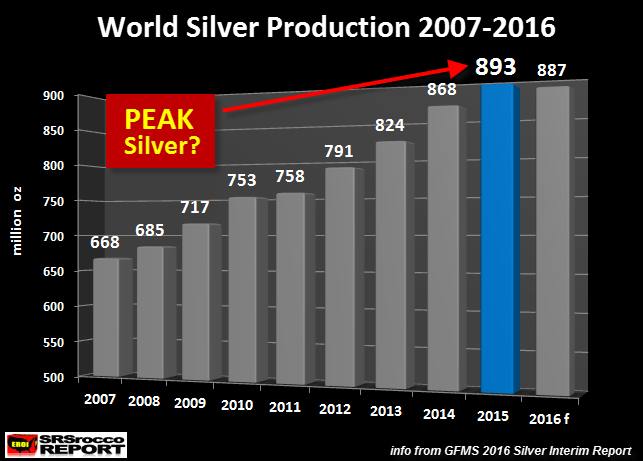
The Silver Institute just published its 2016 Silver Interim Report.  This report is published by Thomson Reuters GFMS.  According to their forecast for 2016, global silver production will decline to 887 million oz (Moz), down from 893 Moz in 2015:

World Silver Production

While forecasted global silver production for 2016 is down only slightly versus last year, GFMS also stated this in their report:

    1) We estimate that mine supply peaked in 2015 and will trend lower in the foreseeable future.
    2) Declining total supply is expected to be a key driver of annual deficits in the silver market going forward.

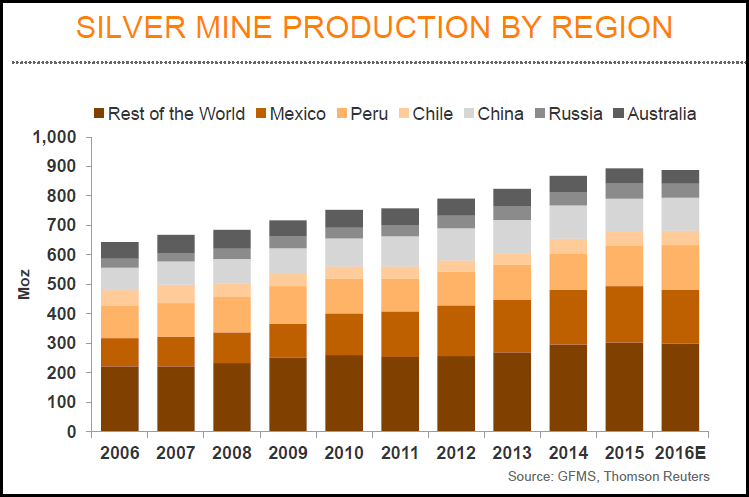
I will get to the annual silver deficits in a minute, but let's look at their world silver mine supply by region:

World Silver Production by Region

What is interesting here, is that GFMS forecasts the number one silver producer, Mexico, to be down in 2016 by more than 6 Moz.  Last year, I forecasted that global silver production would likely be lower in 2015.  I was going by data by the "World Metals Statistics."  However, Mexico's INEGI (government agency) considerably revised their figures higher for 2015.  While I have seen revisions take place, the revisions by Mexico's INEGI for 2015 were quite substantial.

Regardless, GFMS does a pretty good job with the silver mine supply data.  The important take-away here is that the trend of global silver production will likely be lower going forward.

The Majority Of Global Silver Production Declines Will Come From By-Product Base Mining

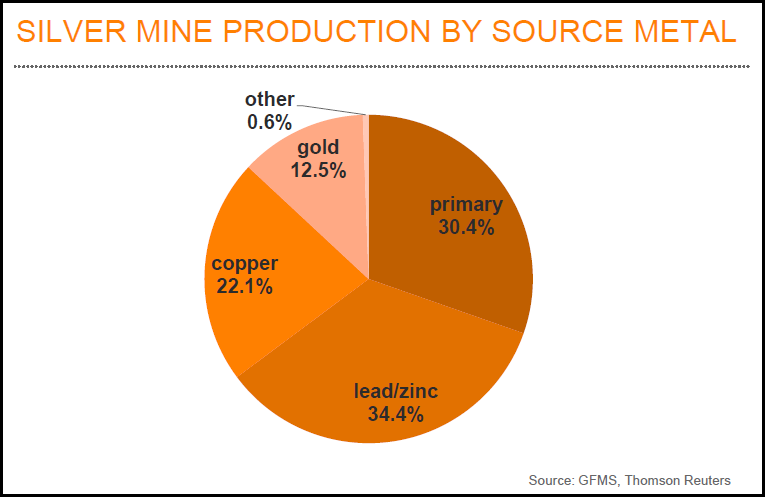
The majority of silver production comes from the by-product of base metal mining.  According to GFMS 2016 Silver Interim Report, lead & zinc accounted for 34.4% of silver supply, while copper yielded 22.1%.  Thus, the mining of these three base metals supplied 56.5% of global silver production in 2016.  Primary silver production accounted for 30.4% and gold mining supplied 12.5%:

Silver Production by Metal

As I have mentioned in prior articles, the decline in global oil production will impact base metal mining to a larger degree than primary silver production.  It takes a great deal of liquid fuels to produce the world's base metals.

For example, the Chilean Copper Commission stated in a 2014 report, that the country consumed 535 million gallons of liquid fuel to produce 5.7 million tons of copper.  Thus Chile's copper industry consumed 94 gallons of liquid fuel for each tonne of copper produced.

On the other hand, Pan American Silver burned 20.5 million gallons of liquid fuel to produce their 26.5 million oz of silver in 2015.  Which means, each ounce of silver production took 0.80 gallons of liquid fuel.  If we use Pan American Silver as a guide, then the 269 Moz of primary silver production in 2016 consumed 215 million gallons of liquid fuel.  However, I would imagine the global primary silver production average is much less, more like 0.50 gallon per ounce of silver.  So, we are talking about 135-150 million gallons of liquid fuel to produce all the primary silver in the world.

Now, the world produced a total of 18.4 million tons of copper in 2014.  Taking Chile's average of 94 gallons per tonne of copper produced and providing a conservative estimate of say 75 gallons per tonne for entire globe, then the world consumed roughly 1.4 billion gallons of liquid fuels to produce its copper in 2014.  This is about ten times the amount of fuel it took to produce all the primary silver production.  Of course this is a simple estimate, but there you have it.

Once the world enters into the next financial collapse, U.S. and world oil production will plummet.  This will impact base metal mining a great deal more than primary silver production.  Which means, overall silver production will decline more rapidly due to more than half coming from zinc, lead and copper.

Global Annual Silver Deficits Continue For 13 Consecutive Years

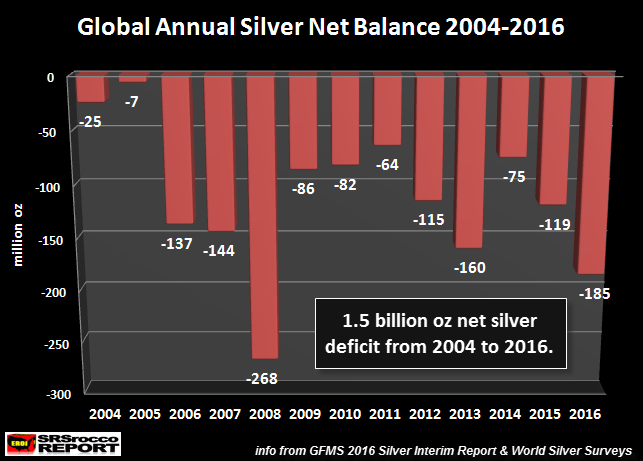
Due to the huge increase in Global Silver ETF demand as well as a large Exchange Inventory build, the silver market will suffer a forecasted 185 Moz annual deficit in 2016.  If we look at the annual silver deficits since 2004, it equals a stunning 1.5 billion ounces:

Silver Annual Deficits

GFMS calculates their "net balance" by subtracting physical demand from supply, then deducted or added changes in Silver ETF and Exchange inventories.  According to their data (as of Sept 2016), Silver ETF's and Exchanges added 133.3 Moz of silver to their inventories.  Furthermore, total physical demand exceeded total supply by 52.2 Moz to arrive at the total 185.5 Moz (rounded to 185 Moz) net deficit.

These annual deficits have been supplemented by silver surpluses of the 1980's and 1990's.  However, annual deficits are forecasted to continue as mine supply continues to decline along with subdued scrap supply.

Why Do These Supply & Demand Factors Matter For the Future Price Of Silver?

Recently I have stated that new information on the Thermodynamic Oil Collapse, based on the Hills Group and Louis Arnoux's work, suggests that supply and demand are not the real factor that determines price, rather it's the cost of production.

However, gold and silver are different from most other metals, commodities and energy.  While silver is consumed more than gold, it still functions as "MONEY" or a "STORE OF VALUE."  Thus, it should be valued differently than copper, wheat or oil.

I don't look at global mine supply or the annual silver deficits as factors that will impact the market price of silver by certain degrees, rather I look at them as a TELLTALE sign that the overall trend is changing, and has been for nearly a decade.  It is the longer term fundamental trend change that interests me, not the year by year supply and demand factors on price.

Currently, the silver price is based on its cost of production (90-95%) plus some supply and demand factors.  While many believe the BIG BANKS can push the price of silver anywhere they see fit, this is pure nonsense.  If the Big banks pushed the price of silver 25-50% below its average primary silver cost of production, traders would come in by the droves.   While traders may be uninterested in long-term fundamentals, they aren't stupid as it pertains to short-term market forces.

That being said, silver's ultimate value is not based on its cost, it will be based on its STORE OF VALUE properties when the MOTHER OF ALL DEFLATIONS finally arrives.  I am talking about deflation of most paper assets (stocks & bonds) and real estate.

Because there is so little real physical silver out in the market, 3-4 billion oz, any significant amount of capital moving into it will push its value to seriously high levels.  This may seem a play on hype, especially for those who are a bit disillusioned by the price smash since the Trump President election.

Unfortunately, for those who continue BELLY-ACHING about low silver prices, there isn't much I can say to change your opinion.  I have come to realize that a significant percentage of silver investors who continue to understand the long-term fundamentals, will never complain about lower prices.  They just suck it up and know that insane Central Bank policies won't last forever.

Unfortunately, the precious metals community also has its group of individuals who will complain when the going gets rough.  This should be expected as this is the typical nature of a FICKLE public.  All slaps on the back when things are good and the first to bad mouth when things turn south.

I get a kick out of the BELLY-ACHERS who seem to forget that the Central Banks have embarked on the most insane monetary policy in history.  They have pushed debt and money supply to an exponential trend.  I find it simply amazing how a disgruntled silver investor points out how wrong the precious metals analysts were on the silver price since 2012, while totally dismissing massive Central Bank monetary invention.

Regardless, peak silver production on top of the continued annual deficits point to a trend that will reach an INFLECTION POINT in the future.  So, here is the BEEF.  If you think exponentially increasing debt and monetary liquidity will continue for the next 5-10 years, then maybe you should stay in Dollars, U.S. Treasuries, Stocks and Real Estate.  However, if you aren't suffering from brain damage as many in the markets are today, you may want to consider staying put in the 2,000+ year monetary history and store of value of silver.

Lastly, if you haven't checked out our new PRECIOUS METALS INVESTING section or our new LOWEST COST PRECIOUS METALS STORAGE page, I highly recommend you do.

Check back for new articles and updates at the SRSrocco Report.

Friday, December 2, 2016

Defensive Stocks Bounce -- Led Higher by Gold Stocks

Published here: http://www.zerohedge.com/news/2016-12-02/defensive-stocks-bounce-led-higher-gold-stocks

For gold traders, it has been a long month of the 'Trump-trade' completely decimating their lives -- disrupting their austere lifestyles with harrowing losses. In the shadow of soon to be great again America, gold stocks plummeted by more than 15% over the past month -- knee capping an otherwise spoiled rotten investor base who've been enjoying magnanimous gains throughout 2016 -- even though they've mostly done it under the pretext of waiting for an end of days scenario to unfold.


In addition to gold, bonds and anything defensive, like consumer staples, utilities and REITs got hammered -- as Joe Blow blew his wad into high beta, psychotic energy, and aluminum stocks -- gleefully and flippantly tossing money at bank stocks too because the yield curve blew out.


If only for today, the defensive plays are back in vogue, reminiscent of the days when the deflationary vortex reigned supreme and people, literally, feared for their lives and the future of their nation. Gold and silver stocks are higher by 4%, REITs by 2.5% Utilities by 1% and Goldman is down 1.6%.


Recent underperformers in the biotech space are participating in the rally -- as a general malaise wistfully sweeps through Wall Street -- exuberant about any and all best case scenarios. Traders, as always, are ignoring all of the negative aspects of sharply higher sovereign borrowing costs and an administration whose central campaign promise was to bring China to its knees -- reversing decades of unfair currency manipulation and one sided trade deals. Judging by the sharp rise in basic materials, especially copper, none of that is being priced into stocks. 


Once again, Trump is not being taken seriously. 


If recent history is of any use, investors will soon learn about the seriousness of Trump's policies and how upsetting the apple cart isn't exactly a seamless transition into mindless rallies -- based solely on hope.


Content originally generated at iBankCoin.com

Gold and Silver Will Protect From Coming Financial Crash - Rickards

Published here: http://www.zerohedge.com/news/2016-12-02/gold-and-silver-will-protect-coming-financial-crash-rickards

Gold and silver coins will protect from the coming financial crash - James Rickards, author of The Road to Ruin told Sean O'Rourke in a must listen to RTE Radio interview this week.

gold-and-silver-coins
Rickards is the best selling author on finance and money and advises the US intelligence community on international economics and financial threats.

His advice to people with savings or investments to protect from the coming crash? Buy gold and silver coins.

"For savers and investors at any level, modest or wealthier - put 10% of your invest-able assets in physical gold or silver, for smaller amounts, silver might do very well."  

“It’s the future of money… Here is why . First of all it is non-digital. Everyone thinks they have money; what they have are electrons in banks...” You can have confiscation, negative interest rates, bank closures. 

If you have physical gold you are outside of the digital system - that money cannot be frozen by the government. It cannot be hacked by Vladimir Putin..."

"Even if you have €10,000 (euros), out a thousand euros buy one ounce of gold put it in a safe place. If the banks are shut you will have a valuable asset. Or buy 50 ounces of silver - thats also about €1,000. 50 ounces of silver coins, one ounce coins in a safe place. 

You will have something of value, even if the system collapses or not. "

4coinswhitebackground
Other key points made in interview:

"Financial Crashes are like earthquakes: we know that they are coming, but we know not the day or the hour. The next one is close and is likely to be severe, even epochal." 

“In 1998, Wall Street bailed out the hedge funds. In 2008, the central banks bailed out Wall Street. In 2018 – if not sooner – who’s going to bail out the central banks?”

Financial crises are cyclical and the next one is close. Not only that, but global elites have a secret plan for the next financial crisis.

It was decided at the G20 meeting in Australia in 2014 that there would be no more bail-outs. Instead, there would be bail-ins: when a bank is in distress, the rescue money comes from the stakeholders including depositors and savers.

“So depositors’ money is at risk, bondholders can take haircuts, stockholders can see their stock go to zero. That’s the new template.”

And this new template means that when the next crisis comes, the whole financial system will be shut down while the rescue is organised. People won’t be able to get their money from banks, they won’t be able to sell their shares. This is pretty scary stuff.

Rickards predicted that Donald Trump would be president and he says that Trump is using the Ronald Reagan playbook to try to boost the US economy, but it won’t work because the world is too different today from the way it was in the 1980s.

“Reagan had a lot of tailwinds: inflation had to come down, interest rates had to come down. He had fiscal space to run up the debt. Trump has headwinds.”

There’s a war going on between national leaders and the heads of major corporations, according to Rickards, and corporation tax will play a major part in the struggle.

“In a financial panic, everyone wants their money back… People say, oh I’ve money in stocks, money in bonds. No you don’t, you have stocks and bonds, but that’s not money. You have to sell them to get your money.”

Rickards’ distressing vision has happened before, he says. In 1933, President Roosevelt closed every bank in America. It’s also happened recently in Cyprus, Greece and in India today.

“It’s the future of money… It’s non-digital. Everyone thinks they have money; what they have are electrons in banks...”

Listen to Rickards Interview Here


Gold and Silver Bullion - News and Commentary

Gold rises from 10-month lows, heads for fourth consecutive weekly drop (LiveMint.com)

Fed may face unnerving shake-up under Trump administration (Reuters.com)

US Construction Spending up 0.5 Percent in October (GO.com)

Asian Shares Drop as Trump Effect Fades (WSJ.com)

China gold premiums hold near 3-year high (Reuters.com)

Doublelines Gundlach likes bonds, gold (ForexLive.com)

10-year Treasury yield hits fresh 17-month high (MarketWatch.com)

$4.1 billion pulled from U.S.-based taxable mutual bond funds during week: Lipper (Reuters.com)

Diana Choyleva: the unravelling of globalisation (MoneyWeek.com)

Can the Trump rally last? (MoneyWeek.com)

7RealRisksBlogBanner

Gold Prices (LBMA AM)

02 Dec: USD 1,171.65, GBP 929.00 & EUR 1,100.88 per ounce
01 Dec: USD 1,168.75, GBP 930.09 & EUR 1,099.68 per ounce
30 Nov: USD 1,187.40, GBP 952.06 & EUR 1,115.44 per ounce
29 Nov: USD 1,187.30, GBP 952.45 & EUR 1,119.98 per ounce
28 Nov: USD 1,189.10, GBP 956.51 & EUR 1,117.99 per ounce
25 Nov: USD 1,187.50, GBP 953.30 & EUR 1,121.83 per ounce
24 Nov: USD 1,187.25, GBP 953.60 & EUR 1,125.04 per ounce

Silver Prices (LBMA)

02 Dec: USD 16.35, GBP 12.95 & EUR 15.36 per ounce
01 Dec: USD 16.30, GBP 12.91 & EUR 15.35 per ounce
30 Nov: USD 16.67, GBP 13.39 & EUR 15.66 per ounce
29 Nov: USD 16.54, GBP 13.26 & EUR 15.61 per ounce
28 Nov: USD 16.68, GBP 13.45 & EUR 15.73 per ounce
25 Nov: USD 16.47, GBP 13.21 & EUR 15.55 per ounce
24 Nov: USD 16.31, GBP 13.09 & EUR 15.43 per ounce


Recent Market Updates

- RBS Fail Bank of England Stress Test
- Peak Silver – Supply Deficits Mean Higher Prices
- Bail In Risk – €4 Trillion Banking System In Italy Poses Contagion Risk as Referendum Looms
- Gold Down 13.5% In 13 Days – Trump Bearish For Gold?
- War On Cash Just Got Real – India and Citibank In Australia
- Russia Gold Buying In October Is Biggest Monthly Allocation Since 1998
- Stocks, Bonds, Pension Funds “Will Be Wiped Out…” – Rickards
- Physical Gold Is A “Long-Term Position” as “Hedge Against Governments”
- Gold Sell Off On Fed Noise – “Interesting Times” To “Support Gold”
- Islamic Gold – Vital New Dynamic In Physical Gold Market
- Peak Gold Globally – “Bullish For Gold”
- Gold Price Should Go Higher On Global Risks and Trump – Capital Economics
- President Trump – Why Market Loves Him and Experts Wrong

Indian ‘Gold Ban’ a Portent of Major Events?

Published here: http://www.zerohedge.com/news/2016-12-01/indian-%E2%80%98gold-ban%E2%80%99-portent-major-events

Hold your real assets outside of the banking system in one of many private international facilities  -->    https://www.sprottmoney.com/intlstorage 


Indian ‘Gold Ban’ a Portent of Major Events?

Written by Jeff Nielson (CLICK HERE FOR ORIGINAL)


The price of gold (and silver) is presently falling. This was previously predicted as far back as the middle of February. Precious metals prices will almost certainly continue to fall, soon accompanied by a general crash in our markets and economies. The need (for the banking crime syndicate) to depress precious metals markets is to create the illusion that these metals are not safe havens, when panicked people are looking for somewhere to place the remnants of their wealth.


However, in order to create a veneer of legitimacy in these serially rigged markets, it’s necessary to fabricate a pretext for the decline in precious metals prices. This is coming from the mouths of the same talking-heads who only a few months earlier were crowing about “a new and very long bull market” for gold. It is in this light that we can view the latest propaganda nonsense from the Corporate media: the “India gold ban”.


Regular readers have already seen this theater previously. Three years ago; India’s previous government began radically curbing gold imports, culminating in a near-total ban in gold imports to the world’s greatest gold-lovers, and second-largest population. As was explained at the time, the ban on gold was for no reason in terms of economic fundamentals.


What was actually happening at that time is that the One Bank was blackmailing that government to do something about the extremely strong gold demand, and larger-than-normal gold imports which were
flowing into India. So the Big Banks did what these convicted currency-manipulators do every time they want to punish any particular nation, they manipulated India’s currency – lower. These convicted currency-manipulators continued pushing the rupee lower and lower until the gold ban was initiated by India’s government. At that point, the downward plunge in the rupee instantly and magically disappeared.


The ban didn’t work. It didn’t work (from the perspective of the One Bank) for several reasons. The ban on official gold imports simply inspired Indians to reopen centuries-old gold smuggling routes. Those smuggling routes had only been previously closed, voluntarily, after India’s government liberalized its gold market when it abolished the Gold Control Act in 1990.


The 2013 gold ban also failed because the moderate restriction of inflows of gold into India motived the Indian people to buy much larger quantities of silver, shattering previous import records for that metal. Finally, in banning the official importing of gold – and provoking gold smuggling – this meant that a blackmarket for gold arose in India, the automatic partner of any large-scale smuggling.


What accompanies blackmarkets? A blackmarket price for gold: a real-world price for gold where there would be no direct means for the banking crime syndicate to manipulate that price. It was for all these reasons that the One Bank relented on its previous blackmailing of India’s government, and allowed that nation to resume normal importing of gold.


Flash ahead to 2016; and some things are now different. There is a new regime in India, an extremely corrupt government which does not require blackmailing by the One Bank because the bankers already own this regime. This was previously demonstrated when this puppet government announced its “gold deposit scheme” (scam). It was such a laughably transparent attempt to steal the gold from the Indian people that it failed miserably.


While the corrupt Modi regime has denied it has plans to block imports, this denial comes despite weeks of persistent rumors that the government intends to “impose curbs” on India’s gold market. Based on these fears, premiums to buy gold in India jumped to a two-year high.


Again, as before, there is no reason for this attack on India’s gold imports. The official propaganda is that (ironically) this suppression of the gold market is aimed at reducing the amount of “black money” circulating in India’s economy. This propaganda is nonsensical for two reasons. First, we live in a world where the Big Banks are allowed to launder $trillions in dirty money for the drug cartels, and for supposed “terrorist entities”.


The banking crime syndicate is never punished for this serial money-laundering, despite the U.S.’s supposed “War on Terror” and “War on Drugs”. Yet here we have India’s (corrupt) government announcing increasingly draconian measures aimed at alleged money-laundering activities which only amount to $millions each year.


The second absurdity here was already noted. Any serious restriction of legitimate gold imports into India will instantly and automatically result in systemic gold-smuggling. That gold-smuggling will result in the blackmarket which inevitably accompanies smuggling. You can’t reduce the amount of “black money” in India’s economy by creating a blackmarket.


The final absurdity here is the increasingly hysterical hype emanating from the mainstream media in the West, to accompany this new (and doomed to fail) attack on India’s gold market:


Potential gold-import ban by India could be biggest bombshell since Nixon


This propaganda is both laughable and nonsensical. It’s nonsensical to suggest that ta (potential) second ban on India’s gold imports would be the “biggest bombshell” in the gold market in nearly half a century, when we already saw a ban on India’s gold imports three years ago – and the first ban failed. It’s laughable for the same reason: we already know that (at worst) this will be nothing more than a small-and-temporary deterrent to overall gold demand.


The fact that the mainstream media in the West have jumped all over the rumors coming from India is further proof that the propaganda machine is back to full-manipulation mode, and all talk of the Fake Rally has been abandoned. If these two-faced mouthpieces were even neutral toward the gold market, we could not possibly be seeing such bearishly one-sided and inaccurate propaganda about events in India.


While this current push in India will have no long-term effect on the gold market, the potential for a short-term disruption of imports into that nation is acknowledged. In this respect the timing of the latest announcement from the One Bank’s puppets in India is interesting.


What will happen when the One Bank crashes our markets and economies, and slams precious metals prices even lower to accompany this? Demand for gold and silver will explode higher throughout the Rest of the World, with populations which have not been brainwashed into forgetting the eternal wealth-protection provided by gold and silver. In this respect, the rumored attack by the Modi regime on India’s gold market can be seen as a closely-choreographed, preemptive move.


We know the general crash in our markets and economies is coming, but we don’t know when. Now we have an apparent move aimed at manipulating gold market demand in the world’s largest gold market which can/will only have a short-term impact on precious metals markets. This appears to be a strong indicator that the Next Crash is coming very soon.


Regular readers will recall that this Crash was originally pegged to occur in the middle of this year, pre-U.S. election, to follow the pattern of crashes in previous bubble-and-crash cycles. With the Next Crash now about to occur immediately after a new puppet regime has been elected/appointed in the United States, this suggests
that an exogenous “cause” for this Crash will be fabricated by the banking crime syndicate. This will be done in order to prevent their new puppets from being fingered as the scapegoats for this Crash.


As has been previously suggested, the most likely exogenous event to be manufactured as camouflage for a Crash is, as always, a new war, or perhaps some “terrorist” false-flag event. We are left with the following, implied chain of events. India’s government is apparently in the process of creating a temporary bottleneck in Indian gold demand. This implies that the Next Crash is nigh. In turn, this implies that the Next War is just around the corner.


Please email with any questions about this article or precious metals HERE


Indian ‘Gold Ban’ a Portent of Major Events?

Written by Jeff Nielson (CLICK HERE FOR ORIGINAL)

Thursday, December 1, 2016

What Is Blockchain and How Will It Change Your Life?

Published here: http://www.zerohedge.com/news/2016-12-01/what-blockchain-and-how-will-it-change-your-life
  • Blockchain technology - What is it?
  • Latest developments - Royal Mint Gold & CME, Goldman Sachs and Santander
  • Why do we need it? It’s about value
  • Blockchain is an extension of economics
  • Blockchain allows us reduce uncertainty and risk
  • How will it change your life?

By @Skoylesy . Editor @MarkTOByrne

For those of you who follow anything to do with blockchain and blockchain technology,  you will know that the space has had its ups and downs in the last couple of weeks.

The exciting news is that two major players in the gold market, the Royal Mint and CME Group have announced a blockchain-backed gold project, and the surprising news is that the R3CEV consortium is apparently under threat.

Making a mint on the blockchain

The Royal Mint and CME Group have announced that they are working on a blockchain project together. The project will see the creation of Royal Mint Gold (RMG) digital tokens which will each be backed by 1g gold.

We will look at the Royal Mint’s announcement in more detail shortly, particularly at how they expect the implementation of a blockchain-backed platform to mean that they are able to remove storage fees.

But the focus of today’s research note is to look at why blockchain is grabbing everyone’s attention.

The use of blockchain technology in the gold space is nothing new, it is something we discussed recently in regard to changes in the gold market and the risks posed to the London gold market.

However, the move by the world’s oldest gold organisation is an illustration of just how complimentary the technology that was first known for backing ‘digital gold’ (bitcoin) and the longest surviving money, really are.

Goldman Sachs and Santander Drop Out of R3 Consortium

In recent weeks, both Goldman Sachs and Santander have dropped out of the R3CEV consortium, whilst a further five (including Morgan Stanley and National Australia Bank) are also rumoured to be about to leave.

R3 is a blockchain company formed of a consortium of near 70 banks and financial institutions (including those focused on insurance). It leads research and development in distributed ledger technology, and is currently raising $150m.

However the move by those mentioned above is a positive sign, and one that shows the blockchain (or distributed ledger technology) industry is maturing. Shake-outs are inevitable in new technology industries as institutions, governments and regulators negotiate their way through new developments and working out what it means for them.

Those companies that are set to leave the consortium are still committed to the ground-breaking technology. Goldman Sachs and Santander are both, for example, still shareholders in Blythe Masters’ Digital Asset Holdings. The former co-led a $60 million investment into the business alongside IBM.

Even CME Group, as mentioned earlier, are involved in multiple blockchain projects, as a member of the industry body Post Trade Distributed Ledger Group (PTDL) (fellow members include the London Stock Exchange, Euroclear and HSBC) and the Hyperledger project.

But what is it about this technology that is so groundbreaking and has the likes of Goldman Sachs investing millions and ex-senior JP Morgan banker, Blythe Masters breaking rank and joining a (well-funded) start-up?

Why are established gold-market participants deciding this is the technology they need to bring the space into the 21st century?

Uncertain about blockchain?

Bettina Warburg, presented a TED Talk over the summer in one of the best explanations we have seen for a long-time, that will help you to understand the power of blockchain technology.


Ultimately blockchain’s genius comes down to its ability to reduce uncertainty in the transfer of value - whether that value is information, a digital asset, a contract note, an agreement or a deed - you name something that is effectively information and it has value.

The exchange of value is something we have sought for millennia to reduce the uncertainty of, and it has resulted in the formal and informal institutions and systems we have today.

Ranging from regulators, to oversized banks like Goldman Sachs, to lawyers, to barter systems.

What is blockchain?

“So what is the blockchain?" Warburg explains it well:

"Blockchain technology is a decentralized database that stores a registry of assets and transactions across a peer-to-peer network. It's basically a public registry of who owns what and who transacts what. The transactions are secured through cryptography, and over time, that transaction history gets locked in blocks of data that are then cryptographically linked together and secured. This creates an immutable, unforgettable record of all of the transactions across this network. This record is replicated on every computer that uses the network."

Never seen before

The concept of blockchain, something that can be decentralised, can operate autonomously, is auditable and apparently immutable is something that is difficult to get our heads around. The closest description Warburg can provide is Wikipedia.

“We can see everything on Wikipedia. It's a composite view that's constantly changing and being updated. We can also track those changes over time on Wikipedia, and we can create our own wikis, because at their core, they're just a data infrastructure. On Wikipedia, it's an open platform that stores words and images and the changes to that data over time.”

There are of course further technical details to blockchain, but at its core it is a very similar concept.

“On the blockchain, you can think of it as an open infrastructure that stores many kinds of assets. It stores the history of custodianship, ownership and location for assets like the digital currency Bitcoin, other digital assets like a title of ownership of IP. It could be a certificate, a contract, real world objects, even personal identifiable information….It’s this public registry that stores transactions in a network and is replicated so that it's very secure and hard to tamper with.”

This is where much of the attraction comes for the gold market. In itself gold is an immutable form of money, it cannot be edited, multiplied and in many ways it is an autonomous currency.

However the market that drives the prices is none of these things. By placing gold on a blockchain, we may get the first steps to a truly autonomous gold market that is about price discovery rather than price creation.

Why do we need it? It’s about value

Bettina points out that much of human behaviour comes down to how we exchange value. This has lead to a huge number of industries developing that are, at their core, about value.

They are about how we attribute value to items, how we exchange value and how we maintain value.

Blockchain will “fundamentally change how we exchange value”.

Why is this? Because the blockchain has a capability that no human-managed organisation has yet managed to master - the removal of uncertainty through technology.

Blockchain is an extension of economics

It still surprises me the number of people who haven’t heard of bitcoin, and even those who have heard of bitcoin are unaware of blockchain. Blockchain is the technology that underpins bitcoin, but it is so much more than the ledger of a cryptocurrency.

Blockchain means that we may no longer have to use the layers of bureaucracy in order to reduce uncertainty. Warburg sees the potential of blockchain as an extension of Nobel Prize winning economist Douglass North’s ‘New Institutional Economics’.

Institutions, in this context, are just the rules (and organisations, whether informal or formal) that implement them e.g. the law or just bribery.

“As Douglass North saw it, institutions are a tool to lower uncertainty so that we can connect and exchange all kinds of value in society. And I believe we are now entering a further and radical evolution of how we interact and trade, because for the first time, we can lower uncertainty not just with political and economic institutions, like our banks, our corporations, our governments, but we can do it with technology alone.”

Knowing that these organisations exist form the rail on which we operate our lives, our businesses and our economies. In the future blockchain will act as the rails that reduce uncertainty, on top of which we will exchange value through digital assets.

The uncertainties of life

“Blockchains give us the technological capability of creating a record of human exchange, of exchange of currency, of all kinds of digital and physical assets, even of our own personal attributes, in a totally new way. So in some ways, they become a technological institution that has a lot of the benefits of the traditional institutions we're used to using in society, but it does this in a decentralized way. It does this by converting a lot of our uncertainties into certainties.”

For Warburg there are three uncertainties when it comes to transferring value:

1) Not knowing who you are dealing with
2) Degrees of transparency in complex transactions and supply chains
3) Reneging on an agreement - no recourse if it goes wrong

The uncertainty of the unknown party

Today, with many of the transactions we are able to take part in, the uncertainty is reduced thanks to verification. Whether this be by receiving a bank transfer from someone who has been verified by their own (also verified bank) or if it is booking AirBnb which you trust thanks to social verification, GoldCore customer reviews on Ekomi, personal reviews and links to Facebook profiles.

Warburg points out this is a very fragmented system. I have bank accounts in the UK, but if I want to open an additional one in the same country I have to be verified all over again. One verification does not determine the next. “Think about how many profiles you have,” says Warburg.

“Blockchains allow for us to create an open, global platform on which to store any attestation about any individual from any source. This allows us to create a user-controlled portable identity. More than a profile, it means you can selectively reveal the different attributes about you that help facilitate trade or interaction, for instance that a government issued you an ID, or that you're over 21, by revealing the cryptographic proof that these details exist and are signed off on. Having this kind of portable identity around the physical world and the digital world means we can do all kinds of human trade in a totally new way.”

In the project announced by the Royal Mint and CME Group there is expected to be transparency over the ownership records - to those who have access to the 'permissioned' ledger.

Degree of transparency

At the moment there is very little transparency and accountability when it comes to the London Gold Market and it’s over-the-counter (OTC) trading. This can be difficult to contend with given so much physical gold demand is, in its simplest from, based on transparency and trust. Yet as gold product providers such as ETFs and digital gold providers grow in power we appear to forget why we trust gold in the first place.

For many one of the key issues with the way gold products are traded is a lack of transparency over the underlying asset or currency - physical gold.

However, blockchain can potentially be used to bring some of the much-missed transparency to the gold market. This is when we start to use the phrase ‘trustless’ which is a bit of a mind-upset for those who are new to bitcoin and blockchain.

A trustless transaction is where the participants do not need to trust one another, as instead a blockchain (which is verified, immutable and decentralised) is used to monitor and validate the information in a supply chain. Imagine what this could mean in a network of goods and data that currently can be tampered with - medicines, technology, designer items.

This means that in theory it should not matter when you are dealing with a multi-party horizontal supply chain, which each have different infrastructures, about whether you can trust them or not as there is ‘one single truth’.

This is something we have not had before - we have an unbelievable lack of transparency, which currently we rely on layers of verification agents (lawyers, compliance, personal trust) to provide visibility.

“We can create a decentralized database that has the same efficiency of a monopoly without actually creating that central authority. So all of these vendors, all sorts of companies, can interact using the same database without trusting one another. It means for consumers, we can have a lot more transparency. As a real-world object travels along, we can see its digital certificate or token move on the blockchain, adding value as it goes. This is a whole new world in terms of our visibility.”

Reneging - no going back with blockchain

The ability to solve this uncertainty is the application of blockchain that really put it on the map. Smart-contracts are where we are seeing some serious innovation. Currently we rely on legal entities and processes to guarantee our transactions.

Supply finance is one particularly complicated area that is built on layers of organisations and timings in order to facilitate deals. A more familiar example is the process of buying a house - something that is inordinately lengthy, time-consuming and expensive for what is basically the exchange of a good (too often) financed with debt.

Both of these examples rely on third parties to create trust within a transaction, to enforce it because of the checks that are put in place. But blockchain now enables us to do away with the bureaucracy and red tape, as the code acts as the enforcer.

Warburg uses the example of purchasing a smart-phone online:

“Blockchains allow us to write code, binding contracts, between individuals and then guarantee that those contracts will bear out without a third party enforcer. So if we look at the smartphone example, you could think about escrow. You are financing that phone, but you don't need to release the funds until you can verify that all the conditions have been met. You got the phone.”

And this, I agree with Warburg, is one of the most exciting things about blockchain’s ability to lower our uncertainties:

“…because it means to some degree we can collapse institutions and their enforcement. It means a lot of human economic activity can get collateralized and automated, and push a lot of human intervention to the edges, the places where information moves from the real world to the blockchain.”

Will it change my life?

The reason blockchain is so groundbreaking is because it is both a technological disruption and economic evolution. It has combined the human need to reduce uncertainty with mathematics and technology. Its end result is a system free of layers.

“…the very thing that keeps the blockchain secure and verified, is our mutual distrust. So rather than all of our uncertainties slowing us down and requiring institutions like banks, our governments, our corporations, we can actually harness all of that collective uncertainty and use it to collaborate and exchange more and faster and more open.”

It is difficult to see how it won’t change our lives.

The implications for a world that is affected from the top to the bottom by institutions that are required to manage our mutual distrust, is unfathomable.

But this is where many will take issue. Why would an institution be it government, bank, legal entity, regulator or compliance company decide to invest in and implement a system that is, at its core, designed to do their job?

Why embrace a blockchain that could expose unethical, illegal practices?

Why operate on a blockchain that removes the need for expensive lawyers, compliance officers etc.

In truth the concept of blockchain in practice is far more complex than it initially appears. There can be multiple blockchains. Some operate privately between a select network, some are public (such as the bitcoin blockchain) and others a hybrid of the two.

Blockchains can be implemented to do an inordinate number of processes that we are hardly aware of, the whole time keeping the current status-quo just more efficient. And this is why everyone is looking into using the technology.

That may seem depressing but it will lead to many, many positive developments in terms of ethical behaviours, regulated activities, efficiencies in deal-making and even reducing payment costs.

For many the discussion is beyond this, it’s not will or how but when?

The short-answer is not for a while. Unless you are an avid bitcoin user, trader or enjoy taking part in initial coin offerings. In the long-term it probably will affect your life, but the masses may barely know about it.

At the moment there are few applications (other than bitcoin) that are up and running in the real world. But the possibilities really do appear to be infinite and it is with this in mind that regulators are launching incubators, insurance companies are hosting hackathons, banks are investing in blockchain tech projects and venture capitalists (VCs) are snapping up anything that merely mentions the phrase ‘decentralised ledger’.

For Warburg, we will soon see a world where blockchain technology and distributed, autonomous organisations will “have quite a significant role.”

We concur.

Watch Warburg Blockchain Ted Talk
Read Blockchain Promises To Be As Disruptive A Technology As Internet
Read Bitcoin and The Blockchain – Banks Must Embrace Or “Die”
Read Gold, Silver, Blockchain and Fintech – Solutions To Negative Rates, Bail-ins, Cash Confiscations and Cashless Society


Gold and Silver Bullion - News and Commentary

Gold sinks to lowest in 10 months; firm dollar, chance of U.S. rate hike weigh (Reuters.com)

Gold Slips As China Curbs Imports To Slow Capital Flight (ZeroHedge.com)

Tumbling Gold Prices Mean More Pain for Barrick & Newmont But… (Barrons.com)

Bank of England Sees Economic Risks From Trump and Brexit (WSJ.com)

Bucket of gold flakes valued at $1.6 million stolen from truck (Edition.com)

7RealRisksBlogBanner

World is feeling the might of China's commodity traders (Bloomberg.com)

John Embry – Some Long Time Gold Holders Are Now Capitulating… (KingWorldNews.com)

Michael Oliver – Conspiracy Theorists Would Use This As Evidence Of Central Bank Manipulation Of The Gold Market (KingWorldNews.com)

Paul Craig Roberts Denounces Gold Market Rigging (USAWatchDog.com)

China’s 'extraordinary leverage' tops Bank of England’s growing list of concerns (CNBC.com)

Gold Prices (LBMA AM)

01 Dec: USD 1,168.75, GBP 930.09 & EUR 1,099.68 per ounce
30 Nov: USD 1,187.40, GBP 952.06 & EUR 1,115.44 per ounce
29 Nov: USD 1,187.30, GBP 952.45 & EUR 1,119.98 per ounce
28 Nov: USD 1,189.10, GBP 956.51 & EUR 1,117.99 per ounce
25 Nov: USD 1,187.50, GBP 953.30 & EUR 1,121.83 per ounce
24 Nov: USD 1,187.25, GBP 953.60 & EUR 1,125.04 per ounce
23 Nov: USD 1,213.25, GBP 980.00 & EUR 1,143.00 per ounce

Silver Prices (LBMA)

01 Dec: USD 16.30, GBP 12.91 & EUR 15.35 per ounce
30 Nov: USD 16.67, GBP 13.39 & EUR 15.66 per ounce
29 Nov: USD 16.54, GBP 13.26 & EUR 15.61 per ounce
28 Nov: USD 16.68, GBP 13.45 & EUR 15.73 per ounce
25 Nov: USD 16.47, GBP 13.21 & EUR 15.55 per ounce
24 Nov: USD 16.31, GBP 13.09 & EUR 15.43 per ounce
23 Nov: USD 16.56, GBP 13.36 & EUR 15.59 per ounce


Recent Market Updates

- RBS Fail Bank of England Stress Test
- Peak Silver – Supply Deficits Mean Higher Prices
- Bail In Risk – €4 Trillion Banking System In Italy Poses Contagion Risk as Referendum Looms
- Gold Down 13.5% In 13 Days – Trump Bearish For Gold?
- War On Cash Just Got Real – India and Citibank In Australia
- Russia Gold Buying In October Is Biggest Monthly Allocation Since 1998
- Stocks, Bonds, Pension Funds “Will Be Wiped Out…” – Rickards
- Physical Gold Is A “Long-Term Position” as “Hedge Against Governments”
- Gold Sell Off On Fed Noise – “Interesting Times” To “Support Gold”
- Islamic Gold – Vital New Dynamic In Physical Gold Market
- Peak Gold Globally – “Bullish For Gold”
- Gold Price Should Go Higher On Global Risks and Trump – Capital Economics
- President Trump – Why Market Loves Him and Experts Wrong


Gold ETF Mechanics

Published here: http://www.zerohedge.com/news/2016-12-01/gold-etf-mechanics
Submitted by Ronan Manly, BullionStar.com


Introduction

Exchange traded investment vehicles backed by physical gold refer to a group of trusts, funds, or other legal entities which hold gold bars with a custodian in a vault and which issue securities, units or other fractional ownership claims against that gold. These securities are pitched and marketed as an alternative to direct ownership of gold bullion and these products have seen significant expansion and evolution over the last 10-12 years.

There are a number of such products including Exchange Traded Funds (ETFs) and Exchange Traded Certificates (ETCs). These product classes now represent a relatively large footprint within the gold investing space. In addition to the very large and well-known SPDR Gold Trust (GLD) and iShares Gold Trust (IAU), there are several other similar products from providers such as ETF SecuritiesSource ETFs, and Xetra-Gold. At the time of writing, GLD held nearly 900 tonnes of gold, ETF Securities products held over 300 tonnes, iShares gold ETFs held approximately 275 tonnes of gold, and Xetra-Gold held 110 tonnes. Therefore, their combined gold holdings are now larger than all but the world’s largest central bank gold reserve holdings.

As popular as these securities are, it’s important to look at what exactly these products provide, and what they don’t provide when compared to ownership of segregated physical gold bars or gold coins.


Exposure to the Gold Price, not to Gold

A common investment objective of all of these gold-backed vehicles is to provide the security holder with exposure to the price of gold, not to actual physical gold.

For example, the investment objective of SPDR Gold Trust shares is to “reflect the price of gold bullion”. The iShares Gold Trust “seeks to reflect generally the performance of the price of gold” The Source Gold P-ETC “aims to provide the performance of the spot gold price”. Xetra-Gold is an “opportunity to participate in the performance of the gold market”, in a product that has “no beneficial ownership to gold”. These products therefore do not provide their holders with direct ownership of gold.


ETFs: Paper at the end of the day

No Right to Underlying gold – Cannot take Delivery

Although these products do hold physical gold that backs the respective securities, a primary concern is that they do not, and never will, allow the unit holders to obtain access to the underlying gold. The gold bars held in these vehicles are almost always large ‘variable weight’ gold bars, commonly called London Good Delivery bars, which weigh anywhere between 350 ounces and 430 ounces.

For example, in ETFS Physical Gold (Ticker PHAU), “each individual security has an effective entitlement to gold”. For Source Physical Gold P-ETC, “each Gold P-ETC is a certificate which is secured by gold bullion”. For the SPDR Gold Trust, the “gold shares represent fractional, undivided interests in the Trust” which owns the underlying gold. But in none of these vehicles can the unit holder take delivery of the underlying physical gold that backs the shares or units.

Xetra-Gold does offer a roundabout option to its holders to convert their securities into physical gold if they so choose. This route, however, does not even involve access to the specific underlying gold bars of the product. Instead, Xetra-Gold holds an additional pool of unallocated gold for conversion purposes. In the words of Xetra, “in order to facilitate the delivery of physical gold, the issuer holds a further limited amount of gold on an unallocated weight account with Umicore AG”. Umicore is a Belgian headquartered metals refiner and recycler.


Counterparty Risk

Another common trait of gold-backed ETFs and similar vehicles is that they all have quite complex structures, long prospectuses filled with numerous risk warnings, and lots of moving parts. Lots of moving parts also means lots of participating entities such as trustees, custodians, marketing agents, Authorised Participants (APs), issuers, and market-makers, which potentially also means significant counterparties risks. A retail investor would also generally need a brokerage account to hold and trade these ETFs and securities, which is another layer of counterparty risk.

For example, the SPDR Gold Trust (GLD), marketed as a gold-backed ETF, is technically a grantor trust, established under the laws of New York State, and registered as a non-managed investment pool. It has a Trustee, a Sponsor, a Marketing Agent, and a Custodian, among other involved entities. Similarly, the iShares Gold Trust (IAU) is set up as a grantor trust. The Source Physical Gold P-ETC is an exchange traded certificate collateralised by gold bullion. ETF Securities Physical Gold securities are secured, undated, limited recourse debt securities that are listed on exchanges such as the London Stock Exchange. In the event of extreme financial market crisis, the complex structures of these products and the potentially complex counterparty risk scenarios that could arise should not be overlooked.


Vault Visits and Personal Audits Prohibited

The gold bar holdings underlying these collective investment pools are mostly stored in the London precious metals vaults of HSBC and JP Morgan, and in some cases, similar vaults in New York, Zürich and Frankfurt. Without exception, retail holders of gold-backed ETF units / shares / certificates can never visit these custodian vaults. In the case of the London vaults of HSBC and JP Morgan, the vault locations aren’t even publicly disclosed, so even if you wanted to turn up at the vault, you wouldn’t know where to go. Some large institutional holders of the SPDR Gold Trust and the iShares Gold Trust have on occasion been allowed into these HSBC and JP Morgan vaults, but this simply demonstrates that institutional clients get preferential treatment from these Trusts relative to smaller investors.

It goes without saying that since retail investors can’t ever visit the vaults in which ETF gold is stored, and since even institutional holders only get a quick vault ‘tour’, these ETF holders can never perform their own independent audits of the stored gold. This would not be practical anyway given that the ETF gold is a pool of undivided interests in the form of large Good Delivery bars, so there are no ear-marked gold bars individually identifiable per holder.

BullionStar allocated and segregated vault storage

Contrast this with segregated and allocated private vault storage offered by a company such as BullionStar, where the storage customer is always welcome to go to the premises and view their own gold holdings in person.


High Cost for Non-Physical Ownership

The costs of investing into gold-backed ETFs are not cheap. For example, the SPDR Gold Trust has an expense ratio of 0.40% per annum which covers fees incurred by the Trust to pay the multitude of entities involved in running the Trust, such as sponsor fees, marketing agent fees, trustee fees, custodian fees, listing fees, and legal fees. And these ETF’s do not even provide investors with ownership of physical segregated and allocated gold ownership.

Contrast this to BullionStar’s storage costs. BullionStar operates a secure storage vault in Singapore which is integrated into its shop and showroom premises.

BullionStar secure vault storage

BullionStar’s Bullion Savings Program (BSP) for gold is a fully backed physical precious metal allocation program that only costs 0.09% per annum. For example, when a customer buys 1 BSP Gram of gold, 1 gram of gold is allocated to the program from BullionStar’s stock inventory. The BSP is available in goldsilver and platinum metals. For silver and platinum, the cost of the BSP is only 0.19% per annum. BSP Grams can be converted to physical bars when sufficient grams have been accumulated and conversion is free, i.e. there is no conversion cost.

BullionStar BSP gold grams can be converted to 100 gram PAMP gold bars anytime there is a sufficient balance in the holder’s account. This conversion level is attainable and realistic and is far more practical than converting ETF units to 400 ounce gold bars which, although it may be theoretically possible, would be beyond the reach of all but the largest institutional ETF holders. Similar to BSP gold grams, BSP silver grams can be converted to 15 kilogram silver bars once a sufficient balance is reached, and platinum grams can be converted to 1 kilogram platinum bars.

Vault storage in BullionStar’s secure storage vault is only 0.39% per annum for gold bullion products (gold bars and gold coins). This storage cost is for fully allocated, fully audited and fully insured vaulted gold.


No Sub-Custodian Agreements in the London Vaulting System

A custodian is an institution that holds securities or physical assets in safekeeping on behalf of the owner. Similarly, a sub-custodian is an institution that provides custody / safekeeping services on behalf of a custodian. A custody contract is formed between asset owner and the custodian. From the perspective of the asset owner, the sub-custodian can be viewed as an unrelated third-party.

In addition to the secrecy surrounding the locations of the London precious metals vaults, an outdated and informal system of conventions is still used between custodians and sub-custodians in the London Gold Market. For example, the SPDR Gold Trust prospectus states that “the sub-custodians selected and available for use by the Custodian include: Bank of England, The Bank of Nova Scotia-ScotiaMocatta,…JPMorgan Chase Bank, and UBS AG”.

However, the same prospectus also states that there are no written sub-custodian agreements or contracts in the London gold market:

There are expected to be no written contractual arrangements between sub-custodians that hold the Trust’s gold bars and the Trustee or the Custodian, because traditionally such arrangements are based on the LBMA’s rules and on the customs and practices of the London bullion market.”

The LBMA here refers to the London Bullion Market Association. Therefore, in the London Gold Market, which is the world’s center for the storage of the gold that backs the large gold ETFs, there are no subcustodian agreements. This lack of sub-custodian agreements in the London Gold Market goes against how all other financial markets are run. In comparison, the world’s equity and bond markets employ very sophisticated and highly detailed custody and sub-custody agreements covering the roles and legal responsibilities of both parties, and their liabilities under various scenarios.

The use of sub-custodians in the London vaulting system by gold-backed ETFs is not just a theoretical issue. It happens in practice and has happened quite recently. In the SPDR Gold Trust 10-Q filing with the SEC for the quarter ended March 31, 2016, the filing revealed that the Bank of England had acted as a custodian for GLD as recently as February 2016.:


During the quarter ended March 31, 2016, the greatest amount of gold held by sub-custodians was approximately 29 tonnes or approximately 3.8% of the Trust’s gold at such date. The Bank of England held that gold as sub-custodian.”

Therefore, this lack of sub-custodian agreements in the London Gold Market is a real and somewhat underappreciated concern.

HSBC gold vault London


Inadequacy of Insurance

Given the sheer scale of some of the gold-backed ETFs such as the SPDR Gold Trust and iShares Gold Trust, and the value of the gold held in these Trusts, one would assume that the insurance coverage of the gold held must be vast and in excess of the value of the gold held. For example, the SPDR Gold Trust, at the time of writing, held nearly US$ 34 billion worth of gold bars.

However, insurance cover of the gold held in these Trusts is not sufficient. In fact, these Trusts don’t even insure their gold, as they leave the responsibility of insurance to the custodian. However, the custodians of the Trusts only insure the contents of the vaults (specie insurance) for limited general insurance cover that vastly falls short of the value of the gold bars held in those vaults. For example, the GLD prospectus states:

            “The Trust does not insure its gold. The Custodian maintains insurance with regard to its business on such terms and conditions as it considers appropriate which does not cover the full amount of gold held in custody”

The GLD FAQ reiterates this situation:

“The Trust is not a beneficiary of any such insurance and does not have the ability to dictate the existence, nature or amount of coverage. Therefore, Shareholders cannot be assured that the Custodian will maintain adequate insurance or any insurance with respect to the gold held by the Custodian on behalf of the Trust.

If the gold held by the custodian on behalf of the Trust becomes lost, or gets stolen or confiscated, the Trusts shareholders would have to bear the loss.


Insolvency Risks

Physical gold has been held as a form of savings and as a store of value for thousands of years. Gold-backed ETFs and associated products have only existed for the last 15 years or so. It’s not clear how gold-backed ETFs and their custodians and trustees would perform in a fully fledged systemic financial crisis. In contrast, physical gold has a long and proven history of acting as a reliable safe-haven status during financial crises.

What, for example, would happen if an ETF’s custodian such as HSBC became in danger of failure? This is not merely a theoretical issue as this scenario is covered in the GLD prospectus:

 “If the Custodian becomes insolvent, its assets may not be adequate to satisfy a claim by the Trust or any Authorized Participant. In addition, in the event of the Custodian’s insolvency, there may be a delay and costs incurred in identifying the gold bars held in the Trust’s allocated gold account.”

Arguably, the default of a custodian entity is a real risk when holding a gold-backed ETF, and the ETF price should be discounted by quantifying the cost of this risk using a proxy such as the price of purchasing Credit Default Swap (CDS) insurance on the debt securities of a custodian bank.


A Shareholder, not a Gold Holder

In gold-backed ETFs, such as GLD, that are structured as publicly traded Trusts, the unit holders are actually shareholders of the Trust. These trusts are governed by Trust Indentures which are legal documents laying out the roles and responsibilities of the Trustee, Sponsor, Custodian, and Marketing Agent. In some scenarios, such as fee arrangement changes, the wording of the indentures cannot be amended without the approval of more than 50% of shareholders.

Since the unit holders of the ETFs are actually the shareholders of the Trust, the unit holders have voting rights on the indenture wording change, and can be contacted by proxy voting agents operating on behalf of the Trust. This was starkly illustrated over 2014 / 2015 when the SPDR Gold Trust chose to launch a proxy solicitation campaign in an attempt to change the fee structure of the Trust to make it more advantageous to the Sponsor, which is a subsidiary of the World Gold Council.

During the proxy campaign, GLD shareholders were bombarded for months on end by disruptive phone calls from the proxy voting services Broadridge and D.F. King who were attempting to gather the required number of shareholder votes. Many small GLD shareholders who thought they were buying physical gold when they bought SPDR Gold Trust units, were not impressed when they realised that they  were actually shareholders on the receiving end of constant phone calls soliciting their vote and even phone calls trying to convince them to update their already cast vote. This type of disruptive fiasco would obviously not happen when owning segregated physical gold bars or gold coins.


ETFs Valued using LBMA Gold Price

ETFs and similar investment vehicles are usually valued based on their Net Asset Value (NAV). The NAV is the value of assets, less the value of liabilities, divided by the number of shares outstanding. ETFs usually trade at prices in and around the NAV but they can trade at either a discount or a premium to the NAV.

In the case of the large gold-backed ETFs, the NAV is calculated based on the LBMA Gold Price benchmark which is a price derived from a daily auction of unallocated gold in London where the only direct participants are a small group of LBMA bullion banks. In fact, the rules of access to the auction prevent any entity except LBMA bullion bank members from being direct participants in this auction.

Since March 2015, this auction is the successor to the scandal ridden London Gold Fix auction, and is essentially the same process, run by some of the same banks. The new LBMA auction will not even reveal who the auction chairman is, so the entire process is still not transparent. As such, the NAVs of these ETFs are formed by a gold price which is central to the London Gold Market’s system of unallocated gold transfers, where there is zero trade reporting, zero position reporting, an opaque system of clearing and vaulting, and where vastly more gold is traded than there is physical gold backing.

In a scenario under which the paper price of gold diverged from the physical price, the fact that these ETFs are valued based on the LBMA gold price and not on physically settled gold transactions has potential implications for the trading price of these ETFs, and the discounts / premiums to their NAVs.


ETF Ownership Perpetuates the Opaque LBMA run London Gold Market

Investment flows into gold-backed ETFs tend to channel gold demand that might otherwise have gone into physical gold into products whose supply is met by tapping the pool of LBMA bank controlled gold inventories and even the pool of central bank gold lending.

The actual mechanism for adding gold bars to the large London-based gold ETFs requires the custodians to allocate gold from the unallocated metal credit balances of the Authorised Participants (APs). These APs are mostly bullion banks. The unallocated metal balances of the bullion banks are essentially a general pool of bullion bank unallocated gold credits that have been created via the fractional-reserve gold banking system.

There is very little transparency around where the additions to the large London vaulted gold ETFs come from. The physical gold which the custodians HSBC and JP Morgan source is not provided by  the APs and bullion banks, by definition because the APs and bullion banks only transfer unallocated gold to the custodians. More importantly, the APs and bullion banks don’t normally maintain large physical gold inventories.

The custodians may even be directly borrowing from central banks which store their gold at the Bank of England, as a recent case of SPDR Gold Trust gold held in the sub-custody of the Bank of England during Q1 2016 implied.

The investment flows into ETFs therefore support and prop up a) the LBMA unallocated gold accounting system, b) the opaque London gold clearing and vaulting system, and c) the bullion banks that are at the heart of the fractional reserve unallocated gold system.


ETF Ownership Directly Funds World Gold Council

The World Gold Council is a member-owned non-for-profit organisation that was established to promote the demand for physical gold. The Council’s members currently comprise 19 gold mining companies from around the world.

Another concern specifically regarding the SPDR Gold Trust is that the majority of the fees earned by the Trust flow to the World Gold Council (WGC) due to the sponsor of the Trust being a fully owned subsidiary of the World Gold Council.

In fact, a large majority of WGC’s revenue are derived from fees from the SPDR Gold Trust. The WGC also receives recurring income each year from ETF Securities in connection with a historic transaction it previously entered into with this ETF provider. Therefore, the World Gold Council has a strong and vested interested in marketing and promoting investments into gold-backed ETFs, and less incentive in promoting direct ownership of segregated and allocated gold.

GLD fees fund the World Gold Council

Additionally, since the SPDR Gold Trust leaves it to the custodian HSBC to allocate physical gold to the Trust, the SPDR Gold Trust is also reinforcing the LBMA fractionally reserved and  unallocated gold accounting system, as well as the opaque London gold clearing and vaulting system. Therefore, there is a potential conflict of interest in that retail demand for the GLD does not necessarily increase the demand for the physical gold mined by WGC’s members.

For those who are not impressed with the World Gold Council’s track record in promoting the physical gold industry, these are important philosophical considerations.


The Quantity of Gold Represented by each ETF Share Declines over Time

Since gold backed ETFs accrue their expenses and pay those expenses by selling some of the gold held in the Trust / Fund, the quantity of gold represented by each share / unit declines over time. As the SPDR Gold Trust prospectus states:

 “The Trust does not generate any income and regularly sells gold to pay for its ongoing expenses. Therefore, the amount of gold represented by each Share has gradually declined over time.”

When the SPDR Gold Trust was launched in 2004 (originally called StreetTRACKS Gold Shares when it launched in November 2004), it was structured so that each GLD unit was worth 1/10th of an ounce of gold. This is also called the Trust’s ‘Initial Pricing’.

At the time of writing, December 2016 (12 years after launch), the NAV per GLD share expressed in gold ounces had declined to 0.095338 ounces per share. Therefore, since launch in November 2004, the value of each GLD share has declined by 0.004662 ounces of gold due to the fact that the Trust’s expenses are paid by continually selling a portion of the Trust’s gold. Therefore for a holder of GLD since launch date, that holder has lost 4.662% of the gold that was initially backing each share.

There is another metric displayed on the GLD website which also illustrates this point, and its referred to as “Monthly Gold Sales per Share”. As an example, at the time of writing (November 2016), this figure was stated as being US$0.04133. Annualizing this cost into “Annual Gold Sales per Share” brings it to US$ 0.49596. Expressing the annual gold sales per share in terms of the GLD NAV (which was US$115.454 at the time), means that the annual gold sales equate to 0.4296% of the Trust’s NAV, which is about the same as the Trust’s estimated expenses of 0.40% per year.


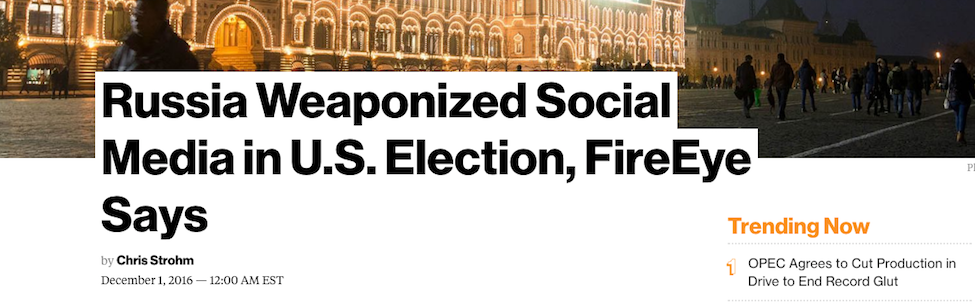
Bloomberg Reports Fake News: Story Claims FireEye Said Russia ‘Weaponized Social Media’ During Elections

Published here: http://www.zerohedge.com/news/2016-12-01/bloomberg-reports-fake-news-story-claims-fireeye-said-russia-%E2%80%98weaponized-social-medi

Pardon me, but I physically recoil when I read yellow journalism by shills trying to promote a narrative that is either entirely false or exaggerated for political purposes. During the election, at the vanguard of the Clinton talking points were to ignore all of the scandals coming out of Wikileaks or the DNCleaks because they were the byproduct of Russian hacking -- a charge that was never backed up with any real evidence. CNN even went as far to say that it was ILLEGAL to possess the Wikileaks and that viewers should only watch CNN to see what it was all about. Utter and complete bullshit. Now we have a consummate professional shill, Chris Strohm, reporting for Bloomberg -- suggesting that one of the leading internet security companies in the country believes Russia 'weaponized social media' to affect the elections. By doing so, Strohm is attempting to legitimize a talking point that hitherto has proven to be nothing short of conspiratorial guess work. russia Let's examine his evidence. Claim: Russia’s government didn’t just hack and leak documents from U.S. political groups during the presidential campaign: It used social media as a weapon to influence perceptions about the election, according to cybersecurity company FireEye Inc.

Material stolen by Russia’s intelligence services was feverishly promoted by online personas and numerous fake accounts through links to leaked material and misleading narratives, according to an analysis of thousands of postings, links and documents by FireEye, which tracks Russian and Chinese hackers breaking into U.S. systems. The operation was a new and belligerent escalation by Moscow in the cyber domain, company Chairman David DeWalt said.

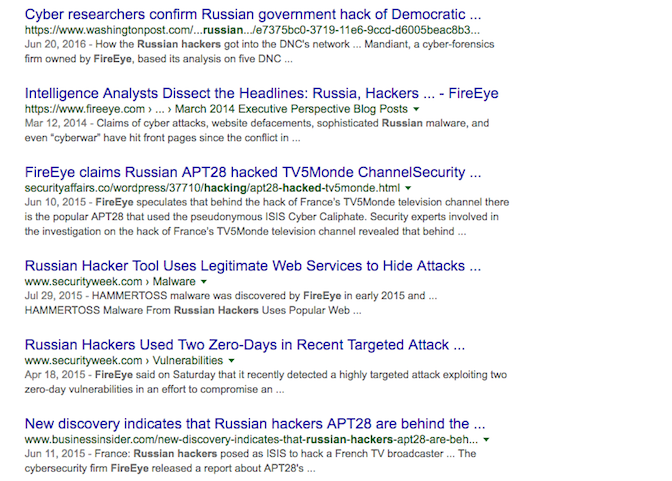
Firstly, FireEye has been making a lot of claims for a very long time. This isn't anything new. Plus, their stock is a steaming pile of shit, down about 90% over the past few years -- the very worst mut in a kennel filled with dogs. russia Secondly, there are hackers everywhere, many of which live right here in the US. Just because something is coming from Russia doesn't mean the fucking government is doing it to crush the democrats. This is lazy thinking and not at all rational.

“The dawning of Russia as a cyber power is at a whole other level than it ever was before,” DeWalt said in an interview in Washington. “We’ve seen what I believe is the most historical event maybe in American democracy history in terms of the Russian campaign.”

What does that even mean? Yes, hacking is at an all time high. Yes, people need to remain vigilant. But when you say 'Russia as a cyber power', are you implying that the Russian government is doing it? If so, show us the evidence.

The closeness of the Nov. 8 election sparked scrutiny over the spread of fake news and has fueled demands from Green Party candidate Jill Stein, backed by some Democrats and independents, for a recount in key states lost by Democrat Hillary Clinton. President-elect Donald Trump responded on Twitter that “millions” of people voted illegally, which he said may have been what cost him the popular vote, but he offered no evidence.

Fucking idiot.

‘Minor’ Incidents

A computer scientist for Stein said security flaws in voting machines and suspicions of Russian meddling justified the recount efforts. J. Alex Halderman, a professor at the University of Michigan, said hackers could have infected Pennsylvania’s voting machines with malware designed to lay dormant for weeks, pop up on Election Day and then erase itself without a trace. Trump narrowly won Pennsylvania as well as two other states where Stein’s campaign may seek recounts, Michigan and Wisconsin.

None of what he just said in the paragraph above is true. All parties, including Stein and Clinton have said, repeatedly, that there is no evidence that the elections were tampered with. Nate Silver, hardly a fan of Trump, explains to people drolling about the earth, like Strohm, that it's the demographics stupid, not the Russians.

We found no apparent correlation5 between voting method and outcome in six of the eight states, and a thin possible link between voting method and results in Wisconsin and Texas. However, the two states showed opposite results: The use of any machine voting in a county was associated with a 5.6-percentage-point reduction in Democratic two-party vote share in Wisconsin but a 2.7-point increase in Texas, both of which were statistically significant.6 Even if we focus only on Wisconsin, the effect disappears when we weight our results by population. More than 75 percent of Wisconsin’s population lives in the 23 most populous counties, which don’t appear to show any evidence for an effect driven by voting systems.7 To have effectively manipulated the statewide vote total, hackers probably would have needed to target some of these larger counties. When we included all counties but weighted the regression by the number of people living in each county, the statistical significance of the opposite effects in Wisconsin and Texas both evaporated.

Even if the borderline significant result for Wisconsin didn’t vanish when weighting by population, it would be doubtful, for a few reasons. You’re more likely to find a significant result when you make multiple tests, as we did by looking at eight states with and without weighting by population.9 Also, different places in Wisconsin and Texas use different kinds of voting machines; presumably if someone really did figure out how to hack certain machines, we’d see different results depending on which type of machines were used in a county, but we don’t. And Nate Cohn of The New York Times found that when he added another control variable to race and education — density of the population — the effect of paper ballots vanished.

Back to Bloomberg's Russian scare.

Kevin Mandia, chief executive officer, of Milpitas, California-based FireEye, and DeWalt said in the interview this week that they haven’t seen any evidence that U.S. vote tabulation systems were hacked. And U.S. officials have said they saw only “minor” cyber incidents on Election Day.

What the fuck is that all about? If you weren't paying attention, the headline said 'social media'  was playing a role in the elections, not hacking. But then the reporter delved right into hacking, making it seem like FireEye was implying there might've been a breach. Strohm even mentioned some guy who said some miracle voting virus could've been planted ahead of time and activated on election day. Yeah, and I could've won the lottery the other day, had I played it.

“We did not see anything that I would characterize as significant,” Homeland Security Secretary Jeh Johnson said at a Bloomberg Government event Nov. 14 in Washington. “There were minor incidents here and there of the type that you would normally expect, but nothing significant.”

End of story, right? Of course not, the lies have to be woven into an intricate web of deceit in order to confuse an otherwise idiot public. He continues.

Russian officials have repeatedly rejected accusations that the government hacks or supports groups that does so on its behalf.

That hasn’t quelled concerns. The activity detected in the FireEye analysis echoed the Russian strategy of information warfare seen previously in cyber attacks on Estonia, Georgia and Ukraine, where a simmering border conflict has claimed almost 10,000 lives over 2 1/2 years.

As far as I can tell, the so called 'information warfare' is nothing more than a few trolls opening up Twitter and Facebook accounts to fuck with people. Hello, wakey the fuck up. This is stupid.

The strategy isn’t limited to online media. The U.K. in October closed the British bank account for RT, a Russian state-controlled news service that was reprimanded by the U.K. media regulator Ofcom for biased or misleading reporting on Syria and Ukraine. Russia protested the move, saying it was being targeted for political reasons.

Baseless.

Democrats’ Request

On Tuesday, Democrats on the Senate Intelligence Committee sent President Barack Obama a letter asking him to declassify information about Russian activity related to the U.S. election.

“We believe there is additional information concerning the Russian government and the U.S. election that should be declassified and released to the public," the senators wrote. "We are conveying specifics through classified channels."

Then do it and show us the evidence. Anything short of evidence is idle speculation or propaganda.

A month before the election, the Office of the Director of National Intelligence and the Homeland Security Department issued a joint statement saying American intelligence agencies were confident that Russia directed hacking against U.S. political groups.

“The recent disclosures of alleged hacked e-mails on sites like DCLeaks.com and WikiLeaks and by the Guccifer 2.0 online persona are consistent with the methods and motivations of Russian-directed efforts," according to the statement. “The Russians have used similar tactics and techniques across Europe and Eurasia, for example, to influence public opinion there. We believe, based on the scope and sensitivity of these efforts, that only Russia’s senior-most officials could have authorized these activities.”

Remember Seth Rich. Again, there is zero evidence tying Russian agents to DCleaks or Wikileaks. This is childish already.

False Personas

In line with those findings, FireEye has mapped what it says is a Russian-backed campaign using at least six key false hacktivist personas to advance the country’s interests, including Guccifer 2.0, DC Leaks, Anonymous Poland and Fancy Bears’ Hack Team. The company’s autopsy also includes thousands of postings on Twitter as well as fake social-media accounts used to pass the information back and forth to generate an online buzz.

So, FireEye has concluded that people from Russia have Twitter accounts and shitpost. Anything more? This is groundbreaking.

The hacking extends to trying to use legitimate websites to promote stolen material. Guccifer 2.0, for example, first promoted stolen documents from the Democratic National Committee through The Smoking Gun and Gawker. There’s no evidence that those websites knew that hacked material given to them was part of a broad campaign to meddle in the U.S. election.

The 'evidence' tying Guccifer 2.0 to Russia is a proxy IP address. How silly is this?  In an interview with RT, Guccifer laughed the whole thing off.

“I read several reports, some experts found out that my proxy IP is hosted at a service that’s somehow connected with Russia and has a version in Russian as well as in English,” the individual wrote as cited by WSJ. “This is their strong evidence,” he wrote, adding a smile emoticon.

“It made me angry they attributed my deals to the Russians,” the hacker wrote. “But then I realised the deeper they go this way the safer I am.”

“My goal is to bring the truth, I call it to bring the light,” the hacker wrote, adding that “the big capital has occupied the policy” and “big [IT] companies are leading us to the disaster.”

Back to Bloomberg.

The campaign also includes what FireEye terms “direct advocacy,” in which the personas direct tweets promoting stolen or false information at the accounts of influential people such as journalists, and “indirect advocacy”in which social-media accounts seemingly unaffiliated with the personas also engage in promotion.

Which social media accounts have been hacked and which 'influential journalists' have been infiltrated by Russian hackers? I do this everyday and cannot recall seeing one in the news. Again, show me, the curious reader, actual evidence.

Even after the U.S. election, there are few signs that Russia’s actions are abating, creating a complicated, emerging challenge for the incoming Trump administration, FireEye’s DeWalt said. During the campaign, Trump was deferential to Russia and its president, Vladimir Putin, and repeatedly questioned the conclusion of the U.S. intelligence community that Russia was meddling in American elections. For years, Russian spies carried out stealthy hacking attacks aimed at hiding their identities, said Mandia, the FireEye CEO. Their tactics began to change around the fall of 2014 and have now escalated to include leaking stolen documents and apparently caring less about operational security or getting caught, Mandia said.

“That’s a change in the rules of engagement,” Mandia said. “All of a sudden, they’re more of a tank through the cornfield when they hack, not a whisper or a ghost.”

Fucking drama Queens. Russian spies. Hacked Twitter accounts. People retweeting fake news. Tanks through the corn field. When will the madness end?