Tuesday, September 5, 2017

Bitcoin Falls 20% as Mobius and Chinese Regulators Warn

Published here: http://www.zerohedge.com/news/2017-09-05/bitcoin-falls-20-mobius-and-chinese-regulators-warn

Bitcoin Falls 20% as Mobius and Chinese Regulators Warn

- Bitcoin falls 20% as Mobius and Chinese regulators warn
- “Cryptocurrencies are beginning to get out of control” - warns respected investor Mark Mobius
- Mobius believes governments will begin to clamp down on cryptocurrencies sparking rush to gold

- Yesterday China's PBOC ruled Initial Coin Offerings (ICOs) are illegal and all related activity to halt
- China is home to majority of bitcoin miners
- Paris Hilton latest celebrity to support an ICO
- Gold's return of 16% YTD look 'dull' or 'stable'?

- Bitcoin fell 23%, now down 16% from $5,000 high

Editor: Mark O'Byrne
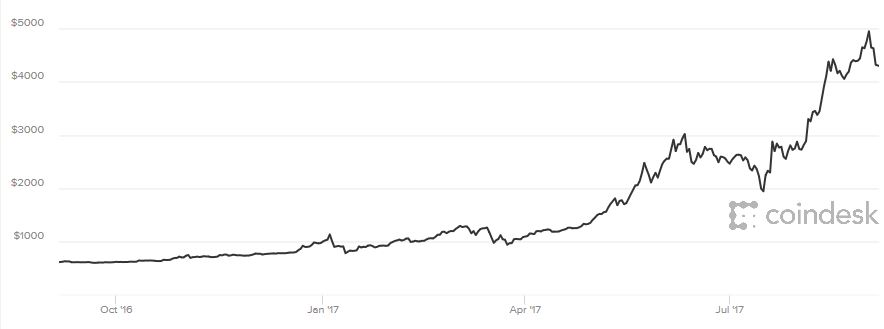
Bitcoin in USD 1 Year (Coindesk)

An ICO - “unregulated issuances of cryptocoins where investors can raise money in bitcoin or other [cryptocurrencies]”
Financial Times

Just as you thought you were getting your head around bitcoin and all the other hundreds of cryptocurrencies out there, the financial headlines are screaming at you about something called initial coin offerings or ICOs. Now you don’t really know what’s going on.

The latest news in the crypto world is that the People’s Bank of China (PBOC) announced yesterday that ICOs (Initial Coin Offering) are illegal and that all related fundraising activity should cease immediately.

But what is an ICO?

An ICO is like an IPO but kind of in reverse.  It is a tool that trades future cryptocoins in exchange for cryptocurrencies of immediate, liquid value. You exchange bitcoin or ethereum with the underlying company in exchange for a new token, say ‘ISawYouComing Coin’

A more formal explanation is offered by Travis Scher:

An ICO is a crowdsale of cryptographically secured blockchain tokens to fund the development and operation of one of three types of blockchain projects:

A platform-layer blockchain (such as ethereum or Lisk)

An organization that operates on a blockchain (known as a decentralized autonomous organization ('DAO'), or a centrally organized distributed entity ('CODE')

A decentralized application ('dapp') that runs on a platform-layer blockchain. Tokens that fund these are sometimes known as appcoins. 

So far in 2017 $1.366 billion has been raised in ICOs. In global market terms they are still relatively small. But when you consider that US startups raised just $11 billion through IPOs in the second-quarter of this year then you can appreciate the rapid growth in the space.
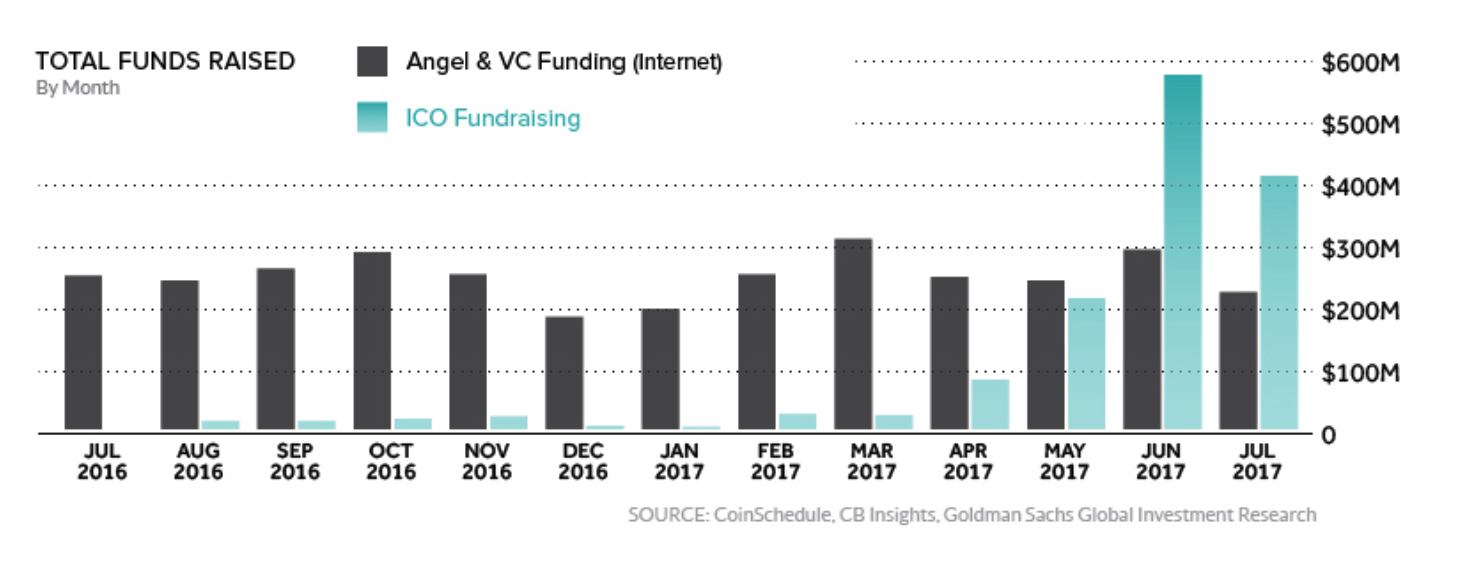
The largest ICO so far this year has been by Tezos to fund its new blockchain tech which is still alpha testing. They raised $232 million worth of bitcoin (BTC) and ether (ETH) coins.

To be clear, to partake in an ICO does not automatically grant you ownership or shareholder rights to the underlying company, as would happen in an IPO. Instead you are exchanging money for a token that may or may not succeed in the future.

Given how many thousands of cryptos are currently competing with one another this is a real punt. Investors have to make sure they spend a huge amount of time researching the underlying blockchain, the market, the team etc. You should only go for an ICO if you have a very significant appetite for risk, no concerns about losing your capital and love a good flutter.

Sound little too new and Wild West? You’re not the only one who thinks so and there is plenty of evidence to back up your concerns.

There is no regulation ensuring that those offering the ICO do so in a responsible manner as per other fundraising activities.

A quick search of ICO fraud and you will be confronted with many articles (all from 2017) reporting on various ICO scams. Plus Paris Hilton has just jumped in on one…not to cast aspersions but, but, but…it is ...

So what’s the deal? A $2bn+ fundraising market and no regulation?

In a brilliant report by Smith+Crown it is explained how the usual rules of fundraising can be avoided by ICOs:

Most ICOs today are marketed as ‘software presale tokens’ akin to giving early access to an online game to early supporters. In order to try to avoid legal requirements that come with any form of a security sale, many ICOs today use language such as ‘crowdsale’ or ‘donation’ instead of ICOs.

Don’t forget the bitcoin and cryptocurrency industry is also relatively unregulated. By allowing it to grow organically and without various regulatory restrictions we have seen major shakeouts in the industry and it has forced its members to pull up their socks and seek out regulation.

However ICOs are now at a point where they are no doubt attracting unsophisticated investors. I have met many people who are worried they have missed out ‘on the bitcoin thing’ and believe that by getting in on an ICO they might be getting ahead of the game.

These same people tend to know little about blockchain instead stating that it is ‘the next big thing’ and just have major FOMO.

Without regulation there is little protecting newbie investors.

What’s the difference between an ICO scam and all the other’s we’ve seen before now? Matt Levine of Bloomberg explains it perfectly:

‘an ICO scam is subtly different from a gold-mining scam in that, with an ICO scam, you can do a scam ICO. You don't have to get a publicly listed company and pump and dump its stock: You can just say "I'm doing an ICO, here's the address to send money," and people will send you money if you have scammed them correctly. Lord knows, it happens often enough. This does not work as well with gold: You can't say "I found some gold, please buy some," because buyers will want to see the gold. (Well, there are gold scams like that, but they seem harder to pull off.) With an ICO you may have to write a white paper explaining your token, but the quality bar for that is low, certainly lower than faking up some bars of gold. Lower even, I would think, than faking up a public company, making false filings with the SEC, doing wash trades to pump the stock higher, and then dumping it at the right moment on unsuspecting buyers.’
The government clampdown

But this may now be about to come to an end. Seven-China based regulators took sweeping action against ICOs, putting both the practice and the future of the underlying tokens at risk.

A joint statement released by the regulators explained:

[ICO financing] is a kind of non-approved illegal open fund raising behavior, suspected of illegal sale tokens, illegal securities issuance and illegal fund-raising, financial fraud, pyramid schemes and other criminal activities.

Subsequent statements have ordered that all fundraising activity cease and all completed ICOs be refunded.

China is not the world’s biggest coin offering market but does account for 25% of the capital raised in the last year. There are 43 ICO platforms in China. By mid-July this year these platforms had raised 2.6 billion yuan ($399 million) from 105,000 investors.

The China decision is not totally unexpected and comes on the back of both the US and Canadian regulators voicing similar concerns about ICOs.

In the US the SEC has mentioned these potential ‘pump and dump schemes’ whilst the Canadians have suggested that ‘most ICOs need oversight.’ Both have referred to the tokens as potentially being ‘unlicensed securities.’

Just last week the SEC suspended trading of shares in four companies that had been talking up ICO-related activity. The four firms (First Bitcoin Capital Corp., CIAO Group, Strategic Global, and Sunshine Capital).

None of the four firms are currently big deals by any means but it didn’t stop them from announcing as such. CIAO Group, for example  announced a"$530 Billion [!!!] Blockchain and Cryptocurrency Target Market Collaboration" this summer.

A total scam

Not everyone running an ICO is out to scam you. One of the dangers of the press coverage is that its getting to be a little like the initial coverage of bitcoin, i.e. if you’re using it you must be a crook.

This is certainly not the case for all entrepreneurs offering an ICO. ICOs can be an easy way to raise money.  Even the SEC explained that not all ICOs are not intrinsically bad, stating that they "may provide fair and lawful investment opportunities."

Anyone who has run a start-up knows how tough and time-consuming it is to raise capital. Should the ICO do well then the broad distribution of the token can provide some pretty powerful momentum for your business.

It is also an interesting way for the bitcoin millionaires to use their new-found wealth. In the same way we see Silicon Valley entrepreneurs re-invest their wealth into startups, we see a similar effect taking place in the crypto world.

However, they are unregulated with a serious lack of control regarding valuation, marketing and ethics.

Worse than the dot com bubble

We have seen a number of bubbles over the years, people still speak of the dot com bubble. Then of course there was the global real estate bubble that helped trigger this whole financial mess.

With both situations inexperienced investors thought they had found quick and easy ways to make money. This in itself isn't how investing is supposed to work.

A recent Sovereign Man blog explained this well:

There’s a token issued by Stratis, for example, that is up 101,168% since its ICO last summer. The NXT token is up 672,989%.

Those are not type-o’s.

There’s another token that’s actually called “Fuck” which is up 370% in the last 24 hours.

The returns are absurd… especially considering the assets are priced in Ether or Bitcoin, which have also soared to all-time highs.

So on top of a 1,000% return in Bitcoin, ICO investors have also made a 100,000% return in the token.

But I’m hearing exactly the same cackling that I heard from the real estate bubble days more than a decade ago.

- It’s soooo easy to make money in ICOs. 
- It’s a foregone conclusion that the tokens will go up in value.

Sorry, but it just doesn’t compute.

If the tokens represent ownership in a business, then the only thing that matters is whether or not the underlying business performs well.

Does the company have a compelling long-term strategic plan?

More importantly-- are the managers successfully implementing the plan and achieving milestones?

Is the company on a path to financial sustainability?

Nobody seems to be paying attention to these details. They just buy tokens with the expectation that the price will rise.

And even if a business performs well, it’s ridiculous to think that a startup company can be worth 100,000% more in a year. Or nearly 700,000% more in a couple of years.

To put these numbers in context, Peter Thiel invested $500,000 in Facebook back in 2004 as the company’s first big investor. In 2012 he sold most of it for $1 billion.

That’s a return of 200,000% in eight years… pretty tame by ICO standards.

Does gold look dull or just stable?

Earlier this year the bitcoin price surpassed that of gold for the first time. When it had previously reached parity with the precious metal it had subsequently experienced a fall back in price. Since then it has slowly but with major volatility recovered in price and reached a high of $5,000 last Saturday (Sept 2).

Bitcoin’s stellar performance has prompted some respected investors to suggest that gold will be replaced by either bitcoin or another cryptocurrency.

Many of the arguments for this surround the potential convenience of bitcoin plus the returns that investors have experienced over this period of time. Some have dubbed gold as ‘dull’ in comparison.
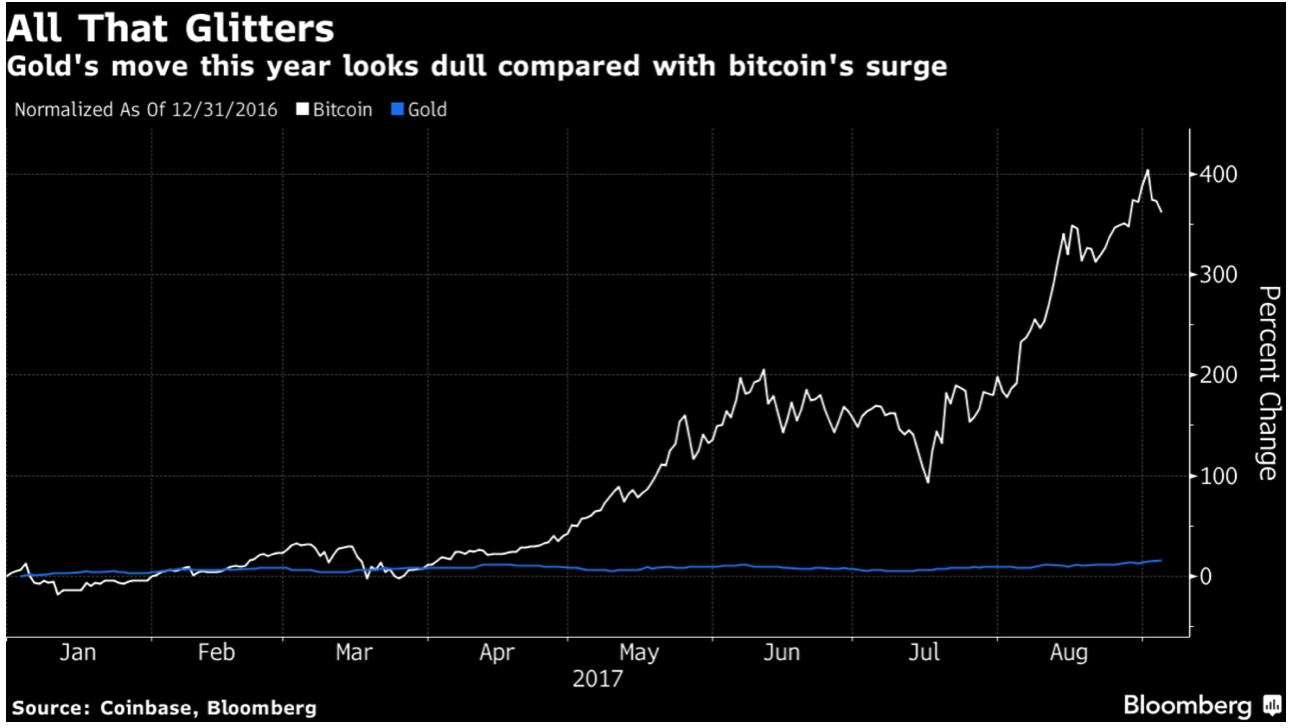
The problem is that one is bought by and trusted by central banks, the other isn’t. Not only that but the infrastructure forming around bitcoin and its contemporaries is making regulators increasingly nervous rather than reassured.

When governments get nervous about an industry it’s a bad sign for those hoping a cryptocurrency will succeed. In order to succeed a cryptocurrency needs a strong infrastructure surrounding it.

Legendary investor Mark Mobius believes this is good news for gold. He told Bloomberg:

“Cryptocurrencies are beginning to get out of control and it’s going to attract the attention of governments around the world,” Mobius said. “You’re going to get a reversion back to gold because people are going to wonder, can I really trust these currencies?”

Currently it isn’t so much the cryptocurrencies that are getting out of control but instead part of the infrastructure. However this in itself get people nervous and wondering if they can trust a crypto as a store of value and medium of exchange.

“People need a means of exchange and they need to trust that,” said Mobius, who was interviewed before China’s announcement. “Right now the trust is good -- with bitcoin people are buying and selling it, they think it’s a reasonable market -- but there will come a day when government crackdowns come in and you begin to see the currency come down.”

That day is here now.

News and Commentary

Gold eases from near 1-year high as dollar steadies (Reuters)

Safe Havens Maintain Gains as Korea Threats Linger (Bloomberg)

Gold Prices Jump On Fresh North Korean Fears, Long Positions Increase Further (Economics Calendar)

Perth Mint Silver sales slump to one-year low; Gold sales down 2.3% (Scrap Register)

China’s virtual coin fundraising ban just the start of tighter regulations (Reuters)

Source: Zerohedge.com

We're addicted to debt and headed for a crash. It could be worse than 2007 (The Guardian)

The Return of Meltdown Risk? (Handelsblatt)

The Decline and Fall of America (In Numbers) (Medium.com)

Ethereum, Bitcoin Crash After China Declares Initial Coin Offerings Illegal (Zerohedge)

Mobius Foresees Cryptocurrency Crackdown Sparking a Rush to Gold (Bloomberg)

Gold Prices (LBMA AM)

05 Sep: USD 1,331.15, GBP 1,029.51 & EUR 1,120.43 per ounce
04 Sep: USD 1,334.60, GBP 1,030.98 & EUR 1,120.53 per ounce
01 Sep: USD 1,318.40, GBP 1,020.18 & EUR 1,107.98 per ounce
31 Aug: USD 1,305.80, GBP 1,013.17 & EUR 1,098.31 per ounce
30 Aug: USD 1,310.60, GBP 1,014.93 & EUR 1,096.71 per ounce
29 Aug: USD 1,323.40, GBP 1,020.34 & EUR 1,097.36 per ounce
25 Aug: USD 1,287.05, GBP 1,003.90 & EUR 1,090.90 per ounce

Silver Prices (LBMA)

05 Sep: USD 17.88, GBP 13.80 & EUR 15.03 per ounce
04 Sep: USD 17.80, GBP 13.75 & EUR 14.95 per ounce
01 Sep: USD 17.50, GBP 13.53 & EUR 14.69 per ounce
31 Aug: USD 17.34, GBP 13.47 & EUR 14.62 per ounce
30 Aug: USD 17.44, GBP 13.49 & EUR 14.60 per ounce
29 Aug: USD 17.60, GBP 13.59 & EUR 14.62 per ounce
25 Aug: USD 17.02, GBP 13.26 & EUR 14.40 per ounce


Recent Market Updates

- Gold Surges To $1338 as U.S. Warns of ‘Massive’ Military Response
- 4 Reasons Why “Gold Has Entered A New Bull Market” – Schroders
- Gold Reset To $10,000/oz Coming “By January 1, 2018” – Rickards
- Gold Surges 2.6% After Jackson Hole and N. Korean Missile
- Diversify Into Gold On U.S. “Political Instability” Advise Blackrock
- Trump Presidency Is Over – Bannon Is Right
- The Truth About Bundesbank Repatriation of Gold From U.S.
- Cyberwar Risk – Was U.S. Navy Victim Of Hacking?
- Global Financial Crisis 10 Years On: Gold Rises 100% from $650 to $1,300
- Mnuchin: I Assume Fort Knox Gold Is Still There
- Buffett Sees Market Crash Coming? His Cash Speaks Louder Than Words
- Gold, Silver Consolidate On Last Weeks Gains, Palladium Surges 36% YTD To 16 Year High
- Must See Charts – Gold Hedges USD Devaluation, Rise in Oil, Food and Cost of Living Since Nixon Ended Gold Standard

Important Guides

For your perusal, below are our most popular guides in 2017:

Essential Guide To Storing Gold In Switzerland

Essential Guide To Storing Gold In Singapore

Essential Guide to Tax Free Gold Sovereigns (UK)

Please share our research with family, friends and colleagues who you think would benefit from being informed by it.
Monday, September 4, 2017

The Forking Paradise, Gold & Silver Report 3 Sep 2017

Published here: http://www.zerohedge.com/news/2017-09-04/forking-paradise-gold-silver-report-3-sep-2017

A month ago, we wrote about the bitcoin fork. We described the fork:

Picture a bank, the old-fashioned kind. Call it Acme (sorry, we watched too much Coyote and Road Runner growing up). A group of disgruntled employees leave. They take a copy of the book of accounts. They set up a new bank across the street, Wile E Bank. To win customers, they say if you had an account at Acme Bank, you now have an account at Wile, with the same balance!

This fork came about from a disagreement among the bitcoin miners, those who control the blockchain and hence the currency. The equivalent of the disgruntled Acme Bank group left to form bitcoin cash, the equivalent of Wile E. Bank. However, it has often been said that necessity is the mother of invention. Applied to bitcoin, that means that what happened due to irreconcilable differences in this case, could also occur deliberately later.

Why would someone do this deliberately? Well, as of this writing (Saturday afternoon), bitcoin cash is trading for $568.28. This copy of the original bank ledger is worth over fahv hunnert Benjahminns! Actually, not the ledger. Each record in the ledger. The ledger as a whole is worth $9.4 billion.

For anyone—or a cartel of someones—who can fork bitcoin, there are now 9.4 billion reasons to do so. Think about that. Take as long as you need.

Now, we don’t want to disparage anyone. We are absolutely certain that everyone who is speculating to get rich in bitcoin will turn away from forking. It just doesn’t feel right, and it couldn’t possibly be moral to create forks on purpose, to get richer quicker.

But if someone did wish to do it, there is a powerful incentive. Economics tells us that if a powerful incentive exists to do something, then someone will do it. For example, if the government subsidizes borrowers by pushing down the interest rate then there will be all sorts of borrowing that would otherwise not occur (to finance all sorts of activities that would otherwise make no sense). Or, if it subsidizes insurance for people who build in flood plains, then many people will build in flood plains.

We now live in a world where altcoins are proliferating. There is a crypto currency named for a set of Internet memes called Doge. There is PotCoin for the marijuana industry, and even PepeCash and PutinCoin. There is a coin named for the most popular four-letter word. By this standard, it makes sense to fork bitcoin as many times as one can. To fork and fork and fork until the marginal ForkCoin has value lower than the cost of forking.

Snark aside, and in all seriousness, the point of our article a month ago is that the fork shows the contradiction in a ledger of liabilities unbacked by assets. By dispensing with the need for assets, the liabilities can proliferate—fork—and there can be any number of alt liabilities too.

Our point in this article is that this contradiction creates a powerful perverse incentive, that someone sooner or later will take up. We prefer the term “perverse incentive” to “unintended consequence”, because it puts the focus where it belongs. We look at what is profitable for someone to do, rather than the real or alleged intentions of the designers. In some cases, the intention is obviously evil. For example, Obamacare was designed to destroy the insurers and drive America towards socialized medicine. In other cases, perhaps in bitcoin, the designer did not foresee much less intend the outcome.

However, here we are. Both the possibility to fork and the incentive are now obvious. We would not bet against it, as we would not bet against Boromir putting on the One Ring. In a Middle Earth minute.

We have not much focused on price, other than how rising price makes bitcoin unsuitable as money or how bitcoin does not have a firm bid. We do not subscribe to the view that bad means the price must go lower soon. However, let’s look at price of an asset in a bubble starting with the dollar.

The dollar, it is often and loudly asserted, has value only because of faith. As soon as the faith is pricked, the air will rush out of the bubble. This partly explains why the gold bugs latch on to every story about gold repatriation in Germany or Treasury Secretary Steve Mnuchin visiting Fork Knox. Mnuchin said, “I assume the gold is still there,” and thus began quite a tempest in a tea pot.

The belief is that as soon as the one-awful-fact-they-don’t-want-you-to-know becomes known, then the dollar will collapse. And gold will go to $65,000 (price measured in collapsed dollars). It’s a quest for the holy grail. Now, we enjoy tilting at windmills as much as Don Quixote, but this view is wrong. The dollar does not have value because of some fragile, collective faith.

The dollar has value because of the struggles of the debtors. What are you willing to sell, in order to avoid foreclosure on your house, repossession of your car, or bankruptcy of your business? Your labor and the products of your effort. As much as you need to sell, in order to service your debts and avoid default.

However, there is no real borrowing in bitcoin. What holds up the value of bitcoin?

There is a risk that a series of forks could prick this bubble of faith.


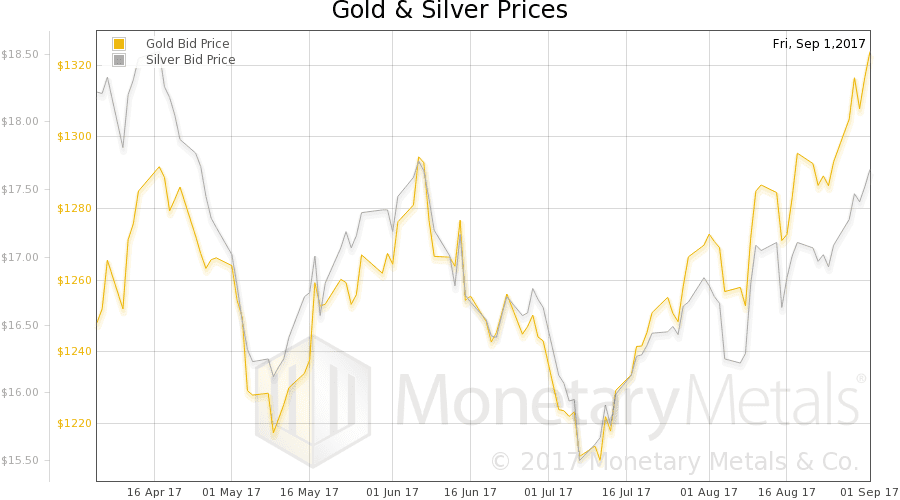
There were big moves in the metals markets this week. The price of gold was up $31 and that of silver $0.56. The price of gold hasn’t been this high in just about a year, which is another way of looking at the one-year low price of the dollar. From its high over 27.5mg gold in mid-December 2016, the dollar has dropped 11% to its current 23.5mg.

Will the dollar fall further? In the short term, anything is possible. Once speculators smell blood in the water (i.e. a strong looking chart pattern), they may enter bigger trades with leverage. We will, of course, see that as a rising basis which is a contrarian signal. In the longer term, prices cannot go up too far or remain high if there is not a renewed demand to hold gold metal.

One possible driver of this is portfolio rebalancing by those who bought a small allocation of bitcoin or Etherium which is now not-small. Will these folks sell their cryptocurrencies, which are anti-dollar plays, to buy more dollars? Or will some of them buy real money? This remains to be seen.

As always, we are interested in the fundamentals of supply and demand as measured by the basis. We will show intraday basis charts this week as there are some interesting features.

But first, here are the charts of the prices of gold and silver, and the gold-silver ratio.

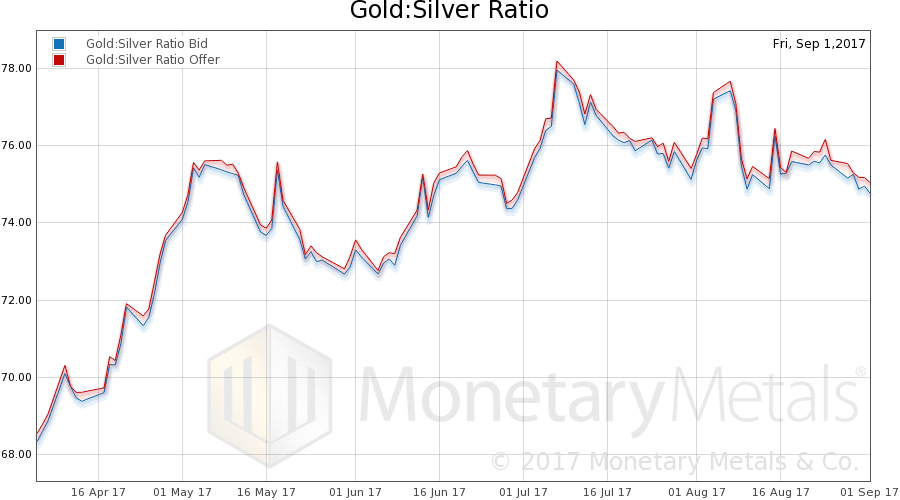
Next, this is a graph of the gold price measured in silver, otherwise known as the gold to silver ratio. The ratio moved down.

In this graph, we show both bid and offer prices for the gold-silver ratio. If you were to sell gold on the bid and buy silver at the ask, that is the lower bid price. Conversely, if you sold silver on the bid and bought gold at the offer, that is the higher offer price.

For each metal, we will look at a graph of the basis and cobasis overlaid with the price of the dollar in terms of the respective metal. It will make it easier to provide brief commentary. The dollar will be represented in green, the basis in blue and cobasis in red.

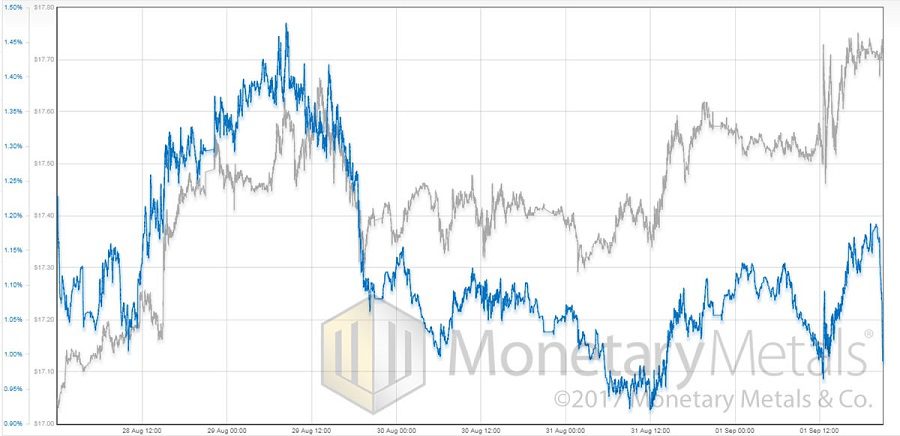
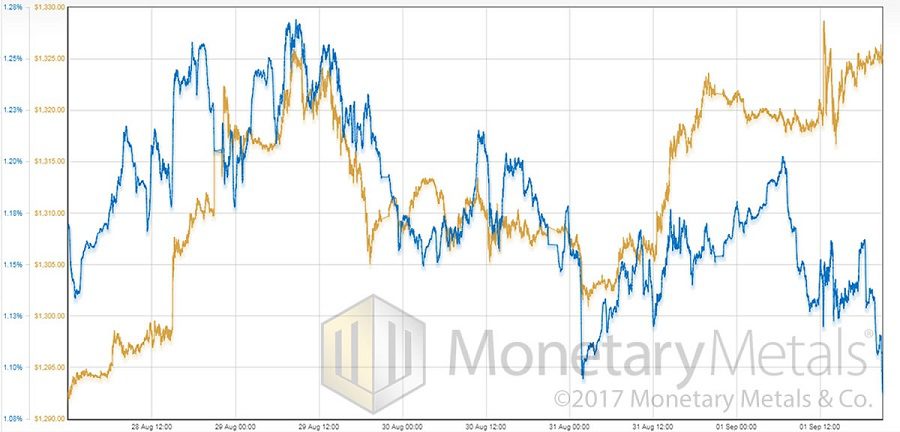
Here is the gold graph (Dec contract), this time showing intraday resolution for the full week (here is the regular gold basis chart).

We have posted many graphs showing basis correlating with price. That is, as price rises so does basis. Basis is the spread between futures and spot. A rising basis means futures are rising faster than spot, which occurs if the buying pressure is occurring in the futures market. If the buyers are mostly speculators.

Something should immediately leap out at you on this graph. This relationship broke down Thursday afternoon (GMT). First there is a minor sell off seen in the price move from about $1,307 to $1,305. The basis drops from about 1.17% to 1.12%. The basis begins to rise with rising price after that, but it trails. It recovers the 1.17% level but only when price is about $1,317—ten bucks higher. Then as price keeps rising, basis is sideways until midnight. Basis makes one more rally approaching 7am (GMT), then falls back sharply as price continues to rise. Especially late in the day. Even if we ignore the last part below 1.11% as liquidity is dropping with the rest of the world offline and only whatever trading volume remains in the US Friday afternoon before a major holiday weekend (Monday is Labor Day), we still see a falling basis with rising price.

Demand for gold metal has picked up, even at this higher relative price. One of gold’s unique properties is that demand can rise as price rises, without any particular limit (even if it hasn’t happened much in recent years).

To put this into perspective, we would not characterize the current market state as a gold shortage. Every contract is in contango (Sep basis is over 0.5%). The continuous gold basis has been in a rising trend for two months. Gold is not exactly scarce, nor facing massive demand for physical metal and shortage. As our old buddy Aragorn would say, “today is not that day.”

However, the basis move is notable in contrast to the price move. The rise in basis has not been much, considering how much the price has risen—about $120 in two months. Now the December contract, which matures in under 120 days, has a basis below that of 3-month LIBOR (about 1.3%).

The calculated Monetary Metals gold fundamental price was up $25, to $1,355.

Now let’s look at silver, with a similar graph of the week’s action (here is the regular silver basis chart).

At the risk of turning these charts into Rorschach Tests, this one does not look the same to us at all. The silver basis tracks the silver price, though a skew occurred on Wednesday and widened on Thursday. The movement of both traces were a close fit on Thu and Fri. Note the spike down in the basis at the end of the day on Friday (as in gold, though gold had been falling all during the London day through the US day).

Our calculated Monetary Metals silver fundamental price increased $0.46. And, though our calculated Monetary Metals gold:silver ratio fundamental price has dropped a bit, it was rising the last three days of the week.


© 2017 Monetary Metals

Saturday, September 2, 2017

Precious Metals Outperform Markets In August – Gold +4%, Silver +5%

Published here: http://www.zerohedge.com/news/2017-09-01/precious-metals-outperform-markets-august-%E2%80%93-gold-4-silver-5

Precious Metals Outperform Markets In August – Gold +4%, Silver +5%

 - All four precious metals outperform markets in August
- Gold posts best month since January, up nearly 4%
- Gold reaches highest price since US election, climbs due to uncertainty and safe haven demand
- S&P 500 marginally higher; Euro Stoxx, Nikkei lower for month

- Platinum is best performing metal climbing over 5%
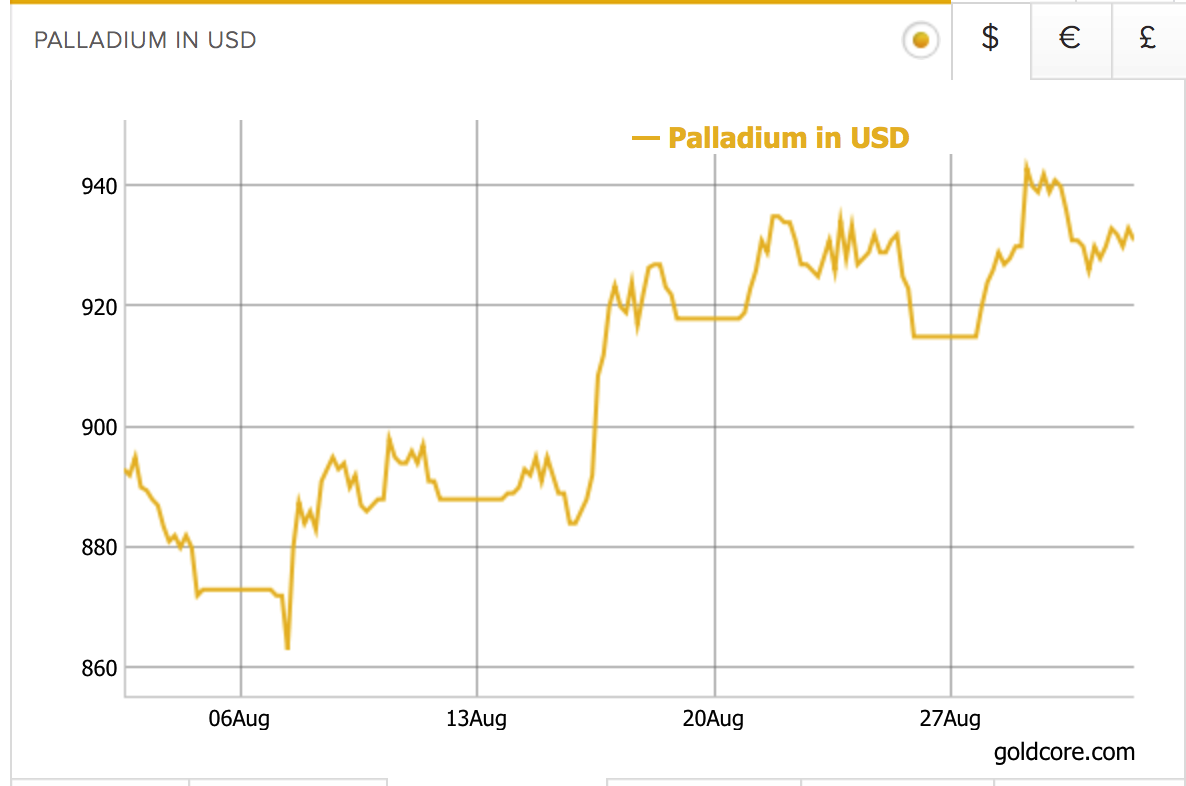
- Palladium climbs over 4% thanks to seven year supply squeeze
- Fear, uncertainty and political sanctions are amongst biggest drivers for precious metals
- Never been a better time to diversify and rebalance portfolios with stocks and bonds near record highs and looking vulnerable

Editor: Mark O'Byrne

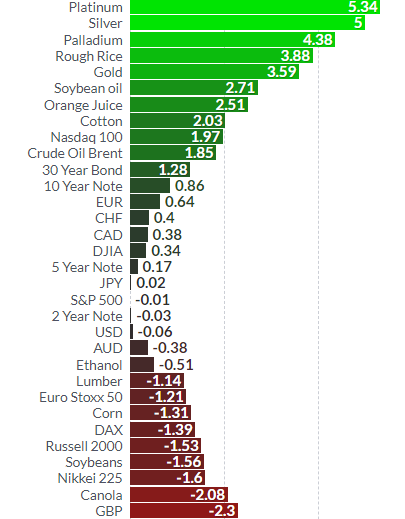
Market Performance in August (Finviz.com)

All four precious metals have made gains in the month of August.

Whilst platinum and palladium's leading performances can largely be attributed to industrial factors they have also benefited from the safe haven demand which is driving gold and silver prices.

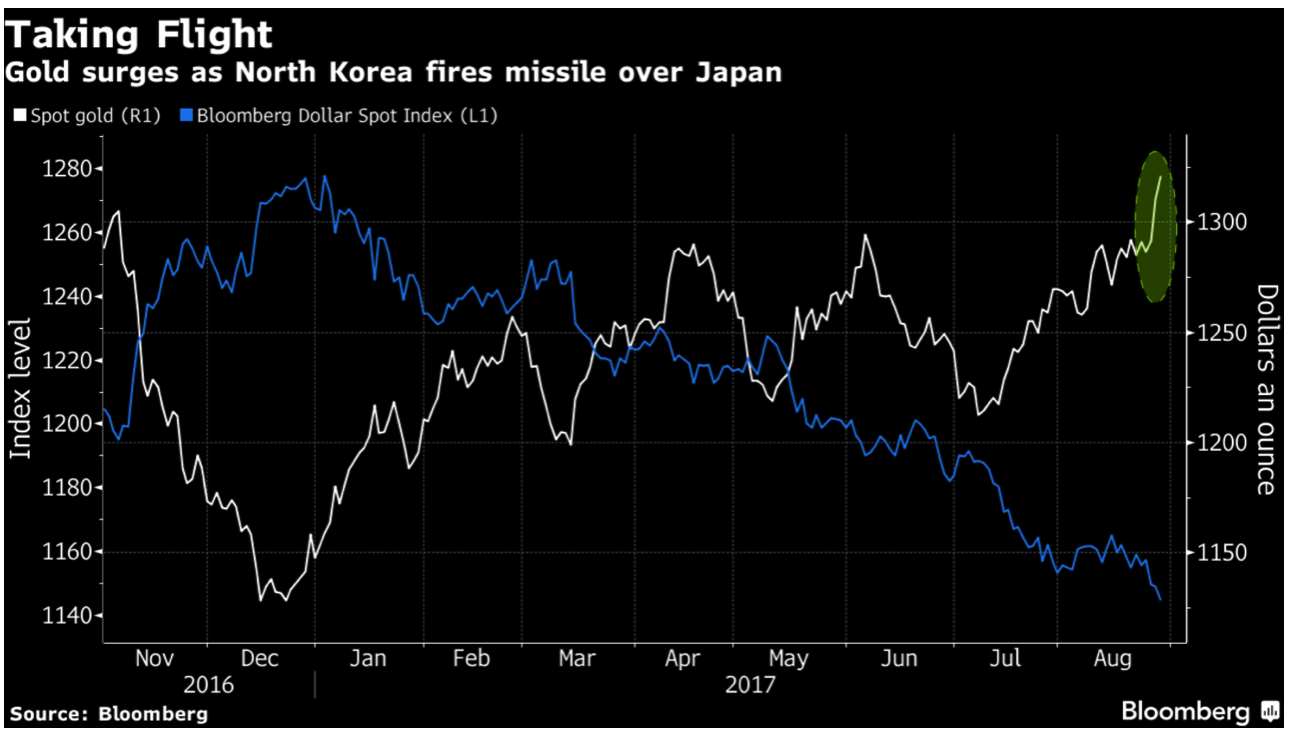
Safe haven demand really came into its own this last month. Issues with North Korea have stepped up a level whilst markets have finally begun to question the complacency they have been feeling in regard to the US political and financial situation, geopolitical risk and the increasingly uncertain outlook for the global economy.

Ultimately very little is known about what will happen with the US debt ceiling, increasingly overvalued stocks (both the NASDAQ and  the S&P500), Trump's plans for corporate tax, dealings with North Korea and (not forgetting) Venezuela.

We are living in very uncertain times indeed and investors decided to allocate funds to the ultimate safe havens - the precious metals.

Gold shines as investors rush into safe havens

This week gold rose to its highest point so far in 2017 as tensions between North Korea (but really, the rest of the world) and the US ramped up. For the month of August the price is up 3.59%.

Silver was also up thanks to safe haven demand, but its 5% climb was also in part due to manufacturing demand. Currently, about 55% of all silver consumed is for industrial use.

Gold has so far risen in every month, bar June.

Gold's climb has in part been due to ongoing demand from countries such as China and India, but it has primarily been driven by the desire in the West to own a safe haven. This is not surprising given the ongoing concerns regarding North Korea, Venezuela, the Middle East and a lack of cohesion in the Trump administration.

One of the dampeners on gold and silver has been the Federal Reserve's plans to raise interest rates. However, when they did so it had little effect. Expectations for further hikes are falling. Going forward Yellen and team are expected to slow down on further interest-rate increases which has provided an additional boost for the gold price.

In the very short-term storm Harvey in Houston, Texas has also impacted the price of gold and silver. As a result of lost income and recovery operations, US GDP is expected to be lower in the third-quarter than was initially expected.

In the long-term investors will look to gold and silver as they begin to price risk into the market. Yesterday we expressed our concerns over market complacency whilst other financial organisations have begun to warn clients about the overpriced equity markets and lack of perceived risk.

It is also worth noting an expected climb in demand from China. Mark Tinker, Head of AXA Framlington wrote in a note that China’s pricing of assets in yuan (together with the plan by the Hong Kong Stock Exchange to  sell yuan-priced physical gold contracts) could allow them to trade out of the banking system in the US

“Having accepted payment for oil or gas in RMB, the seller, be it Russia or Saudi Arabia or anyone else for that matter, does not have to worry about having excess RMB, they can simply trade it back into gold,” Tinker said. “We are moving to a multi-polar world.”

Platinum gains as Russia feels the pain

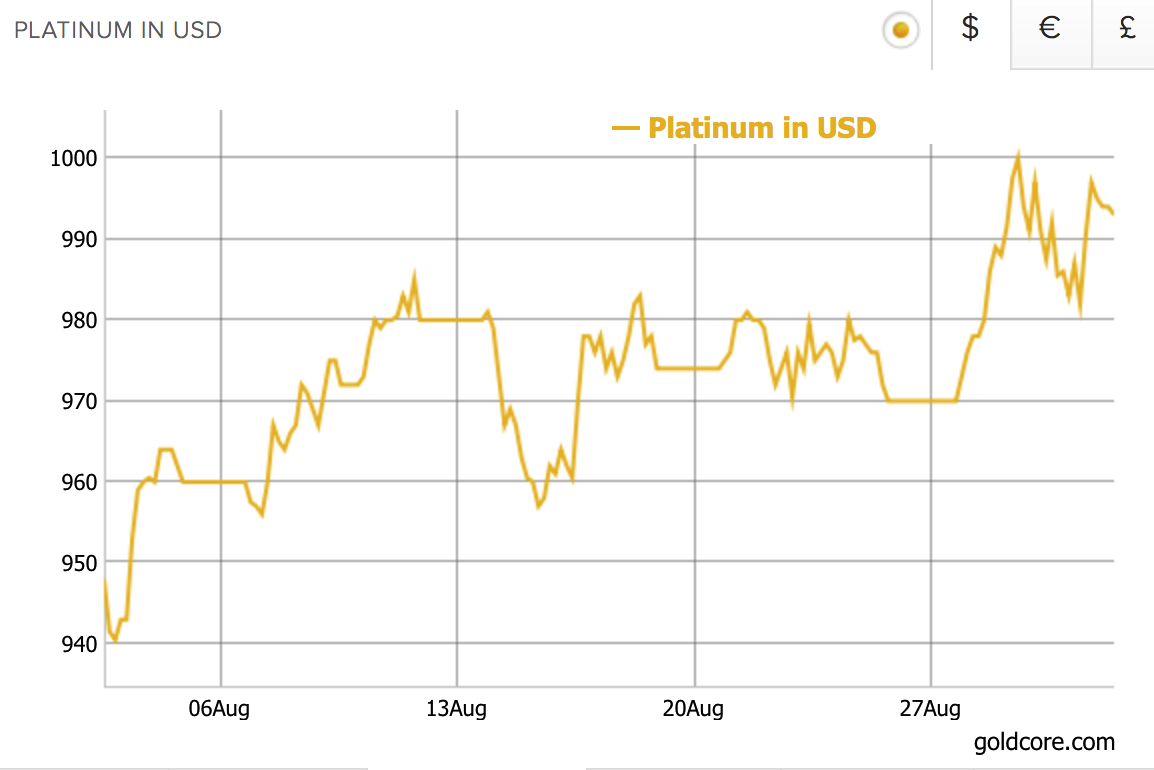
Platinum has performed very well so far in the second half of the year. This most recent surge has likely come about thanks to further sanctions being placed on Russia by the US. Russia is the world's second biggest producer of the metal.

The World Platinum Investment Council outlined the following arguments for platinum's role as a safe haven investment asset:

- Supply demand fundamentals are strong and ETF holdings are stable, despite price volatility
- Risks of supply declines are underestimated - cost pressure and falling mining investment continue - Downside risks to platinum automotive demand are overestimated
- Futures positioning follows poor sentiment with high correlation to price
- Platinum is undervalued against its past, its production cost and against gold

Palladium climbs on Vauxhall’s woes

Palladium is currently at a 16 year high. There is a major tightening in the supply of palladium because of increased demand for it in engines. 67% of palladium supply is used in car engines to clean exhaust gases from gasoline engines. There is obviously a major push for ‘clean’ transport and the Vauxhall emissions scandal and obviously helped boost demand.

Inventories of palladium supply are down by abut 45% this year, whilst supply trails demand by the most in the seven years.

Despite the increase in supply, there has been a significant number of redemptions in the the two main U.S. and European palladium ETFs - the ETFS Physical Palladium Shares and the ZKB Palladium. By the 22nd August $49 million had been traded in. Supply in the spot market is reportedly so tight that companies are being forced to trade in multiple ETF shares in order to redeem them with the issuer in exchange for physical palladium.

ETFs are now being treated like palladium warehouses.

It is also important to note that, like platinum, palladium is also hugely affected by the sanctions on Russia.

It is also important to note that ETFs are a risky way to invest in precious metals and most investors would be better served owning actual precious metals rather than paper or digital proxies.

Conclusion: Stars aligning? Outlook good for rest of 2017

Earlier this week we explained how investors shouldn't always be focused on price. Whilst it is nice to look at the metrics for August and see that all precious metals are up, we should instead focus on why they are up and most importantly the diversification benefits for our portfolios.

Precious metals are largely climbing because the perceived risk in the political and financial system is also climbing. Interestingly many commentators do not feel some risky issues have been wholly appreciated by the markets.

Problems such as North Korea are such serious risks that even someone who pays no attention to markets could spot it. The issue is that you have an overvalued stock market and a US President who cannot get his people together. This means that the US debt ceiling issue might ground the U.S. government to a halt.

These issues are ones which have not yet been fully priced into the markets. They likely will be in the coming months and then the safe haven role of the precious metals and gold in particular will come into its own.

News and Commentary

Gold up 4% in August - largest monthly gain since January (Marketwatch)

Gold steady near 9-1/2 month highs as N.Korea tensions persist (Reuters)

Gold Scores Fifth Monthly Increase; US Mint Bullion Sales Slow in August (Coin News)

Gold edges lower, but N.Korea worries lend support (Nasdaq)

Massive wartime bomb to be defused near German gold reserves (Irish Times)

Source: Marketwatch

From Stocks to Bonds, the Bear-Market Signals Are Multiplying (Bloomberg)

Rothschild reduces exposure to US stocks amid turmoil (Standard)

Five charts show why millennials are worse off than their parents (FT.com)

When the Butterfly Flaps Its Wings - Kunstler (Zerohedge)

Buffett: North Korea situation is very concerning (CNBC)

Gold Prices (LBMA AM)

01 Sep: USD 1,318.40, GBP 1,020.18 & EUR 1,107.98 per ounce
31 Aug: USD 1,305.80, GBP 1,013.17 & EUR 1,098.31 per ounce
30 Aug: USD 1,310.60, GBP 1,014.93 & EUR 1,096.71 per ounce
29 Aug: USD 1,323.40, GBP 1,020.34 & EUR 1,097.36 per ounce
25 Aug: USD 1,287.05, GBP 1,003.90 & EUR 1,090.90 per ounce
24 Aug: USD 1,285.90, GBP 1,003.26 & EUR 1,090.44 per ounce
23 Aug: USD 1,286.45, GBP 1,004.33 & EUR 1,091.68 per ounce

Silver Prices (LBMA)

01 Sep: USD 17.50, GBP 13.53 & EUR 14.69 per ounce
31 Aug: USD 17.34, GBP 13.47 & EUR 14.62 per ounce
30 Aug: USD 17.44, GBP 13.49 & EUR 14.60 per ounce
29 Aug: USD 17.60, GBP 13.59 & EUR 14.62 per ounce
25 Aug: USD 17.02, GBP 13.26 & EUR 14.40 per ounce
24 Aug: USD 16.93, GBP 13.20 & EUR 14.36 per ounce
23 Aug: USD 17.06, GBP 13.32 & EUR 14.48 per ounce


Recent Market Updates

- 4 Reasons Why “Gold Has Entered A New Bull Market” – Schroders
- Gold Reset To $10,000/oz Coming “By January 1, 2018” – Rickards
- Gold Surges 2.6% After Jackson Hole and N. Korean Missile
- Diversify Into Gold On U.S. “Political Instability” Advise Blackrock
- Trump Presidency Is Over – Bannon Is Right
- The Truth About Bundesbank Repatriation of Gold From U.S.
- Cyberwar Risk – Was U.S. Navy Victim Of Hacking?
- Global Financial Crisis 10 Years On: Gold Rises 100% from $650 to $1,300
- Mnuchin: I Assume Fort Knox Gold Is Still There
- Buffett Sees Market Crash Coming? His Cash Speaks Louder Than Words
- Gold, Silver Consolidate On Last Weeks Gains, Palladium Surges 36% YTD To 16 Year High
- Must See Charts – Gold Hedges USD Devaluation, Rise in Oil, Food and Cost of Living Since Nixon Ended Gold Standard
- World’s Largest Hedge Fund Bridgewater Buys $68 Million of Gold ETF In Q2

Important Guides

For your perusal, below are our most popular guides in 2017:

Essential Guide To Storing Gold In Switzerland

Essential Guide To Storing Gold In Singapore

Essential Guide to Tax Free Gold Sovereigns (UK)

Please share our research with family, friends and colleagues who you think would benefit from being informed by it.
Wednesday, August 30, 2017

Gold Reset To $10,000/oz Coming "By January 1, 2018" - Rickards

Published here: http://www.zerohedge.com/news/2017-08-30/gold-reset-10000oz-coming-january-1-2018-rickards-0

Gold Reset To $10,000/oz Coming "By January 1, 2018" - Rickards

- Trump could be planning a radical “reboot” of the U.S. dollar
- Currency reboot will see leading nations devalue their currencies against gold
- New gold price would be nearly 8 times higher at $10,000/oz
- Price based on mass exit of foreign governments and investors from the US Dollar
- US total debt now over $80 Trillion - $20T national debt and $60T consumer debt
- Monetary reboot or currency devaluation seen frequently - even modern history
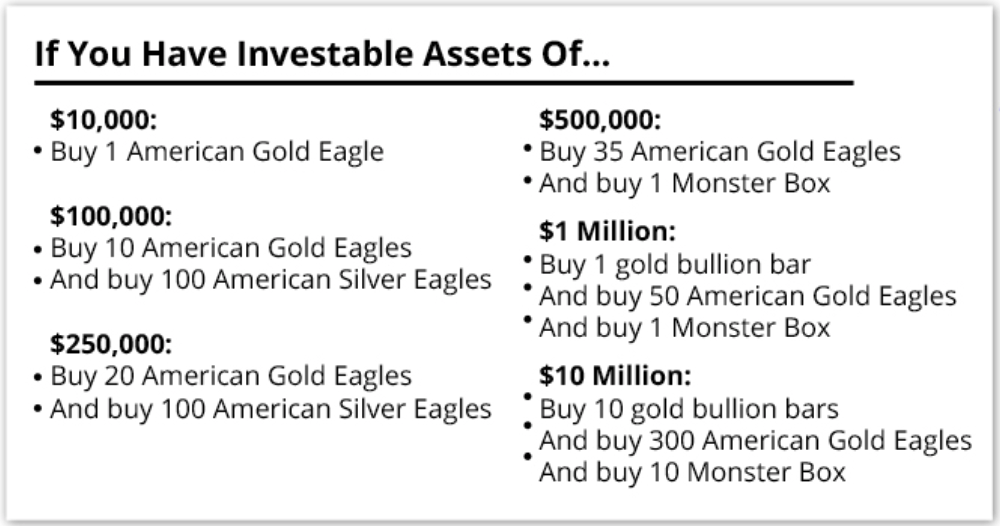
- Buy gold eagles, silver eagles including monster boxes and gold bars 

- Have a 10% allocation to gold, smaller allocation to silver

Editor: Mark O'Byrne

Source: Agora Financial

A new monetary standard which will see the dollar "reboot" and gold be revalued to $10,000/oz according to best-selling author and Pentagon insider Jim Rickards.

A monetary 'reboot' is not unprecedented

Articles about an imminent return to the gold standard are not exactly infrequent in the gold world and it can be easy to become immune to them and dismiss them without considering the facts and case being made.

Many of the articles are not just based one ever-wishful daydreams. Much of it comes from information that is true about today and is then applied to situations that we have seen in the past.

Rickards makes this point himself. A monetary reset is not unheard of. Since the Genoa Accord in 1922 there have been a further eight reboots. The most recent was in 2016 in what Rickards refers to as the Shanghai Accord which purportedly saw deals done that would allow China to ease without leading to a sharp correction in the US stock market.

Rickards isn't the only one who is speculating that there could be some big monetary changes on the horizon. In March intelligence service Stratfor wrote:

Trump may consider unilateral or, failing that, multilateral currency interventions to bring it back down...Negotiating a new coordinated monetary intervention

Stratfor's analysis was considering the threat of a strong dollar on Trump's plans to reduce the trade deficit. We have recently discussed the danger of political deadlock and uncertainty on the US Dollar and how this will benefit gold.

Rickards' comments come from a similar viewpoint in that there is decreasing faith in the US dollar. This lack of trust is mainly driven by the more than $100 trillion debt ($20 trillion national debt and another $100 trillion in off 'balance sheet' liabilities) in the country and the ongoing dedollarisation by major economies.

Should Trump continue to stumble, disappoint and provoke then we will no doubt see this issue snowball even faster.

No longer banking on debt

The Federal Reserve — America’s central bank — has lowered interest rates and printed nearly 4 trillion new dollars out of thin air since the economic crisis in 2008.

That’s equivalent to nearly one quarter the size of the entire U.S. economy.

The number one consequence of all of this money printing so far hasn’t been inflation at all…

It’s been debt.

Total U.S. debt — across all private sectors — has risen to nearly $60 TRILLION…

That’s over three times as big as the entire U.S. economy.

If you add the federal debt to that number, you get $80 trillion! That’s more than four times the size of the U.S. economy.

Source: Jim Rickards via Agora

In fact, the Government Accountability Office just reported this year that the U.S. is at risk of “fiscal failure.”

And Harvard Economics Professor Kenneth Rogoff says, “There’s no question that the most significant vulnerability… is the soaring government debt. It’s very likely that will trigger the next crisis as governments have been stretched so wide.”

And Investor’s Business Daily reports that: “Current total debt, at roughly 105% of GDP, is already in the danger zone — and based on historical economic studies, this is where nasty things can happen.”

All of this is the result of too much debt… too many Obama policies… and too much meddling by the Federal Reserve.

But what happens when there is too much debt? The dollar is still relatively strong so does it matter? Yes, says Rickards, 'many countries are relentlessly abandoning the dollar.' 

Too much debt to make America Great Again

Countries aren’t sticking around to figure out whether the U.S. can really pay back its debt or wait to see if their dollar reserves are going to keep losing their value…

Like billionaire investor Warren Buffett said

“People are right to fear paper money… it’s only going to be worth less and less over time…”

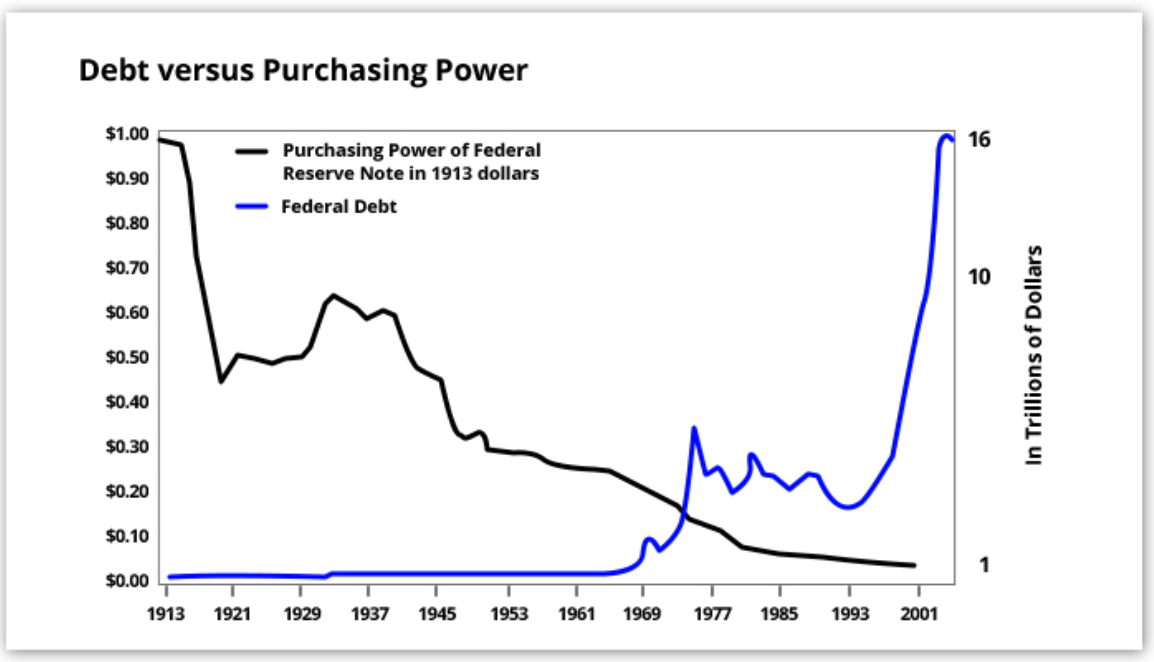
And he’s right. The U.S. dollar has lost 96% of its value since the Federal Reserve was created in 1913. Meanwhile the national debt has skyrocketed!

The dollar and debt are two sides of the same coin:

Source: Jim Rickards via Agora

That’s why many countries are relentlessly abandoning the dollar.

Typically most foreign governments invest their surplus or savings in U.S. financial assets.

Global trade is typically conducted in U.S. dollars, too.

The dollar is what’s called the “world’s reserve currency.”

As one Forbes columnist put it, “ There is a global currency. It’s called the ‘U.S. dollar.’”

But all of that is about to change if the dollar is not rebooted.

The dollar is getting dumped around the globe because of our debt, spending and money printing.

The total amount of “de-dollarization” is at least: $1.14 TRILLION…

But it’s not just the “de-dollarization” of the world that’s making this so urgent. You see, countries have not only stopped buying U.S. Treasuries… but they're selling them at a record clip.

Bloomberg reports, “ America’s Biggest Creditors Dump Treasuries in Warning to Trump .”

The Economist says, “As America’s economic supremacy fades, the primacy of the dollar looks unsustainable.”

Trump to call global summit and take control

Rickards believes that the situation of dedollarization will get so bad that the US President will be forced to call a summit of world leaders and monetary authorities.

Using his stature as leader of the free world, he’ll bring the financial leaders of the globe together.

This would include delegates from the U.S., China, Japan, Germany, Italy, France, the UK and the International Monetary Fund.

Then, they’ll agree to simultaneously revalue all of their currencies against gold until the price reached $10,000 per ounce.

Will Trump really call a global summit? Who knows. His own team probably won't know until he tweets about it.

But you should consider one element that Rickards mentions. Aside from a new monetary order, Trump is about to become the most powerful US president when it comes to looking after the US Dollar.

You see, there are seven total seats on the Board of Governors of the Federal Reserve. That’s the group that makes our central bank’s decisions.

The president appoints each governor.

That means Trump could be able to appoint five governors in the coming months, including a chair and two vice chairs.

Trump will have six out of seven board seats in Republican hands.

In effect, Trump will own the Fed!

The Republicans will also have the White House…

And a majority in the House of Representatives and Senate…

Conservatives will soon be a majority on the Supreme Court, too.

And there are more Republican state legislatures and governors in the state mansions than at any time since Civil War reconstruction.

This means President Trump could have zero resistance to changing the debt-dollar system we have.

Whether Trump 'owning' the Fed means he would seek to upend the international monetary order is one thing. But, even if he doesn't do that, investors would be wise to consider what impact a Trump-controlled Federal Reserve would have on the world.

Why $10,000 per ounce?

It’s the gold price Donald Trump will need to use to “reboot” the U.S. dollar and the world’s international monetary system.

This isn’t a far-fetched concept, by the way…

Since the world financial crisis in 2008, many of the world’s governments have been buying physical gold in record amounts.

In fact, according to a recent report by the Official Monetary and Financial Institutions Forum (OMFIF), world central banks have been buying gold at a rate of 385 tons per year since the 2008 crisis.

Those are levels last seen when the world was on the gold standard pre-1971.

Why are they buying so much gold?

Because they know gold is going to be money again…

And the more gold they own, the more leverage they'll have when Trump calls the world’s financial powers together to reform the monetary system at his Mar-a-Lago resort.

As with chat surrounding soon-to-be gold standard, calls for $10,000/oz gold (or more) are also not uncommon in precious metal spheres. Since I began in the gold industry I have been reading about the imminent rise of the gold price to $30,000 even $40,000.

In truth, I believe such outlandish predictions are damaging for the long-term reputation of the gold and silver investment community. Regardless of where you think the gold price and gold standard could head to, it is all relative to your own situation, your own portfolio and the currencies you buy it in.

At the same time, while gold at $10,000 per ounce seems outlandish now, it is not impossible and indeed the scale of the levels of debt in the U.S. and internationally make it quite possible. When gold was trading at $250/oz in 2002, a rise of more than seven times and gold at $1,900 seemed outlandish to most.

Whether or not you believe Trump will ever achieve a new gold standard in a currency reset, it is vital to consider the point that central banks have been net buyers of gold for some time. A lesson for all investors.

And the most important nugget to takeaway from pieces such as this is that governments are in a completely unsustainable, debt-laden position. The current state of the global economy is unprecedented. We are also in unknown times when it comes to technology, cyber threats and nuclear sabre rattling. Governments buying gold is sensible portfolio diversification.

Buying gold coins and bars a prudent way to hedge coming currency devaluations

Rickards, Stratfor and even us here at GoldCore cannot predict what will happen in terms of the gold price. What we do know is that gold has played a very important role throughout history - especially as a hedge against currency devaluation.

Currency devaluations are coming and currencies are set to fall in value against gold as they have done throughout history. The only question is how much fiat currencies will fall versus gold and silver.

History has taught us that governments rarely know what they are doing when it comes to financial and monetary planning. It has also taught us that when times are tough countries turn on one another and war becomes common. Trade wars lead to currency wars lead to real wars. We are seeing that today.

Investors and savers are wise to think small. They should consider their own form of gold standard and how they can protect themselves. Buying gold bars, gold eagles and silver eagles including monster boxes is a prudent way to hedge the real risk of global currency debasement today.

The extracts are taken from an article which originally appeared on Agora Financial.

Gold eagles can currently be acquired from GoldCore at record low premiums of 3%.
Please call to secure coins as this is a phone call offer only and not available online.

Gold and Silver Bullion - News and Commentary

Gold slips on stronger dollar; geopolitical risks support (Reuters.com)

Asian markets rebound, shrugging off North Korea tensions (Marketwatch.com)

Crude slips, gasoline jumps as storm shuts a fifth of U.S. fuel output (Reuters.com)

ICE to take over London silver benchmark on Sept. 25 (Reuters.com)

Wall Street insiders sell bank shares as Trump rally reverses (Irish Times)

Source: GoldCore

Gold to surge to $1,400 by early 2018 as rates stay low - BoA (Gulf News)

The Battle for India's $45 Billion Gold Industry Has Begun (Bloomberg)

Stevenson-Yang Warns "China Is About To Hit A Wall" (Zerohedge)

U.S. may revalue gold if debt ceiling isn't raised - Rickards  (Daily Reckoning)

Gold may assume traditional role as "risk mitigator" ... Cryptocurrencies "vulnerable" - El-Erian (Bloomberg)

Gold Prices (LBMA AM)

30 Aug: USD 1,310.60, GBP 1,014.93 & EUR 1,096.71 per ounce
29 Aug: USD 1,323.40, GBP 1,020.34 & EUR 1,097.36 per ounce
25 Aug: USD 1,287.05, GBP 1,003.90 & EUR 1,090.90 per ounce
24 Aug: USD 1,285.90, GBP 1,003.26 & EUR 1,090.44 per ounce
23 Aug: USD 1,286.45, GBP 1,004.33 & EUR 1,091.68 per ounce
22 Aug: USD 1,285.10, GBP 1,000.71 & EUR 1,091.95 per ounce
21 Aug: USD 1,287.60, GBP 999.82 & EUR 1,096.52 per ounce

Silver Prices (LBMA)

30 Aug: USD 17.44, GBP 13.49 & EUR 14.60 per ounce
29 Aug: USD 17.60, GBP 13.59 & EUR 14.62 per ounce
25 Aug: USD 17.02, GBP 13.26 & EUR 14.40 per ounce
24 Aug: USD 16.93, GBP 13.20 & EUR 14.36 per ounce
23 Aug: USD 17.06, GBP 13.32 & EUR 14.48 per ounce
22 Aug: USD 17.02, GBP 13.27 & EUR 14.48 per ounce
21 Aug: USD 17.02, GBP 13.20 & EUR 14.48 per ounce


Recent Market Updates

- Gold Surges 2.6% After Jackson Hole and N. Korean Missile
- Diversify Into Gold On U.S. “Political Instability” Advise Blackrock
- Trump Presidency Is Over – Bannon Is Right
- The Truth About Bundesbank Repatriation of Gold From U.S.
- Cyberwar Risk – Was U.S. Navy Victim Of Hacking?
- Global Financial Crisis 10 Years On: Gold Rises 100% from $650 to $1,300
- Mnuchin: I Assume Fort Knox Gold Is Still There
- Buffett Sees Market Crash Coming? His Cash Speaks Louder Than Words
- Gold, Silver Consolidate On Last Weeks Gains, Palladium Surges 36% YTD To 16 Year High
- Must See Charts – Gold Hedges USD Devaluation, Rise in Oil, Food and Cost of Living Since Nixon Ended Gold Standard
- World’s Largest Hedge Fund Bridgewater Buys $68 Million of Gold ETF In Q2
- Diversify Into Gold Urges Dalio on Linkedin – “Militaristic Leaders Playing Chicken Risks Hellacious War”
- Gold Has Yet Another Purpose – Help Fight Cancer

Important Guides

For your perusal, below are our most popular guides in 2017:

Essential Guide To Storing Gold In Switzerland

Essential Guide To Storing Gold In Singapore

Essential Guide to Tax Free Gold Sovereigns (UK)

Please share our research with family, friends and colleagues who you think would benefit from being informed by it.