Friday, September 8, 2017

BullionStar's Website Features Content Rich Media on the Precious Metals Markets

Published here: http://www.zerohedge.com/news/2017-09-08/bullionstars-website-features-content-rich-media-precious-metals-markets

Submitted by BullionStar.com

In addition to offering a full transactional platform for buying gold and buying silver, BullionStar's website features a wide variety of original research, analysis and content addressing the global precious metals markets. BullionStar's goal with this content is to provide readers and viewers with unique and up-to-date insights into the precious metals markets that are not available elsewhere.

A case in point is the BullionStar Perspectives video series which provides viewers with free access to original and independent opinions on the precious metals markets. In July, BullionStar had the privilege of hosting an exclusive interview in Singapore with legendary investor, author and financial commentator Jim Rogers, and this interview has now been published as part of the BullionStar Perspectives series.

Jim Rogers - Catastrophe and Opportunity

Rogers, who currently resides in Singapore, co-founded the famous Quantum Fund in 1973, and has written a number of best-selling investment and travel themed books.

The interview touches on potential crises that Rogers thinks could impact the global economy and the opportunities that such crises may offer investors. According to Rogers, catastrophe and opportunity can be viewed as two sides of the same phenomenon, and catastrophe and panic often create buying opportunities.

Ideally, Rogers thinks the Federal Reserve should stand aside or even be aolished given that it is the cause of many finanical market problems, for example, for having driven interest rates to zero which is wiping out savers. Realistically, however, Rogers doubts that the Fed would be abolished, and in a future crisis will, as per usual, be pressured by vested interests into generating financial market rallies, reallies which will ultimately be futile.

Crucially, Rogers believes in the importance of acquiring physical gold and silver as an insurance policy, and in understanding what you are investing in. Everybody, he says, should have some gold and silver as an insurance policy if nothing else. “You hope you never need it”, but “its the best insurance policy in the world” he says.

Rogers owns his own physical gold, and thinks that due to future financial market instabilities, gold could well turn into its own bubble. This is because, when financial crises hit, people go to gold and silver as a safe haven asset. "That’s what they do", he says.

Rogers appreciates that the gold market is a fractional-reserve market, with only partial backing by real physical metal. On the subject of paper gold versus physical gold, Rogers envisages that in a real crisis, there won’t be a paper gold market - the paper gold markets will close down due to widespread market chaos. That is why there is a need for physical gold ownership, gold in your pocket or gold stoted in a vault.

Jim, who has some of his own gold stored in Singapore, thinks that Singapore is a better jurisdiction than most for storing gold, and offers an added attraction is that buying investment gold and silver in Singapore is free of sales tax (GST free).

The Jim Rogers Interview, which is just over 14 minutes long, can be viewed here:

Other videos in the BullionStar Perspectives videos series include Marcus Grubb of the World Platinum Investment Council on the Case for Platinum. Bron Suchecki of Monetary Metals on the intricacies between the physical and paper gold markets, Chris Powell of GATA on price manipulation in the gold market,  analyst Jayant Bhandari on the Indian gold market, and Ronan Manly of BullionStar on Secrecy vs Transparency in the gold market.

The BullionStar website also features in-depth factual gold market information in BullionStar's Gold University portal, original research and analysis of the global precious metals markets by BullionStar analysts Koos Jansen and Ronan Manly, a unique monthly review of the world's most important physical gold markets in chart form in BullionStar's Gold Market Charts series, and a specific company-focused blog series known as BullionStar Blogs (aka 'Inside BullionStar').

BullionStar's Gold University is a Wikipedia-style resource for use by the gold industry, by financial media and reporters and by general readers. It features contemporary factual information covering the world's gold markets, a selection of the world's largest gold vaults, profiles of the world's largest precious metals refineries and mints, and profiles gold industry associations. It also contains sections addressing the core concepts of the Chinese gold market, central bank policies on gold, and the mechanics of bullion banking and gold ETFs.

Articles and analysis by BullionStar analysts Koos Jansen and Ronan Manly, published in the form of blogs, keep readers up to date with developments in the precious metals markets. These blogs contain original research, such as in-depth analysis of the Chinese and London gold markets, and these blogs are popular across the precious metals industry as well as being frequently featured across many other websites.

BullionStar's Gold Market Charts uses charts by webite www.GoldChartsRUs.com to capture current developments and demand and flow trends in the world’s most important physical gold markets. These markets include China, India, Russia and Switzerland.

The BullionStar Blog's series (Inside BullionStar) features posts relevant to the company BullionStar and its products, but also extends to hosting interesting articles on aspects of the gold market and it also hosts BullionStar's unique Infographics on the gold market, such as an infographic on the Chinese Gold Market.

All of the above content can be found on the BullionStar site under the 'BullionStar Research' menu.

This article originally appeared under the title of 'BullionStar Media' on the BullionStar.com website.

Gold/Dollar-Multi year breakout, says Joe Friday

Published here: http://www.zerohedge.com/news/2017-09-08/golddollar-multi-year-breakout-says-joe-friday

joe friday, chris kimble post

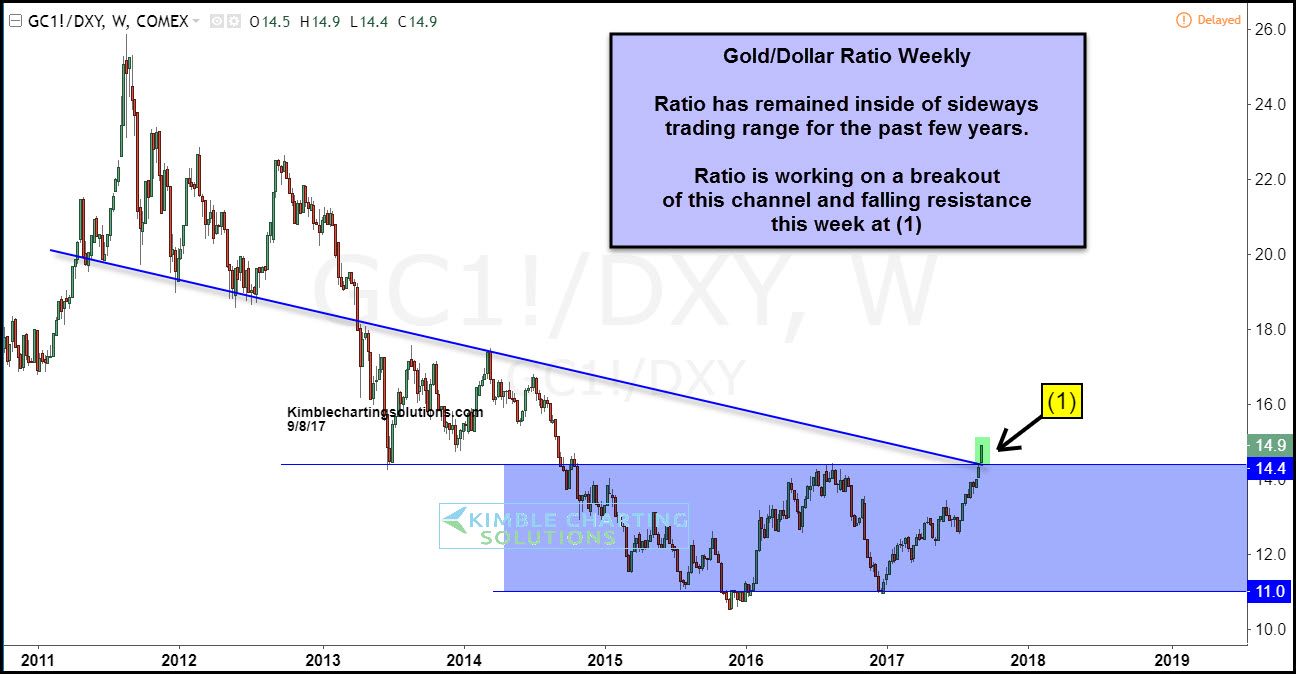
Gold has been weaker than the US$ since 2011 highs, highlighted in Gold/Dollar chart below. The ratio is attempting to do something this week that it hasn’t been able to accomplish the past few years-

gold dollar ration GC1! / DXY chris kimble post

CLICK ON CHART TO ENLARGE

The ratio has traded sideways for the past three years, inside the blue shaded zone-

Joe Friday Just The Facts Ma’am– Gold/Dollar ratio is attempting a breakout above dual multi-year resistance this week at (1).

Gold/Dollar strength in the past has been positive for Gold, Silver and Miners. Will it be different this time?

To send a positive message to these assets that these assets are attempting to break a multi-year trend, one needs to see the ratio continue higher.


from Kimble Charting Solutions.  We strive to produce concise, timely and actionable chart pattern analysis to save people time, improve your decision-making and results

Send us an email if you would like to see sample reports or a trial period to test drive our Premium or Weekly Research


Receive Chris Kimble's research by email posted to his blog daily  https://kimblechartingsolutions.com/newsletter-preferences/


Email services@kimblechartingsolutions.com 


Call us Toll free 877-721-7217 international 714-941-9381


Website: KIMBLECHARTINGSOLUTIONS.COM

Gold Has 2% Weekly Gain,18% Higher YTD - Trump's Debt Ceiling Deal Hurts Dollar

Published here: http://www.zerohedge.com/news/2017-09-08/gold-has-2-weekly-gain18-higher-ytd-trumps-debt-ceiling-deal-hurts-dollar

Gold Has 2% Weekly Gain,18% Higher YTD - Trump's Debt Ceiling Deal Hurts Dollar

- Gold hits $1,355/oz as USD at 32-month low -concerns about Trump, US economy
- Silver and platinum 2.3% and 1.2% higher in week; palladium 3% lower
- Euro Stoxx flat for week - S&P 500, Nikkei down 0.65% and 2.2%
- Geo-political concerns including North Korea, falling USD push gold 2.1% in week
- Gold prices reach $1,355 this morning following Mexico earthquake

- Safe haven demand sees gold over one year high, highest since August 2016
- Silver touches $18.24 - highest level since April 2017
- Goldman, BoAML and Deutsche Bank all warn re markets this week

Editor: Mark O'Byrne

Gold price Sept 2017

This morning the earthquake in Mexico likely contributed to gold eking out further gains to $1,355/oz, its highest since August 2016. The gold price is now up 2.1% for the week.

Sadly some of the short-term performance in both gold and silver is because of devastating events around the globe. From hurricanes and earthquakes to potential nuclear wars.

However, as explained earlier this week, while gold is reacting to geopolitical events in the short term, the real driver of gold will be the impact of these events which is government money printing and debasement of the currency. Only this week, Trump extended the debt ceiling - with the devastation of the floods in Texas and Hurricane Irma the latest reason to increase the US national debt.

Is the Euro too strong?

Yesterday the ECB decided to leave interest rates unchanged. On the back of the decision, the euro rose to $1.20 pushing the US dollar to a 32-month low. Draghi did not express concern over the currency’s strength.

Some indication was given as to the when the ECB would taper asset purchases - October is expected.

Relative to gold and silver in the last week, the euro has underperformed.

No increase in the US rates or the dollar

Meanwhile in the US weak economic data and events in Texas and Florida have likely pushed any chance of further rate hikes back. Data yesterday showed weekly jobless claims rose this week to their highest since 2015. Hurricane Harvey likely contributed to this and it is likely the start of a trend and will likely get worse.

Odds of the increase happening this year have slipped from 40% to 29%. For many a rate hike would be bad news for gold and silver prices. However so far this year this has not proven to be as damaging as some bears expected. Indeed, as we have shown with data and charts many times, rising interest rates generally corresponds with rising gold prices - as seen in the 1970s and from 2003 to 2006.

Trump’s deal-making and money printing 

This week President Trump struck a short-term deal with the Democrats in order to avoid a showdown over the US debt ceiling. Many had been worried that the issue would be dragged out by both parties. Republicans were reportedly furious at Trump’s decision.

As a result gold fell back somewhat after a stellar start to the week. Many market participants had expected the debt ceiling issue to be a far greater issue than it turned out to be. Of course, it still is a big issue as Trump and the Democrats have merely pushed the can down the road, but for now this is something they (and markets) will likely not worry about too much.

There are concerns over the discontent and discord in the White House which has still not passed any meaningful legislation since Trump’s inauguration. This is providing greater support for gold which appears to be gaining strength due to issues in Washington.

Is it about geopolitical risks?

Short-term hikes in the gold and silver price are thanks to expected increases in safe haven demand considering events such as North Korea, potential genocide in Myanmar, Venezuelan economic crisis and of course, extreme weather events and now a massive earthquake.

However these are not necessarily the long-term drivers of the gold and silver price. As we explained earlier this week. It is most likely down to concerns over governments and their monetary policies.

Trump and his government are of course creating geopolitical risks, however it is the fact that his policis are (and will continue) to result in currency debasement that will provide longer-term support for gold.

Goldman Sachs’ analysts suggested this week that gold’s rise to one-year highs is thanks to perceived pro-growth promise from Trump which are currently floundering but will result in more money creation. His to-do (and expense) list has also grown as a result of hurricanes in the country.

Conclusion 

We should rightly pay attention to events happening around the world. They are devastating the lives of so many people.

However, when it comes to our portfolios we should not look to the pattern of a hurricane or the sabre-rattling of a dictator to justify our decisions to hold certain assets.

Instead we need to switch off the 23-hour rolling news and ask ourselves what this means for the long-term.

All of it whether war, recovery from an environmental disaster or peacekeeping operations in Myanmar means spending. Money does not grow on trees and no Western government has any money left ... just debt and lots of it.

Currency debasement continues on a massive scale globally. This in time will have devastating consequences for our economies and our digital and paper savings and investments. Investors should prepare their portfolios in the same way one would for an environmental disaster or war - with good, solid insurance.

News and Commentary

Gold climbs to 1-year high as U.S. dollar sees fresh weakness (MarketWatch.com)

Gold rises to one-year high amid sluggish dollar (Reuters.com)

Dollar Tumbles as Yen, Euro Rally on Irma, ECB (Bloomberg.com)

ECB keeps door open to even more stimulus (Reuters.com)

Hurricane Harvey lifts U.S. jobless claims to more than two-year high (Reuters.com)

Source: Bloomberg

Yen Losing its Haven Sheen to Gold on North Korea (Bloomberg.com)

Gold to reach $1400 on dollar weakness and North Korea (CNBC.com)

Flight to quality may see further gains for gold bullion (CNBC.com)

Gold prices boom as fears grow over North Korea nuclear crisis (Independent.co.uk)

Own Gold for Long Term as Fiat Money is Doomed - Frisby (MoneyWeek.com)

Gold Prices (LBMA AM)

08 Sep: USD 1,350.90, GBP 1,026.82 & EUR 1,120.71 per ounce
07 Sep: USD 1,340.45, GBP 1,026.52 & EUR 1,119.54 per ounce
06 Sep: USD 1,340.15, GBP 1,028.03 & EUR 1,122.11 per ounce
05 Sep: USD 1,331.15, GBP 1,029.51 & EUR 1,120.43 per ounce
04 Sep: USD 1,334.60, GBP 1,030.98 & EUR 1,120.53 per ounce
01 Sep: USD 1,318.40, GBP 1,020.18 & EUR 1,107.98 per ounce
31 Aug: USD 1,305.80, GBP 1,013.17 & EUR 1,098.31 per ounce

Silver Prices (LBMA)

08 Sep: USD 18.21, GBP 13.80 & EUR 15.09 per ounce
07 Sep: USD 17.79, GBP 13.59 & EUR 14.85 per ounce
06 Sep: USD 17.77, GBP 13.62 & EUR 14.90 per ounce
05 Sep: USD 17.88, GBP 13.80 & EUR 15.03 per ounce
04 Sep: USD 17.80, GBP 13.75 & EUR 14.95 per ounce
01 Sep: USD 17.50, GBP 13.53 & EUR 14.69 per ounce
31 Aug: USD 17.34, GBP 13.47 & EUR 14.62 per ounce


Recent Market Updates

- ‘Things Have Been Going Up For Too Long’ – Goldman CEO
- Physical Gold In Vault Is “True Hedge of Last Resort” – Goldman Sachs
- Bitcoin Falls 20% as Mobius and Chinese Regulators Warn
- Gold Surges To $1338 as U.S. Warns of ‘Massive’ Military Response
- Precious Metals Outperform Markets In August – Gold +4%, Silver +5%
- 4 Reasons Why “Gold Has Entered A New Bull Market” – Schroders
- Gold Reset To $10,000/oz Coming “By January 1, 2018” – Rickards
- Gold Surges 2.6% After Jackson Hole and N. Korean Missile
- Diversify Into Gold On U.S. “Political Instability” Advise Blackrock
- Trump Presidency Is Over – Bannon Is Right
- The Truth About Bundesbank Repatriation of Gold From U.S.
- Cyberwar Risk – Was U.S. Navy Victim Of Hacking?
- Global Financial Crisis 10 Years On: Gold Rises 100% from $650 to $1,300

Important Guides

For your perusal, below are our most popular guides in 2017:

Essential Guide To Storing Gold In Switzerland

Essential Guide To Storing Gold In Singapore

Essential Guide to Tax Free Gold Sovereigns (UK)

Please share our research with family, friends and colleagues who you think would benefit from being informed by it.

Thursday, September 7, 2017

Gold- Mother of all bullish patterns formed?

Published here: http://www.zerohedge.com/news/2017-09-07/gold-mother-all-bullish-patterns-formed

Six years ago this week, the Power of the Pattern shared that “Gold could be flat to down for years to come!” See Why the Power of the Pattern felt this way. See Post Here  

Below looks at the performance of Gold, Silver, GDX and GDXJ since the post on 9/1/11-

performance comparison gold silver miners, chris kimble chart

CLICK ON CHART TO ENLARGE

Could the struggles of the metals markets be about to end? Mother of all “Bullish Patterns” in play for Gold? Could be, check out the chart below-

gold monthly, chris kimble chart

CLICK ON CHART TO ENLARGE

Even though Gold has been down hard the past 6-years, it did NOT break below rising support off the 2001 lows, which was tested at last years lows. This is a long-term positive.

Over the past couple of years, Gold could be forming a base, that is taking the shape of a “Bullish Inverse Head & Shoulders” pattern. If the read would happen to be correct, an all important test is in play at this time. The key test in play is this…Gold is testing the underside of the neckline, which is resistance at this time.

Bottom Line– If this read is correct and Gold breaks above the neckline at (1), we could see buying pressure take place, that has been absent for years.

If you are interested in Gold, Silver, Miners or Copper, we would be honored if you were a Premium or MetalsMember.


from Kimble Charting Solutions.  We strive to produce concise, timely and actionable chart pattern analysis to save people time, improve your decision-making and results

Send us an email if you would like to see sample reports or a trial period to test drive our Premium or Weekly Research


Receive Chris Kimble's research by email posted to his blog daily  https://kimblechartingsolutions.com/newsletter-preferences/


Email services@kimblechartingsolutions.com 


Call us Toll free 877-721-7217 international 714-941-9381


Website: KIMBLECHARTINGSOLUTIONS.COM


‘Things Have Been Going Up For Too Long’ – Goldman CEO

Published here: http://www.zerohedge.com/news/2017-09-07/%E2%80%98things-have-been-going-too-long%E2%80%99-%E2%80%93-goldman-ceo

“Things have been going up for too long...” - Goldman Sachs’ CEO

- Lloyd Blankfein, Goldman CEO "unnerved by market" (see video)
- Bitcoin bubble is no outlier says Bank of America Merrill Lynch

- Bubbles are everywhere including London property
- $14 trillion of monetary stimulus has pushed investors to take more risks
- We are now in a new era of bigger booms and bigger busts - BAML
- “Seeing signs of bubbles in more and more parts of the capital market" - Deutsche Banks' John Cryan
- Global debt bubble and China very vulnerable too - warns Steve Keen
- Bubbles, bubbles everywhere ... lots of potential pins ... got gold?

Editor: Mark O'Byrne

Video - Goldman CEO Unnerved By Market. Image: Getty Images via CNBC

The B word is something which is almost whispered in financial circles. To acknowledge there might be a bubble somewhere is like admitting the proverbial elephant is in the room.

But, like many taboo words, it seems the mainstream are coming around to the idea that it is ok to mention the word ‘bubble’ and express their concerns about the possibility of at least one existing.

This week Goldman Sachs’ Lloyd Blankfein, Deutsche Banks’ CEO John Cryan and strategists at Bank of America Merrill Lynch have separately expressed concerns that there are signs of bubbles in the markets - from the obvious bitcoin bubble to the less obvious bubble in London and other property markets and bubbles in many stock and bond markets.

The most obvious one is bitcoin. Bitcoin is up 380% this year whilst the combined market cap of cryptocurrencies is up by 800%. However these are by no means anomalies according to analysts at BAML.

Wealth effect

Cryan and Blankfein agree, thanks to central bank money printing and low interest rates, they too are expressing their concerns over the state of markets.

"When yields on corporate bonds are lower than dividends on stocks? That unnerves me ... "
Lloyd Blankfein

There's no bubble here

Professor Robert Shiller has been calling a bubble in bitcoin for a couple of years, for him it is the latest sign of 'Irrational Exuberance'. 

“The best example right now [of irrational exuberance] is Bitcoin. And I think that has to do with the motivating quality of the Bitcoin story. And I’ve seen it in my students at Yale. You start talking about Bitcoin and they’re excited! And I think, what’s so exciting? You have to think like humanities people. What is this Bitcoin story?”

The bitcoin community was not best pleased when the man who is credited with being able to spot speculative manias decided to single out the cryptocurrency as the latest one.

In response CoinTelegraph wrote an article entitled 'Bitcoin So High Above the Bubbles They Can't Be Seen'. The author claims that bitcoin is failing to follow the pattern of other bubbles.

In fact, a closer inspection of the growth, and the eventual burst of the associated bubbles shows that Bitcoin is so far off the charts that it looks like an absolute outlier.

The bitcoin crowd are doing exactly what so many tend to do when a market is massively outperforming - they build a narrative from it and begin to fuel the belief that the price can only go up.

A BBC Capital article on the bitcoin phenomenon quotes a small bitcoin investor as saying '“I don’t know how far it’s going to grow,” he explains, “but if something is growing at hundreds of per cent, that’s a pretty valuable return.” Note 'I don't know how far it's going to grow...' The investor is convinced this can only go one way.

For now we can perhaps assure ourselves that unlike in some other markets few investors will have gone all in or driven themselves into debt (as per the housing market).

A happy, bubbly narrative

Bubbles are created when investor enthusiasm and optimism are at excessive levels.

In a 2010 interview with the Financial Crisis Inquiry Commission (FCIC) Warren Buffett explained that this happens because investors originally invest based on a sound premise, which is then the only focus for the investment strategy and they end up blinkered.

Simply put investors begin to invest based on a sound premise, for example house prices are going to go up because money is losing its value and there is a more demand than supply.

Investors are convinced that as house prices are climbing they must buy now. This goes on and on based on the original premise. Investors ignore other developments such as house price climbs are now outstripping inflation. We are seeing a similar thing in bitcoin.

The housing example is no more pertinent right now than in Australia which is basically a $1.7 trillion house of cards. According to LF Economics, Australian housing speculators are able to use unrealized gains in properties as a 'cash substitute' for down payments on other investment properties. 'Profitability is therefore predicated on ever-rising house prices...“[Many] international wholesale lenders ... may find out the hard way that they have invested into nothing more than a $1.7 trillion ‘piss in a fancy bottle scam’,”

Homebuyers forget the original premise and and become blinkered by the price action - which is that house prices are going up and up. Because it has been relatively easy and cheap to borrow money to finance purchases on these properties homebuyers suddenly see themselves as investors and decide to buy more than one house, because ‘it’s only going to go up’.

This is where we are with so many asset classes right now, including bitcoin, property, vintage cars and equities.

Debt and bubble junkies

But what gets the narrative going in the first place? In the last ten years it has been the generosity of central banks in their infinite money printing and low interest rate policies.

“Post the financial crisis, the largesse of central banks appears to be inducing quicker and steeper price gains in assets compared to the case historically,” analysts at BAML wrote “Speculative behavior in assets is cropping up more frequently and in more places than just credit markets.”

Earlier in the summer Citi's Hans Lorenzen said the effect of the central banks' 'largesse' was that "the wealth effect is stretching farther and farther afield."

BAML's analysts are also seeing this spread of the bubble effect across a number of markets, not just in credit markets where there is an unprecedented buying spree. 'Asset bubbles seem to be becoming more “bubbly” as time goes by...'

Unlike our bitcoin friends, BAML sees a key issue with the current trajectory of the crypto's price:

For instance, the increase in Japanese equities was pronounced between mid-1982 and the end of 1989, with share prices rising around 440% over the period. But Bitcoin, for instance, has risen roughly 2000% since just mid-2015. And other, recent, in-vogue indices seem to be surging higher as well.

Not to mention the Nasdaq index has soared over 18 % this year while the S&P 500 and Dow Jones indexes are each around 10% higher - building on the already large gains seen in recent years. Throughout the year U.S. bond yields at the 10-year and 30-year maturities have also fallen.

As Deutsche Bank's John Cryan pointed out much of this inflation in the market place is thanks to the prolonger period of low-interest rates and cheap monetary policy. He called for the ECB to put an end to their current monetary policy and it is now causing “ever greater upheaval.”

“We are now seeing signs of bubbles in more and more parts of the capital market where we wouldn’t have expected them...I welcome the recent announcement by the Federal Reserve and now also from the ECB that they intend to gradually bring their loose monetary policy to an end.”

Is no one else worried about this?

Cryan pointed out that today volatility is markedly cheap given what is going on in both financial markets and the wider geopolitical space.

"The interesting thing about the markets today is that obviously they pay some regard to these hotspots but they don't seem to be paying too much regard because we see very high asset prices in almost all asset categories..."

In Professor Steve Keen’s book Can We Avoid Another Financial Crisis?, he argues that many countries have become debt junkies.

“They face the junkie’s dilemma, a choice between going ‘cold turkey’ now, or continuing to shoot up on credit and experience a bigger bust later.”

Is it all about to go ‘pop’?

BAML strategist Barnaby Martin thinks not. Currently the market has a benign view on rates and this will most likely only be altered by an ‘inflationary shock’ which will see the major flows into the credit cycle fall back. Or the ECB swiftly stops with its current QE programme.

The latter may come sooner than we think, today the ECB is expected to give some indication on its plans regarding bond purchases, but in reality it probably won’t make much difference.

As Martin writes, this party isn’t coming to an end just yet:

"the end of the credit party will likely require a big inflationary “shock” in Europe, and one strong enough to reset market expectations over the pace of rate hikes. Safe to say that this seems a long way off to us."

As a result, helped by falling political uncertainty (note European policy uncertainty is now lower than US policy uncertainty – the first time since mid-2012) and the renewed rise in negative yielding assets (note record number of European countries now with negative yielding debt), we see credit spreads heading tighter into year-end.

China swoops in from the left-field

How might all this end? Who knows. The last time interest-rates were this low for as long was during the 1930s and that ended with the Second World War.

It might be through trying to avoid World War III that the financial collapse is finally triggered. Currently Trump is relying heavily on China to cool things down with Kim Jong-Un of maniacal despot fame.

In Keen’s latest book China is one of the countries he believes is a debt junkie. The country’s credit-driven expansion has accounted for more than half of global growth since 2008. Why? Because it dealt with the collapse of the Western credit bubble in 2008 by fuelling a bubble of its own.

Today Chinese banks have $35tn of assets on their balance sheets – a fourfold increase since 2008. In the last decade private debt as a proportion of the country’s annual economic output (GDP) has increased from 120% to 210%.

Its financial system could almost be a mirror to those seen in the US and UK in the run up to the financial crisis. It has a large shadow banking system and special investment vehicles that take assets off balance sheets.

How does this relate to Trump, North Korea and the next financial crisis? Trump needs China on side when dealing with Kim Jong-Un. However, last week Beijing said that in the event of war between the two nuclear powers it would sit on the sidelines.

Trump now has to decide how to handle China as the country clearly has its limits in how much it will help. The most obvious option would be to impose economic sanctions for example, slapping tariffs on steel imports. It could also put China in a negative light in terms of its dealings in markets such as going back to Trump’s old rhetoric branding the country as a currency manipulator or accusing it of facilitating illegal piracy businesses.

Should sanctions be imposed then a trade war would inevitably erupt. This eruption would firmly put a pin in China’s bubble and ripples would be sent out across the world.

Bubbles, bubbles everywhere ... lots of potential pins ... got gold?


News and Commentary

Gold holds steady amid softer dollar (Reuters.com)

Stocks Rise, Treasuries Fall on Debt-Ceiling Deal (Bloomberg.com)

Trump cuts deal with Democrats in Congress to avert immediate budget and debt crisis (LATimes.com)

Fed’s Beige Book finds worry about health of U.S. auto industry (MarketWatch.com)

Fischer to Step Down in Mid-October as Fed Vacancies Mount (Bloomberg.com)

Source: Bloomberg

“Sum of All Fears” Restores Investors’ Faith in Gold (Bloomberg.com)

How Investors Are Preparing for the Worst on North Korea (Bloomberg.com)

We’re Going into Another Long-Term Gold, Silver Bull Market - Neumeyer (SmallCapPower.com)

Gold Break Above $1,375/oz Should See Rise To "Initial Target of $1,705/oz" - BMO (GoldSeek.com)

‘Things Have Been Going Up for Too Long’ - Goldman CEO (CNBC.com)

Gold Prices (LBMA AM)

07 Sep: USD 1,340.45, GBP 1,026.52 & EUR 1,119.54 per ounce
06 Sep: USD 1,340.15, GBP 1,028.03 & EUR 1,122.11 per ounce
05 Sep: USD 1,331.15, GBP 1,029.51 & EUR 1,120.43 per ounce
04 Sep: USD 1,334.60, GBP 1,030.98 & EUR 1,120.53 per ounce
01 Sep: USD 1,318.40, GBP 1,020.18 & EUR 1,107.98 per ounce
31 Aug: USD 1,305.80, GBP 1,013.17 & EUR 1,098.31 per ounce
30 Aug: USD 1,310.60, GBP 1,014.93 & EUR 1,096.71 per ounce

Silver Prices (LBMA)

07 Sep: USD 17.79, GBP 13.59 & EUR 14.85 per ounce
06 Sep: USD 17.77, GBP 13.62 & EUR 14.90 per ounce
05 Sep: USD 17.88, GBP 13.80 & EUR 15.03 per ounce
04 Sep: USD 17.80, GBP 13.75 & EUR 14.95 per ounce
01 Sep: USD 17.50, GBP 13.53 & EUR 14.69 per ounce
31 Aug: USD 17.34, GBP 13.47 & EUR 14.62 per ounce
30 Aug: USD 17.44, GBP 13.49 & EUR 14.60 per ounce


Recent Market Updates

- Physical Gold In Vault Is “True Hedge of Last Resort” – Goldman Sachs
- Bitcoin Falls 20% as Mobius and Chinese Regulators Warn
- Gold Surges To $1338 as U.S. Warns of ‘Massive’ Military Response
- Precious Metals Outperform Markets In August – Gold +4%, Silver +5%
- 4 Reasons Why “Gold Has Entered A New Bull Market” – Schroders
- Gold Reset To $10,000/oz Coming “By January 1, 2018” – Rickards
- Gold Surges 2.6% After Jackson Hole and N. Korean Missile
- Diversify Into Gold On U.S. “Political Instability” Advise Blackrock
- Trump Presidency Is Over – Bannon Is Right
- The Truth About Bundesbank Repatriation of Gold From U.S.
- Cyberwar Risk – Was U.S. Navy Victim Of Hacking?
- Global Financial Crisis 10 Years On: Gold Rises 100% from $650 to $1,300
- Mnuchin: I Assume Fort Knox Gold Is Still There

Important Guides

For your perusal, below are our most popular guides in 2017:

Essential Guide To Storing Gold In Switzerland

Essential Guide To Storing Gold In Singapore

Essential Guide to Tax Free Gold Sovereigns (UK)

Please share our research with family, friends and colleagues who you think would benefit from being informed by it.