Wednesday, October 4, 2017

Safe Haven Silver To Outperform Gold In Q4 And In 2018

Published here: http://www.zerohedge.com/news/2017-10-04/safe-haven-silver-outperform-gold-q4-and-2018

Safe haven silver to outperform gold in Q4 and 2018

- "Expect silver to eventually outperform gold" say Metals Focus
- 2017 YTD, silver has underperformed gold, climbing by 5% versus 11%
- Silver undervalued versus gold and especially stocks, bonds and many property markets
- Will follow gold's reactions to macroeconomic & geopolitical factors and should outperform gold
- Special report on India shows it accounts for just 16% of global silver demand
- Silver a "safe haven at times during which gold failed to be" according to academic research
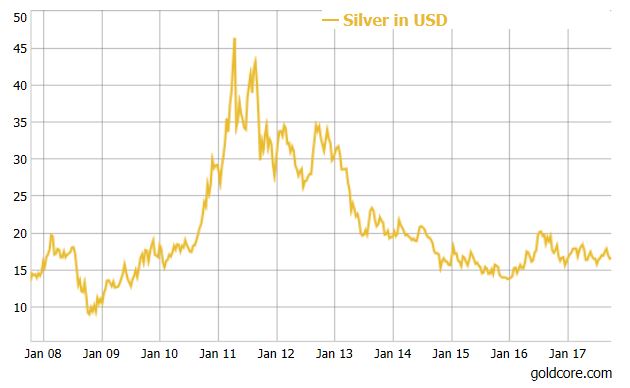
Since the beginning of 2017 the silver price has disappointed many investors. With a 5% gain so far in 2017, it has failed to match gold's 11% gains this year. Both precious metals have ultimately performed below expectations given the positive macroeconomic and geopolitical backdrop.

However, things are starting to look up for the industrial precious metal as industry observers believe it will outperform gold this quarter and into 2018.

In a recent Metals Focus report, the precious metals consultancy concluded that 'we do expect silver to eventually outperform gold.' 

Whilst demand for silver coins in the US has been weak, there are some indicators that suggest this physical demand is beginning to pick up, alongside industrial demand. For example, there has been robust silver ETF demand and in September there was significant uptick in those taking immediate delivery on COMEX.

This year has also taken many market participants by surprise as silver demand has fallen in a number of areas. One of which is India.

The Metals Focus report for the Silver Institute believes that Indian demand in 2017 has not matched the decades' unprecedented silver demand due to higher prices and a clampdown by Indian government on unbanked money in the drive to the cashless society.

However, incomes and the economy and both growing which leads the report to conclude that demand will come back to the country with a bang.

Gold-Silver ratio shows silver undervalued

In June, silver hit a low of $15.60/oz, since then it has recovered somewhat. The gold-silver ratio is also higher than expected, given gold's performance of late. Earlier this year it fell to as low as 68, but has recently been stuck between 74 and 80.
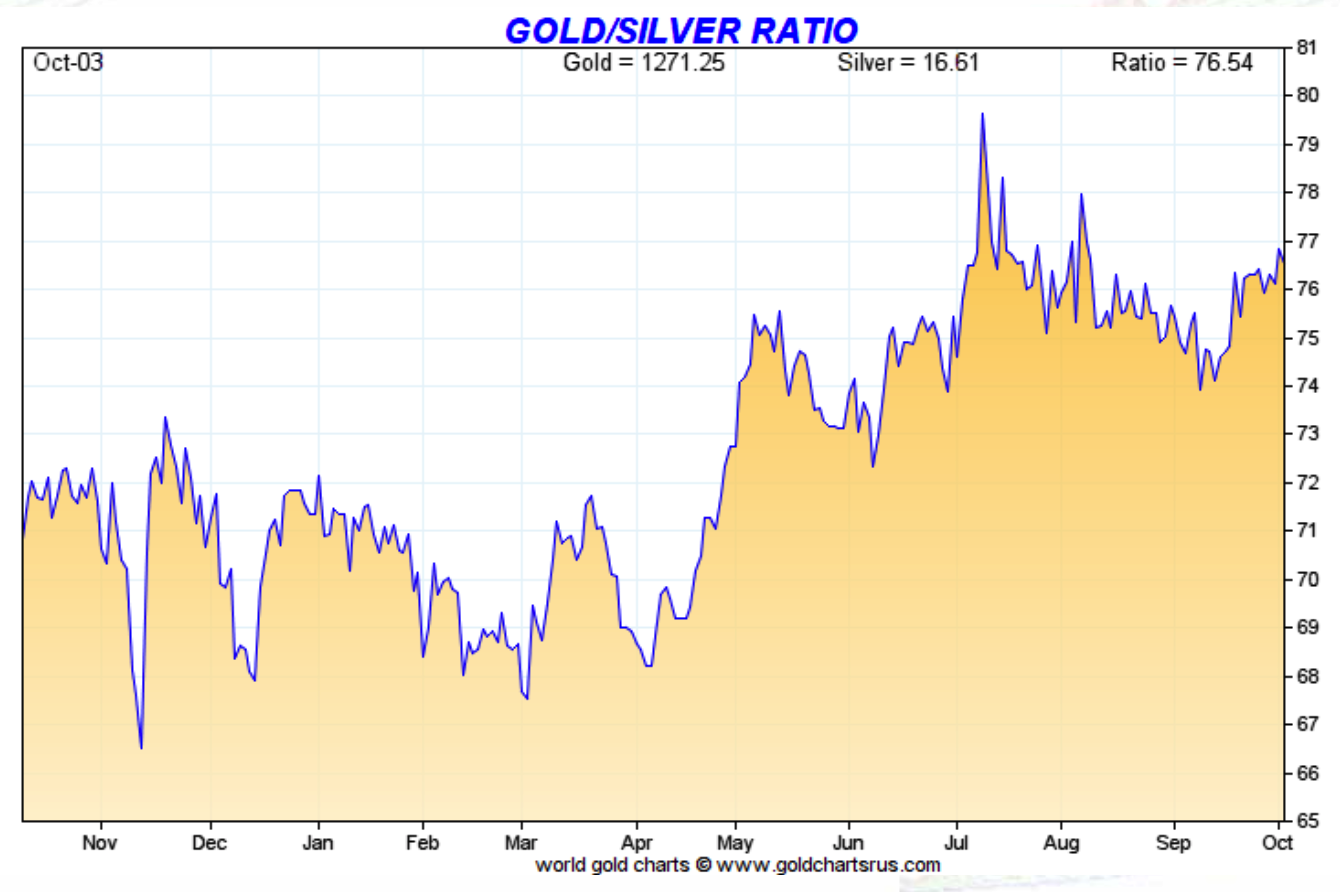
Gold-Silver ratio

The modern historical average is around 40 to 1. The long term historical average is 15 to 1.

Not only is silver undervalued relative to gold but also to increasingly over valued stocks, bonds and property markets.

Given silver’s industrial role and the fact that geologically there are just 15 particles of silver to every one particle of gold, it is likely that the gold/silver ratio will gradually return to below the 100 year average of 40 to 1.

At the current depressed gold price this would put silver at nearly $32/oz.

India's love for silver

Love for gold in the world's seventh largest economy is well-documented but few are aware of its feelings towards silver.

In 2016 India's demand for silver accounted for just 16% of global demand. The report summarises the all important context for this:

India is one of the world’s largest silver markets, with a very traditional core in a diverse market. To put this into perspective, India consumed 160.6Moz (4,996t) last year, which accounted for a noteworthy 16% of global silver demand. It is not only the scale of Indian demand that matters; the country’s dependence on imported metal means that changes in Indian offtake can impact those countries that supply bullion to India.

The sheer scale of the Indian silver market resonates across much of the country, from physical investment, through to day-to-day activities.

It is also integral to India’s cultural and belief systems. It is therefore not surprising that silver is an important part of Indian festivities and weddings.

For example, it is considered auspicious to gift silver during weddings or for the birth of a child. All this means that silver’s appeal extends across most income groups. Even so, the silver market in recent years has evolved considerably in line with the growth in the Indian economy and the rise in
incomes.

Regarding demand, jewellery, silverware and physical investment account for around 75% of total Indian silver demand. With jewellery and silverware accounting for more than 50% of total silver demand.

Investment demand is increasing from a very low base.
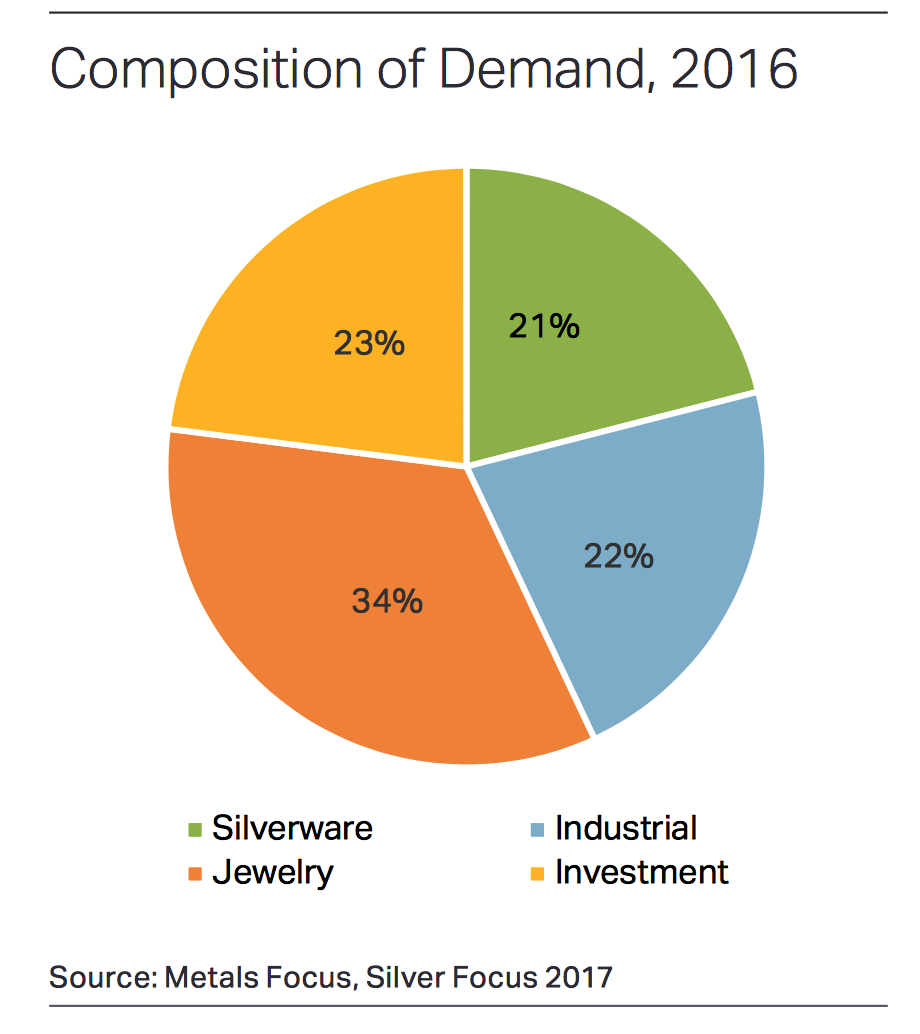
composition of Indian silver demand

In 2010 the two markets combined accounted for 1,200t. By the end of the decade the Silver Institute believes 'the market will expand further to around 109Moz (3,400t), driven largely by healthy economic growth.'

Industrial demand accounts for just 22% of Indian demand and, like investment silver, it has struggled in recent years. The report explains, that this was due to an economic slowdown:

'This saw Indian demand fall from 45.7Moz (1,421t) in 2010 to 35.9Moz (1,115t) in 2015. However, with the economy improving over the last two years (GDP growth is back over 7%), we expect industrial demand to continue to rise in the coming years.'

Outlook has a silver lining

World Gold Council data-provider Metals Focus' conclusion will bring some hope to silver investors:

“the case for further price gains, for both silver and gold still appears strong. Together with negative interest rates (in real or nominal terms) in several key currencies, expectations for Fed rate increases have also been pushed further out. This should make the case for a weaker dollar going forward. Along with heightened geopolitical concerns, investment demand should strengthen. While gold will be the main beneficiary, silver prices should also improve."

Overall, silver will not only step back up to the plate but it will excel the lacklustre performance of this year.

"Given silver’s much smaller market (compared with gold) it should experience greater price volatility. This in turn should see silver prices eventually outperform gold, both later this year and into 2018”

A buying opportunity

We can sit and ponder where we think the price may or may not go in the last three months of the year. We can also sit and hypothesise as to why both gold and silver haven't performed better this year. Neither of these scenarios help our portfolios.

Instead we have to focus on what we do know - silver is currently relatively cheap when considered against a backdrop of heightened geopolitical concerns, rising inflation and ever-prominent and increasing debt risks.

History tells us that very little currently at the forefront of both economic and political concerns are going to be dealt with without negative consequences. History also tells us that silver has a key role to play as a safe haven in your portfolio.

Academic research echoes this sentiment.

Should you believe the politicians both here and across the pond that the economy is improving, this is a further reason to hold silver as part of your portfolio. In 2012 Belousova and Dorfleitner concluded that

‘Adding silver or platinum to a portfolio [of stocks, sovereign bond and the money market instruments] during bull markets reduces volatility and enhances return.'

When looking at all four precious metals’ role as a safe haven between 1989 and 2013, against the S&P 500 and US 10 year bonds, Lucey and Li (2015) found that ‘silver was a safe haven at times during which gold failed to be', but also during far more quarters than both platinum and palladium.'

Related Content
Silver, Platinum and Palladium as Investments – Research Shows Diversification Benefits

‘The Financial Economics of White Precious Metals – A Survey’ here

Indian Silver Market Study by Metals Focus

News and Commentary

GOLD EDGES HIGHER AS DOLLAR WEAKENS (BullionDesk.com)

Gold crawls up as dollar retreats (Reuters.com)

ETF Buyers Exit SPDR Gold as Fed Fears Eclipse Missile Mayhem (Bloomberg.com)

Bitcoin’s rise may be like when ‘paper money displaced gold' - Goldman’s CEO (MarketWatch.com)

Bank of England warns European banks are not 'sufficiently focused' on Brexit risks (CityAM.com)


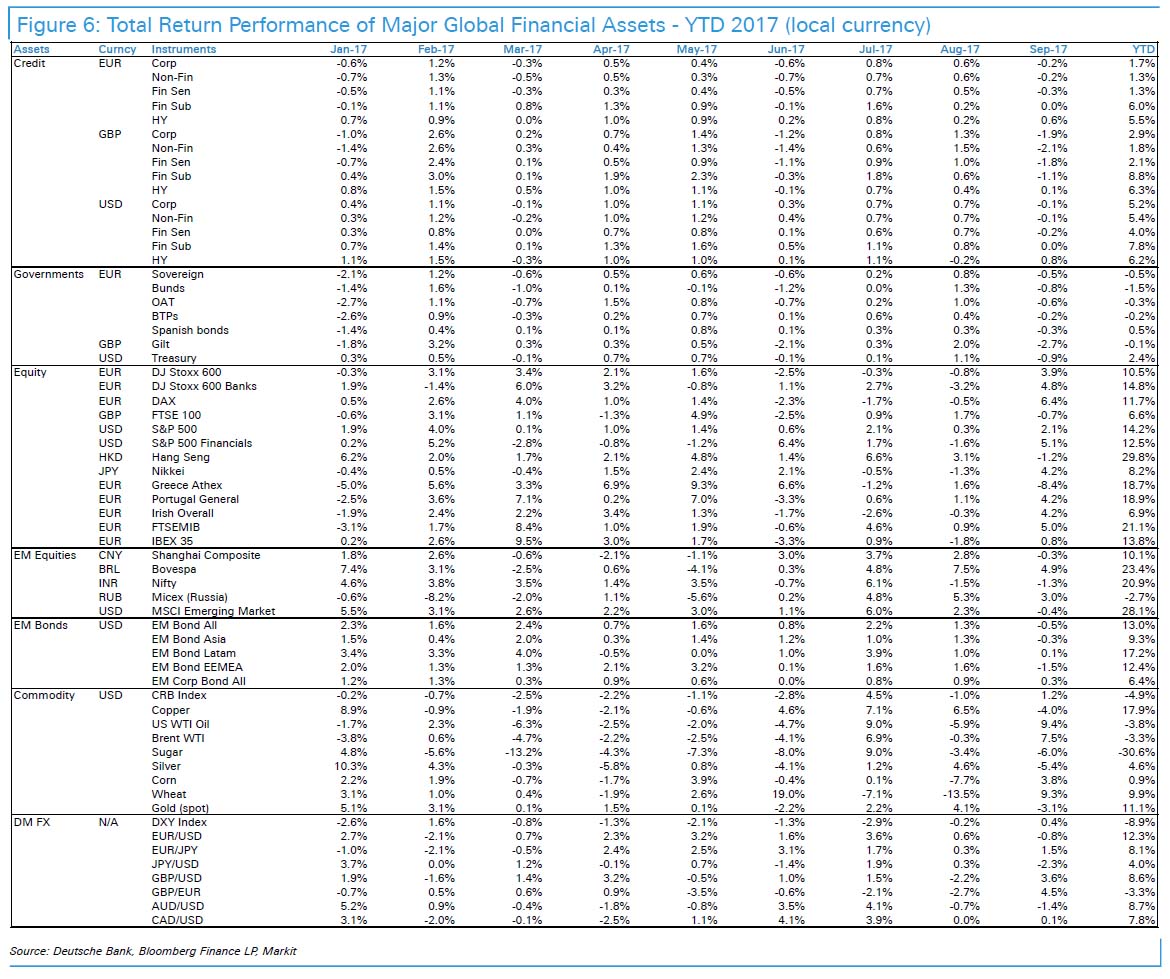
Global Financial Assets Total Return YTD. Source: Zero Hedge
Hard Assets In an Age of Negative Interest Rates (Mises.org)

Big institutional investors all make this one big mistake (StansBerryChurcHouse.com)

The Best And Worst Performing Assets In September, Q3 And 2017 YTD (ZeroHedge.com)

An Accountant Smells a Rat (TheyDailyCoin.org)

Bitcoin and the Tragedy of the Speculations (24HGold.com)

Gold Prices (LBMA AM)

03 Oct: USD 1,270.70, GBP 959.00 & EUR 1,081.87 per ounce
02 Oct: USD 1,273.10, GBP 956.48 & EUR 1,084.55 per ounce
29 Sep: USD 1,286.95, GBP 963.15 & EUR 1,090.82 per ounce
28 Sep: USD 1,284.30, GBP 961.04 & EUR 1,091.40 per ounce
27 Sep: USD 1,291.30, GBP 963.83 & EUR 1,099.54 per ounce
26 Sep: USD 1,306.90, GBP 969.59 & EUR 1,105.38 per ounce
25 Sep: USD 1,295.50, GBP 957.89 & EUR 1,089.26 per ounce

Silver Prices (LBMA)

03 Oct: USD 16.61, GBP 12.53 & EUR 14.13 per ounce
02 Oct: USD 16.58, GBP 12.46 & EUR 14.12 per ounce
29 Sep: USD 16.86, GBP 12.60 & EUR 14.27 per ounce
28 Sep: USD 16.82, GBP 12.53 & EUR 14.28 per ounce
27 Sep: USD 16.89, GBP 12.58 & EUR 14.38 per ounce
26 Sep: USD 17.01, GBP 12.67 & EUR 14.43 per ounce
25 Sep: USD 16.95, GBP 12.57 & EUR 14.27 per ounce


Recent Market Updates

- Plan For Run On The Pound
- Russia Gold Rush Sees Record Reserves For Putin Era
- China Catalyst To Send Gold Over $10,000 Per Ounce?
- Gold Matches S&P 500 Performance In First 3 Quarters; Up 12% 2017 YTD
- Gold Standard Resulted In “Fewer Catastrophes” – FT
- Financial Advice From Man Who Made $1+ Billion in 1929 – Importance Of Being Patient and “Sitting”
- “Gold prices to reach $1,400 before the end of the year” – GoldCore
- Commodities King Gartman Says Gold Soon Reach $1,400 As Drums of War Grow Louder
- Bitcoin “Is A Bubble” but Gold Is Money Says World’s Biggest Hedge Fund Manager
- Pensions and Debt Time Bomb In UK: £1 Trillion Crisis Looms
- Gold Investment “Compelling” As Fed May “Kill The Business Cycle”
- “This Is Where The Next Financial Crisis Will Come From” – Deutsche Bank
- Global Debt Bubble Understated By $13 Trillion Warn BIS

Important Guides

For your perusal, below are our most popular guides in 2017:

Essential Guide To Storing Gold In Switzerland

Essential Guide To Storing Gold In Singapore

Essential Guide to Tax Free Gold Sovereigns (UK)

Please share our research with family, friends and colleagues who you think would benefit from being informed by it.

Tuesday, October 3, 2017

Not All Hard Assets Are Created Equal

Published here: http://www.zerohedge.com/news/2017-10-03/not-all-hard-assets-are-created-equal

Not All Hard Assets Are Created Equal

Written by Jeff Nielson, Sprott Money News


A familiar refrain in many previous commentaries is that fiat currencies – especially Western fiat currencies – are fundamentally worthless. These currencies are backed by nothing, the definition of a fiat currency.


Typically, these currencies have been borrowed into existence. This makes such notes de facto IOU’s of our governments. However, Western governments are bankrupt. Their currency IOU’s are just as void of value as their bonds. Compounding this fundamental worthlessness, these Western currencies (especially the U.S. dollar) have been conjured into existence in unprecedented quantities in recent years.


Denominated in these worthless currencies, the “price” of any hard asset is effectively infinite. Why have the exchange rates of these various forms of worthless paper not already priced in this worthlessness?


There is a general answer and a specific to this question. The general answer goes as follows. The plunge of a currency to worthlessness is almost always “a confidence event”. What does this mean?


It means that such fiat currencies almost always become worthless from a fundamental perspective well before the official exchange rate descends to zero. The reason for this is quite simple.


A currency that has been in use for a significant period of time acquires the faith of the population that uses it. Few members of any population have the economic savvy to understand when a currency has become worthless from a monetary standpoint. Thus there is a honeymoon period.


A currency continues to have a relatively normal exchange rate even after it is fundamentally worthless because it still enjoys the confidence of that population. At some point (generally when the currency becomes even more extremely diluted), the population realizes that their currency has been debauched.


The paper loses the confidence of that population, and the descent in the exchange rate to near-zero quickly follows. We are currently in this “honeymoon period” with Western fiat currencies. They are fundamentally worthless, but very few people are aware of this.


There is also a second, specific reason why these various forms of worthless paper have not already begun their final death-spiral. The banking crime syndicate, better known as the One Bank, uses this paper to fund its criminal operations.


It has a very, very strong motive to delay this final death spiral. It has two powerful tools that it uses to extend this delay: propaganda and currency manipulation.


The propaganda is as constant as it is absurd. The central bankers (and their media lackeys) pretend there is no connection between the increase in supply of these currencies and the decrease in their value – the basic fundamentals of supply and demand.


In the fantasy world of Western central banks, the concept of dilution essentially does not exist. The laughable propaganda goes as follows.


With their reckless money-printing, these central bank charlatans are “trying” to create inflation (i.e. reduce the value of these currencies) but supposedly failing to do so. It’s the equivalent of a magical lemonade stand, where no matter how much water is added to the lemonade it cannot be diluted – it remains as strong as ever.


The other tool that the banking crime syndicate uses to delay the end of, in particular, the U.S. dollar is currency manipulation. The Big Bank tentacles of the One Bank have been criminally convicted of manipulating all of the world’s currencies.


With a potent propaganda machine, near-omnipotence in manipulating markets, and no meaningful law enforcement, the One Bank has added extra years to the life of its fraudulent fiat currencies. But their days are numbered.


What then?


All hard assets would have an effective “price” of infinity denominated in the various forms of this worthless paper. In that scenario, readers have asked: why should they be giving preference (now) to holding gold and silver?


It is because all of these hard assets are not equal. They are not equal in absolute value. Perhaps more importantly, as the bankers have manipulated most of our markets, prices have become severely skewed. The relative value of various hard assets has become even more unequal.


In terms of absolute value, gold and silver are “precious” metals. Silver, in fact, is even more aesthetically brilliant than gold. This means that when the fiat paper goes to zero, these are assets which (historically) are always valued highly.


However, the real reason why people should gravitate towards these assets is relative value. Many readers know that in monetary terms, gold and silver are “canaries in the coal mine”. They are supposed to alert us to precisely the sort of currency debauchment that has swept the Western world.


As a further means of delaying the end of this fraudulent paper, the One Bank has made the price suppression of precious metals one of its overriding obsessions. The price of gold has been held to a small fraction of its real value in order to make the bankers’ fiat paper appear to have retained its worth.


The price of silver has been suppressed even more ruthlessly. In real dollars, it was driven to a 600-year low, and has effectively remained at that level. Compare the relative value of these hard assets with real estate.


Year after year of near-zero interest rates has fueled real estate bubbles of unprecedented proportions across major urban centers. In relative terms, real estate has never been more expensive. Real estate is the worst place to attempt to shelter our wealth as we flee the bankers’ paper currencies.


Various other classes of hard assets fall somewhere in between these two extremes. Almost all commodities are at relatively depressed levels. Soaring commodity prices are a secondary warning of imminent hyperinflation, so the bankers have suppressed most commodity markets.


This may confuse the issue in the minds of some. If all commodities are suppressed, then any commodity becomes a suitable haven for our wealth as we flee fiat currencies. Not so.


There is the simple, practical issue. Few commodities can be held directly by the average investor. It’s not practical to attempt to hold bushels of wheat, barrels of oil, or warehouses full of lumber. “Holding” commodities in the form of paper ETF’s means venturing into the bankers’ corrupted markets – and accepting counterparty risk.


As a practical matter, it is easier to hold gold and silver than virtually any other class of hard asset. This leads to the reason why it is so easy to hold these metals.


Gold and silver are money. In terms of wealth preservation, they are stores of value which is why they are universally regarded as premier safe havens. Because gold and silver are money, this makes them the most liquid hard assets.


It is this property of ultimate liquidity that makes gold and silver such coveted safe havens. Implied when one seeks shelter from any crisis is that at some point the crisis ends. At that point the asset-holder is looking to exchange their hard assets for other goods (and services). As a
basic fundamental of commerce, the greater the liquidity of any asset, the more fully-valued it is when liquidated, i.e. the smaller the discount faced by the seller/trader.


Our fiat currencies are worthless. Even most readers who may not be ready to accept this ultimate verdict must be troubled by the dubious monetary fundamentals of these various forms of paper.


They are going to zero. They always go to zero. In the one thousand years since humanity first began practicing this form of monetary fraud, all fiat currencies plunge to worthlessness – and generally quickly. Our own fiat currencies are overdue for their final Death Spiral.


In fleeing fiat, not all hard assets are created equal. Gold and silver offer three superior qualities:


  1. Relative value today. Gold and silver are more undervalued at present, meaning we get the best exchange rate in return for our fiat paper.
  2. Superior liquidity tomorrow. Whether selling or spending our gold and silver, these hard assets will be discounted less than virtually any other asset class.
  3. Convenience. Even at the absurd price of $1,200/oz (USD), most of us could carry all or almost all of our life-savings, converted to gold.


Gold or silver? Silver is the better buy in relative value. As the more valuable metal, gold is much more portable and thus much more convenient.


With its lower exchange rate, silver is the better metal in which to conduct routine commerce. With its higher exchange rate, gold provides greater security in a crisis. In short, hold both, each for their own reason.


The need to rid ourselves of paper fiat currencies should be obvious. Our primary refuge from those fiat currencies should be equally obvious.


Questions or comments about this article? Leave your thoughts HERE.


Not All Hard Assets Are Created Equal

Written by Jeff Nielson, Sprott Money News


Plan For Coming Run On The Pound

Published here: http://www.zerohedge.com/news/2017-10-03/plan-coming-run-pound

Run On The Pound ? Jeremy Corbyn Says Should Plan For

- Right to plan for 'run on pound' if Labour wins says Corbyn and Labour party 
- British pound already down 20% since Brexit, collapse already in play
- Run on the pound likely due to Labour's 'command economy' approach
- Collapse in Sterling would undermine UK financial system
- Portfolios holding sterling and related assets would be significantly affected
- Pension funds and property the most likely to get hit by run on the pound
- Gold to benefit as sterling collapse picks up pace

Editor: Mark O'Byrne

currency collapse

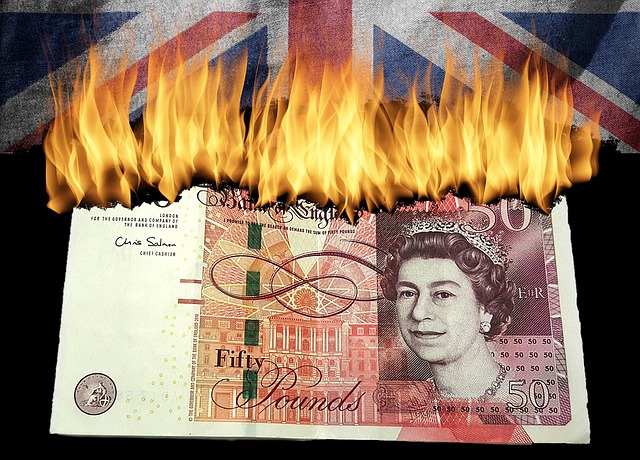
Last week Labour Shadow Chancellor John McDonnell said the party was carrying out "war-game-type scenario-planning" for events such as "a run on the pound".

A run on the pound would see the value of the currency plummet, increase inflation and increase the value of those age old stores of value - namely gold and silver.

McDonnell's reasons for war-gaming were because of expectations that a 'radical' Labour government would face a range of challenges.

He said was seeking to "answer the question about what happens when, or if, they come for us".

When asked what McDonnell meant by 'they', party leader Jeremy Corbyn said he was likely referring to outside forces who have previously punished Labour governments in such a way.

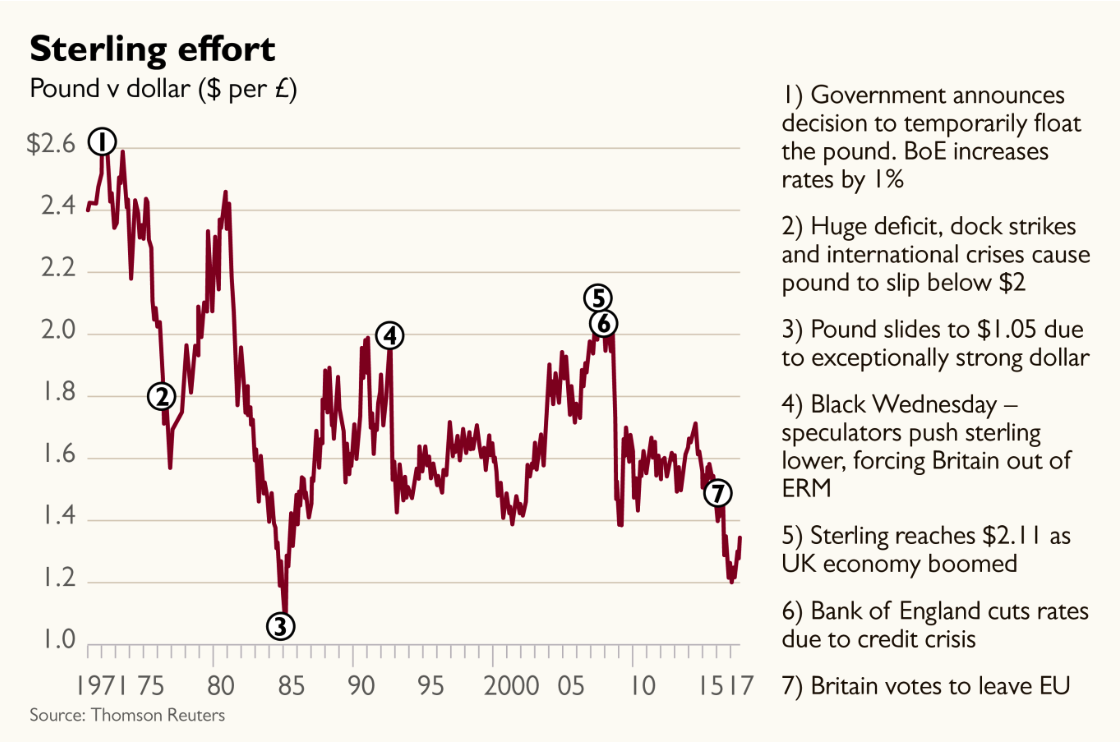
Pound collapse 1971

Of course the most famous run on the pound in living memory happened in 1992 but for Labour it was nearly 50 years ago that still haunts them.

In November 1967 Harold Wilson's government announced it was lowering the exchange rate.  The pound fell to $2.40, down from $2.80, a fall of just over 14%.

Wilson is now much ridiculed for his statement made on national radio and television in which he 'reassured' citizens that:

"It does not mean that the pound here in Britain, in your pocket or purse or in your bank, has been devalued."

Wilson's comments, whilst derided at the time, seem to still ring true for our own government who do not appreciate that ongoing policies have resulted in a ongoing devaluation in the pound.

Labour's adverse effect on the pound

It is not a ridiculous thought that 'they' might come for us should Labour be victorious. If one takes a look at Labour's policies then we would come about as close to a command economy as one can get in peacetime.

McDonnell has pledged to 'take back' rail, water, energy and the Royal Mail.

Both the CBI the British Chambers of Commerce have denounced the shadow chancellor's plans as “forced nationalisation”

Europe has seen this before, writes Alex Rankine:

Not since François Mitterrand took the French presidency in 1981 has a European party come this close to power with such a radical policy programme. Mitterrand’s purist socialist experiment was “brought to heel” by the markets when the franc slumped, creating a surge in inflation and a policy U-turn.

Labour are prepared for this and almost seem to be relishing the idea. Mark Serwotka, from the PCS union representing civil servants, said Labour would face "huge" opposition should it win. Serwotka predicted "all the usual arms of the ruling class will be brought to bear".

The union leader included using financial markets to bring "economic pressures" such as "the flight of capital" and trying to destabilise the economy.

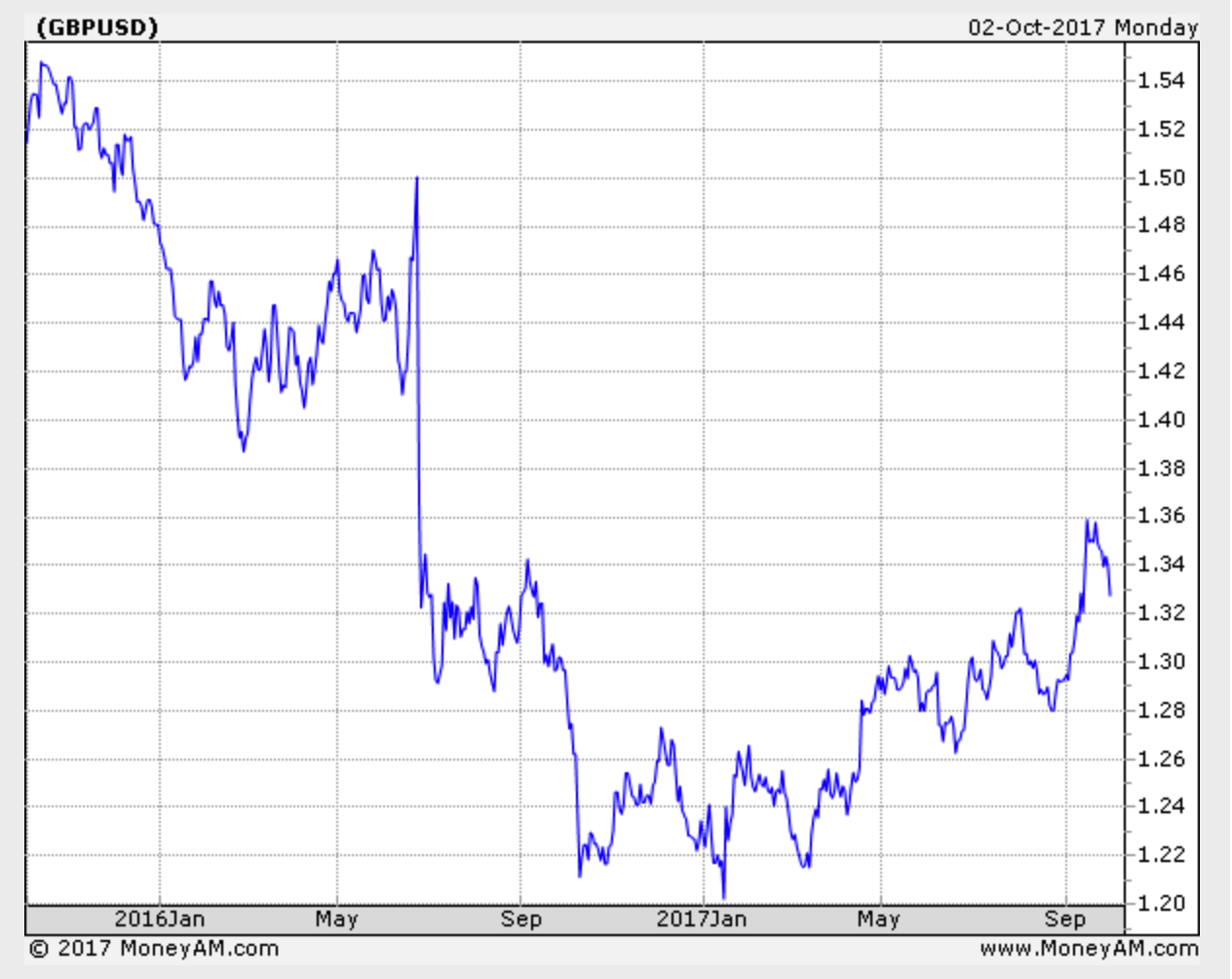
GBP 2 year performance

For the Conservatives, "Labour's plans would go too far, and ordinary working people will end up footing the bill," Chancellor Philip Hammond said.

The problem is, ordinary working people are already footing the bill. Without the help of Labour's socialist policies.

What is a "run on the pound" and the consequences

A run on a currency usually happens when markets feel it is overvalued or is likely to drop quickly.

Both international investors and speculators sell the currency and assets denominated in that currency en masse, forcing its value down.

The UK's most recent, famous example is from 1992. That September, a day now known as Black Wednesday, the falling value of sterling forced the Conservative government exit the European Exchange Rate Mechanism after its attempts to support the currency failed.

In the most recent threat of a run on Sterling Labour's opposition seized on McDonnell's comments. Current Chancellor of the Exchequer Philip Hammond said Labour’s economic policies would trigger “a collapse in business investment and a crash in the value of the pound, causing a shock wave of inflation”.

When there is a panic sell of a currency, the value drops and we see a rise in price of imported goods and raw materials.

There is of course major capital flight. A sudden exodus of large sums of money out of the country which would undermine the stability of the financial system in the UK.

Altogether financial shocks such as these could push up inflation.

It sounds awful but the truth is Labour's success may only mean an acceleration of what is already in place.

The value of the pound has been in decline for many decades now. This is thanks to stealth inflation caused by loose monetary policies and little focus on preserving the value of the pound in our pockets.

Between 2007 and 2008 the British Pound fell 21% (peak to trough). Whilst the rest of the world was on the verge of deflationary collapse we experienced an inflationary recession. GDP contracted at a top rate of 6.1% annually and inflation touched 5.1%.

We still haven't recovered. Previously we would have hauled ourselves out of such a fall thanks to manufacturing. Generally manufacturing has higher returns to scale than services.

Today we don't have that option. As a result we are extremely reliant on capital inflows into the City of London to limit a fall in sterling.  But, as 2007 -2008 showed, this is an extremely unstable source of foreign demand for our currency.

No right for Tory smugness

Of course one thing that in all of their criticism the Conservative Party appears to have forgotten is that for the past year the United Kingdom has been experiencing a collapse in the Pound, whilst under their rule.

Since the Brexit vote on June 23rd 2016 the value of Sterling has fallen by over 20% against the U.S. Dollar.

Many point to Brexit as the leading cause, it is most certainly the catalyst. However Conservative policies have done little to boost confidence in the currency in the last two years.

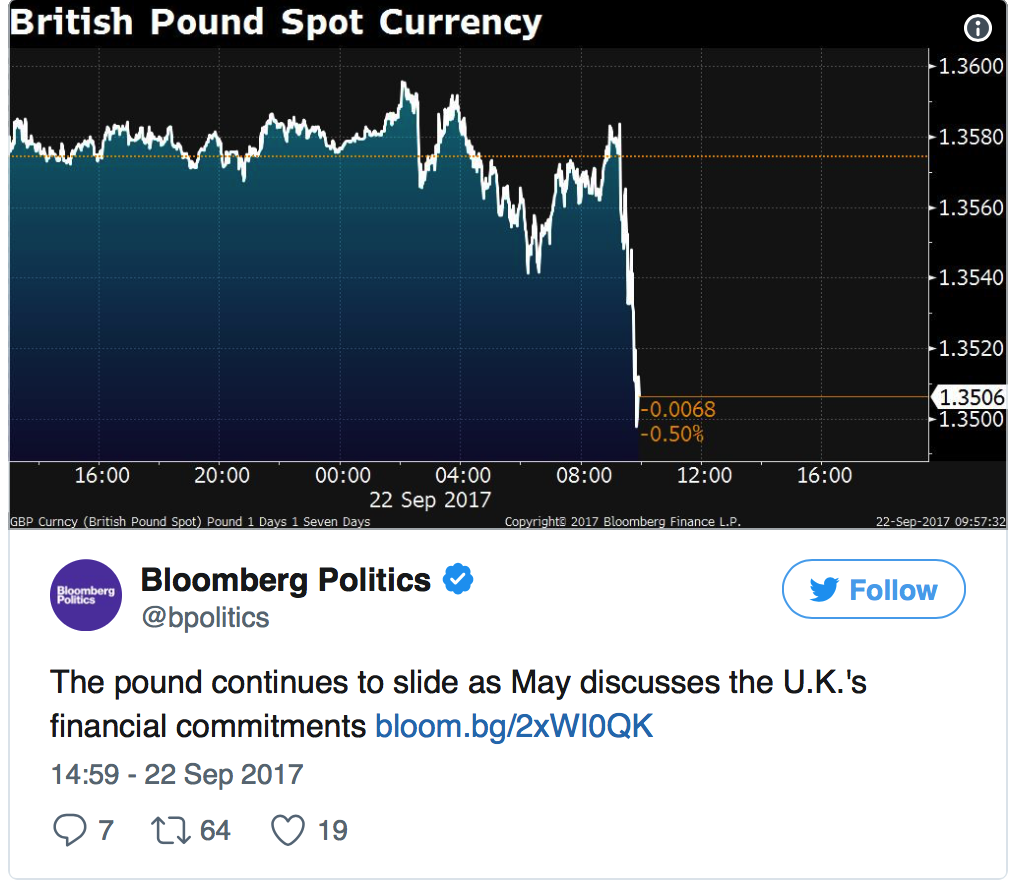
Concerns are so serious regarding Brexit and Mrs May's ability to keep her government on side that not even a speech in Florence could give the pound a much needed boost.

Bloomberg tweet


Conclusion - no need for war-gaming, we're already at war

Labour's practice runs should perhaps be closer observed by those already in power. They should see it as a reflection of what is already happening. The only difference is the Labour scenario would be at a faster pace.

As demonstrated, the British Pound is already in free-fall. Just because we haven't seen major capital flight since the 1970s does not mean that it isn't happening. Just because inflation measures suggest there is little inflation in the economy does not mean it isn't there.

Currency devaluation is very much a part of every-day financial life. We all witness it, as prices increase and our paper and electronic fiat currencies no longer goes as far.

Already pension funds and the housing market are in a state of disarray. Few really know how pension funds are going to manage their major deficits and the housing market is on the brink of collapse.

A run on the pound would merely be the final spark in a highly combustible environment. With or without a Labour victory savers' personal wealth is already at great risk.

In all previous collapses in currencies, gold and silver have acted as hedges and safe havens. We only need to look at situations such as the stagflation that afflicted most western economies in the 1970s to see this. Or indeed the more extreme versions as seen in the Weimar Republic historically and Zimbabwe and Venezuela today.

Investors would be well advised to line their portfolios with gold bullion before the UK economy or electorate throws up yet another fuse for the international markets to take a dislike to.

UK investors have the great benefit of being able to invest in gold capital gains tax (CGT) free when they buy Gold Sovereigns or Gold Britannias for insured delivery or stored in the safest vaults in Switzerland, Singapore and Hong Kong.

The best time to get insurance is before the event you need to protect against happens ... whether that be car insurance, health insurance or the financial insurance of gold coins and bars.

News and Commentary

Gold slips to near 7-week low as dollar firms (Reuters.com)

Stocks Add Gains, Dollar Climbs on Economic Cheer (Bloomberg.com)

Gold imports up 330% (DNAIndia.com)

U.S. Stocks, Dollar Gain as Manufacturing Surge (Bloomberg.com)

China proven gold reserves at 12,100 tonnes at end-2016 (Reuters.com)


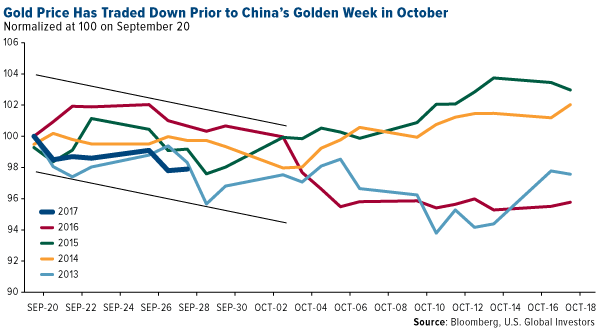
Gold sells off before Chinese golden week. Source: US Funds

This Could Be a No-Brainer Gold Buying Opportunity - Holmes (GoldSeek.com)

IMF Head Foresees the End of Banking and the Triumph of Cryptocurrency (Fee.org)

[VIDEO] Peter answers: What’s the real story behind China’s “ghost cities”? (StansBerryChurcHouse.com)

Incredible images from 1890s capture life for prospectors chasing Yukon gold (DailyMail.co.uk)

Satan's Bank Note (HistoryToday.com)

Gold Prices (LBMA AM)

03 Oct: USD 1,270.70, GBP 959.00 & EUR 1,081.87 per ounce
02 Oct: USD 1,273.10, GBP 956.48 & EUR 1,084.55 per ounce
29 Sep: USD 1,286.95, GBP 963.15 & EUR 1,090.82 per ounce
28 Sep: USD 1,284.30, GBP 961.04 & EUR 1,091.40 per ounce
27 Sep: USD 1,291.30, GBP 963.83 & EUR 1,099.54 per ounce
26 Sep: USD 1,306.90, GBP 969.59 & EUR 1,105.38 per ounce
25 Sep: USD 1,295.50, GBP 957.89 & EUR 1,089.26 per ounce

Silver Prices (LBMA)

03 Oct: USD 16.61, GBP 12.53 & EUR 14.13 per ounce
02 Oct: USD 16.58, GBP 12.46 & EUR 14.12 per ounce
29 Sep: USD 16.86, GBP 12.60 & EUR 14.27 per ounce
28 Sep: USD 16.82, GBP 12.53 & EUR 14.28 per ounce
27 Sep: USD 16.89, GBP 12.58 & EUR 14.38 per ounce
26 Sep: USD 17.01, GBP 12.67 & EUR 14.43 per ounce
25 Sep: USD 16.95, GBP 12.57 & EUR 14.27 per ounce


Recent Market Updates

- Russia Gold Rush Sees Record Reserves For Putin Era
- China Catalyst To Send Gold Over $10,000 Per Ounce?
- Gold Matches S&P 500 Performance In First 3 Quarters; Up 12% 2017 YTD
- Gold Standard Resulted In “Fewer Catastrophes” – FT
- Financial Advice From Man Who Made $1+ Billion in 1929 – Importance Of Being Patient and “Sitting”
- “Gold prices to reach $1,400 before the end of the year” – GoldCore
- Commodities King Gartman Says Gold Soon Reach $1,400 As Drums of War Grow Louder
- Bitcoin “Is A Bubble” but Gold Is Money Says World’s Biggest Hedge Fund Manager
- Pensions and Debt Time Bomb In UK: £1 Trillion Crisis Looms
- Gold Investment “Compelling” As Fed May “Kill The Business Cycle”
- “This Is Where The Next Financial Crisis Will Come From” – Deutsche Bank
- Global Debt Bubble Understated By $13 Trillion Warn BIS
- Bitcoin Price Falls 40% In 3 Days Underlining Gold’s Safe Haven Credentials

Important Guides

For your perusal, below are our most popular guides in 2017:

Essential Guide To Storing Gold In Switzerland

Essential Guide To Storing Gold In Singapore

Essential Guide to Tax Free Gold Sovereigns (UK)

Please share our research with family, friends and colleagues who you think would benefit from being informed by it.
Monday, October 2, 2017

Is That a Feature or a Bug? Gold & Silver Report 1 Oct 2017

Published here: http://www.zerohedge.com/news/2017-10-02/feature-or-bug-gold-silver-report-1-oct-2017

We have covered many reasons why bitcoin is unsound and not money. It’s a ledger of unbacked liabilities. It is designed to have finite quantity but therefore indeterminate and hence volatile value. This makes it unusable for borrowing or lending and hence savings, but a great a vehicle for conversion of one person’s wealth into another’s income. It is not a commodity—discussion of the usefulness of the network notwithstanding—nor is it backed by a commodity or any asset. It is a perfect, cryptographically secure record—of itself. People use it to get rich quick. In other words, it’s the very model of a (post)modern monetary marvel (OK, Keith is not the next Gilbert and Sullivan).

And bitcoin has a questionable feature. Transactions are irreversible.

First it should be addressed that irreversible transactions have an appeal to merchants. Everyone who sells on eBay knows the frustration of shipping merchandise to a customer only to have the customer claim it was never received. Merchants would surely love the idea that once payment is made, it cannot be unmade.

However, there are good reasons why our payments system was designed as it is. Sometimes there is a clear mistake. No one has an interest in allowing the payee to keep $100,000 when $10,000 was the purchase price of the used car. No one wants to see Jon Schmidt get the money that was intended for John Smith. There is also the occasional case of fraud. If someone breaks into your account, you want recourse to recover the lost funds. Irreversible transactions are not a dream come true for consumers who are defrauded by merchants.

Consider that bitcoin’s designer, Satoshi, built the system so that transactions cannot be reversed. Is this a merchant’s dream come true? Or a criminal’s? Qui bono (who benefits?) It is hard to even think of a good legitimate case for this.

Now also consider that bitcoin was designed so payments can be sent and received anonymously. You not only cannot reverse a transaction, but you don’t even know who got it, so there is no way to know who to sue in court. Your money (well your bitcoin) is irretrievably lost.

The combination of irreversible and anonymous may still seem to have some legitimate appeal, but let’s acknowledge the elephant in the room. It’s perfect for criminals. Anyone who sells fake driver’s licenses or murder for hire would love it.

As an aside, bitcoin’s anonymity is not perfect. The ledger shows every transaction, which means that if your identity is ever discovered, anyone can go through the history of what you have done. For example, if you sell bitcoins in an account at an exchange, and wire the dollars to your bank account.

To address this problem, there is the bitcoin mixer. It is designed to mix up your bitcoins with the bitcoins of others who also want to hide the identity of their coins and their origin. It seems almost as if it is designed for money laundering. While irreversible transactions may have some legitimate use cases, this is a whole ‘nother beast. If you steal millions of dollars of bitcoin from an exchange, hack a DAO, sell rocket launchers to terrorists, or even infect companies with ransomware, the mixer is great. You need a way to get paid, without anyone being able trace your loot.

It’s just like bags of cash left in the phone booth at 2am across the street from the all-night diner (as we recall from detective shows in the 1970’s), only better. In those shows, the bad guy always demanded “unmarked” bills, but no one ever clearly showed what “marked” vs. “unmarked” looked like. Well (we assume) bitcoins that have been tumbled are unmarked.

Irreversibility, anonymity, and untraceable unmarked bills. That may still sound attractive to a consumer, an end user of the system. However, that is not the main question, which is: are these desirable features for businesses who sell you things? Are they appropriate features for financial businesses who ask you to trust them with your life savings?

If no trust is possible, if civil society ever breaks down so far that no one can trust anyone else, that transactions are conducted between two armed groups with cash exchanged for goods under cover of more armed men with rifles, then we will have arrived in Keynes’ long run—a dark age. This has not happened just yet. So let’s continue with our inquiry into the nature of anonymity, irreversibility, and untraceability.

It takes us now to the concept of transparency. Let’s look at some examples outside finance. A grocer sells tomatoes labeled “locally grown”. Consumers want to be able to trust the label, and not have to be suspicious that they were really grown in Venezuela. If E Coli breaks out, everyone has an interest in tracing the tainted produce back to the packaging plant or farm which introduced the bacteria.

If a solar panel company tells you that its panels generate 15 watts per square foot, you want to trust that it is not only telling the truth but the whole truth. Is this figure for residents of a high altitude southern desert like Albuquerque or is it for a northern city like Oslo?

If an electric car company claims that its HEPA air filter is good enough to block biological warfare agents, buyers want to know if this has been validated by a credible third party.

It’s one thing if such marketing claims are mere puffery. We don’t know if any Tesla buyers are planning to drive through war zones where anthrax bacteria are in the air. We assume it is more about so called bragging rights:

“Oh yeah, your 911 turbo S can out-accelerate my Tesla in super-duper ludicrous insane mode?! Well can it do it under conditions of biological warfare??”

It is quite another when a company custodies client assets, or brokers or conducts financial transactions. A responsible financial business thinks constantly about—and establishes systems and controls for—conflicts of interest, unsustainable structures, shady transactions, and all factors which affect pricing or execution for its clients. For example, Monetary Metals publishes graphs of the offers that set the gold interest rate in its lease auctions.

You would expect disclosure statements, documented processes, guidance from a credible law firm, and an auditor—not to mention due diligence. Conversely, if a firm seems optimized to avoid government scrutiny, if there is no way to discover who owns it much less its liabilities, then it may not be seeking to build a great business for the long term.

Like it or not, we live in a world which is demanding more transparency from the companies we trust. And consumers and savers should like it.

In this light, let’s look at two interesting promises of the blockchain, One, there is no need to trust in a counterparty. Two, it enables realtime audit and verification.

The reality is any coalition of miners that controls a majority of the mining power can do whatever they want. For example, they can fork to undo a transaction. Whether you realize it or not, you are giving your trust to them—whomever they are. As the capital investment required to be a serious player in bitcoin mining has increased, mining power has consolidated. As the electricity consumption of serious mining power increased, miners consolidated in regions with subsidized electricity prices.

We do not believe that most people understand or appreciate that bitcoin governance is political.

As to realtime audit, how many cryptocurrency financial firms show even just their assets on the blockchain? (This would be of limited value without the liabilities also). It is telling that MtGox, before it collapsed, was a leading (if not the leading) bitcoin exchange and account provider. Serious allegations have emerged that MtGox was operating in a state of insolvency for years. A leading firm in the space. It was insolvent for years. A leading firm. Think about that. Take as long as you need.

The hype-reality spread is wide indeed.

Finally, we get to the so called Initial Coin Offering, or ICO. Raising capital is difficult and expensive under securities regulations. Many regulations serve to protect incumbents (see this article by Keith). It would seem to be a good thing to bypass all this, and sell a newfangled thing that is not called a security but a token.

However, it must be said that early-stage companies are risky. Regulation or no regulation, a responsible entrepreneur does not raise capital from people who don’t understand the risks and/or cannot afford to bear them. Yes, that means retirees living on a fixed pension. Responsible entrepreneurs do not promote their offerings with unrealistic promises of huge gains, while omitting a discussion of risks. They certainly do not use the proceeds to speculate on asset prices or plow them into the next startup’s hot deal (said next startup having an undisclosed relationship with management, of course).

For that matter, and this also needs to be said, no good comes of raising too much money too early in a company’s development. In a sane world, investors do not inject $30,000,000 into a company with a white paper and a partial management team. So what does that make the ICO world?

As the bitcoin mixer is designed to help criminals evade law enforcement, the ICO is designed to help businesses raise money that they have no business raising.

We are not lawyers, however one thing seems clear enough. The tokens sold in ICOs are securities. Sooner or later, regulators will crack down on issuers. And if innocent investors are bilked of their savings, the crackdown will be sooner.

This discussion brings us full circle. Bitcoin proponents will tell you that bitcoin is going to a million dollars. That may be, but it helps make our point that while the price is going up everyone is happy and fraud often goes undiscovered. Bernie Madoff was not caught until December 2008, when stocks crashed in the global financial crisis. If the Fed had kept the boom going for another 5 years, it’s likely that Madoff would have gotten away with it until 2013.

We are not, by the way, big fans of prior restraint regulation. In practice, regulatory compliance—whatever its stated intent—often means guilty until proven innocent. It demands that you constantly prove your innocence, at your own expense, under threat of being convicted of the crime of not complying.

However, we firmly believe that if a crime is committed then law enforcement should obtain a warrant and ask financial intermediaries for documentation related to the suspicious transactions and persons of interest. And we believe that responsible businesses keep records of transactions and clients for a number of reasons, including that they want to assist law enforcement catch criminals. No honest person benefits from aiding and abetting criminals.

A responsible financial business makes money by making money for its clients. It does so whether it operates in a free market or in a severe regulatory environment. Conversely, regulation does not stop the bad actors. Witness Bernie Madoff, who stole tens of billions, in a Ponzi scheme that endured perhaps 30 years (the start of the great boom fueled by falling interest rates since 1981).

Regulation, or not, a responsible business does not tout incredible gains, cherry pick performance numbers, conceal the source of funds, obscure its activities, ignore its liabilities, or understate or deny the risks while hyping the possible gains.

Of course, most businesses involved in bitcoin are not dishonest, the same as people elsewhere. However, it cannot be ignored that the bitcoin ecosystem has features which seem tailor-made for criminal activity.

Our final caveat is that law enforcement may allow things to proceed for years. When it enters a new technology arena, law enforcement can be like a steamroller. It doesn’t move forward quickly. However, once it grabs a toe, it will keep rolling right over the body, until it is made one with the pavement.


The prices of the metals dropped $17 and $0.35, and the gold-silver ratio rose to 77.

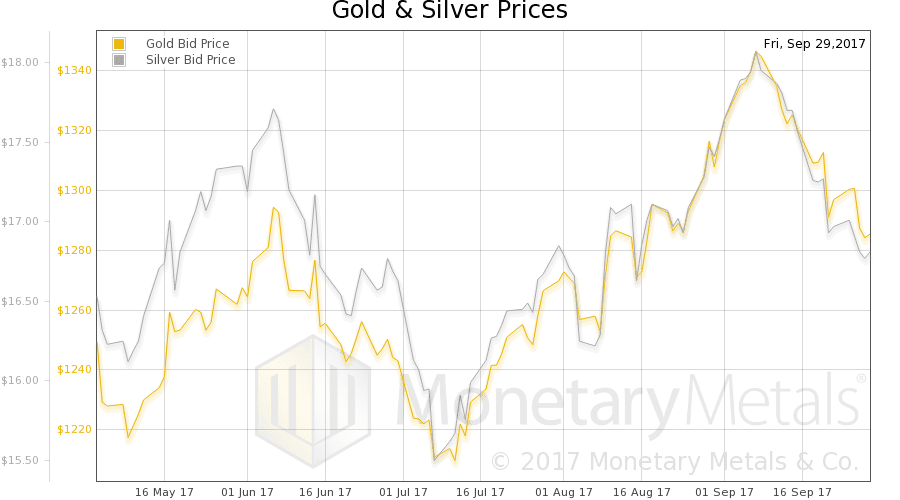
A look at the chart of either metal shows that a downtrend in prices (i.e. uptrend in the dollar) that began in mid-April reversed in mid-July. Then the prices began rising (i.e. dollar began falling). But that move ended Sep 8.

One way to think of these moves is as the addition of energy into the market. Like tossing a pebble into a still pond (not quantity of water, but energy that perturbs it). Once the speculators get the idea that gold and especially silver should go up, well it becomes self-fulfilling. Statements by the Fed, the ECB, or even the fatboy who rules North Korea can all have an effect.

Buying begets buying, as the chart shows signs of a breakout. But then, especially in this moribund market, the energy of new speculation is depleted. And the price subsides, until new energy is added by the next event. We are in that mode right now.

We will look at an updated picture of the fundamentals of supply and demand of both metals. But first, here are the charts of the prices of gold and silver, and the gold-silver ratio.

Next, this is a graph of the gold price measured in silver, otherwise known as the gold to silver ratio. The ratio rose.

In this graph, we show both bid and offer prices for the gold-silver ratio. If you were to sell gold on the bid and buy silver at the ask, that is the lower bid price. Conversely, if you sold silver on the bid and bought gold at the offer, that is the higher offer price.

For each metal, we will look at a graph of the basis and cobasis overlaid with the price of the dollar in terms of the respective metal. It will make it easier to provide brief commentary. The dollar will be represented in green, the basis in blue and cobasis in red.

Here is the intraday gold graph showing Friday’s action (you can see the regular 3-month gold basis chart).

This is interesting. From a bit after 6am (GMT) the price of gold is rising but the basis is falling. That means the buying was fundamental, i.e. gold metal was bought. This lasted until a bit after 7am. At around 10:30am, something different occurred. Speculators started buying futures. They drove the price up from $1,288 to $1,290, but this took the basis up from 0.8% to 0.83%. After that, the basis tracked the price. That is, when price was falling basis was falling (i.e. futures were being sold) and when price was rising basis rose with it (i.e. futures were bought). By the way, don’t pay too much attention to the end of the day, as particularly on a Friday liquidity is dried up and the signal can be spurious.

Our calculated Monetary Metals gold fundamental price fell $30 to $1,348.

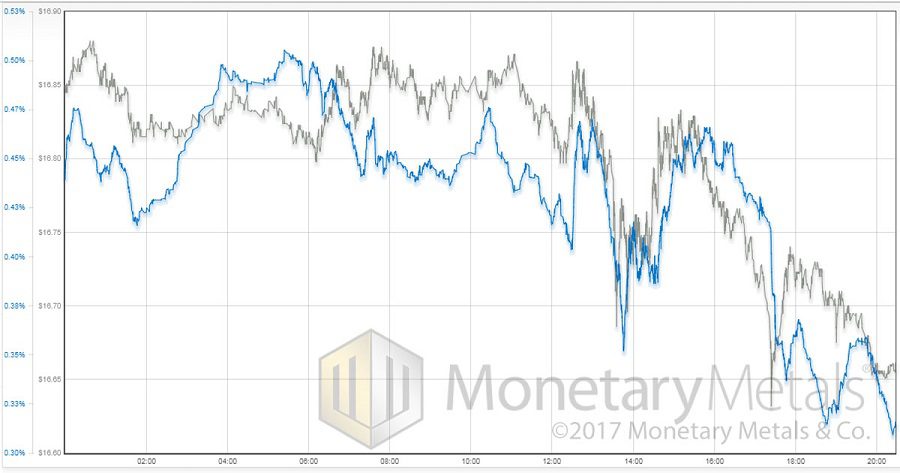
Now let’s look at silver intraday (here is the regular daily silver basis chart).

Interestingly again, we see the same fundamental buying of silver after 6am from $16.80 to $16.86 while the basis drops from 0.5% to 0.47%. After that, like gold, the price action was driven by speculators in the futures markets.

Our calculated Monetary Metals silver fundamental price fell $0.25 to $17.05.


© 2017 Monetary Metals

Russia Gold Rush Sees Record Reserves For Putin Era

Published here: http://www.zerohedge.com/news/2017-10-02/russia-gold-rush-sees-record-reserves-putin-era

Russia Gold Rush Sees Record Reserves For Putin Era

by Yuliya Fedorinova of Bloomberg via Irish Indepedent

Vladimir Putin is doing his part to keep the upswing in gold alive.

Since the Russian president went on a geopolitical offensive in Ukraine in 2014, the haven asset had its first annual gain in four years in 2016 and is on track for another in 2017.

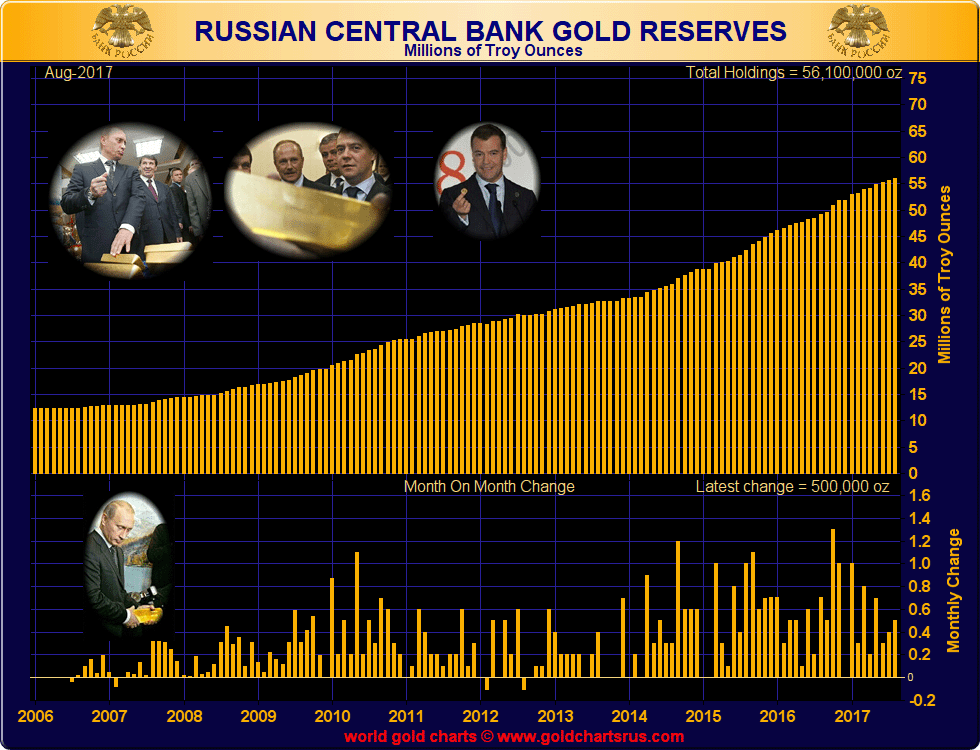
Click to enlarge. Russia added another 500,000 ounces of gold to it's reserves in August. Source: Goldchartsrus.com

A beneficiary of economic and political perils from North Korea to Brexit, it's among the top-performing commodities this year.

Meanwhile, the Bank of Russia has more than doubled the pace of gold purchases, bringing the share of bullion in its international reserves to the highest of Mr Putin's 17 years in power, according to World Gold Council data.

In the second quarter alone, it accounted for 38pc of all gold purchased by central banks.

The gold rush is allowing the Bank of Russia to continue growing its reserves while abstaining from purchases of foreign currency for more than two years.

But what may matter most is that gold is as geopolitics-proof an investment as any in the age of sanctions and a deepening rift with the US.

"Gold is an asset that is independent of any government and, in effect, given what is usually held in reserves, any Western government," said Matthew Turner, metals analyst at Macquarie Group in London. "This might appeal given Russia has faced financial sanctions."

Besides being the largest official buyer of gold, Russia is also among the world's three biggest producers, with the central bank purchasing from domestic miners through commercial banks and not in the open market.

Since starting to accelerate bullion purchases in 2007, Russia's holdings have more than quadrupled to 1,556 tonnes at the end of June, just behind China and more than Turkey, India and Mexico combined, bringing its share in Russia's $427bn (€361bn) reserves to near 17 percent.

If buying continues at a similar pace, the World Gold Council said the full-year increase in 2017 "could closely match" 2015 and 2016.

Source: Irish Independent

Related Content

Russia Sees Gold Reserves As “Additional Financial Cushion” In Face Of “External Uncertainties”

Russia Gold Buying Returns – Buys One Million Ounces In January

Putin Says Russia and China Must Secure Gold and FX Reserves

Russia Coordinating Gold Reserve Accumulation With Ex Soviet States?


News and Commentary

Gold drops to lowest in nearly 7 weeks; stronger dollar, equities weigh (Reuters.com)

Deutsche Bank in $190M currency-rigging settlement (Reuters.com)

U.S. Stocks Hit Records, Fed Talk Weighs on Bonds (Bloomberg.com)

Kevin Warsh is far from a lock to replace Janet Yellen as Fed chair (CNBC.com)

London house prices have fallen for the first time in eight years (CityAM.com)


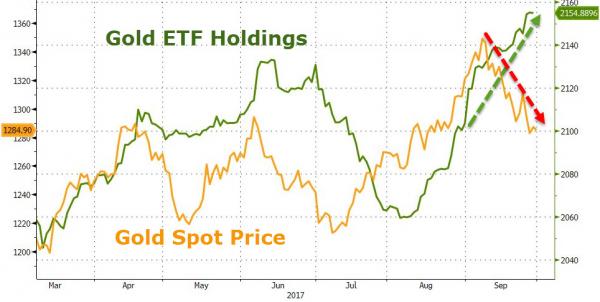
Demand for gold in September surged with ETF holdings rising most since Feb 2017. Source: ZeroHedge

Gold Demand Surges As Price Suffers Worst Month Since November (ZeroHedge.com)

Trump's "1500-Word Airball" Tax Plan (DailyReckoning.com)

Stock Market Is Seriously Overvalued Based On This Benchmark (GoldSeek.com)

Macquarie Lashes Out At Dimon: "Modern Finance", Not Bitcoin, Is The Real Fraud (ZeroHedge.com)

Specter of Hyperinflation in Zimbabwe Triggers Panic Buying (ENCA.com)

Get your insurance while you can, not when you have to… (TheMacroTourist.com)

Gold Prices (LBMA AM)

02 Oct: USD 1,273.10, GBP 956.48 & EUR 1,084.55 per ounce
29 Sep: USD 1,286.95, GBP 963.15 & EUR 1,090.82 per ounce
28 Sep: USD 1,284.30, GBP 961.04 & EUR 1,091.40 per ounce
27 Sep: USD 1,291.30, GBP 963.83 & EUR 1,099.54 per ounce
26 Sep: USD 1,306.90, GBP 969.59 & EUR 1,105.38 per ounce
25 Sep: USD 1,295.50, GBP 957.89 & EUR 1,089.26 per ounce
22 Sep: USD 1,297.00, GBP 956.15 & EUR 1,082.09 per ounce

Silver Prices (LBMA)

02 Oct: USD 16.58, GBP 12.46 & EUR 14.12 per ounce
29 Sep: USD 16.86, GBP 12.60 & EUR 14.27 per ounce
28 Sep: USD 16.82, GBP 12.53 & EUR 14.28 per ounce
27 Sep: USD 16.89, GBP 12.58 & EUR 14.38 per ounce
26 Sep: USD 17.01, GBP 12.67 & EUR 14.43 per ounce
25 Sep: USD 16.95, GBP 12.57 & EUR 14.27 per ounce
22 Sep: USD 16.97, GBP 12.52 & EUR 14.18 per ounce


Recent Market Updates

- China Catalyst To Send Gold Over $10,000 Per Ounce?
- Gold Matches S&P 500 Performance In First 3 Quarters; Up 12% 2017 YTD
- Gold Standard Resulted In “Fewer Catastrophes” – FT
- Financial Advice From Man Who Made $1+ Billion in 1929 – Importance Of Being Patient and “Sitting”
- “Gold prices to reach $1,400 before the end of the year” – GoldCore
- Commodities King Gartman Says Gold Soon Reach $1,400 As Drums of War Grow Louder
- Bitcoin “Is A Bubble” but Gold Is Money Says World’s Biggest Hedge Fund Manager
- Pensions and Debt Time Bomb In UK: £1 Trillion Crisis Looms
- Gold Investment “Compelling” As Fed May “Kill The Business Cycle”
- “This Is Where The Next Financial Crisis Will Come From” – Deutsche Bank
- Global Debt Bubble Understated By $13 Trillion Warn BIS
- Bitcoin Price Falls 40% In 3 Days Underlining Gold’s Safe Haven Credentials
- Gold Up, Markets Fatigued As War Talk Boils Over

Important Guides

For your perusal, below are our most popular guides in 2017:

Essential Guide To Storing Gold In Switzerland

Essential Guide To Storing Gold In Singapore

Essential Guide to Tax Free Gold Sovereigns (UK)

Please share our research with family, friends and colleagues who you think would benefit from being informed by it.