Friday, November 3, 2017

Gold Price Reacts as Central Banks Start Major Change

Published here: http://www.zerohedge.com/news/2017-11-03/gold-price-reacts-central-banks-start-major-change

Gold Price Reacts as Central Banks Start Major Change

- Bank of England raised interest rates for the first time in ten years
- President Trump announces Jerome Powell as his choice to lead the U.S. Federal Reserve
- Most investors outside the US Dollar and Euro see gold prices climb after busy week of central bank news
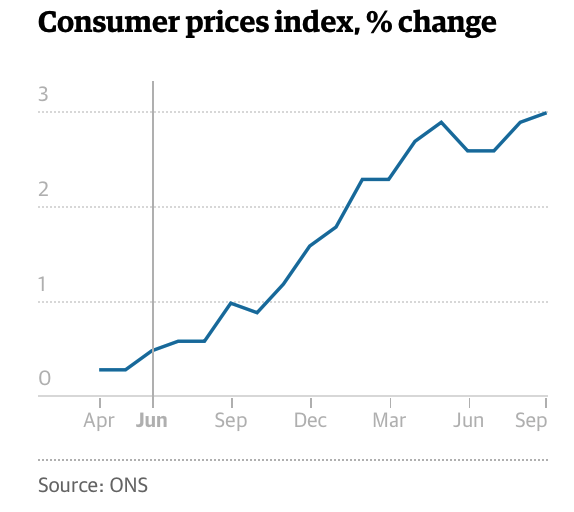
- Inflation now at five-year high of 3%
- Inflation, low-interest rate, debt crises and bail-ins still threaten savers and pensioners
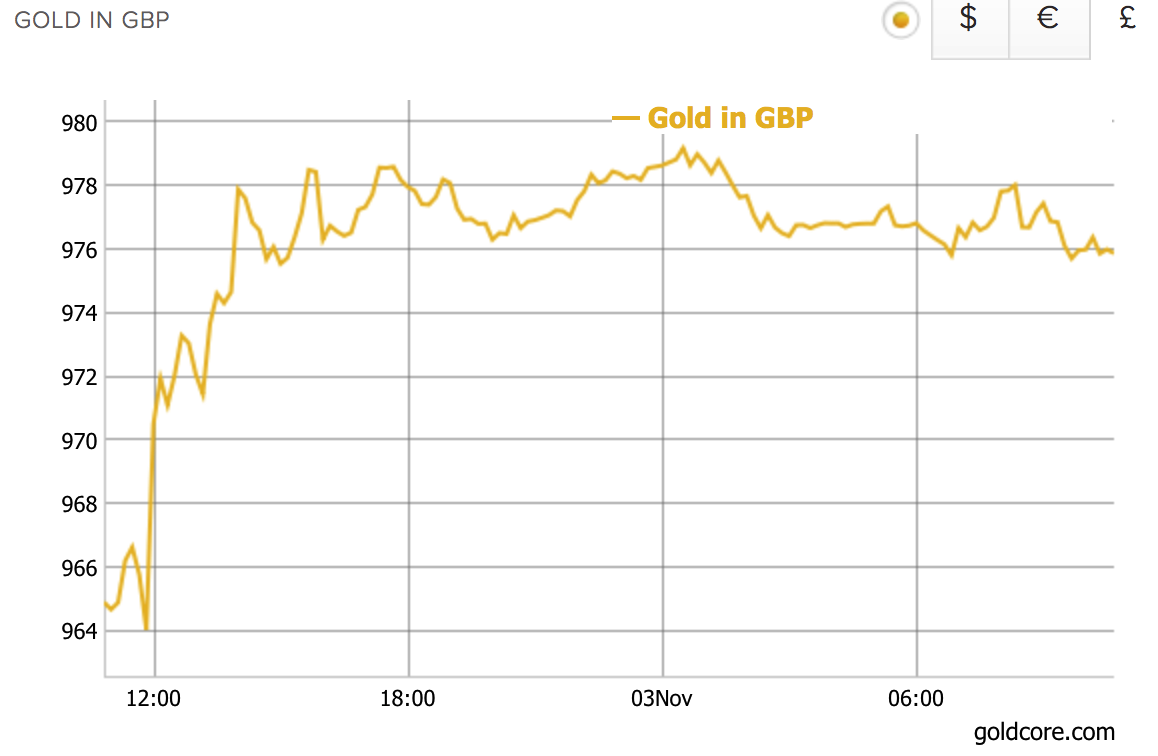
gold price today

This week has been a significant week for central banks. The Bank of England raised interest rates for the first time in ten years, the Federal Reserve indicated that a December rate hike may happen and President Trump named Powell as his choice for leader of the Federal Reserve.

Gold reacted positively to Trump's announcement as markets see little change ahead with a Powell-led Federal Reserve.

golds powell reaction

The interest rate decision is arguably the most interesting at present. Announcements on both sides of the pond suggest that the age of easy money is coming to an end, albeit slowly.

Since the financial crisis central banks have flooded markets with easy money, kept interest rates near zero and bought trillions of dollars in government and corporate bonds. Now most central banks (excluding Japan) have indicated that the party must soon stop.

The problem is, no one is sure how economies will cope when the moreish juice of central bank assistance will be taken away. None of the financial centres have managed to meet inflation targets which they were all so vocal about. Instead, they are suddenly aware that the encouraged financial excesses of the last ten years may well lead to another crash and something must be done to curb their enthusiasm.

Adding to the uncertainty is the issue that three of the world’s four most important central bank chiefs are nearing the end of their terms and may be well replaced. The jump in the gold price and fall in the dollar is just the first indication with how markets feel about such changes.

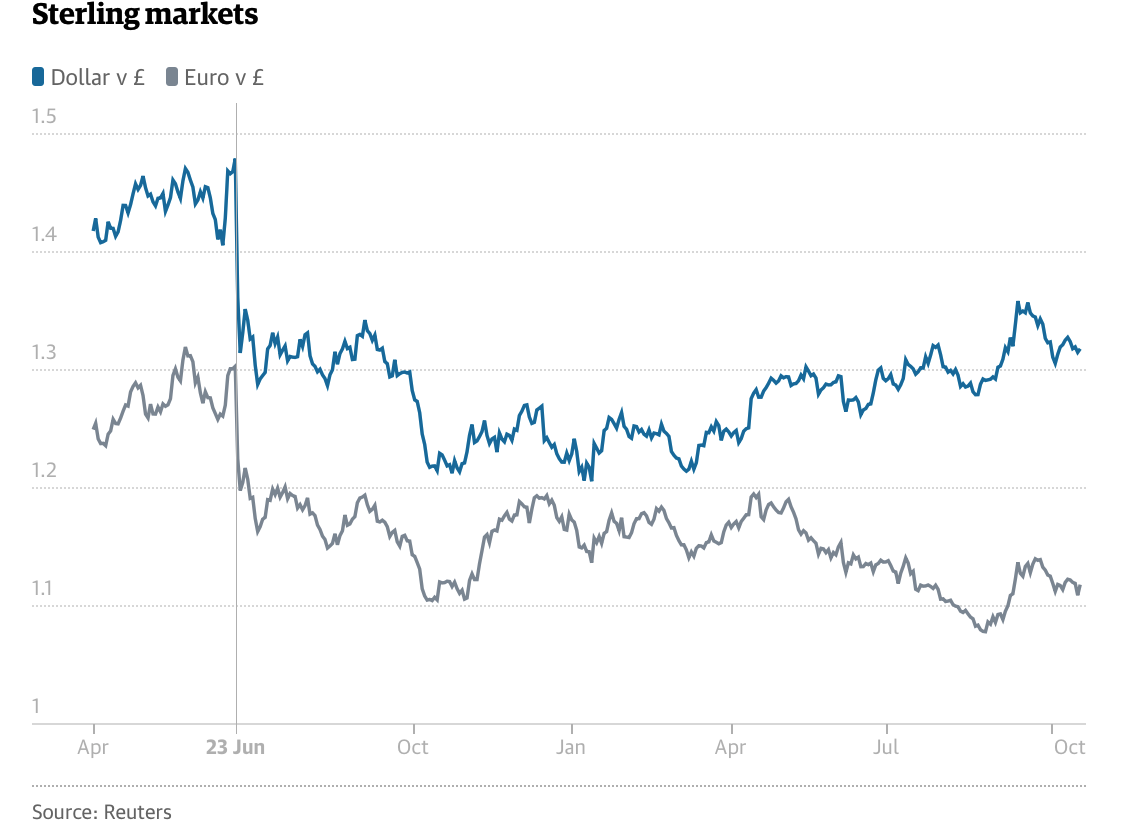
But is the age of easy money really coming to an end and are interest rate hikes a sign that central bankers have confidence in the economic recovery? Yesterday's drop in the pound suggests markets aren't buying it. They weren't helped by Mark Carney's dovish comments regarding the UK's post-Brexit future.

All in all, anyone hoping they might finally earn some interest on their savings, see a slowdown in the devaluation of their wealth or a reduction in the counterparty risk their cash is exposed to, needs to think again. The UK along with the rest of the world remain very vulnerable and will take investors along for the ride.

A whole new world with little hope

Here in the UK a whole generation of homeowners are waking up to a world where interest rate rises can really happen. There are 8 million homeowners, many of whom will have bought in the last ten years and as a result have never experienced a rate rise in their adult lives.

Bloomberg explained how much the world has changed since the Bank of England last increased interest rates:

The world was drastically different the last time the Bank of England hiked interest rates: the iPhone was less than a week old; Gordon Brown was Prime Minister; the average price of a home in London was £261,000 (it’s now  £470,632).

In interest rate terms how much has changed? Very little. The rise merely cancels out the cut that happened following the Brexit referendum.
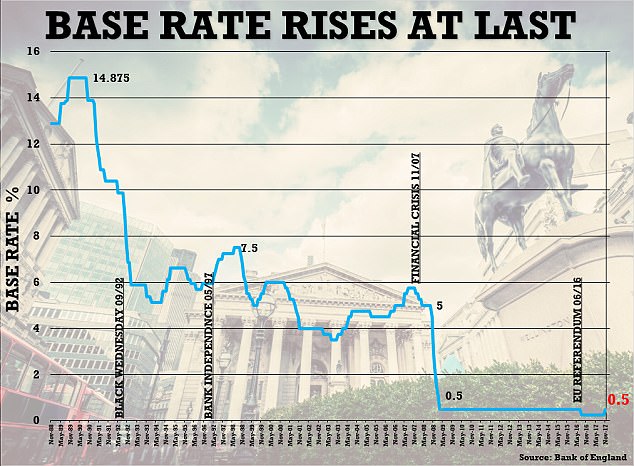
interest rate UK history

It's likely the hike in interest rate could do more harm than good. Previously savers, pensioners and investors suffered as a result of (arguably) negative real interest rates. Now the rate hike makes little difference to their current situation but propels debtors into further issues.

Those on variable mortgages will be facing rate hikes whilst the millions who have personal, unsecured loans will also be facing increased payments. All to contend with against a backdrop of rising inflation, pressure on wages and a slowing economy.

No change, nothing to see here

A decade of damage by easy monetary policy has caused unforeseen damage which cannot be undone by a few quarter-percent hikes over the next two years.

Low rates have created problems for savers and pensioners around the globe. Pension funds are in trouble with rising levels of unfunded liabilities. Consider the 2016 PWC report that found pension fund deficits have expanded by £100bn over the past year to total £700bn. This gives a “debt” of £26,000 per UK household.

Debt levels continue to rise from unsustainable to even more unsustainable. Here in the UK we are facing a £1 trillion crisis as pensions deficits and consumer loans snowball out of control.

And lest we forget how low rates have distorted financial markets and created asset price bubbles in shares, property and investments across markets.

Easy monetary policy came at a time when governments should have been implementing policies that dealt with an ageing population. Instead they have increased inflation and discouraged conservative money management -  creating incentives in totally the wrong direction.

The rise in inflation to 3% today also means that even those who have opted to keep cash in the bank have seen its value slowly eaten away. Those who chose to embrace low rates are inevitably in a debt-hole that is increasingly difficult to climb out from.

No faith in post-Brexit Britain

Interest rate hikes are ideally supposed to be an indicator that a central bank has faith in the economy's recovery but the Bank of England statement yesterday suggested this wasn't the case for post-Brexit Britain.

Carney expressed his concerns over the strength of the UK's economic recovery heading into and following our departure from the EU. He is also likely to be considering the risks the weak exchange rate poses to Britain’s ability to finance its current account deficit.

So bleak is Carney et al's outlook that they are only considering a two further rate rises by the end of 2020. Even this might not be guaranteed. Consider the state of the global financial system and where that could drag the UK.  Last time the BoE increased rates, it was soon forced to cut  them by 4.75 percentage points in the following 18 months as the global financial crisis dragged the UK into a recession.

Little hope for savers

The EU has already set the precedent of official negative interest rates, but in truth inflation combined with low rates does mean we are already in negative territory. Now, a 0.25% interest rate hike to 0.5% won't do much to contend with the forces of excess money supply and falling value of the pound.

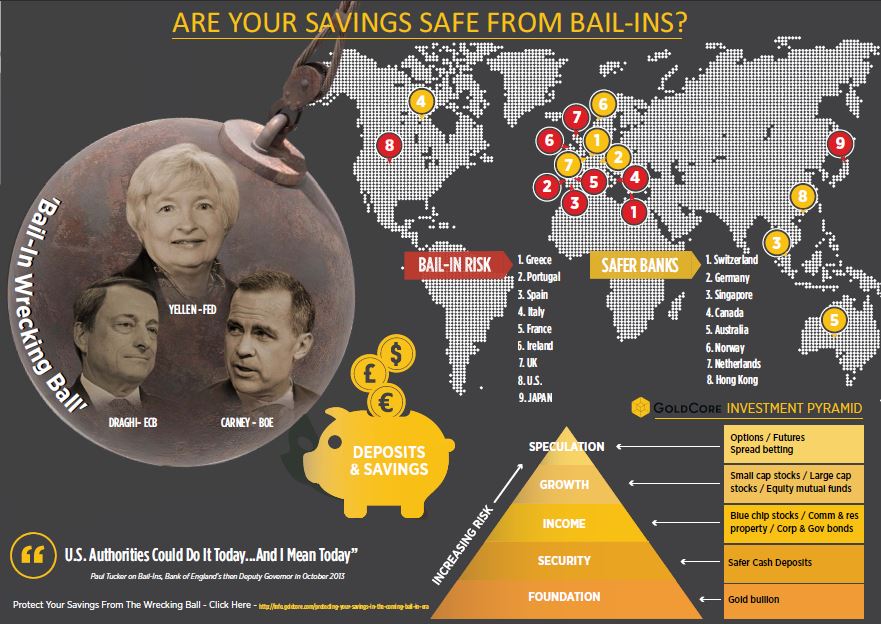
Add to this the ongoing threat of bail-ins, courtesy of the EU government. Even if interest rates were hiked up to levels of the early 1990s then savers' cash is still not safe.

Investors need to be prepared for the ongoing threats that exist in our banking system whether thanks to Brexit or our own governments.
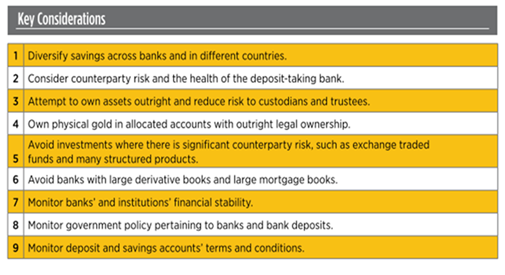
bail-ins-considerations

Gold isn't losing its head over interest rates 

The gold price and subsequent demand have performed well this year, despite interest rate hikes. Usually they stumble when central banks increase the price of money as it is seen as an incentive to no longer hold gold.

Instead, gold has climbed nearly 11% in dollar terms in the year to date as investors increasingly lose faith in the system and look to diversify and protect their wealth.

In the UK sterling-priced gold is even perkier, in the period Jan-Oct this year it has performed better than in the same period in previous years  outside of 2012.
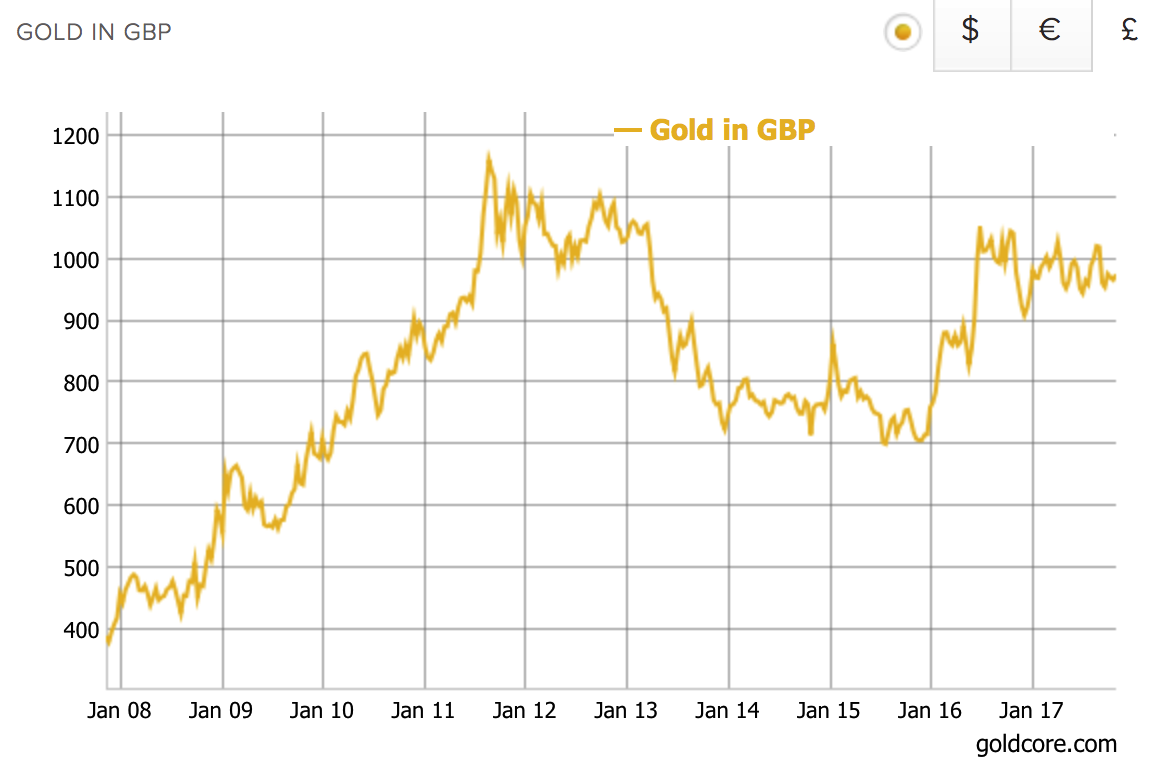
gold price UK decade

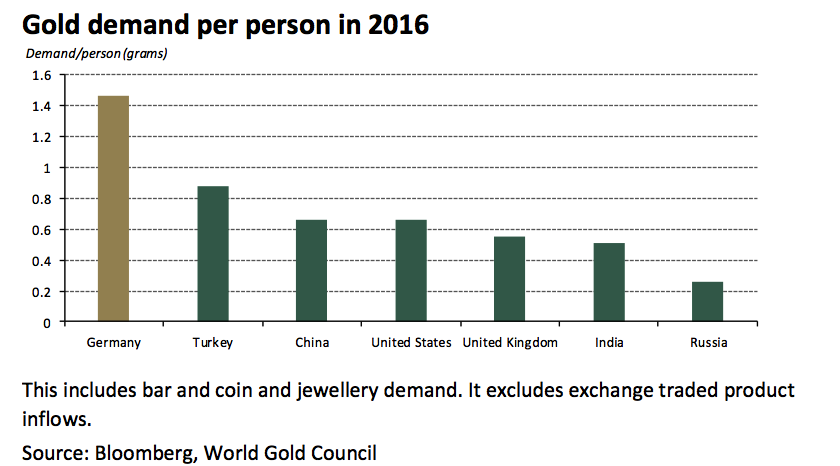
A report on Germany released yesterday by the World Gold Council showed how gold investment has increased in the last decade as worries over the financial system grow.

In the face of successive financial crises and loose monetary policy, German investors turned to gold to protect their wealth. Last year, more than €6bn was ploughed into gold investment products in Germany and, encouragingly, there is room for further growth. 

No matter the number of banks hiking rates this year it is not an salve for the global economy. Astute investors have recognised this and continue to stock up on gold - the age old financial safe haven from central bank policies and poor economic performance.


Conclusion 

Ultimately low interest rates and QE have been politically beneficial for governments around the world, yet the consequences have been severe for the electorate and health of the economy.

Investors should not see this week's or subsequent announcements from the central bank as an indication that their money is suddenly safe from devaluation and counterpart risk.

Instead our consistent advice is as pertinent as ever - diversify your portfolio and reduce your exposure to counterparty risk. Very little has changed and if it has then it is arguably worse.

Allocated, segregated gold and silver have performed consistently well in the last decade since central banks began pumping the economy with addictive easy money. Even before and after 2007 the precious metals had proved their worth as protectors of wealth and insurers against disastrous monetary policy.

Savers, investors and pensioners would be wise to remain on the tracks of portfolio diversification and continue to prepare for a future that has just contended with a decade of unprecedented debt and poor financial decisions.

News and Commentary

Gold Investors Weigh ‘Dove’ Powell for Fed Chief as Prices Hold (Bloomberg.com)

Gold firms amid steady dollar after U.S. tax plan (Reuters.com)

B-1 bombers skirt North Korea, which accuses U.S. of ‘seeking to ignite a nuclear war’ (MarketWatch.com)

Gold comes off highs after U.S. House Republicans propose tax cuts (Reuters.com)

What a Jerome Powell Fed means for investors and the economy (MarketWatch.com)

Risk Profile for Powell at the Fed May Be All Wrong (Bloomberg.com)

Bitcoin Is the ‘Very Definition’ of a Bubble, Credit Suisse CEO Says (Bloomberg.com)

Here’s What the World Looked Like the Last Time the BOE Raised Interest Rates (Bloomberg.com)

Randgold boss sees higher gold price (FT.com)

When central banks are buying gold, should we just sit and watch? (IndiaTimes.com)

Gold Prices (LBMA AM)

03 Nov: USD 1,275.30, GBP 976.24 & EUR 1,094.59 per ounce
02 Nov: USD 1,276.40, GBP 965.09 & EUR 1,095.92 per ounce
01 Nov: USD 1,279.25, GBP 961.48 & EUR 1,099.52 per ounce
31 Oct: USD 1,274.40, GBP 964.21 & EUR 1,095.60 per ounce
30 Oct: USD 1,272.75, GBP 966.91 & EUR 1,093.80 per ounce
27 Oct: USD 1,267.80, GBP 968.35 & EUR 1,090.18 per ounce
26 Oct: USD 1,278.00, GBP 968.34 & EUR 1,082.34 per ounce

Silver Prices (LBMA)

03 Nov: USD 17.09, GBP 13.05 & EUR 14.67 per ounce
02 Nov: USD 17.08, GBP 12.98 & EUR 14.66 per ounce
01 Nov: USD 16.94, GBP 12.74 & EUR 14.55 per ounce
31 Oct: USD 16.82, GBP 12.72 & EUR 14.45 per ounce
30 Oct: USD 16.74, GBP 12.69 & EUR 14.39 per ounce
27 Oct: USD 16.72, GBP 12.76 & EUR 14.38 per ounce
26 Oct: USD 16.97, GBP 12.84 & EUR 14.37 per ounce


Recent Market Updates

- Why Switzerland Could Save the World and Protect Your Gold
- Invest In Gold To Defend Against Bail-ins
- Stumbling UK Economy Shows Importance of Gold
- Wozniak and Thiel Fuel Bitcoin-Gold Debate: Gold Comes Out On Top
- Russia Buys 34 Tonnes Of Gold In September
- Gold Will Be Safe Haven Again In Looming EU Crisis
- Gold Is Valuable Due to “Extreme Rarity” – Must See CNN Video
- Gold Is Better Store of Value Than Bitcoin – Goldman Sachs
- Next Wall Street Crash Looms? Lessons On Anniversary Of 1987 Crash
- Key Charts: Gold is Cheap and US Recession May Be Closer Than Think
- Gold Up 74% Since Last Market Peak 10 Years Ago
- How Gold Bullion Protects From Conflict And War
- Silver Bullion Prices Set to Soar

Important Guides

For your perusal, below are our most popular guides in 2017:

Essential Guide To Storing Gold In Switzerland

Essential Guide To Storing Gold In Singapore

Essential Guide to Tax Free Gold Sovereigns (UK)

Please share our research with family, friends and colleagues who you think would benefit from being informed by it.

Thursday, November 2, 2017

BREAKING: China - World's Largest Gold Producer Mine Supply Plummets 10%

Published here: http://www.zerohedge.com/news/2017-11-02/breaking-china-worlds-largest-gold-producer-mine-supply-plummets-10

SRSrocco

By the SRSrocco Report,

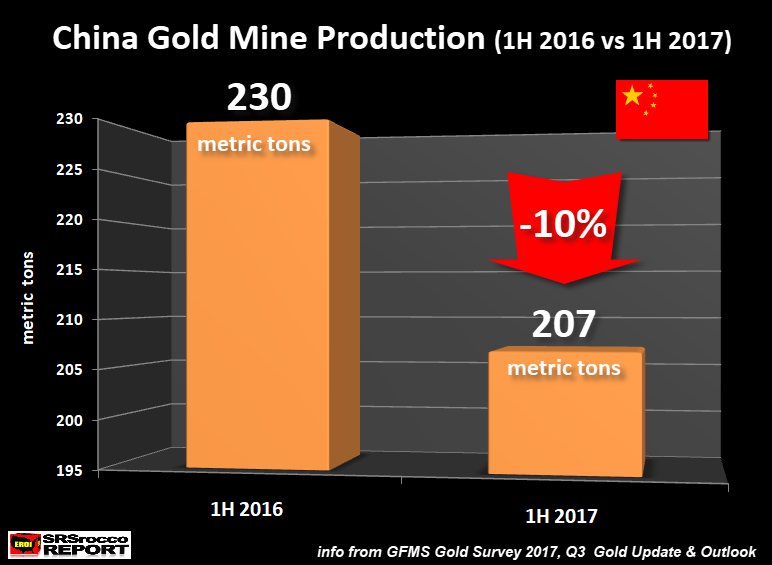
The world's top gold producer saw its mine supply plummet by 10% in the first half of 2017.  According to the GFMS World Gold Survey newest update, China's gold production in 1H 2017 fell the most in over a decade.  The fall in Chinese gold production is quite significant as the country will have to increase its imports to make up the shortfall in its mine supply

The data in the GFMS 2017 Q3 Gold Survey Update & Outlook reported that Chinese gold mine supply declined 23 metric tons to 207 metric tons in the 1H 2017 versus the 230 metric tons during the same period last year:

The report stated the reason for the decline in Chinese gold production was due to the government's increased efforts to curb pollution as well as heightened awareness of environmental protection.  Furthermore, GFMS analysts forecast that Chinese gold production will continue to deteriorate for the remainder of the year as production is scaled down.

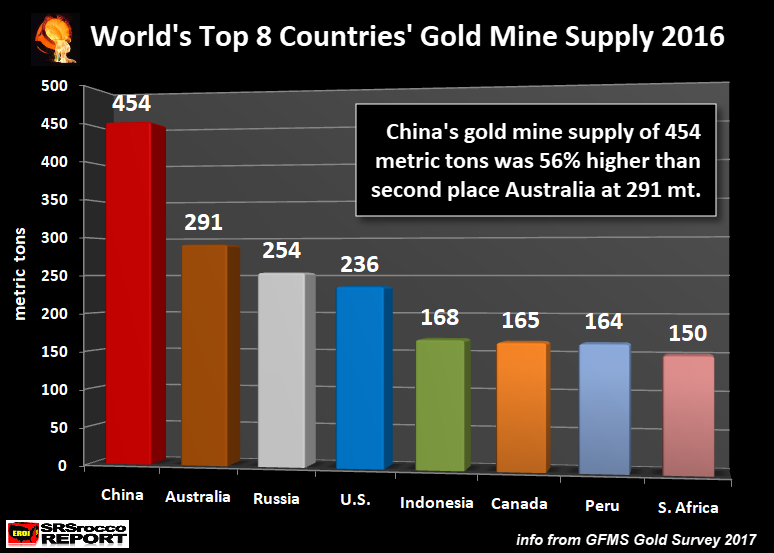
This is undoubtedly bad news for a country that is not only the world's largest gold producer but also because China consumes all of its domestic mine supply.  To get an idea just how far China is ahead of the rest of the pack, take a look at the following chart:

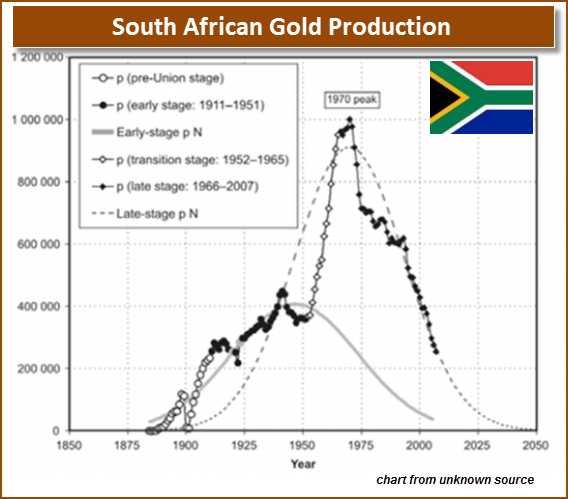
Last year, Chinese gold mine supply of 454 metric tons (mt), was 56% higher than second-ranked Austraila at 291 mt.  These eight top gold mining countries produced 56% of the total world's supply of 3,222 mt in 2016.  Lastly, you will notice that South Africa came in last place at 150 mt.  However, South Africa was the leading gold supplier in the world in 1970, when it produced a staggering 1,000 mt:

Also, isn't it ironic that the U.S. dropped the Gold-Dollar peg (Aug. 1971) the year after South African's gold production peaked?  Regardless, South African gold production is now down 85% from its peak in 1970.  For those individuals who don't believe in the theory of Peak Gold or Peak Oil, stick around a few years... and you will become a believer.

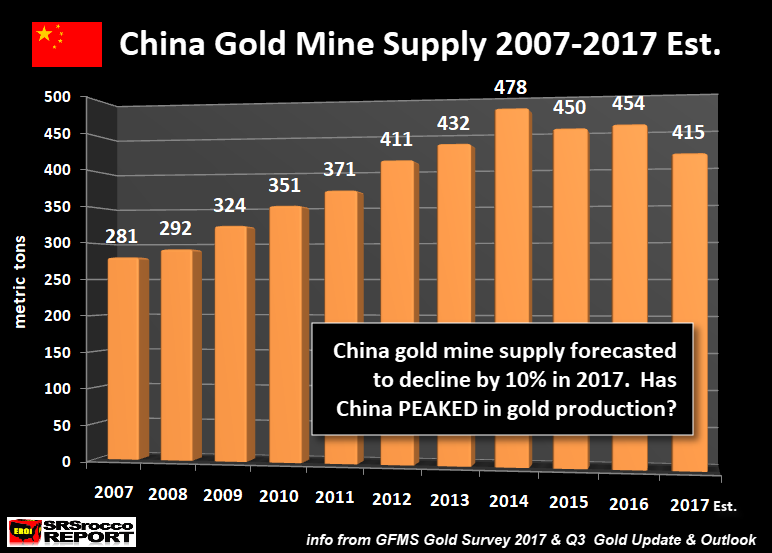
Now, there seems to be another interesting development as it pertains to Chinese gold production.  Unless China experiences a considerable rebound of its gold mine supply over the next several years, 2014 may turn out to be its ultimate production peak:

According to the figures reported in the GFMS 2017 World Gold Survey, China's gold production reached a peak of 478 mt in 2014 and is estimated to decline to 415 mt* this year (*415 mt is my estimate based on GFMS data).  If the forecast for 2017 is correct, China's gold production will have fallen 13% from its peak in 2014.  Moreover, if the world experiences a huge market correction and economic contraction in 2018, there's a high probability that Chinese gold production will have peaked in 2014.

Lastly, the peak and decline of global gold production will likely mark the time of the peak and fall of the global economy.  Now, I am not saying this occurs the very same year, but it will be a gauge to pinpointing the very time when reached the SENECA CLIFF.

Lastly, if you haven't checked out our new PRECIOUS METALS INVESTING section or our new LOWEST COST PRECIOUS METALS STORAGE page, I highly recommend you do.

Check back for new articles and updates at the SRSrocco Report.

Why Switzerland Could Save the World and Protect Your Gold

Published here: http://www.zerohedge.com/news/2017-11-02/why-switzerland-could-save-world-and-protect-your-gold

Why Switzerland Could Save the World and Protect Your Gold

 - Precious metals advisor Claudio Grass believes Switzerland can serve as an example to rest of world
- Switzerland popular for gold storage due to understanding of the risks inherent in fiat money and gold’s value as a store of wealth.
- International investors opt to store gold in Swiss allocated accounts due to tradition of respecting private property.
- Country respects the importance of gold ownerships and 70% of world's gold is refined there

Across Europe many voters and politicians are expressing their dislike at the bureaucratic and overarching approach of the European Union. There are also regions and countries pushing to break ties with others that they have long been associated with. Catalonia is just the most recent example, many in Scotland are also calling for independence.

It is not an understatement to say that the role and influence of government is currently at the forefront of many citizens' minds. This is understandable given political upheaval but also thanks to decisions by authorities that are arguably not in the best interests of the electorate. Bail-ins are just one very important example.

This is a situation investors must consider when deciding where they would like to store their gold bullion. It is because of concerns regarding political stability, motive and financial decisions that there is a belief amongst many bullion owners that owning bullion in Switzerland is safer than owning it in many EU countries, the UK and the U.S.

Claudio Grass, an Swiss independent precious metals advisor, recently spoke to the Mises Institute about Switzerland. In the interview he explains why the country is so attractive for investors.

The introduction by the Mises Institute notes that Switzerland is attractive as its political approach differentiates it from other countries. By taking a subsidiary function, the result is major limitations being placed on central political power structures at the federal level.

Switzerland is no libertarian paradise. It has bureaucrats and a wayward central bank. But it remains an astonishing modern example of the principles of federalism and subsidiarity in action. In fact, it exemplifies Lew Rockwell's daydream: nobody much knows or cares who is president. Its federal administrative state demonstrates humility instead of hubris. And virtually all political decisions, from taxes to welfare to immigration, are decided locally. Claudio Grass joins Jeff Deist to discuss what libertarians can learn from Switzerland, and how neutrality in two disastrous European wars shapes Swiss DNA today.

Readers can watch the full interview with Claudio Grass, below.


Investors interested in protecting their wealth and looking for ways to diversify their assets should consider holding allocated gold bullion in Switzerland

In our Essential Guide to Gold Storage in Switzerland we clearly explain why the country remains the preferred destination for many Western and international retail and institutional investors. It takes just three simple steps to create a GoldCore secure storage account in Switzerland.

The Swiss people understand the importance of gold in wealth management and preservation and the importance of storing bullion in a secure, independent and stable jurisdiction that specialises in discretion and confidentiality.

News and Commentary

Dollar Slips With Treasury Yields; Stocks Mixed (Bloomberg.com)

Gold prices up; focus on pick for U.S. Fed chair (Reuters.com)

Gold holds gains after Fed says it will leave rates unchanged (Reuters.com)

Germany fears EUROZONE MELTDOWN: German investors rush to buy gold (Express.co.uk)

Fed Signals December Hike On Track a Day Before Trump Announces Next Chair (Bloomberg.com)

Powell to Lead Fed Overseeing Trump Economy Fraught With Risks (Bloomberg.com)

What If the Bank of England Doesn't Raise Rates? (Bloomberg.com)

The World Is Running Out of Gold, Should You Invest? (Fortune.com)

BITCOIN vs. GOLD: Which One’s A Bubble And How Much Energy Do They Really Consume (GoldSeek.com)

China's gold consumption grows in Jan-Sept (Xinhuanet.com)

Gold Prices (LBMA AM)

02 Nov: USD 1,276.40, GBP 965.09 & EUR 1,095.92 per ounce
01 Nov: USD 1,279.25, GBP 961.48 & EUR 1,099.52 per ounce
31 Oct: USD 1,274.40, GBP 964.21 & EUR 1,095.60 per ounce
30 Oct: USD 1,272.75, GBP 966.91 & EUR 1,093.80 per ounce
27 Oct: USD 1,267.80, GBP 968.35 & EUR 1,090.18 per ounce
26 Oct: USD 1,278.00, GBP 968.34 & EUR 1,082.34 per ounce

Silver Prices (LBMA)

02 Nov: USD 17.08, GBP 12.98 & EUR 14.66 per ounce
01 Nov: USD 16.94, GBP 12.74 & EUR 14.55 per ounce
31 Oct: USD 16.82, GBP 12.72 & EUR 14.45 per ounce
30 Oct: USD 16.74, GBP 12.69 & EUR 14.39 per ounce
27 Oct: USD 16.72, GBP 12.76 & EUR 14.38 per ounce
26 Oct: USD 16.97, GBP 12.84 & EUR 14.37 per ounce


Recent Market Updates

- Invest In Gold To Defend Against Bail-ins
- Stumbling UK Economy Shows Importance of Gold
- Wozniak and Thiel Fuel Bitcoin-Gold Debate: Gold Comes Out On Top
- Russia Buys 34 Tonnes Of Gold In September
- Gold Will Be Safe Haven Again In Looming EU Crisis
- Gold Is Valuable Due to “Extreme Rarity” – Must See CNN Video
- Gold Is Better Store of Value Than Bitcoin – Goldman Sachs
- Next Wall Street Crash Looms? Lessons On Anniversary Of 1987 Crash
- Key Charts: Gold is Cheap and US Recession May Be Closer Than Think
- Gold Up 74% Since Last Market Peak 10 Years Ago
- How Gold Bullion Protects From Conflict And War
- Silver Bullion Prices Set to Soar
- Brexit UK Vulnerable As Gold Bar Exports Distort UK Trade Figures

Important Guides

For your perusal, below are our most popular guides in 2017:

Essential Guide To Storing Gold In Switzerland

Essential Guide To Storing Gold In Singapore

Essential Guide to Tax Free Gold Sovereigns (UK)

Please share our research with family, friends and colleagues who you think would benefit from being informed by it.
Wednesday, November 1, 2017

Invest In Gold To Defend Against Bail-ins

Published here: http://www.zerohedge.com/news/2017-11-01/invest-gold-defend-against-bail-ins

Invest In Gold To Defend Against Bail-ins

 - Italy's Veneto banking meltdown destroyed 200,000 savers and 40,000 businesses
- EU bail-in rules have wiped out billions for savers and and businesses, with more at risk 
- Bail-ins are not unique to Italy, all Western savers are at risk of seeing savings disappear
-  Counterparty-free, physical gold bullion is best defence against bail-ins

One of Italy's twenty regions is calling for more autonomy from the state following a nonbonding referendum. Why? Because a government supported 'rescue package' caused the lifesavings of 200,000 savers to be wiped out during the  implosions of Popolare di Vicenza and Veneto Banca.

Since then the banks have been rescued in one way or another yet the impact of the collapse on individuals and small businesses is only just becoming clear.

As in Spain's Catalonia the region of Veneto is wealthier than the average Italian region, with its own industries and language yet it has been left with a pile of ash when it comes to its banking sector.

The region is proud to be the home of successful brands such as Benetton, De’Longhi, Geox and Luxottica. But it is the 40,000 small businesses that are in a state of limbo unable to pay workers, find credit or operate on a day-to-day basis.

Sadly the case of Veneto is one of a growing list of regions of banking customers that have been destroyed due to the incompetence of national authorities and the overbearing powers of the EU.

Profitable businesses take the hit

What is seen is as surprising to many reading about the story of Veneto is that profitable, stable businesses are also suffering as a result of a banking collapse.

When someone's savings are wiped out, that isn't the end of the nightmare. Many businesses were exposed to those banks both through credit and shares.

Many businesses operate on credit. This happens in companies of all scales and levels of success. The businesses that borrowed from the two Veneto banks are now in a state of limbo. They have no line of credit due to their exposure to the collapsed banks.

This is despite a government-led body stepping into help manage the fallout and finances of the ruined institutions. Bloomberg explains:

Even a perfect credit score is useless in Veneto now if your only collateral is stock in either bank, which were coveted investments for generations of locals.

Bail-in of the first resort 

Italians are in very deep financially when it comes to their banking system. The 2015 IMF report states:

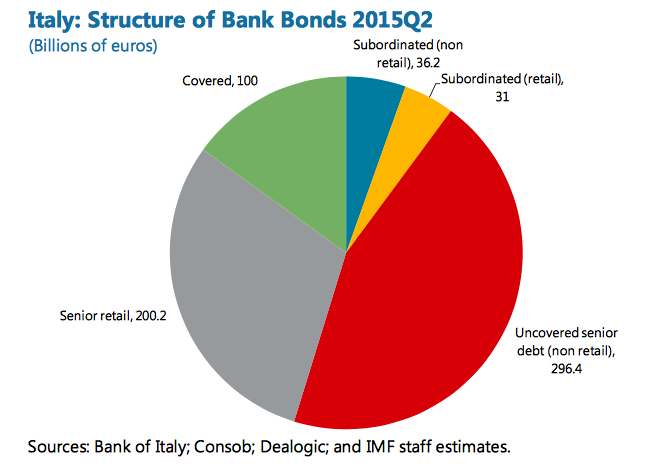
Retail holdings in Italy are relatively large compared to other countries, comprising about one- third of about €600 billion worth of bank bonds and half of about €60 billion worth of subordinated bonds.

That is all money that will just disappear overnight in the case of bank failure. In some cases, it already has.

In Italy a common problem has been that savers and businesses were persuaded to invest in subordinated (junior) bonds by their bank managers.

By 2015 over €31 billion of retail sub bonds had been sold to retail investors. Retail investors are ordinary savers and small businesses.

'Households hold about one-third of senior bank debt and almost half of total subordinated bank debt.' - IMF

These bondholders are seen as creditors. The same type of creditor that EU rules state must take responsibility for a bank's financial failure, rather than the taxpayer. This is a bail-in scenario.

In a bail-in scenario the type of junior bonds held by the retail investors in the street is the first to take the hit. When the world's oldest bank Monte dei Paschi di Siena collapsed ordinary people (who also happen to be taxpayers) owned €5 billion ($5.5 billion) of subordinated debt. It vanished.

A 2015 IMF study found that the majority of Italy's 15 largest banks a bank rescue would 'imply bail-in of retail investors of subordinated debt'. Only two-thirds of potential bail-ins would affect senior bond-holders.

Nothing will respect you like gold does

Why put so much faith in the bank? Because, despite many financial crises in the last 100 years, savers and businesses still believe their money will be safe.

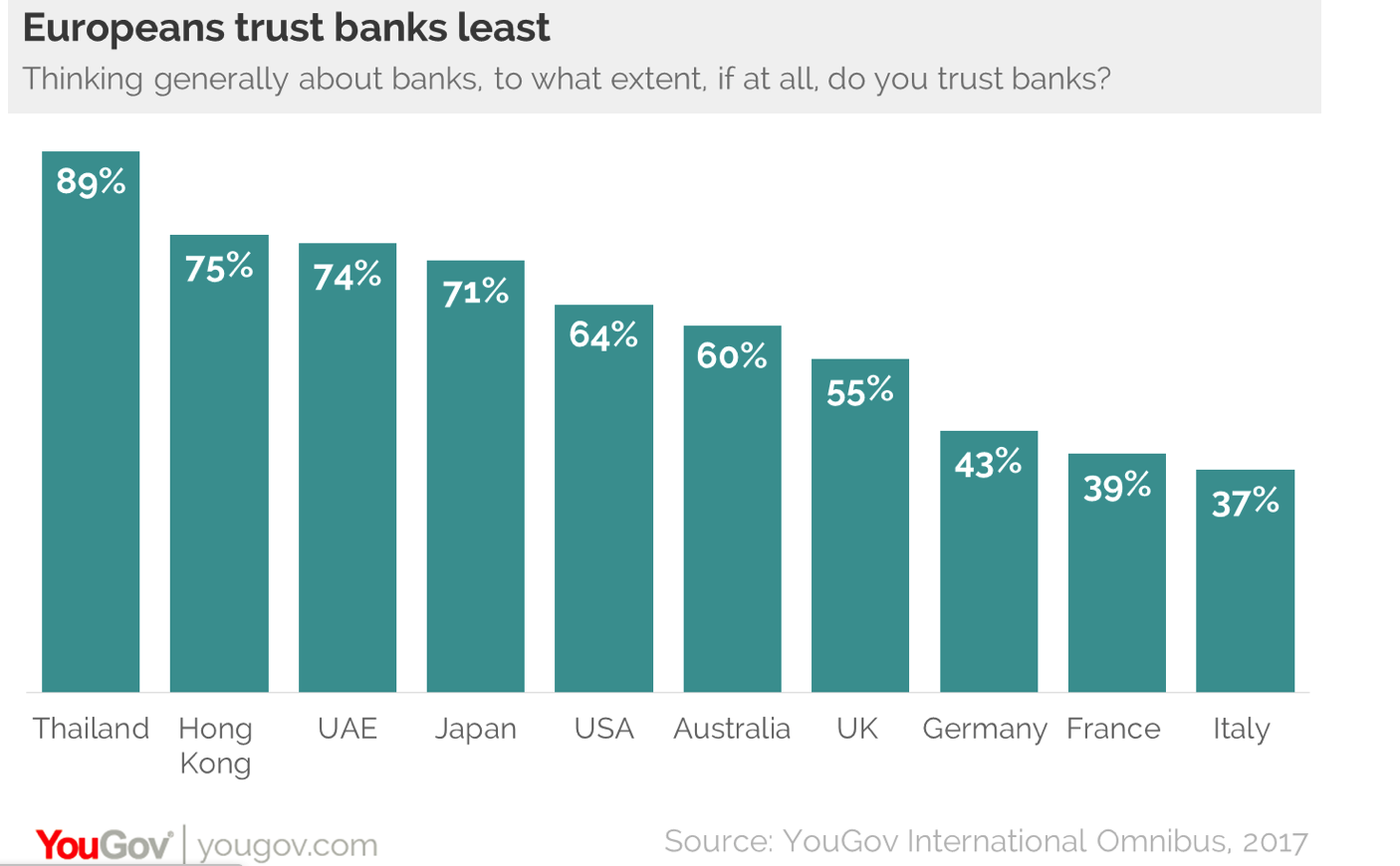
The graph above shows just how much we still trust our banks. The least trusting country is Italy yet their exposure has been so great, imagine what damage will be done when the likes of the UK, US or Germany face a bail-in situation.

In Italy where banks have been around for literally hundreds of years, many family business owners are still dealing with bank accounts, investments and loans their ancestors organised a century ago.

This kind of relationship can lead to an almost Stockholm Syndrome situation. Despite receiving consistency bad treatment from your bank you want to support it and help it out. You still trust it. So when the bank suggests you hold shares then you take their advice.

“We jealously guarded those shares like you would gold bars,” A 60 year old baker told Bloomberg, “Buying your bank’s stock was the traditional thing to do. We got it badly wrong.”

Of course what everyone forgets is that banks are not there to look after you. They are there to make money. They do this almost instantly the second you deposit funds, it's their money. The second you take out a loan, they own you. The second you buy shares, they have a license to be reckless.

Naively treating anything other than gold like gold is the first step in financial mismanagement. Nothing is like physical, allocated and segregated gold. For a start it is all yours.

Is your government or the EU there for you? Don't bet on it 

A bail-in forces creditors of a bank to shoulder losses when the firm fails. The term covers cover every case of creditor loss-sharing when a bank goes belly-up.

This is different to events we saw during the 2008 financial crisis when taxpayers tended to bail-out banks. Since 2016 European Union rules have stated there must be a bail-in before a government bailout is allowed.

Governments would clearly like to prevent savings of hardworking individuals and businesses from being wiped out. However they are fearful of the EU, trying to skirt their bail-in rules would no doubt sour relations with a body that is keen to stick to rules it only recently passed.

There is a conflict of interest it seems between pleasing the EU and doing the right thing by voters.

Given Brexit and now Catalonia the EU is unlikely to be in the mood to bend its rules for another troublesome country. This is despite it costing the EU's own citizens billions of euros in lost savings and investments.

This is a risk for the EU, especially in Italy where there is already strong anti-EU sentiment. The case of Veneto, where 75% require more power and 15% would like to see total autonomous rule is another Catalonia again. A further sign of increased populism thanks to an overbearing and indifferent EU.

Invest in gold, or prepare to fail

Depositors and investors should be aware of their country’s requirements when it comes to keeping their money safe in the banks. Whilst bail-ins will at present only hurt those who hold deposits above EUR 100,000, there is little stopping the protected amount being decreased, or ignored altogether.


For those living in the EU, the European Commission has forced all 28 countries to implement bail-in legislation. This means depositors must be more vigilant than ever about the health of a particular bank, and the risk exposure of their portfolio.  This means diversifying your invesments and decreasing the level of counterparty exposure.

One area of portfolio diversification that is growing due to concerns over the safety of bank accounts, is gold investment which saw a 15% climb in Q2 of 2016. Europe, in 2015, showed the largest regional demand for gold bars and coins (an increase of 12% year on year).

Unallocated gold is as much at risk as any other asset exposed to counterparties. Savers and businesses can protect their wealth by investing in allocated gold, in segregated accounts. This gives your outright legal ownership. There are no counterparties who can pop along after going bust and take what is legally theirs. It cannot be made to disappear overnight.

Gold is the financial insurance against bail-ins, political mismanagement and overreaching government bodies.


Read our guide on how to protect yourself from bail-ins here

News and Commentary

Gold logs a 1.1% monthly loss in October (MarketWatch.com)

Gold falls as dollar recovers, Fed chair in focus (Reuters.com)

Small Caps Lead U.S. Stocks Higher as Dollar Gains (Bloomberg.com`)

Consumer confidence climbs to a nearly 17-year high in October (MarketWatch.com)

CME to launch bitcoin futures in fourth quarter subject to approvals (Reuters.com)

Credit: Wall Street Journal

Gold vs. Bitcoin: Goldman Sachs Weighs In (DailyReckoning.com)

Why Is Bitcoin a Big Deal? (CharlesHughSmith)

One Misstep Now Would Cost the Bank of England Its Credibility (Bloomberg.com)

Britain accelerates Brexit plans, divorce talks also to speed up (Reuters.com)

China has grand ambitions to dethrone the dollar. It may make a powerful move this year (CNBC.com)

Gold Prices (LBMA AM)

01 Nov: USD 1,279.25, GBP 961.48 & EUR 1,099.52 per ounce
31 Oct: USD 1,274.40, GBP 964.21 & EUR 1,095.60 per ounce
30 Oct: USD 1,272.75, GBP 966.91 & EUR 1,093.80 per ounce
27 Oct: USD 1,267.80, GBP 968.35 & EUR 1,090.18 per ounce
26 Oct: USD 1,278.00, GBP 968.34 & EUR 1,082.34 per ounce
25 Oct: USD 1,273.00, GBP 964.81 & EUR 1,081.67 per ounce

Silver Prices (LBMA)

01 Nov: USD 16.94, GBP 12.74 & EUR 14.55 per ounce
31 Oct: USD 16.82, GBP 12.72 & EUR 14.45 per ounce
30 Oct: USD 16.74, GBP 12.69 & EUR 14.39 per ounce
27 Oct: USD 16.72, GBP 12.76 & EUR 14.38 per ounce
26 Oct: USD 16.97, GBP 12.84 & EUR 14.37 per ounce
25 Oct: USD 16.89, GBP 12.75 & EUR 14.34 per ounce


Recent Market Updates

- Stumbling UK Economy Shows Importance of Gold
- Wozniak and Thiel Fuel Bitcoin-Gold Debate: Gold Comes Out On Top
- Russia Buys 34 Tonnes Of Gold In September
- Gold Will Be Safe Haven Again In Looming EU Crisis
- Gold Is Valuable Due to “Extreme Rarity” – Must See CNN Video
- Gold Is Better Store of Value Than Bitcoin – Goldman Sachs
- Next Wall Street Crash Looms? Lessons On Anniversary Of 1987 Crash
- Key Charts: Gold is Cheap and US Recession May Be Closer Than Think
- Gold Up 74% Since Last Market Peak 10 Years Ago
- How Gold Bullion Protects From Conflict And War
- Silver Bullion Prices Set to Soar
- Brexit UK Vulnerable As Gold Bar Exports Distort UK Trade Figures
- Puerto Rico Without Electricity, Wifi, ATMs Shows Importance of Cash, Gold and Silver


Important Guides

For your perusal, below are our most popular guides in 2017:

Essential Guide To Storing Gold In Switzerland

Essential Guide To Storing Gold In Singapore

Essential Guide to Tax Free Gold Sovereigns (UK)

Please share our research with family, friends and colleagues who you think would benefit from being informed by it.
Tuesday, October 31, 2017

Daily Litecoin Price Forecast – Can LTC Profit from Bitcoin’s Civil War?

Published here: https://www.profitconfidential.com/cryptocurrency/litecoin/daily-litecoin-price-forecast-31-oct/

It’s often said that Litecoin is the “silver to Bitcoin’s gold.” In fact, it’s said so often that investors often forget gold is tough to destroy. It can be melted, but not burned; buried, not vanished.

By contrast, Bitcoin goes through an existential crisis every month.

First, there was Bitcoin Cash, then recently Bitcoin Gold, and now SegWit2x lies before us. It seems like the Bitcoin community is perpetually at war with itself.

What happens if investors grow tired of these fights? Do they simply pull their money out of the industry altogether? Or, and this is where it gets interesting, do they switch to Litecoin?

We believe there is some possibility for the.

The post Daily Litecoin Price Forecast – Can LTC Profit from Bitcoin’s Civil War? appeared first on Profit Confidential.

Stumbling UK Economy Shows Importance of Gold

Published here: http://www.zerohedge.com/news/2017-10-31/stumbling-uk-economy-shows-importance-gold

Stumbling UK Economy Shows Importance of Gold

- UK economy outlook bleak amid Brexit, debt woes and rising inflation
- Confidence in UK housing market at five-year low
- UK high street sales crash at fastest rate since 2009
- Number registering as insolvent in England and Wales hit a five-year high in Q3
- UK public finance hole of almost £20bn in the public finances set to grow to £36bn by 2021-22
- Protect your savings with gold in the face of increased financial woes in UK

This week markets will be watching the UK with baited breath as the Monetary Policy Committee meets this Thursday to discuss a potential rate rise.

Expectations of a rise have increased to 80% in the last week. If the Bank of England does raise rates it will be for the first time in a decade. It is unlikely to be a dramatic increase though, probably a rise of 25 basis points to reverse the emergency rate cut which followed the Brexit vote.

Should the UK decide to raise rates this will likely boost confidence somewhat in the economy. However any increase in positivity regarding the UK will be short lived once markets realise it will take more than a small rate rise to get the country out of the huge red hole it is currently digging its way into.

Brexit is being blamed for the majority of the UK's woes at present, however this is merely a politician's scapegoat. Confidence in the UK housing market has slipped to its lowest level in five years, family spending power has declined in five out of the last six months, the hole in public finances is likely to increase over 100% from the initial forecast by 2020, personal insolvencies are at a five year high and inflation has hit 3%.

These plus many more financial and economic problems have long been brewing. Problems with money naturally lead to social problems which end up exacerbating themselves further as individuals find continue to struggle on a daily basis.

Sadly the UK is in a real state of limbo thanks to Brexit, how the government will manage to solve the other significant issues such as rising debt levels (public and private), inflation and a slowing economy whilst managing EU negotiations is a feat yet to be witnessed.

We have been approaching a juncture for some time where we must decide as individual savers, investors, pensioners and future pensioners what the best way to prepare for the future is. Do we stand back and believe that the government has our best interests at heart or do we prepare for their failure? Their inability to support the value of the pound, protect interest rates, avoid bank bail-ins and solve the debt crisis are all situations that could see our own savings put at real risk.

Falling confidence both in and inside the UK 

Despite expectations of a rate rise, sterling stumbled in October thanks to weak economic data and more negative headlines regarding Brexit.

What's the one thing governments like to say positively about a weak currency? That it's good for exports...but not in the UK it's not.

As we explained earlier this month, a much revered boost to UK exports following the Brexit vote was most likely down to our gold market. Now that the Chinese have calmed down on their gold shopping spree we are seeing what state the rest of the export market is really in.

The Guardian explains:

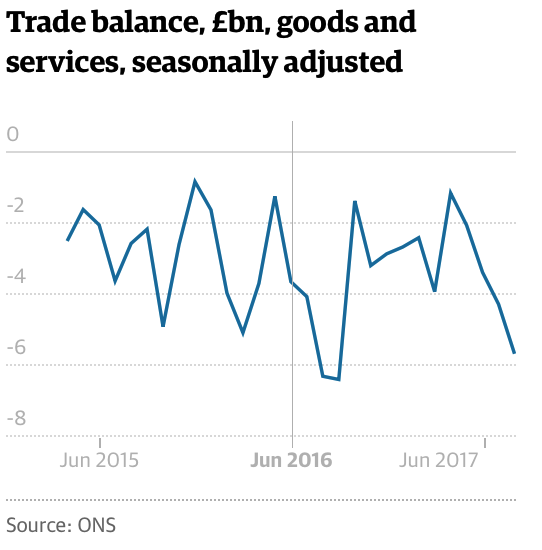
The trade deficit in goods hit a record high, as the gap between what the UK bought and sold widened in August to £14.2bn. That was much bigger than expected, and up from £12.8bn in July. Imports surged by 4.2% during the month, while exports only rose by 0.7%. The overall trade deficit, including services, widened to £5.6bn in August from £4.2bn in July.

...and from within things aren't much better

Currency and export markets are not the only ones having a problem with the UK. There are nervous feelings much closer to home - in people's own homes and on the high street.

A Halifax bank survey found one in five British adults surveyed expect house prices to fall over the next 12 months. This is the weakest reading for consumer expectations since October 2012.

This negativity regarding the housing market is thanks to concerns over the economy, weak wage growth and concerns over rising inflation. For years the UK government has rallied around the UK housing market, convincing citizens that owning a home was a right of passage. It seems the jig is up.

Most new buyers are losing faith in the housing market as not only is the cost of borrowing set to raise but raising the funds for a deposit is near impossible. In the three months to August there was negative wage growth, bringing the total number of months of negative growth to six for 2017, alone.

In all regions of the UK incomes have failed to rise by more than the current inflation rate of 3%. This is not only placing pressure on the housing market but also on consumer spending.

UK inflation rate

A 'steep drop' in retail sales was reported in the CBI survey this month, alongside orders placed with suppliers dropping at their fastest rate since the spring of 2009.

But people still need to eat, clothe themselves, keep a roof over their families' heads and this is where the government has gone so badly wrong. By fuelling an era of cheap credit, stealthflation, zero-hour contracts and low wage growth families and individuals no longer know how to survive on their wage packets.

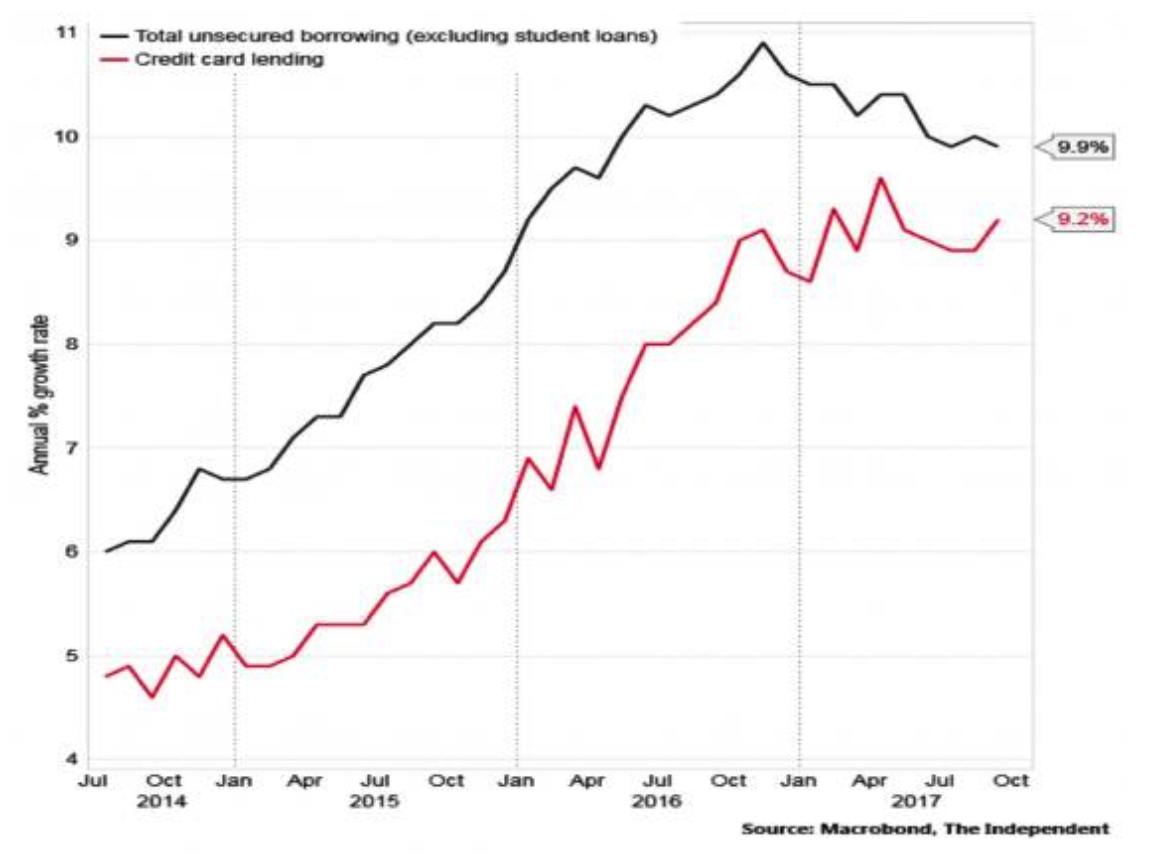
The annual rate of growth of consumer credit climbed is currently at 9.9%, having been as high as 10% in the summer.

According to Bank of England data, another £641m was put onto plastic in the month of September, the sharpest increase in debt since May 2016. The total credit card debt stock reached £69.4bn, the highest on record.

Unsurprisingly, this isn't sustainable. The number of people registering as insolvent in England and Wales hit a five-year high in the third quarter

The number of those registering as insolvent is only set to get worse should interest rates rise. A hike would push up the cost of both secured and unsecured borrowing.

As Gillian Guy, the chief executive of Citizens Advice, told the Independent:

“The rise and rise of consumer debt is a cause for alarm at a time when large numbers of people are already in financial difficulty."

Broken government = broken economy

Of course, very little of the 'on the ground' problems such as wage growth and consumer debt levels are making the headlines.

The headlines are the same as they have been for the last 18 months or so: BREXIT DISASTER.

Is it a disaster? Who knows, but what we do know is that it is costing a huge amount of money with even more expected to be paid out in the coming years. This is all money that the UK simply does not have.

It was only a fortnight ago that we found out Britain’s stock of wealth had fallen from a surplus of of £469 billion to a net deficit of £22 billion. This is down to a massive write-down of the UK’s assets and a drop in foreign direct investment (again, a lack of confidence in the UK).

Meanwhile the gap between government spending and tax receipts is also expected to 'outperform' expectations. The Institute for Fiscal Studies (IFS) expects it to reach £36bn by 2021-22, more than twice the initial official forecast of £17bn.

On the issue the IFS said:

“It is hard to see how the chancellor can both maintain the credibility of his fiscal targets and respond effectively to the growing demands for spending”

Quite. The outlook is not good. Productivity is expected to decline in the UK as the majority of jobs being created are low-skilled, low-wage jobs created for those in need. How this helps the UK tax receipts? It doesn't.

The Office for Budget Responsibility (OBR) has said the UK government will need to significantly lower its estimates for the economic output per hour worked in Britain. In a massive miscalculation admission it states that it views the 0.2% rate of productivity growth over the past five years as a better guide for 2017 than its forecast of 1.6% in March.

EU, it holds the first charge

Not only does the UK government not have the income to sort out its deficit or increase spending but the EU is coming after us for more money.

No one quite knows just yet what the 'divorce bill' will be, but more worryingly it looks like we can't get back the money we placed in a  bank we own 16% of.

According to Alexander Stubb (vice president of the European Investment Bank) the UK may have to wait 30 years to get its £3bn back from the EU’s bank after Brexit and could be on the hook for £30billion if “things go sour”.

As bad as this sounds, can we at least enjoy the hint of irony in this situation. A UK government that has done very little to support customers from the tyranny of British banks, supported bail-outs and pushed for bail-ins is now facing its own problems getting back its money from a bank.

UK savers need to start learning from the mistakes of their leaders.

Conclusion: prepare for the long-term

The 2008/09 financial crisis was not the first economic disaster to hit the United Kingdom. Consider the Wall Street crash on 1929. It very quickly affected this small island nation, causing the economy to shrink by more than 5% and unemployment to spiral to 17%. All in just three years.

Today we find ourselves on arguably scarier ground. Despite lower unemployment, it is an increasingly unproductive labour force with which we find ourselves. It's nine years ago that the last financial crisis started and the economy has rebounded by less than 10% - a far slower pace than after the Great Depression.

The difference? In the 20th century the government put in place policies that worked for the long-term health of the economy. Today, governments are not looking at anything other than day-to-day results. They no longer prepare for the long-term health of the economy.

They are looking at Brexit and how to boost confidence in the UK. They have no idea how to do anymore, Brexit has got their knickers in a twist. This is unlikely to help struggling savers and consumers in the meantime.

Very often plans that result in positive outcomes a few years down the line aren't good for an election just a couple of years away. This means that we live in a five-year cycle of economic policies, budgets and grand plans.

Unfortunately this leaves savers and investors fending for themselves when it comes to planning their long-term finances. This is made more complex by the increasingly uncertain times in which politicians and central bankers are inevitably navigating us towards.

With this in mind we need to take our finances into our own hands. As we explained last week, we must prepare. Failure to prepare is preparing to fail.

Investors should protect themselves from the financial risks of the UK government by diversifying their savings and owning physical gold -not paper or digital gold.

Physical gold that is allocated and segregated cannot fall victim to bail-ins when the government is short of cash or inflation when the central ban needs to print more money.

Physical gold in your portfolio reduces the level of counterparty risk your savings are exposed to and ensures some level of sovereignty and financial safety and freedom when it comes to your wealth.

These financial risks including bail-ins are a threat to all savers in the western world.

News and Commentary

Small Caps Routed as U.S. Stocks Fall, Bonds Rise (Bloomberg.com)

Gold price rises 3.2% in Q3 (MiningWeekly.com)

Gold notches a gain for a second day as strong dollar pauses its climb (MarketWatch.com)

Gold steadies ahead of bumper week for central bank news (Reuters.com)

Trump likely to pick Jerome Powell as next Fed chair: source (Reuters.com)

Credit: Wall Street Journal

This Could Be Huge: Gold Bar Certified By Royal Canadian Mint Exposed As Fake (ZeroHedge.com)

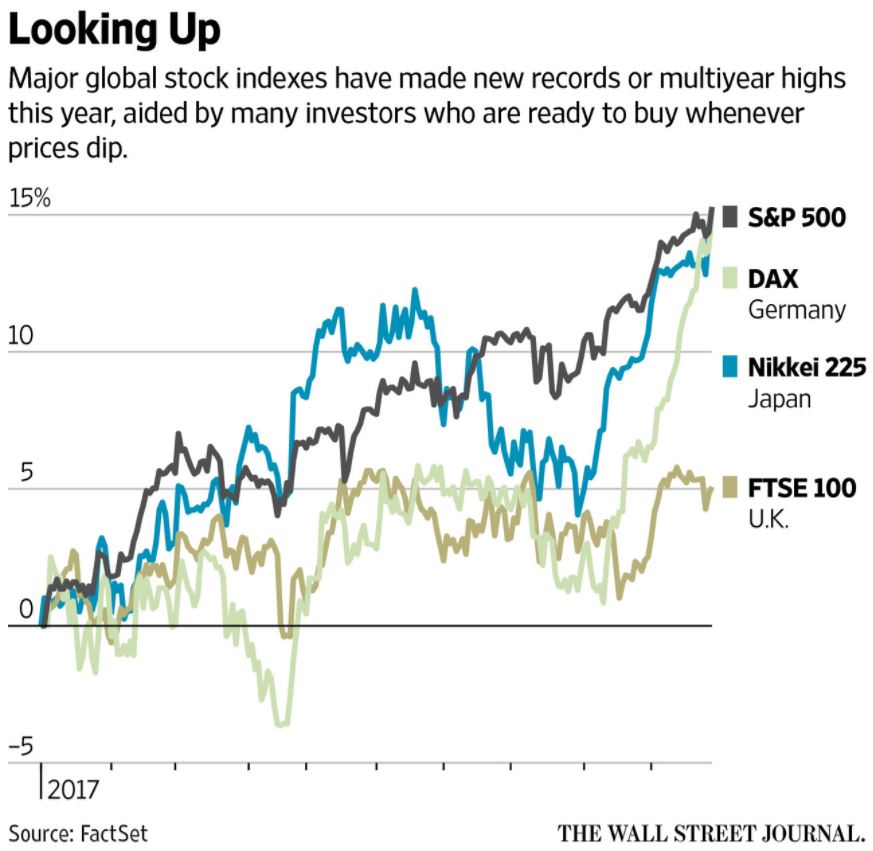
Why Are Markets Rising Everywhere? Investors Can’t Stop Buying Every Dip (WSJ.com)

The US government quietly added $200+ billion to the debt this month alone. (SovereignMan.com)

Are ICOs Replacing IPOs? (USFunds.com)

The economy is failing. We need to think radically about how to fix it (TheGuardian.com)

Gold Prices (LBMA AM)

31 Oct: USD 1,274.40, GBP 964.21 & EUR 1,095.60 per ounce
30 Oct: USD 1,272.75, GBP 966.91 & EUR 1,093.80 per ounce
27 Oct: USD 1,267.80, GBP 968.35 & EUR 1,090.18 per ounce
26 Oct: USD 1,278.00, GBP 968.34 & EUR 1,082.34 per ounce
25 Oct: USD 1,273.00, GBP 964.81 & EUR 1,081.67 per ounce
24 Oct: USD 1,278.30, GBP 970.36 & EUR 1,087.32 per ounce

Silver Prices (LBMA)

31 Oct: USD 16.82, GBP 12.72 & EUR 14.45 per ounce
30 Oct: USD 16.74, GBP 12.69 & EUR 14.39 per ounce
27 Oct: USD 16.72, GBP 12.76 & EUR 14.38 per ounce
26 Oct: USD 16.97, GBP 12.84 & EUR 14.37 per ounce
25 Oct: USD 16.89, GBP 12.75 & EUR 14.34 per ounce
24 Oct: USD 17.04, GBP 12.92 & EUR 14.49 per ounce


Recent Market Updates

- Wozniak and Thiel Fuel Bitcoin-Gold Debate: Gold Comes Out On Top
- Russia Buys 34 Tonnes Of Gold In September
- Gold Will Be Safe Haven Again In Looming EU Crisis
- Gold Is Valuable Due to “Extreme Rarity” – Must See CNN Video
- Gold Is Better Store of Value Than Bitcoin – Goldman Sachs
- Next Wall Street Crash Looms? Lessons On Anniversary Of 1987 Crash
- Key Charts: Gold is Cheap and US Recession May Be Closer Than Think
- Gold Up 74% Since Last Market Peak 10 Years Ago
- How Gold Bullion Protects From Conflict And War
- Silver Bullion Prices Set to Soar
- Brexit UK Vulnerable As Gold Bar Exports Distort UK Trade Figures
- Puerto Rico Without Electricity, Wifi, ATMs Shows Importance of Cash, Gold and Silver
- U.S. Mint Gold Coin Sales and VIX Point To Increased Market Volatility and Higher Gold

Important Guides

For your perusal, below are our most popular guides in 2017:

Essential Guide To Storing Gold In Switzerland

Essential Guide To Storing Gold In Singapore

Essential Guide to Tax Free Gold Sovereigns (UK)

Please share our research with family, friends and colleagues who you think would benefit from being informed by it.