Monday, October 26, 2015

Technicals: Gold Working Its Way Higher

Published here: http://goldsilverworlds.com/category-technicals/technicals-gold-working-its-way-higher/

Gold is working its way higher with a nice pullback to what should be support along the median line of this modified-Schiff pitchfork. This chart is meant to emphasize the failed triple-bottom zone where, IMO, a significant amount of resistance can be expected. After a multi-year downtrend many people were expecting the $1180’ish level to be the bottom. When it failed in late-2014 sentiment became very dark which of course set the stage for a quick rally up to $1300. Breaking above this triple-bottom zone and establishing it as support again will be a major milestone.

gold_daily_26oct2015

Silver is showing strength but being held back by resistance from the 200 day moving average. The $15.70 level is providing support along with the median line of the blue Andrews pitchfork. The rising 50 day MA is encouraging although the recent MACD sell signal suggests price weakness.

silver_daily_26oct2015

In normal markets we would point at the Copper chart and talk about deflation and a global slowdown. While there is certainly a global slowdown occurring, some (most?) of the steam coming out of the Copper price is caused specifically by the slowdown in China’s economy. Perhaps they have decided that they have enough ghost cities at this point. Google “China ghost cities” if you aren’t familiar with this situation.

copper_daily_26oct2015

By Bryan from Pitchforkplayground.com

3 Reasons to Be Bullish on Silver Prices in 2016?

Published here: http://www.profitconfidential.com/silver/3-reasons-to-be-bullish-on-silver-prices-in-2016/

25These Factors Point to Considerable Upside for Silver Prices
Since the summer of 2011, silver prices have fallen by roughly 70%. But since the beginning of October, prices have rebounded. Currently trading near $15.75 an ounce, silver prices have climbed 8.6%.

There are a number of factors that will contribute to the resurgence in silver prices: China’s addition to the LMBA silver benchmark-setting process, and the slowly improving U.S. economy.
China Helps Boost Silver Prices?
China, the world’s largest producer and consumer of silver, is about to have a little more.

The post 3 Reasons to Be Bullish on Silver Prices in 2016? appeared first on Profit Confidential.

Sunday, October 25, 2015

Forget China, Saudi Arabia Could Demolish The US Dollar

Published here: http://www.zerohedge.com/news/2015-10-25/forget-china-saudi-arabia-could-demolish-us-dollar

Saudi Arabia

Source: Internations.org

You probably have heard this numerous times before; the Chinese position in US Treasuries is outright dangerous and China could single-handedly force the US Dollar to weaken quite substantially. Whilst that’s definitely correct, it sure looks like one is overlooking the impact the low oil price has on the public finances of Saudi Arabia.

As the country is mainly depending on exporting its oil to keep its government budget balances, the Kingdom has been hit extremely hard by the 60% drop in the oil price as an almost certain budget surplus was suddenly converted in a huge budget deficit. In fact even during the darkest hours of the Global Financial Crisis, not a lot of countries saw their government budgets dip into the red by in excess of 20%!

Saudi Arabia Deficit

Source: The Guardian

The main problem is the fact Saudi Arabia had been using an assumed oil price of $100/barrel to balance its budget and as the current oil price is less than $50/barrel, a lot of government officials will be scratching their heads. A huge budget deficit also means the Saudi’s will be scrambling to get their hands on cash and earlier this year the country has completed the first debt offering in almost 10 years!

But that won’t really help much. Raising a few billion dollars in government debt won’ offset a lot of the expected $150B deficit and the officials in Riyadh will continue to target the country’s sovereign wealth fund (well, it’s not ‘officially’ a sovereign wealth fund, but just an investment division of the central bank) which is the third largest  in the world and had in excess of $750B in assets before the oil price started to fall.

Saudi Arabia Foreign Reserves

Source: tradingeconomics.com

The Saudi Arabian wealth fund was an excellent performer as it yielded an average 11% return over the past 10 years and this might be the country’s best bet to get out of the current oil crisis. But that’s also where the US Dollar comes into play.

Saudi Arabia Reserves

And zooming in:

Saudi Arabia ZoomIn

Source: International Monetary Fund

The original purpose of the fund was to make sure the Saudi economy remained relatively stable, and the assets could and should be monetized to soften sudden economic shocks. To serve this purpose, the country’s cash was invested in low-risk and highly liquid investments, such as US Treasury bills. It’s impossible to know how many hundreds of billions Saudi Arabia has invested in US debt securities as the American government doesn’t want you to know how which gulf country owns how much of the US debt (Government Accounting Office, 1979). But as the Saudi’s have virtually pegged their currency to the US Dollar, we would dare to bet in excess of half of the fund’s assets are held in US debt securities as it fits the bill in terms of a) liquidity, b) ‘safety’ and c) currency protection.

Even if you’d assume Saudi Arabia would be able to raise $30B per year in government debt, it still has a $120B gap to cover and the only decent solution would be to start selling US debt. This could put additional pressure on the financial markets as it won’t be easy to absorb this kind of selling.

That’s yet another reason why the Federal Reserve won’t be able to increase the interest rates anytime soon. Saudi Arabia’s gradual selling could be taken care of by the market but imagine the USA would start to increase its interest rates as well. A snowball-effect isn’t out of the question at all, and the pressure on the government bonds would be even higher and instead of a stronger Dollar, the US Dollar would be weaker. It will be extremely interesting to see more updates from the Saudi’s to see how much of the US treasuries it has already sold and how it plans to tackle its government deficit.

Because no matter what happens (excluding a sudden jump in the oil price), in 4 years from now, Saudi Arabia’s foreign reserves will be depleted. And that will most definitely fuel additional unrest in the Middle East.

>>> Click here to read our Guide to Gold and prepare yourself for the future!

Secular Investor offers a fresh look at investing. We analyze long lasting cycles, coupled with a collection of strategic investments and concrete tips for different types of assets. The methods and strategies are transformed into the Gold & Silver Report and the Commodity Report.

Follow us on Facebook @SecularInvestor [NEW] and Twitter @SecularInvest

Weekly Gold Market Review For October 23d

Published here: http://goldsilverworlds.com/investing/weekly-gold-market-review-for-october-23d/

In his weekly market review, Frank Holmes of the USFunds.com summarizes this week’s strengths, weaknesses, opportunities and threats in the gold market for gold investors. Gold closed the week at $1,164.572 down $12.60 per ounce (-1.07%). Gold stocks, as measured by the NYSE Arca Gold Miners Index, gained 0.19%. The U.S. Trade-Weighted Dollar Index surged 2.71 percent for the week. Junior miners underperformed seniors for the week as the S&P/TSX Venture Index’s loss of 0.91 percent.

Gold Market Strengths

Gold traders are maintaining their bullish calls on the precious metal for the third week in a row. Of the 24 traders surveyed by Bloomberg, 13 hold a bullish outlook on gold.

Palladium was the best relative performing precious metal this week, recording a fall of just 0.27 percent.  Palladium has been in a gentle decline post the Volkswagen story on emissions fixing, but rallied the last few days of this week.

Gold got a boost this week as China announced further interest rate cuts and the ECB re-emphasized its pledge to use all the monetary tools at its disposal to support global growth. Furthermore, Russia boosted its gold purchases by the largest amount in a year throughout the month of September, adding 34 tonnes.

Gold Market Weaknesses

India has officially announced the implementation of its gold monetization scheme that is set to replace existing deposit structure. The plan seeks to reduce imports as banks will now be allowed to sell or lend gold to retailers, thus boosting supply if owners of the gold trust the system enough to lend their gold to the state.

Silver was off 1.47 percent, making it the worst performing precious metal this week.  Silver is normally more volatile than gold, so during a week that gold declines we should expect to see silver be pared back more so than gold.

Argonaut Gold is facing some operation issues as an illegal blockade has formed at its El Castillo mine in Durango, Mexico.


Gold Market Opportunities

The corporate sector could cause trouble for the U.S. economy as profits are contracting on a year-over-year basis. What’s more, every contraction in profits since 1980 has coincided with a rise in the corporate default rate.   The default rate also closely correlates with job cut announcements.

corporate-defaults-Oct2015

Investors are eyeing gold once again as $393 million flowed into U.S. precious metals-backed exchange traded funds this month, through October 20. After a multiyear downturn in the precious metal, more bulls are emerging. Retail investors have depleted coin dealer inventories of silver coins, Russia and China are buying gold, and even Paul Singer of Elliot Management said recently that investors should have up to 10 percent of their portfolio in gold and/or gold stocks.

Overall, credit conditions for U.S. companies are already deteriorating as the 10-month span through this year has seen more S&P downgrades than the prior two years combined. Even more concerning is that these downgrades are not solely limited to the energy space. Challenger Gray noted that they are seeing layoffs at major firms at a level they have not witnessed since 2009.


Gold Market Threats

Goldman Sachs is expecting the Federal Reserve to hike rates in December and sees gold suffering as a result. The bank sees gold falling to $1,000 over the next 12 months.

The largest hurricane the world has ever recorded could cause trouble for certain Mexican mining operators proximal to the Western coast.  The third-quarter rainy season just ended, normally playing havoc with heap leach operations.  Companies such as Primero, Alamos and Argonaut could be affected; potentially even Goldcorp or Agnico-Eagle, should the rainfall be intense.

Faced with significant debt repayments, the Venezuelan government may tap into its gold reserves to generate sufficient cash. Venezuela dumping its gold could put negative pressure on global prices. Venezuela also made the news when the country notified Guyana Goldfields that its mine, which is nearly finished with construction, is on land claimed to be owned by Venezuela and not Guyana.


Elite’s NWO Secretly Operates In The Open. Gold And Silver Charts.

Published here: http://goldsilverworlds.com/investing/elites-nwo-secretly-operates-in-the-open-gold-and-silver-charts/

There are far bigger concerns about which Americans remain woefully unaware, even within the Precious Metals community.  How much demand there is for silver coins, how low is the supply for silver in contradistinction to an insatiable demand, China supposedly to set the price for physical gold to reflect reality once the Shanghai gold exchange got up and running, which it has been, etc, etc, etc, are not the most relevant factors, right now.

Almost all of the so-called PM experts/bloggers who report detailed information, and many available articles on the web focused on gold and silver, have collectively been untimely as to expectations in the ‘meteoric’ rise in prices that are supposed to reflect the realities of actual supply and demand.  China will not be the country [even including the BRICS nations collectively] to rescue gold from the fiat-driven Western global elites who do whatever possible to make gold economically irrelevant on the world economic stage.

There is no one who has yet made a cause/effect argument for how gold and silver have been priced over the past five years for the simple fact of the proactive suppression by the central bankers acting at the behest of the globalists.  Price suppression is artificial.  It is impossible to reconcile fundamental realities to intangible artificialities.  The two do not intersect, yet almost all interpretations/analysis/understanding of pricing gold and silver have been in vain because of unnatural existence of an ongoing circumstance that has no definable measure.

If, and it seems more probable when, the elite’s corporate operations, known as the federal UNITED STATES, fall apart due do the unsustainable debt creation, and the launching of so many regional wars around the globe in the service of maintaining the fiat Federal Reserve Note, “dollar, as the world reserve currency, then, and only then will we likely see the end of the decline in PMs and some degree of higher prices.

China’s emerging global power, along with the BRICS purported opposition to the elite’s IMF/BIS monetary stranglehold on how the world functions economically, plus Russia’s defending Syria’s Assad, defeating the US-created ISIS via Russia’s air force, and forging a renewed alliance with Iran to replace what appears to be the crumbling House of Saud and its partner in crime, Qatar, all of these events, as a current counterpunch to US destructive control over the Middle East, have not yet altered the suppressed prices for gold and silver,
as one might reasonably expect.

Americans, especially, have greater issues over which to be concerned but appear to be totally unaware.  This unawareness is also important for the PM community as it may affect their holdings of physical gold and silver.  The elites have taken over this country, and it should be taken as a done deal.  There are so many examples bearing this out, and in each and every instance, the American public remains clueless.

The Trans Pacific Partnership, TPP, and the Transatlantic Trade And Investment Partnership, TTIP, have been forced down the throats of the completely unaware, unknowing, and even uncaring American public, including all the politicians who voted for  the passage of both.  We have covered these insidious trade agreements, previously.  No need to give more ink for topics over which people have little to no interest.

We have also mentions the UN’s Agenda 21, exhorting people to do some research on how their lives are going to be intractably altered.  The UN, in effect, already controls the US
corporate government, another fact most are unaware of and would not believe, anyway.
For the uninformed, Agenda 21 takes away private property ownership, single-family homes, private car ownership, individual travel choices, and privately owned farms. All will be under the control of the UN, and this last sentence is just the tip of the iceberg.

There was an article put out by the Rutherford Institute, last week, by John W Whitehead, its founder, Things Are Getting Scary; Global Police, Precrime And The War On Global
‘Extremists.’  It is another prime example of how the NWO is in control and [secretly] operates in the open because most do not care enough to be aware of how their lives are being dictated, let alone do anything about it.

Essentially, this is another step taken by the UN to get local police under direct UN control.  No, it is not overt, [it never is, which is how the elites work], and it will occur slowly but inexorably.  From the article:

“Under the guise of fighting violent extremism “in all of its forms and manifestations” in cities and communities across the world, the Obama administration has agreed to partner with the United Nations to take part in its Strong Cities Network programFunded by the State Department through 2016, after which “charities are expected to take over funding,” the cities included in the global network include New York City, Atlanta, Denver, Minneapolis, Paris, London, Montreal, Beirut and Oslo.

“Working with the UN, the federal government will train local police agencies across America in how to identify, fight and prevent extremism, as well as address intolerance within their communities, using all of the resources at their disposal.”

It is expressed in a benign manner.  “The Obama administration has agreed to “partner”
with the United Nations…”  Then adding, “Working with the UN, the federal government
will train local police across America…”   Since when have local police been accountable to the federal government, and now, they will even be accountable and under the direction of the UN?  This is absolutely incredible!

“The government’s war on extremists, of which the Strong Cities program is a part, is being sold to Americans in much the same way that the USA Patriot Act was sold to Americans: as a means of combatting terrorists who seek to destroy America.”

Earlier in the article, you get an explicit explanation as to who are the “terrorists.”

“If you believe in and exercise your rights under the Constitution (namely, your right to speak freely, worship freely, associate with like-minded individuals who share your political views, criticize the government, own a weapon, demand a warrant before being questioned or searched, or any other activity viewed as potentially anti-government, racist, bigoted, anarchic or sovereign), you have just been promoted to the top of the government’s terrorism watch list.”

If you answered yes to any of the above questions, you may be an anti-government extremist (a.k.a. domestic terrorist) in the eyes of the police.”

“As such, you are now viewed as a greater threat to America than ISIS or al Qaeda.”

This information is not new, and there are many articles of this nature available, but you will nervier hear or read about it in the mainstream news that owes its allegiance to the global elites that own the media, or shall we say whose owners are indebted to, if not an active player with the NWO.

“In other words, police—acting ostensibly as extensions of the United Nations—will identify, monitor and deter individuals who exhibit, express or engage in anything that could be construed as extremist.”

It gets repeated again…your local police will be acting at the behest of the UN, and it is the globalist’s UN’s sole mission to get a one world government where people do not own land, have no say about their own affairs, even as to where they live.  All of that will be determined by the UN and its Agenda 21.  It is all there, in plain site that very few take the time to see.  Take a few minutes to read the UN’s website about Agenda 21, if you harbor any doubts how the federal government never acts in your best interests, ever.

It is about money and power, and the globalists want it all.

The UN and all police will be like the Thought Controllers, monitoring every aspect of your life, circa Orwell’s “1984,” but squared.  If you do not believe that, then you must be clueless about the NSA, Homeland Security, FEMA, and a number of “camps” around the country where people who are determined to be anti-government, [we would call them truth-tellers], could very week be ‘relocated’ at the whim of police and federal government.

“For example, in 2009, the Department of Homeland Security (DHS) released two reports, one on “Rightwing Extremism,” which broadly defines rightwing extremists as individuals and groups “that are mainly antigovernment, rejecting federal authority in favor of state or local authority, or rejecting government authority entirely,” and one on “Leftwing Extremism,” which labeled environmental and animal rights activist groups as extremists.

“Incredibly, both reports use the words terrorist and extremist interchangeably.

“That same year, the DHS launched Operation Vigilant Eagle, which calls for surveillance of military veterans returning from Iraq and Afghanistan, characterizing them as extremists and potential domestic terrorist threats because they may be ‘disgruntled, disillusioned or suffering from the psychological effects of war.’”

If you like preserving the environment and like animals, you qualify as an extremist, aka a home-grown ‘terrorist.’  Sound silly?  Then why would the corporate federal government send Americans to fight foreign wars, and when they return as veterans be characterized as potential extremists?

How does all of this pertain to gold and silver?  Potentially immensely.  For those who know STASI and East Germany, where family members would turn even on other family members, and no one trusted anyone, how do you think you will be viewed by anyone with whom you might want to exchange your gold/silver for something?  The government will have no need to confiscate your gold and silver.  Dutiful, brainwashed citizens will rat you out for defying the government in using something other than whatever paper-denominated “currency” is to be used at all times for all transactions, if everything has not already been digitalized and reported immediately.

Food for thought, for those who chose to think for themselves.

Speaking of fiat, fictional “money,” the federal “dollar” appeared to be headed lower, only to wash out stops and weak longs, trapping new shorts, in the process, to stage a very strong rebound rally.  What difference does it make if the federal government debt is now over $19.5 trillion, and counting?  What difference does it make that NO paper currency has ever maintained its violability and ceased to exist?

The globalist’s central bankers continue to muscle up the dying “dollar,” as it wrecks the US economy, along with that of Europe, in order to install its new fascist one world government.  There is certainly no opposition to be found in the US, and none in Europe. It was thought Germany would be smart enough not to let its economy be ruined by the US, but that US satellite “state” is going along with the kabuki theater directed by the US.

Germany stands to lose its strong business ties to Russia by bowing to US pressure to
unjustifiably, and illegally we might add, sanction Russia and ruin Germany’s economic growth.  [Maybe not ruin, but certainly harm growth.]  Russia simply turned to China, and it is a reasonable question to ask if Russia will need German business in the future?  Merkel has dome that country no favors by kneeling at the alter of political stupidity.

With the manipulated markets, the globalist’s central bankers are doing what they can to prop up the failing “dollar.”  Within the space of a month, the fiat dropped from 97 to 94 and then rallied back above 97 for no discernible reason, surely not one that made sense. For as long as the chart of the sickly fiat “dollar” can give the appearance of ‘health,’ gold and silver are unlikely to rally.  That said, anything is always possible, so gold and silver should be treated independent of this development.

dollar_23Oct15

It used to be when price broke above an area of resistance on a weekly chart, like gold did two weeks ago, it would lead to a rally of substance.  However, in today’s central banking-controlled markets, such a breakout cannot be viewed as reliable anymore.

Still, market activity has to be respected, and the weekly development means it is now more important to watch the daily for immediate direction.

gold_weekly_23Oct15

The chart explanation succinctly captures the potential for a further rally, if the current reaction can hold without going much lower, if at all, and we can see the resumption of another rally on increased volume.  It would warrant taking a small position to take advantage of the developing market momentum to the upside, for now.

gold_daily_23Oct15

Silver does not ‘appear’ to be as strong as gold, chart-wise, but the gold:silver ratio has come in from 78:1 a week or two ago, the around 73.5:1 currently, saying silver is holding its own.

The overlapping bars and clustering of closes over the last 3 weeks has taken on a more positive character, since last week’s analysis.  The daily now needs to be monitored with a view for immediate direction.

silver_weekly_23Oct15

The sideways developing activity over the last 13 TDs [Trading Days], is a weak correction, relative to the rally leading up to it.  Weak corrections tend to lead to higher prices.  It is also encouraging that the sideways correction held above 15.50, a recent resistance area.
A strong intra day turnaround, next week, would warrant a small position from the long side.

It has been quite some time since we have made such a statement.

silver_daily_23Oct15

Peter Schiff: This Should Terrify Americans Everywhere

Published here: http://www.profitconfidential.com/roundup/peter-schiff-this-should-terrify-americans-everywhere/

Think the U.S. Economy is Recovering? Peter Schiff Says This Will Change Your Mind
Are silver prices about to skyrocket? Could this be the end of the euro? What if Peter Schiff is right about the U.S. economy?

Every day, our team here at Profit Confidential combs through hundreds of articles, research reports, and company filings to bring the best investment insights for our readers. Here are the top stories from the last week.
Peter Schiff and Ron Paul Have a Dire Warning for America
“Schiff believes that the Fed has.

The post Peter Schiff: This Should Terrify Americans Everywhere appeared first on Profit Confidential.

Friday, October 23, 2015

How Much Paper Gold Is Being Traded Daily?

Published here: http://goldsilverworlds.com/physical-market/how-much-paper-gold-is-being-traded-daily/

The two charts in this article are definitely eye openers.

It is widely known that derivatives are governing today’s markets. The total notional value of derivatives is estimated to be around $700 trillions. As a comparison, the U.S. economy (GDP) is around $17 trillion, while the economy of all countries worldwide (global GDP) is around $65 trillion. So all derivatives worldwide are ten times bigger than the world economy.

The gold market is also dominated by derivatives, or, in our own words, ‘paper gold’. But what is the dollar value of the ‘paper gold’ market? Here is an estimate.

According to the first chart below, courtesy of the king of gold charts Nick Laird (Sharelynx), the notional value of daily paper gold trading is around $125.3 billion per day, given a dollar gold price of $1200 /oz. That calculcation is based on the equivalent of 3248 tonnes of paper gold being traded daily. Annualized, we get the ballpark figure of $30 trillion.

Compare that with the value of physical gold in the world, which equals 170 tonnes. Given a dollar gold price of $1200 /oz, all physical (above-the-ground) gold in the world has a value of $6.5 trillion.

Global_Gold_Derivatives_oct2015

The second chart shows LBMA Clearing Statistics plus exchange volumes and open interest converted to tonnes, being traded on a daily basis. The last bart on the chart shows new mine supply.

Global_Gold_Derivatives_Detail_Oct2015

It is aweful to realize how paper gold is overshadowing the physical gold market. Paper gold is even setting the price of physical gold, driven by derivatives trading mainly in the COMEX gold market.

Think about it: How is it possible that derivatives are able to set the price of a physical asset?

Gold Miners Are Coming Alive

Published here: http://goldsilverworlds.com/stocks/gold-miners-are-coming-alive/

It seems that gold miners have come alive … finally.

Our most interesting observation of this week is that gold has traded flat for a couple of days but that gold and silver miners were rising significantly on those days. The first chart shows this week’s divergence between gold (upper pane) and gold miners (lower pane), as indicated with the green circle.

gold_2months_oct2015

We know that miners have a track record of leading the metals both higher and lower.

That being said, this week’s price action in the gold mining space could be of exceptional significance. The three key gold and silver mining indices (Barron’s Gold Mining Index, HUI Index, XAU Index) are all flashing the same bullish signals. The chart below features several indicators which are mainly sending bullish signals.

First and foremost, the bullish percentage index is at 100, after it reached 0 in July of this year. Next, relative strength sits exactly at 70, a critical level, as that mostly indicates that an asset is becoming oversold. Short term price behavior will tell a lot about gold’s secular trend.

gold_mining_index_oct2015

Note how buying and volume pressure are somehow disconnected from the other indicators. It is a minor negative, as a rally on increasing volume is the strongest signal possible. The ongoing rally is happening on moderate volume, but that is fine as long as volume is not decreasing during the rally.

We believe that the next direction after gold’s current ‘hesitation’ will have fundamental implications. This is gold’s third attempt this year to break through its 200 DMA. A successful breach would signal a confirmation that the precious metals bear market is in the process of turning into a bull market.

The key price level to watch for a confirmed trend change is $1,300 /oz which should be cleared with conviction. For now, gold miners are signaling that this is in the cards, if not in 2015 then with a high probability in 2016.

Euro Gold Surges Again as Dragi Threatens Negative Interest Rates - 6.7% October Surge

Published here: http://www.zerohedge.com/news/2015-10-23/gold-euros-surges-again-67-october-draghi-threatens-negative-interest-rates

Today’s Gold Prices: USD 1171.55, EUR 1052.84 and GBP 760.70 per ounce.
Yesterday’s Gold Prices: USD 1166.45, EUR 1031.30 and GBP 753.94 per ounce.      
(LBMA AM)

Gold in EUR - 1 Week

Gold fell by an even $1.00 yesterday to close at $1166.30.  Silver fell by $0.13 to close at $15.84.  Euro gold rose to €1050/oz yesterday and to over €1,062/oz today and has surged 6.7% in euro terms so far in October.

Gold in euros rose sharply to the highest in three months after the European Central Bank signaled it will likely engage in more QE and may even move to negative interest rates. Draghi's comments are gold bullish - particularly in euro terms.

Markets took ECB President Mario Draghi’s comments as a signal that additional easing was coming as soon as December. That weakened the euro against the dollar and gold.

Gold has risen about 5 percent in dollar terms this month as patchy economic data lessened expectations of a U.S. rate increase any time soon. Indeed, there are increasing noises suggesting negative interest rates may be coming in the U.S. and EU.

Gold is now just 0.2% lower for the week in dollar terms and is nearly 2% higher in euro terms. Gold is  on track for its best monthly performance since January, with a rise of 5.5%.

Silver's outperforming again today and is up 1% - it has broken above its 200-day simple moving average at $15.94/oz to above the $16/oz level again at $16.08/oz.

Download Essential Guide To Storing Gold In Singapore

Breaking News and Research Here

Follow GoldCore on TwitterFacebookLinkedIn

This Chart Reveals What’s Likely Next for Silver Prices

Published here: http://www.profitconfidential.com/silver/this-chart-reveals-whats-likely-next-for-silver-prices/

Silver Prices are Closing in on an Important Buy Signal
The outlook for silver prices looks bullish. Silver investors should be keeping a keen eye on the gray metal, and related investments. Silver could see big gains ahead and this could happen very soon.  Hint; the U.S. dollar could be the reason.
Bearish U.S. Dollar Outlook Bullish for Silver?
One of the biggest reasons silver prices have taken a big hit in the last year is due to the rise in the U.S. dollar. Now, if you look closely, the dollar is declining compared to other major currencies and could go much.

The post This Chart Reveals What’s Likely Next for Silver Prices appeared first on Profit Confidential.

Thursday, October 22, 2015

The 7 Biggest Lies about Gold

Published here: http://goldsilverworlds.com/money-currency/the-7-biggest-lies-about-gold/

It’s hard to say which lie about gold is the biggest whopper.

Many widely held beliefs about gold are lies – propaganda hammered home to have us believe the only true measure of wealth is government-issued debt.

Big Lie #1: Gold is a barbarous relic.

Repeated for decades, this misquote of 20th century socialist economist John Maynard Keynes perpetuates a lie exploited as an almost biblical prophesy of gold’s demise.

What Keynes actually wrote in 1923 was “the gold standard is already a barbarous relic.” Big-spender Keynes was advocating legislation to demolish gold’s restrictive power over government spending.

While the classic gold standard (gold backing paper money) no longer officially exists, governments buy and sell gold around the clock.

Their economic prestige is still measured by the tonnage of gold they claim to possess.

What’s true is every individual holding gold has adopted his own personal gold standard. They disagree that gold – and the gold standard – are “barbarous relics.”

Big Lie #2: Gold pays no interest.

This silliest lie of all is meant to portray gold as lower class. But no wealth instrument pays interest until transferred to a counterparty. Gold handed to a counterparty does pay, but it’s not called “interest.” Central bankers know that calculation as the Gold Lease Rate (GLR), where gold serves as collateral to lower interest costs when borrowing dollars in “gold swaps.”

Swaps and leases are often code for selling.

What’s true is your dollars don’t pay interest at all, until you give away your controlling possession to a counterparty – like putting your cash in a bank or loaning it to a relative. And the interest you’re paid for taking such risk is heading to zero or negative.

Big Lie #3: Gold will be confiscated, just as in 1933.

This is the lie most useful to government because it has frightened so many away from gold. The “confiscation” was actually a paid-for expropriation, which outlawed “hoarding,” not owning, gold. Franklin Roosevelt left millions in gold legally in Americans’ hands. His order was largely ignored anyway.

FDR’s aim was forcing Americans to recognize only fiat paper as money, because he couldn’t print gold for his government spending spree. President Gerald Ford reversed FDR’s order in 1974.

What’s true is Washington has instead published plans to confiscate your cash in your bank accounts without notice.

Big Lie #4: Gold is not money.

History is littered with the carcasses of collapsed paper currencies, right up to today. In every instance, gold and silver stepped in to restore confidence as accepted and desired money.

Across Asia, gold and silver are commonplace currencies. Utah and Texas have recently taken steps to legalize gold and silver as acceptable money. Other states, terrified of the Federal Reserve’s money printing and Washington’s reckless spending, are studying their examples.

What’s true is gold and silver have been money for thousands of years, despite Ben Bernanke’s dishonest “gold is not money” testimony to Congress in 2011.

Big Lie #5: Gold is useless in a crisis because merchants cannot make change.

History shows in every paper money collapse, barter systems always emerge. Gold and silver make perfect barter, accepted by most, including merchants selling goods and services. And gold and silver are widely available in convenient fractional sizes.

In a dollar collapse, yesterday’s price tags won’t matter, since prices won’t mean much in dollar terms. Customers holding gold and silver will determine their metal’s value and decide what change to expect, not merchants.

What’s true, “he who has the gold makes the rules.”

Big Lie #6: Gold has no practical uses beyond adornment.

This lie is easy to dispel, but it often surprises readers to learn practical uses have been found for gold going back 3,000 years.

Electronics, computers, cell phones, GPS, medicine, dentistry, and space exploration join a long list of modern uses. Gold can be stretched into wire miles long or pounded into sheets thin enough to cover roofs, ceilings, and buildings. Gold is an excellent electrical conductor, doesn’t tarnish or corrode, reflects radioactive and ultraviolet rays, and treats human cancers.

Add gold’s unmatched meaning to religious faiths, significant ceremonies, and personal relationships, and forget billionaire Warren Buffet’s phony rant that “gold is dug from one hole just to be buried in another.”

What’s true is gold won its place as the symbol of wealth, value, faith, and endurance long, long ago.

Big Lie #7: Gold cannot be created in the lab.

Olden day alchemists sought to please their kings by trying to turn lead, and everything else, into gold. Failed experiments often cost them their necks.

Gold has been created in nuclear laboratories, using atomic particle accelerators, but at a cost of about $10,000 per microscopic atom. The tiny gold turned out to be radioactive.

Far more profitable, the “laboratories” of international banks regularly turn paper into gold by selling claims on physical gold through futures, options, and exchange traded funds.

Flooding the marketplace with synthetic paper gold is the preferred method to depress prices of gold and other metals, like silver.

What’s true is this underworld lab experiment ends once banks can no longer deliver the metal they’ve sold. Expert analysis reports the current ratio of factory-made paper claims to real gold is 180:1, meaning each ounce of bullion banks’ gold has been sold to 180 different buyers.

The Seven Biggest Lies about Gold tell the sordid story of a dishonest, bankrupt government, aided by a cozy, compliant news media, and perpetuated by a deficient educational system.

Judging from the constant onslaught of anti-gold propaganda, and the relatively small percentage of Americans owning or knowing anything about gold, these lies have done their damage.

Amazing Chart: Silver To Start A Huge Rally?

Published here: http://goldsilverworlds.com/price/amazing-chart-silver-to-start-a-huge-rally/

A lot of analysts use the gold to silver price ratio in their writings. We are only occasionally using that ratio, mainly because it is not a technical or timing indicator. Rather, we look at it as a long term trend indicator.

The 2-decade chart of the gold to silver ratio has reached the upper border of its range (the 80ish area). Here is the most interesting fact: each time the ratio has reached those upper borders, a trend change has taken place, which implied that the silver price started rising sharply.

The chart below is amazing according to us. It indicates the gold to silver ratio with the yellow dotted line (right axis), and the silver price with the grey line (left axis).

Note how silver started a huge rally, both in 2003 and 2008, when the gold to silver ratio reached the upper border of its long term range.

gold_silver_ratio_1996_2015

Are we about to experience a similar rally now?

Gold’s Bullish Flag Breakout Targets $1200

Published here: http://goldsilverworlds.com/category-technicals/golds-bullish-flag-breakout-targets-1200/

Draghi’s dovish comments from earlier today have led to out-and-out rout in the euro, with the single currency falling over 200 pips against the US dollar and even further against previously beaten-down currencies like the New Zealand dollar. With the prospect of a further easing from one of the world’s most important central banks, you would expect to see strength in commodities like oil, gold and other metals, but the accompanying dollar strength appears to be overwhelming this effect.

Despite a modicum of weakness today, gold’s technical outlook remains optimistic in the near-term. After peaking near 1190 last week, gold has nudged its way back down to 1165 as of writing. The shallow, controlled pullback after the big rally of the previous days has created a clear bullish flag pattern. It’s worth noting that, despite its name, this pattern is only seen as a bullish sign if we see a breakout above the top of the flag (currently near 1180).

That said, the secondary indicators suggest that we could see a bullish breakout sooner rather than later. The MACD continues to trend higher above its signal line and the “0” level, showing bullish momentum despite the recent dip. Meanwhile, the RSI indicator is in an uptrend of its own and has pulled back from overbought territory, potentially clearing the way for another leg higher.

Looking ahead, a break above the top of the flag at 1180 could open the door for a move up to 1200 next, and the measured move target of the pattern actually comes up closer to the 1250 level. Bulls would do well to temper their enthusiasm for now though, as a failure to break out of the bullish flag pattern could lead to a deeper retracement toward the 100-day MA in the 1140 zone.

gold_chart_22_oct_2015


You can find more of FOREX.com’s research at http://www.forex.com/latest-forex-research.html

Disclaimer: The information and opinions in this report are for general information use only and are not intended as an offer or solicitation with respect to the purchase or sale of any currency or CFD contract. All opinions and information contained in this report are subject to change without notice. This report has been prepared without regard to the specific investment objectives, financial situation and needs of any particular recipient. Any references to historical price movements or levels is informational based on our analysis and we do not represent or warrant that any such movements or levels are likely to reoccur in the future. While the information contained herein was obtained from sources believed to be reliable, the author does not guarantee its accuracy or completeness, nor does the author assume any liability for any direct, indirect or consequential loss that may result from the reliance by any person upon any such information or opinions.

Futures, Options on Futures, Foreign Exchange and other leveraged products involves significant risk of loss and is not suitable for all investors. Increasing leverage increases risk. Spot Gold and Silver contracts are not subject to regulation under the U.S. Commodity Exchange Act. Contracts for Difference (CFDs) are not available for US residents. Before deciding to trade forex and commodity futures, you should carefully consider your financial objectives, level of experience and risk appetite. Any opinions, news, research, analyses, prices or other information contained herein is intended as general information about the subject matter covered and is provided with the understanding that FOREX.com is not rendering investment, legal, or tax advice. You should consult with appropriate counsel or other advisors on all investment, legal, or tax matters. FOREX.com is regulated by the Commodity Futures Trading Commission (CFTC) in the US, by the Financial Conduct Authority (FCA) in the UK, the Australian Securities and Investment Commission (ASIC) in Australia, and the Financial Services Agency (FSA) in Japan. Please read Characteristics and Risks of Standardized Options.

Gold Analogue: Then and Now

Published here: http://goldsilverworlds.com/price/gold-analogue-then-and-now/

1970s: Gold rallied from about $35 in 1970 to nearly $200 in December 1974, and then fell to about $100 in August 1976.

So what?

Examine the graph of average monthly gold prices Jan. 1970 – Sept. 1976. Compare it to the graph of gold prices from April 2002 – October 2015. Note that the second graph was prepared with the same number of data points, but the time scale was doubled – each point is a two month average price. Note the similarity in form. The first is scaled $0 to $200 and the second $0 to $2,000.

gold_70ies_Oct2015

gold_2000_Oct2015

What we see:

  1. Gold prices increased by a factor of almost six from 1970 to 1974, and then fell by about 45%.
  2. Gold prices increased by a factor of about six from April 2002 to August 2011, and then fell by about 45% from the peak.
  3. Both the rally and correction in 2002 – 2015 took about twice as long as in the 1970s.
  4. Subsequent to the 1976 bottom, gold prices increased by a factor of about eight in a massive bubble inspired by, among others, inflation worries, fear, and loss-of-confidence in government and central banks.

What does this prove? Well … it proves nothing. But it suggests a few observations.

  1. Gold prices can be amazingly volatile, especially when fear increases and a majority of people lose confidence in debt based fiat currencies, central banks, and politicians.
  2. If the analogue continues for several more years, we might see gold prices increase by a factor of five to ten into the $5,000 to $10,000 range in five to seven years (double the 3.5 year rally in the 1970s).
  3. We should not expect this analogue to predict gold prices, but we should NOT discount the possibility of a similar pattern unfolding.

Why?

  • In the late 1970s the US had lost international prestige due to a weak President (Carter), massive inflation and excessive debt.
  • Today the US has lost considerable prestige in the Middle-East, Europe and Asia, has excessive debt, no capacity to balance the budget, and has twice elected a President who is …. (your choice of complaint).
  • The late 1970s inflation was partially a consequence of massive spending on the Vietnam War – which benefitted few besides military contractors and bankers.
  • Today the US has yet to experience and pay for the consequences of wars in Afghanistan, Iraq, Libya, Syria, and Ukraine, but unpleasant consequences will occur. Those wars primarily benefitted military contractors and bankers.
  • Central bankers and politicians lost considerable respect in the late 1970s.
  • Central bankers and politicians have lost considerable respect in the past several years.
  • Debt based fiat currency, backed by nothing but faith, hope, delusions, and taxing authority was deeply devalued in the late 1970s.
  • Debt based fiat currency, backed by nothing but faith, hope, delusions, and taxing authority will be deeply devalued in the coming years.

CONCLUSIONS

There are similarities between the late 1970s and present day. Gold rose substantially for 3.5 years in the late 1970s and increased in price by a factor of about eight. Something similar could (probably will) happen again.

NONSENSE – such as deficit spending, massive debt, excessive leverage, unindicted fraud, pervasive corruption, derivative contracts with minimal margin, hope and delusions, bond monetization, suppressed interest rates, levitated stock markets, forever wars, and so much more – encourages people to think:

  1. People want to be prepared with the 4 G’s: God, gold, guns, and grub.
  2. The politicians and central bankers created most of the problems so it is foolish to believe they will solve current problems. Expect more fiscal and monetary nonsense, devaluation of currencies, inflation, and higher gold and silver prices.
  3. War pays extremely well – if you are a military contractor, banker, or politician – so expect more war. More war creates much more debt, inflation, and fiscal and monetary nonsense.
  4. The US Congress has a low approval rating – for good reason.
  5. Debt cannot grow to infinity nor can interest rates remain near zero forever.
  6. The “silly season” when the US elects a new president is not a time to expect serious and intelligent discourse or change toward fiscal and monetary sanity.
  7. Time to prepare may be quite short.
  8. Paper dies, gold thrives.
  9. Paper dies, silver thrives.


Gary Christenson | The Deviant Investor

Gold Is Long Term Inflation Hedge - Leading Academic Expert

Published here: http://www.zerohedge.com/news/2015-10-22/gold-long-term-inflation-hedge-leading-academic-expert

Gold Is Long Term Inflation Hedge - Leading Academic Expert

By Dr Brian Lucey

Recent research  has begun to cast some doubt upon the inflation hedging capacity of gold.

The inflation experience over the last 40 years,  since gold began to float freely,  has been  very mixed. In the 1970s we were concerned in relation to inflation, perhaps even fears of hyperinflation;  now the talk is of deflation or disinflation.

GoldCore: US Inflation and Gold

The reality is that the relationship between gold and inflation is very time varying.

Research of mine ("On the Economic Determinants of the Gold-Inflation Relation") found that when you exclude the 1980s there was in fact no stable relationship, on average. The nature of the time variation was mainly explicable by the trade weighted value of the US dollar (which of course is partially determined by inflation) and this strengthened the idea of gold as a money rather  than as “just another asset”.

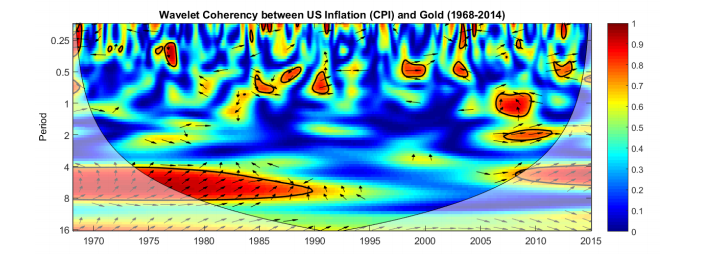
As important as gold being, or not, a hedge is over what period. It is conceivable to have an asset that performs a desired function over the short term but not over longer. More recent work ("Is Gold a Hedge Against Inflation? A Wavelet Time-Frequency Perspective"), using some sophisticated methods borrowed from audio processing and geophysics, allows us to decompose any hedge characteristic into various frequencies.

A further issue is around what kind of inflation - if we knew that inflation was to be 10% we could act. So it is important to look not only at realized but also at unanticipated inflation. Leaving aside the issue of how to obtain a decent forecast (to allow for a decomposition into anticipated and unanticipated) we find some very interesting findings.

First, yes, the 1970s and early 80s do see gold as a hedge against actual inflation.

But second, there are further periods when this happens. 

And third, this happens not just in the USA but also in the UK, Japan (to some extent) and Switzerland.

Fourth, we find that gold works well at different frequencies.

Fifth, we find that it is not just CPI but also a variety of other inflation measures for which gold can act as a hedge. 

And sixth, gold can act as a hedge against unexpected inflation but not unexpected deflation.

The paper contains detailed analysis for the UK, Switzerland and Japan, and also analyses gold bullion versus gold futures versus gold equities as alternative ways to seek exposure to gold's hedging properties against a variety of inflation scenarios. Similar findings to the USA are found.

The graph above shows what we find for the USA. The horizontal axis is time. The vertical axis is the frequency, in months.  Warmer colours represent stronger relationships. Upward facing arrows indicate gold leading inflation, downward the opposite.

Looking then at the USA we see a strong relationship from 1968 through 1990. This high coherency band suggests a strong long-run relationship between gold returns and changes in CPI, during a phase of above average inflation. Gold returns lead changes in inflation at this time.

An investment in gold acted as a strong long-run hedge against future increases in inflation.

Beginning from the early parts of the 2000s, a number of short but significant deflationary phases can be identified. In particular, a sharp period of decreasing inflation (deflation) occurred in the later part of 2008.

A band of high coherency centred on a period of one month is followed by a further band of high coherency centred on a period of 2 months. Declining gold presaged deflationary pressure. Furthermore, an extended period of high coherency is evident at periods between 4 and 8 months from 2008 onwards.

Advancing gold presaged increased inflationary pressure. The evidence found for the US indicates that gold returns have a positive relationship with changes in inflation during both inflationary and deflationary phases.

In other words, gold is generally not found to hedge against the risk of deflation, instead frequently displaying concurrent negative returns.

This relationship is particularly evident at long periods greater than four months, suggesting that gold’s inflation hedging properties are strongest for those with long investment holding periods.

In short, while gold can be useful as a hedge against inflation - this is consistently so only in the long run.

GoldCore: Dr Brian Lucey

Dr Brian Lucey, Professor of Finance at the School of Business, Trinity College Dublin. 

He studied at graduate level in Canada, Ireland and Scotland and holds a PhD from the University  of Stirling. His research interests include international asset market integration and contagion; financial market efficiency, particularly  as measured by calendar anomalies and the  psychology of economics. 

His research on gold has established that gold is important as a long term diversification due to gold’s “unique properties as simultaneously a hedge instrument and a safe haven.”

GoldCore will be conducting a Webinar next Thursday, October 22nd at 1600 (BST/ London/ UK time) in which we will open up the floor to attendees in our ever popular Question and Answer session.

Register Now and have your question answered by John Butler of Amphora Capital.

GoldCore: Register now for Webinar

John will be giving a keynote speech at the Precious Metals Symposium in Sydney, Australia on October 26th and 27th and we are scheduling meetings with HNW clients for him while he is in Sydney.

Contact us at sales@goldcore.com if you wish to meet John in Sydney to discuss optimal strategies to access and allocate funds to the gold market today.

DAILY PRICES

Today’s Gold Prices: USD 1166.45, EUR 1031.30 and GBP 753.94 per ounce. 
Yesterday’s Gold Prices: USD 1174.40, EUR 1035.08 and GBP 759.88 per ounce.     
(LBMA AM)

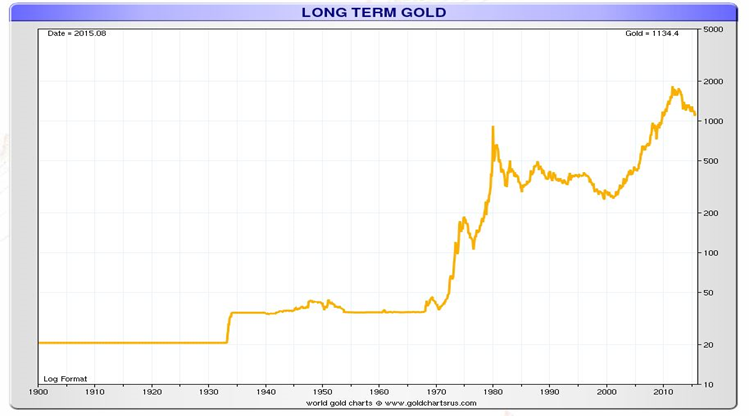
GOldCore: Gold Longterm

Gold fell $9.90 yesterday to close at $1167.30.  Silver was down $0.21 for the day, closing at $15.71.  Euro gold fell to about €1029, platinum lost $16 to $1001.

GoldCore: 7 Key Storage Must Haves

Download 7 Key Storage Must Haves

Breaking News and Research Here

Follow GoldCore on TwitterFacebookLinkedIn

The Cost of Physical Gold vs. Futures

Published here: http://www.zerohedge.com/news/2015-10-21/cost-physical-gold-vs-futures


Hold your real assets outside of the system in a private, non-government controlled, international facility   -->  http://www.321gold.com/info/053015_sprott.html


The Cost of Physical Gold vs. Futures

Written by Keith Weiner (Click For Original)


Suppose you plan to buy gold, hold it 10 years, and sell it at the end. Is it more cost-effective to buy physical metal, store it, and sell it at the end? Or are you better off buying futures?


The Cost of Physical Gold vs. Futures - Keith Weiner


It’s easy to calculate the cost of physical metal. If you buy at $4 over spot, that’s about 35 basis points (bps). You will also pay for storage an insurance, say 30 bps per year. In 10 years, you sell it at the spot price. Your total cost is about 3.3%. If you started with enough to dollars to buy 400oz of gold, then at the end you would have dollars equal to about 386.8oz at the then-current price of gold.


Futures contracts are more complicated. When you buy, there is almost no premium (10 or 20 cents). However, there is a commission of around $0.25 an ounce. So initially, you get more gold.


See the graph above, zoomed in to show the small difference in cost between the two approaches to holding gold for 10 years and then selling it.


However, the cost of holding the position is greater. This is because the price of longer-dated contracts is higher—called contango. Contango represents the majority of your cost if you hold for a long period of time like 10 years.


There’s a simple reason why contango is normal in the gold market. Contrary to popular belief, the typical seller of a gold contract is not betting on a falling gold price. He is an arbitrageur. He is earning a small spread between the price of gold in the spot market and the price in the futures market. He simultaneously buys metal and sells a contract, storing the gold in the meantime. This is called carrying gold. The cost of carry is mostly interest expense. So generally, the price of a future should be above the price of spot by the amount of this interest.


Not too long ago, the contango in gold was about 80 bps. It’s now about 25 bps (which suggests the market has become tight, but that’s a whole separate discussion). This is your cost to hold futures contracts.


For example, a gold contract for Dec 2016 delivery is a little over a year until maturity. Instead of paying spot—say $1,135—you will pay about $4 over spot.


Unfortunately, when December 2016 comes around, you will have to sell the contract and buy another one that’s farther out—called rolling the contract. Rolling costs you another commission.


Also, that premium you paid will have wasted away. When it comes time to sell, you will be lucky to get the spot price. That’s because in our new normal world, gold futures tend to go into backwardation as they approach expiration. Backwardation, the opposite of contango, is when a futures contract trades below the spot price. Selling a backwardated contract costs you more—about 80 cents for the December 2015 contract right now.


Currently, you’re looking at a loss of about $5 when you roll a contract forward one year. To hold futures for 10 years, you have to do this 9 times. Assuming the costs remain the same (they won’t), you will have about a 4.4% loss by the end. To exit your position, you simply sell the last contract but don’t buy the next year.


You end up with a total dollar amount worth about 382.6oz of gold. Remember from above, with gold bars, it’s about 386.8oz. It’s pretty close at the moment, though futures come out behind. And this is with futures being a lot cheaper than normal (due to the tightness I mentioned above). If the market corrects this condition, the cost of using futures could go a lot higher.


There are more complex ways to play with futures. If you’re sophisticated and have a bit of luck, you could end holding your gold exposure at zero or even make a profit. However, this approach is not for most people.


There is one other advantage to physical metal over futures. Futures have counterparty risk. You are extending credit. For a short time frame, I wouldn’t worry about it too much. However for a 10-year period, there is a risk that gold could go into permanent backwardation . In that case, futures contracts could become worthless.


Please email with any questions about this article or precious metals HERE


Author - Keith Weiner is CEO of Monetary Metals, a precious metals fund company in Scottsdale, Arizona. He is a leading authority in the areas of gold, money, and credit and has made important contributions to the development of trading techniques founded upon the analysis of bid-ask spreads. He is founder of DiamondWare, a software company sold to Nortel in 2008, and he currently serves as president of the Gold Standard Institute USA.

Weiner attended university at Rensselaer Polytechnic Institute, and earned his PhD at the New Austrian School of Economics. He blogs about gold and the dollar, and his articles appear on Zero Hedge, Kitco, and other leading sites. As a leading authority and advocate for rational monetary policy, he has appeared on financial television, The Peter Schiff Show and as a speaker at FreedomFest. He lives with his wife near Phoenix, Arizona.


Sprott Money - Established in February 2008, Sprott Money Ltd. is a leading precious metals wholesale, institutional and retail dealer selling gold, silver and platinum bars, coins and wafers online and over the phone. 

Wednesday, October 21, 2015

Gold Is Exceptionally Cheap At The Moment

Published here: http://goldsilverworlds.com/investing/gold-is-exceptionally-cheap-at-the-moment/

According to John Hathaway, senior portfolio manager at Tocqueville, gold’s needed financial market turmoil in order to receive the investment interest it deserves. As global equity markets fell in the 3d quarter, gold was bid during the same time period. Year to date, broad stock indexes are in the red, with the DJI declining for three consecutive quarters which has only happened 3 times in in 40 years.

Hathaway believest that precious metals can see more inflow, but more “damage to confidence” must occur.

Unprecedented and radical monetary policy will end badly. Hathaway explains that he is in agreement with many financial luminaries who he has cited in past letters, including Seth Klarman of Baupost Group, Stan Druckenmiller of Duquesne Capital Management, and Paul Singer of Elliott Capital Management.

From Hathaway’s 3d quarter gold strategy letter:

The effect (and possibly the design) of zero interest rates and quantitative easing has been to force investor savings into risky assets such as overvalued Nasdaq stocks, junk bonds, and emerging markets. The most obvious way for monetary policy to end badly is for investors of all stripes to suffer a prolonged bout of financial market adversity. Losses in risky assets will dissipate investor confidence, undermine economic activity, and leave the Fed with little choice other than to step on the accelerator for more easy money. It is in the midst of this sequence that we expect investors to rediscover gold in a big way.

The flywheel that has driven the price of gold downward over the past four years is the same one that will in our opinion propel the gold price to new highs. That flywheel, for lack of a better term, is synthetic or paper gold. Paper gold consists of futures contracts, options, and derivatives traded on the Comex and more opaquely over the counter in NY and London. The predominant players in synthetic gold are high frequency traders whose computer models are agnostic and impervious to the considerations of fundamental analysis. The magnitude of paper gold trading is an extraordinary multiple of physical gold trading, with credible estimates ranging as high 80 to 1.

In our view, the artificial intelligence of computer generated synthetic gold traders will sniff out a directional change in the market long before the fundamentals can be articulated. As in all markets, price precedes headlines. We judge the pile on effect from the synthetic gold market to be equally potent in either direction, and we therefore expect the extreme, intense lows that we are currently experiencing to be followed by new all-time highs.

Gold’s rise will have four distinct facets, according to Hathaway, as detailed below.

Macroeconomic

Impending exposure of monetary policy is fraudulent and a threat to general welfare. Think of it as checkmate for public policy. As one articulate observer put it: “Gold and The Dollar: Everything Yellen has said is wrong. The U.S. economy is not recovering and the U.S. short term interest rates are not going to rise which removes the argument for being long the Dollar vs. the Yen and Euro. (Belkin Report 10/4/15)”

Microeconomic

The lack of discovery of new gold reserves by the struggling gold mining industry which, absent a significant rise in the gold price, will lead to a supply crunch. The rate of discovery of new gold is at a multi-year low and the mine reserve life currently stands at a perilous 13 years, the lowest in 30 years:

gold_discoveries_1990_2014

mine_life_1996_2015

Technical

The well documented shift of physical gold ownership from Western investment hands to Asian will threaten the highly levered institutions that intermediate financial and physical gold markets. The intermediaries include Comex, LBMA, Over the Counter market, and bullion banks. Hathaway expects the gold drain from West to East to be resolved by a short squeeze. Signs of stress that reflect a growing shortage of physical gold to support the paper market include the prolonged backwardation of the co-basis which has existed now for 3 ½ years and now approaching extremes last seen at the bottom of the gold market at year end 2008:

GOLD-cobasis

comex_stress_indicator

Market psychology

Gold will benefit when the historically reliable cycle of descent from euphoria and well-being to discomfort and malaise starts to kick in.

Conclusions

In our opinion, the most dynamic way for investors to position for these changes is through a diversified holding of well selected gold mining equities, which stand to benefit in a dramatic way from a better gold price environment and improved investor sentiment. The industry has done an excellent job, in our opinion, of pairing costs as well as shedding assets to improve balance sheets. These measures are already showing up in improved production costs and more robust cash flows even at current low gold prices.

Our research process consists of continuous, intensive and extensive due diligence. We believe that our portfolios represent the best possible mix of high quality assets, financial staying power, and dynamic exposure to the better gold price environment that we expect.

In our view, gold is exceptionally cheap at the moment because the radical monetary policies practiced by the world’s leading central banks have led to an egregious mispricing of risk by investors at large. We believe that the Fed’s continuing (and increasingly glaring) inability to normalize interest rates validates our long standing thesis that monetary extremism cannot be unwound without triggering a slew of unacceptably painful consequences for the holders of risk assets and bonds. The dollar gold price has been the main loser from the resurgence of confidence in financial assets and the resultant multiyear rally. Once investors discover that there is a bite to the “risk” in risk assets, gold could be the big winner.

Insane “Trillion Dollar Platinum Bullion Coin” Option Ruled Out By U.S. Treasury To Avert New Debt Crisis

Published here: http://www.zerohedge.com/news/2015-10-21/insane-%E2%80%9Ctrillion-dollar-platinum-bullion-coin%E2%80%9D-option-ruled-out-us-treasury-avert-ne

Insane “Trillion Dollar Platinum Bullion Coin” Option Ruled Out By U.S. Treasury To Avert New Debt Crisis

The silly and somewhat insane uber Keynesian “Trillion Dollar Platinum Coin” appears to be now firmly off the table.

The US Congress has once again ruled out the possibility of issuing a “trillion dollar platinum coin” floated as a possible solution to the looming US Debt Crisis.

GoldCore: Trillion dollar platinum coin
Pressure is mounting as Treasury Secretary Jack Lew said earlier this week that Congress would need to raise the nation’s borrowing cap by November 3 to avoid a potential default. 

“If Congress fails to raise the nation’s debt ceiling by that date, the US could risk a first-ever default on its obligations”.

Brett LoGiurato, writing in UK Business Insider, points out that as a resolution to the US  debt ceiling is still unclear, “speculation has popped up once again about two popular theorized “work-arounds” — the 14th Amendment and the “trillion-dollar platinum coin.”

Read more in “Treasury again rules out the ‘trillion-dollar coin’ option to avert the debt ceiling

DAILY PRICES
Today’s Gold Prices:   USD 1174.40 , EUR 1035.08 and GBP 759.88 per ounce. 
Yesterday’s Gold Prices:  USD 1173.70 , EUR 1032.87 and GBP 747.86 per ounce.    
(LBMA AM)

GoldCore: Gold in GBP - 1 month
Gold in GBP – 1 Month

Gold fell yesterday by $6.30 closing at $1146.60 but was up by 0.61% overall for the week.  Silver lost $0.05 to close at €15.08, down 0.46% for the week.  Euro gold fell to about €1023, platinum lost $7 to $945. 

GoldCore: 7 Key Storage Must Haves

Download 7 Key Storage Must Haves

Breaking News and Research Here

Follow GoldCore on TwitterFacebookLinkedIn

Tuesday, October 20, 2015

Costs For Banks To Hold Gold To Rise Up To 300 Pct

Published here: http://goldsilverworlds.com/physical-market/costs-for-banks-to-hold-gold-to-rise-up-to-300-pct/

As noted by Reuters, new liquidity rules for banks in the EU could raise costs for trading gold by up to 300%. Consequently, banks will be forced out of the market, according to London Bullion Association (LBMA).

After the financial crisis, new capitalization rules were introduced in the context of Basel III. The rules treat physically traded gold the same as other commodities, meaning banks trading the metal would have to carry more cash and cash equivalents as a proportion of their gold exposures to act as a buffer if there is an adverse move in the gold price.

In Basel III’s language, gold’s liquidity “haircut” is increasing to 85 percent from 50 percent. This percentage is used to help calculate a so-called liquidity buffer known as the net stable funding ratio (NSFR) that all banks must hold from 2018. The higher the figure, the more funding is needed to meet the overall NSFR requirement.

This, the LBMA and other industry bodies argue, makes funding gold transactions for commercial banks difficult and increases the cost of doing business.

“Basel III is a big issue for us at the moment, because we are looking at an increase in costs of up to 300 percent and … that is a kind of cost that makes you decide to get out of the business,” said LBMA’s CEO Ruth Crowell. “And whilst there is not a lot of sympathy for banks, it’s the clients of these banks that are going to suffer from that, producers, manufacturers, refiners.”

The rules come into full force in 2019, but regulatory and market pressure has prompted lenders to comply sooner.

Silver Prices Will Rise Considerably Between 2016 And 2020

Published here: http://goldsilverworlds.com/price/silver-prices-will-rise-considerably-between-2016-and-2020/

Last week, we wrote Green Light For Silver in which we stated that “Silver looks like it has bottomed and will move substantially higher.” In summary:

  • The long-term silver to gold ratio is a good indicator of bottoms in silver prices. That ratio was recently exceptionally low and appears to be climbing. Expect higher silver prices.
  • In the long-term, whether you start in 1913, 1971, or the year 2000, silver prices, on average, follow the US national debt. Currently silver prices are far too low compared to that debt. We all know the national debt is exponentially increasing and therefore we should expect silver prices to substantially increase from here to “catch up” with the dramatically increasing debt.
  • Silver prices – weekly basis – are low, oversold, and moving higher. They have recently broken an important downtrend resistance line.

What Happens Next? What Do Others Say?

Craig Hemke suggests that in the near-term prices may experience another engineered fall. Read his excellent commentary here.

There can be little doubt that The Banks are once again preparing to smash the paper prices of gold and silver.”

We all know that short term prices for paper silver are easily pushed up and down by interested players. Consequently let’s seek longer term analysis that is less affected by the HFT manipulations.

From Richard Russell who has seen it all in 90+ years of market observations:

This bear market (and I’m calling it one) has developed a case of internal erosion. Stocks are falling apart one by one as the big averages mask the damage. Bear markets are sneaky beasts and they like to do their damage as secretly and as unobtrusively as possible. I hate to say it, but somewhere ahead the bears are going to get together and the innocent little stream is going to turn into a waterfall.”

What can you do about it? Stay out of the market. Protect yourself by remaining in pure wealth, gold. For thousands of years, silver and gold have been treated as pure wealth.” [emphasis mine]

From Michael Noonan who is concerned about US foreign policy blunders and a march to global war, which will propel gold and silver prices much higher:

By opposing the US and in calling the US bluff, Putin gains international respect at the expense of a lying US administration. This also strengthens Iran’s influence over Assad and Syria, plus Iraq. At the same time, it puts the Saudis and Qatar into a compromised position. The remaining question is, will the Saudis, Qatar, and the US quietly stand by while Russia takes control over the ME, or once backed into a corner, will those three come out fighting, potentially leading to WWIII?”

From Michael J. Kosares regarding movement of money from stocks and bonds into gold and silver:

Now with warnings of the next leg of the financial crisis surfacing almost daily, that demand could accelerate to an even higher level. The massive, artificial wealth built-up in the world’s stock and bond markets will be looking for a place to go and one likely beneficiary will be the underpriced gold and silver markets.”[emphasis mine]

From Christopher Aaron regarding a technical case for a tremendous silver rally. READ HIS ANALYSIS!

Our technical model is showing the completion of a downside capitulation signal for silver prices, indicating that a significant long term bottom is either already in place or will be finalized over the next several weeks across the silver market. Whether or not we see additional short-term weakness to the extent of a few dollars per ounce, the emergence from this pattern will represent a long term silver buy signal of similar magnitude to the one that occurred in November 2008, which saw silver rise over 400% within 2.5 years.”

From a daily email from Miles Franklin quoting a post on LeMetropole Café (subscription service) from a reader named “Derek:”

Well, it seems as though the criminals who control the COMEX have a serious dilemma with silver. If they continue suppressing the price, as they’ve done for decades, they will create a worldwide shortage of silver. If, on the other hand, they allow the price to rise to its true free-market level, they will, once again, due to excitement such circumstances would foster, create a worldwide silver shortage.”

“…however, they can continue keeping the price of silver locked in a narrow range of a few dollars and not allow it to rise or fall to any meaningful degree. What will happen in this case? Well, we’re already witnessing the result: the creation of – you guessed it – a worldwide silver shortage!”

From Business Insider regarding billionaire hedge fund manager Paul Singer:

Singer said the balance sheets of developed countries were hopelessly and utterly insolvent once long-term entitlements were added in.”

SUMMARY

In the next few weeks the banks may engineer another gold and silver smash, but silver prices will rise considerably in 2016 – 2020 .

  1. The US and most global stock markets have entered a bear market. Some paper wealth will move from collapsing stock and bond markets into pure wealth – gold and silver, causing prices to rise.
  1. The Middle-East events from the past several weeks have humiliated the US and damaged belief in US control over the region. The South China Sea is another “hot zone.” Both could lead to an escalation of war, especially if misdirection is needed to distract the populace from the trauma of further stock market and economic declines. Silver prices will rise as war, spending, and debt escalate.
  1. Aaron’s analysis (along with others) shows that silver prices are in a technical position similar to late 2008. Silver prices climbed from under $9 in 2008 to nearly $50 in the subsequent 2.5 years.
  1. Retail silver is more difficult than usual to source. As they say, “the cure for low prices is low prices.” A shortage of physical silver shows up in higher premiums above the paper COMEX prices. There is no shortage of paper contracts for silver, which can be created in an instant with digital currencies created from nothing by a compliant central bank. Physical silver and gold are not so easily created and consequently can experience severe shortages. Prices for the real stuff will rise.
  1. Western governments are “hopelessly and utterly insolvent.” This is easy to see but difficult to fix without massive trauma to many who “own” the politicians. Expect more QE, “printing,” and “helicopter drops” instead of sane and rational action to correct a broken financial system. Silver and gold prices will rise as debt based fiat currencies continue their “swan song” dive toward eventual worthlessness.
  1. It has happened before and it will happen again. Paper dies, silver thrives.

Read

Peak Prosperity: The Smoking Gun Proving Silver and Gold Manipulation
Paul Craig Roberts: The Fall of the Unipower
Zerohedge: UBS About to Blow the Cover on a Massive Gold-Rigging Scandal
Dave Kranzler: The Entire Pension System is a Ticking Time Bomb
SRSrocco Report: Black Swan Event Would Seize Up The Silver Market 


Gary Christenson | The Deviant Investor