Thursday, March 17, 2016

Be very wary of the, "choices," that you are, "given."

Published here: http://www.zerohedge.com/news/2016-03-17/be-very-wary-choices-you-are-given


As someone that has herded a fair bit of livestock, I can honestly say:  Be very wary of the, "choices," that you are, "given."
-hedgeless_horseman

Down here in East Texas, there is an old rivalry between the Dallas Cowboys and New Orleans Saints.  I have been in the home of Saints fans that have furnishings with the Saints NFL logo and gold and black carpeting.  The lady of the house screams and yells at the television on game day.  They actually pray for God to intervene in the game on their team's behalf.  They absolutely hate the Dallas Cowboys.

I know more than a few Cowboys fans that never even played football, yet have painted their vehicle blue and silver, decorated it with the Dallas Cowboy's NFL logo, Cowboys license plate bracket, and vanity plates.  Riding in their vehicles, I have witnessed them as they listen to sports talk radio, screaming profanities, absolutely elated when their team wins, and emotionally depressed when they lose.

I have had the opportunity on more than dozen occasions to spend significant time with both Jerry Jones, the owner of the Cowboys, and Tom Benson, the owner of the Saints.  Both men obviously have have had incredible business acumen and success.  I find both men hard working, intelligent, and likable. On two occasions, I have personally witnessed these two men interacting on game day, and they seem to be on very good terms, if not even very good friends. 

As NFL League owners, they understand that with each game there must be a winner and a loser on the field.  In fact, they openly promote the concept of parity, the state where all teams are equal in terms of talent.  The best teams get the lower draft picks for new talent, etc.  The NFL League owners also understand that regardless of who wins the game on the field, what really matters is that they are all financial winners every year, and that they protect The League monopoly at all costs.

The owners don't really care if we cheer for the black and gold team, or the blue and silver team, as long as you do cheer, do watch the games on TV, and do purchase their League's tickets and paraphernalia. 

I have also had the opportunity to personally spend more than a week with Donald Trump at his home and have twice had brief conversations with Bill and Hillary Clinton in person.  I have spent even more time talking with past leadership of both the DNC and RNC.  It would seem obvious, but these are all very intelligent, hard working, and charismatic people. Yes. Even Hillary. 

At this point, it is important to remind readers that we have not had television in our home for more than a decade.  This means that I have never seen Trump's Apprentice program.  Neither have I watched any of the debates, or television "news" programs.

What may not be obvious to readers that do watch television, as both the DNC and RNC attack Trump, and Trump attacks Hillary, is that they all seem to me, in person, to be on very good terms, if not even very good friends. 

Now, I shall plagiarize from wikipedia.  Please read carefully the following:

In politics and sociology, divide and rule (or divide and conquer) is gaining and maintaining power by breaking up larger concentrations of power into pieces that individually have less power than the one implementing the strategy. The concept refers to a strategy that breaks up existing power structures and prevents smaller power groups from linking up.

Traiano Boccalini cites "divide et impera" in La bilancia politica, 1,136 and 2,225 as a common principle in politics. The use of this technique is meant to empower the sovereign to control subjects, populations, or factions of different interests, who collectively might be able to oppose his rule. Machiavelli identifies a similar application to military strategy, advising in Book VI of The Art of War[1] (Dell'arte della guerra),[2] that a Captain should endeavor with every art to divide the forces of the enemy, either by making him suspicious of his men in whom he trusted, or by giving him cause that he has to separate his forces, and, because of this, become weaker.

The maxim divide et impera has been attributed to Philip II of Macedon, and together with the maxim divide ut regnes was utilised by the Roman ruler Caesar and the French emperor Napoleon.

The strategy, but not the phrase, applies in many ancient cases: the example of Gabinius exists, parting the Jewish nation into five conventions, reported by Flavius Josephus in Book I, 169-170 of The Wars of the Jews (De bello Judaico).[3] Strabo also reports in Geography, 8.7.3[4] that the Achaean League was gradually dissolved under the Roman possession of the whole of Macedonia, owing to them not dealing with the several states in the same way, but wishing to preserve some and to destroy others.

The strategy of division and rule has been attributed to sovereigns ranging from Louis XI to the Habsburgs. Edward Coke denounces it in Chapter I of the Fourth Part of the Institutes, reporting that when it was demanded by the Lords and Commons what might be a principal motive for them to have good success in Parliament, it was answered: "Eritis insuperabiles, si fueritis inseparabiles. Explosum est illud diverbium: Divide, & impera, cum radix & vertex imperii in obedientium consensus rata sunt." [You would be insuperable if you were inseparable. This proverb, Divide and rule, has been rejected, since the root and the summit of authority are confirmed by the consent of the subjects.] On the other hand, in a minor variation, Sir Francis Bacon wrote the phrase "separa et impera" in a letter to James I of 15 February 1615. James Madison made this recommendation in a letter to Thomas Jefferson of 24 October 1787,[5] which summarized the thesis of The Federalist #10:[6] "Divide et impera, the reprobated axiom of tyranny, is under certain (some) qualifications, the only policy, by which a republic can be administered on just principles." In Perpetual Peace: A Philosophical Sketch by Immanuel Kant (1795), Appendix one, Divide et impera is the third of three political maxims, the others being Fac et excusa (Act now, and make excuses later) and Si fecisti, nega (when you commit a crime, deny it).[7]

Elements of this technique involve:

  • creating or encouraging divisions among the subjects to prevent alliances that could challenge the sovereign
  • aiding and promoting those who are willing to cooperate with the sovereign
  • fostering distrust and enmity between local rulers
  • encouraging meaningless expenditures that reduce the capability for political and military spending

Historically, this strategy was used in many different ways by empires seeking to expand their territories.

The concept is also mentioned as a strategy for market action in economics to get the most out of the players in a competitive market.

 https://en.wikipedia.org/wiki/Divide_and_rule

Finally, I will once again post my favorite quote of Boss Tweed, the politician who, "bribed the state legislature, fixed elections, skimmed money from city contractors, and diverted public funds on a massive scale. During his reign at Tammany Hall and then in a variety of elected posts, including as U.S. senator, Tweed wielded almost total control over New York State and City politics."


"I don't care who does the electing, so long as I get to do the nominating."


- Boss Tweed


Sometimes we do not have any good choices, only responses.

Peace!

SILVER INVESTMENT: Switching From A Commodity To A High Quality Store Of Value

Published here: http://www.zerohedge.com/news/2016-03-17/silver-investment-switching-commodity-high-quality-store-value

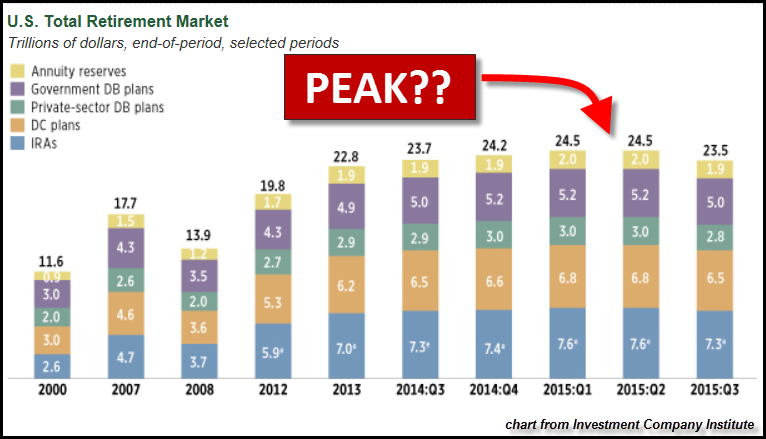
The biggest trade of a lifetime will occur when the value of silver switches from a mere commodity to a high-quality store of value.  Actually, it's not really a trade of a lifetime, but rather a fundamental repricing of real assets verses supposed assets.  According to the Investment Company Institute, the supposed value of the total U.S. Retirement Market was $23.5 trillion in the third quarter of 2015:

US Retirment Q3 2015

As we can see, the value of the U.S. Retirement Market is down $1 trillion from its peak of $24.5 trillion in the previous two quarters.  Could this be the peak of U.S. Retirement assets??  While the broader stock markets rebounded in the fourth quarter of 2015, they fell again during the first quarter of 2016.

If there are any investors who still believe the Fed and member banks aren't propping up the markets, you need to get your head examined.  We know many of the other Central Banks such as Japan and China have officially stated they were buying stocks, why wouldn't the Fed and U.S. Govt??  Of course we are.

And it makes a lot of sense why they are doing it.  The overwhelming majority of Americans that are invested in the markets are invested in the typical assets that comprise the U.S. Retirement Market.  Only a tiny fraction of Americans are invested in physical precious metals.  So, in order to keep "CALM" in the markets, the major indexes are not allowed to collapse.... well, for a while.

Look what happened to the Mainstream investor when the Dow Jones Index fell just 11% in the first two months of 2016... they moved into the Gold & Silver ETF's and Funds in a major way.  I discuss what is taking place in the Gold Market in detail in a new upcoming BULLET REPORT.

What on earth would happen to the Gold & Silver Markets if the Dow Jones Index was decimated by 30-50%??  I believe it would cause Mainstream investors to move into gold and silver in such a forceful way, that it would totally overwhelm the supply causing the prices to shoot up much higher.  And the higher the price of gold and silver would go, the more Mainstream investors would pile in.

The Fed's worst nightmare.....

Right now the values of the major stock indexes are extremely overvalued.  However, the market isn't allowed to find their true fundamental value, but it will.  This will likely happen when gold and silver switch from a commodity pricing mechanism to a high-quality store of value.   Let me explain this in silver's case.

Silver Trades As A Mere Commodity Due To The Oil Price

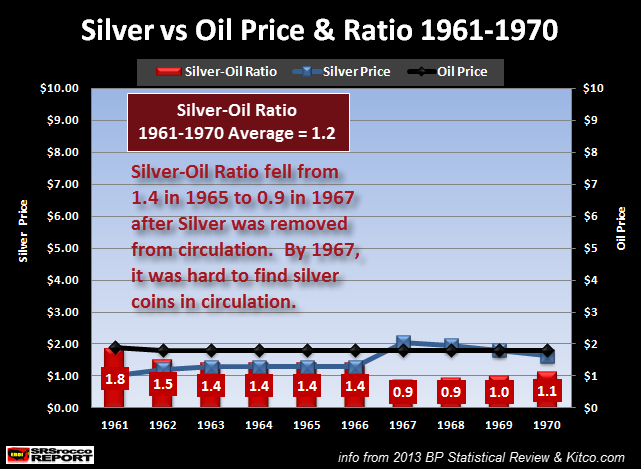
The value of silver has been tied to the price of oil for quite some time.  While some analysts suggest this isn't the case, the charts below provide ample evidence:

Silver Oil Price 1961-1970

These charts were published in an article I wrote a couple of years ago.  However, they still just as valid today.  As we can see there was very little volatility in the price of oil and silver in the 1960's.  Why?  Because the price of oil remained unchanged from 1962 to 1970 at $1.80.  Can you imagine that?  No change in the oil price for nearly a decade?  Well, that all changed in 1970's when the U.S. peaked in oil production and Nixon dropped the Dollar-Gold peg.

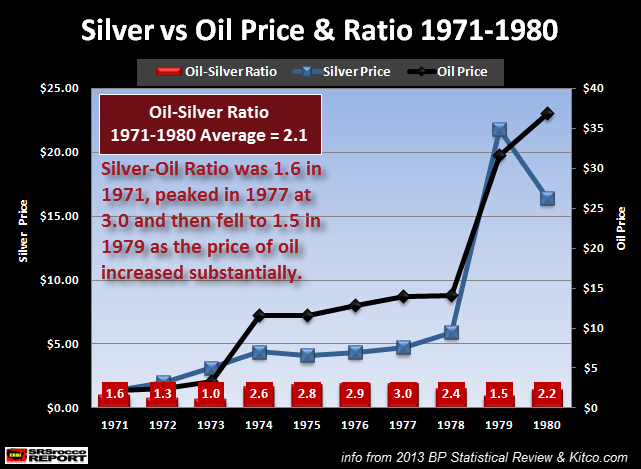
The next chart shows the change in the price of oil and silver due to two oil price shocks:

Silver Oil Price 1971-1980

The price of oil jumped from $3.29 in 1973 to $11.58 in 1974 due to the Arab Oil Embargo.  This impacted the value of silver as it increased from $1.98 in 1972 to $4.39 in 1974.  Both the price of oil and silver increased slightly by 1978, but then jumped violently in 1979.  This was due to the Iranian Revolution led by Ayatollah Khomeini which resulted in a huge reduction in the country's total oil production.  Total oil Iranian oil production fell from 5.3 million barrels per day (mbd) in 1978 to 1.5 mbd in 1980.  This had a profound impact on the price of oil.

The price of oil jumped to $31 in 1979, up from $14 in 1978.  Thus, the price of silver also skyrocketed to nearly $22 (average annual price), from $5.93 the previous year.  Why did silver move up so high?  Well, if silver mining costs were going to increase because of the jump in the price of oil, so would the price of silver.  Of course, there was increased speculation as more investors piled into silver, but we can plainly see the rise in the price of oil was the underlying fundamental cause that impacted the silver price.... as well as gold.

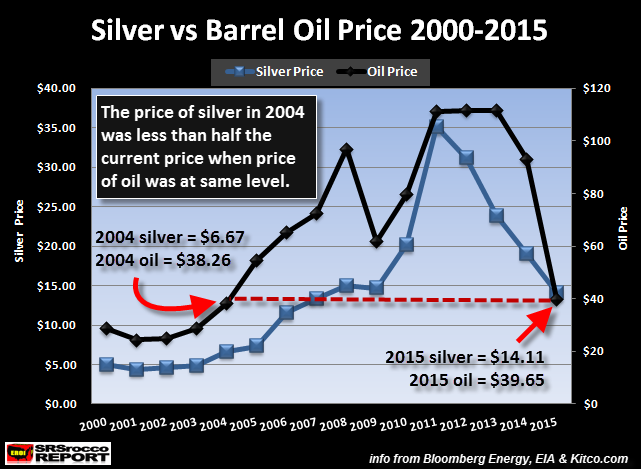
This the exact same thing that took place since 2000:

Silver Oil Price 2000-2015

Again, the price silver moved up with the price of oil.  And as we can see, it also fell with fall in the price of oil... even though prematurely.  That is a discussion for another article.

The fact remains, that the cost to produce silver is based on the price of oil.  This is called a "Commodity Price Mechanism."  Those folks who believe it will take a price of oil at $200 to see silver reach $50-$75, it's likely not going to happen.  Why?  I don't see a high price of oil as sustainable.... even if oil production starts to decline.  That's another topic for discussion in an upcoming report.

And decline it will.  Especially, in the United States:

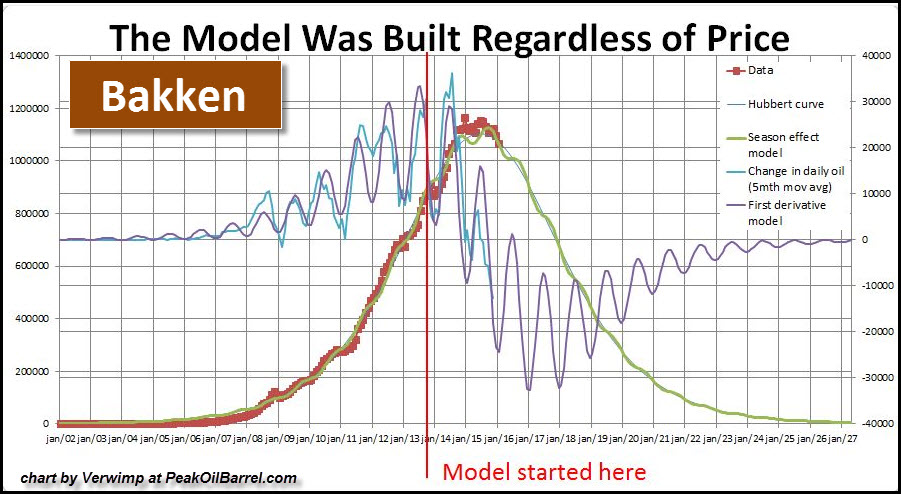
Bakken Production Profile Verwimp

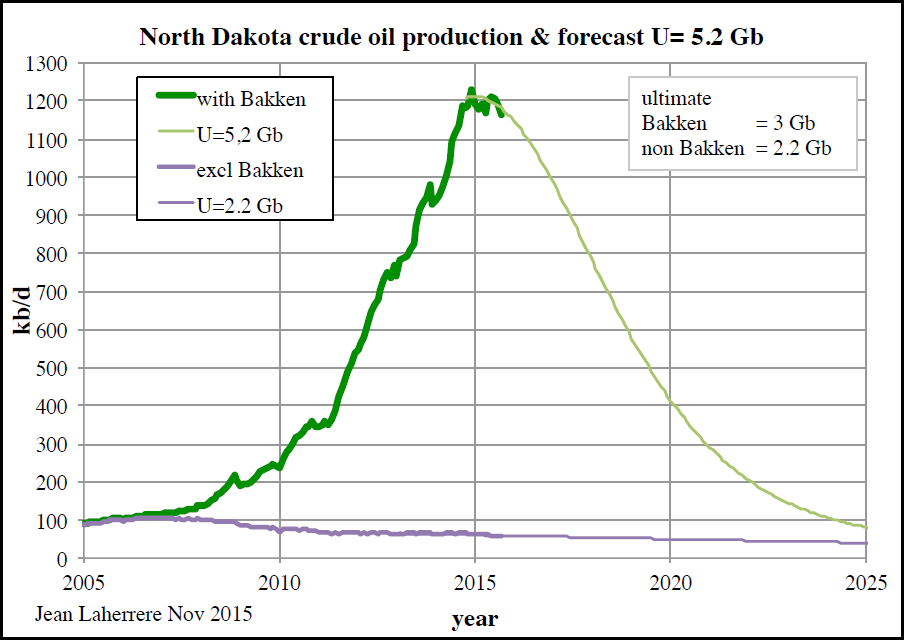
This chart is by one of the contributors (Verwimp) at the PeakOilBarrel.com website.  This is an oil production profile of the Bakken, regardless of price.  It has to do with the high decline rates and the amount of new wells.   This isn't the only person who believes the Bakken oil production is going to collapse.  Jean Laherrere also arrives at the same production profile:

North Dakota Production Profile Laherrere

The Bakken is the second largest Shale oil field in the United States.  The Eagle Ford Shale oil field is the largest, but it will suffer the same fate as the Bakken.  With U.S. oil production to collapse over the next 5-10 years, this will have a profound impact on all paper assets including Stocks, Bonds and Retirement Accounts.  Burning energy gives these paper assets their value.  The collapse of this energy supply will cause a collapse of the paper assets.

For those who think the United States will just import more oil to make up the future shortfall... you are sadly mistaken.  There is a reason why China and Russia are adding gold to the Official Reserves.  They realize the value of the Dollar will be toast... and collapsing domestic oil production will be one of the leading causes.

Silver Investment To Become A High Quality Store Of Value

The collapse in U.S. oil production along with the disintegration in value of most paper assets will cause SILVER INVESTMENT to be finally based on its high quality store of value properties, not its historic commodity based mechanism.  It will no longer matter what the price of oil is.  The value of silver will rise as investors move into it to escape the ongoing collapse in paper assets values.

Some analysts like Jeff Christian of the CPM Group do not consider silver investment demand in their supply and demand figures.  It seems as if Mr. Christian believes silver investment is just a mere store of silver supply ready to come on the market when it's needed.  Well, that may have been the case for the past fifty years, it will not be in the future.

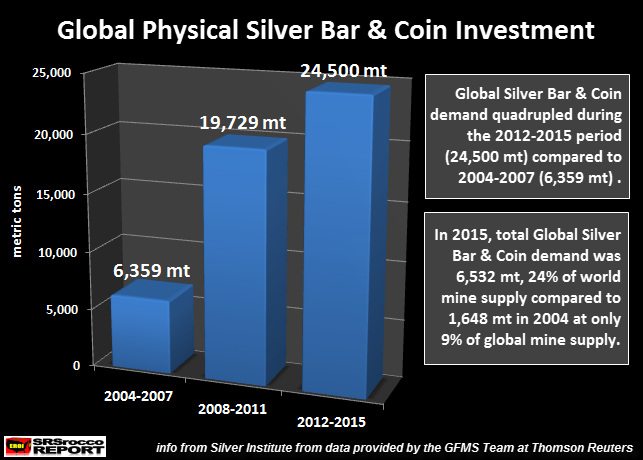
Global Silver Bar & Coin Investment 2004-2015

Investors have been acquiring record amounts of silver for the past eight years.  Total cumulative Silver Bar & Coin demand 2004-2007 was 6,359 metric tons (mt).  This equals 204 million oz (Moz).  This nearly quadrupled to 24,500 mt (788 Moz) 2012-2015.  I see no sign of this trend reversing as investors realize the U.S. financial system is much worse off than it was in 2008.

The notion that investors are going to dump silver on the market at much lower prices to supply the Industrial machine will no longer make sense in the future as global industrial demand will continue to fall along with U.S. and world oil production.

In the future, investors will be learning to PROTECT their wealth, rather than try make a yield or dividends.  Gold and especially silver will become the go to HIGH QUALITY STORES OF WEALTH as the majority of most paper assets head down the toilet.

I will be soon releasing a new BULLET REPORT on the Gold Market.  It provides charts and data on how the recent flows into setting up the Gold Market for a big move in the future.

Please check back for new articles and updates at the SRSrocco Report.  You can also follow us at Twitter below:

SRSrocco Twitter

Fiscal and Monetary Madness

Published here: http://goldsilverworlds.com/gold-silver-experts/fiscal-and-monetary-madness/

When central banks and politicians “manage” global currencies, we can expect:

  • Exponentially increasing debt and currency devaluations
  • Massive inflations and deflationary crashes.
  • Transfer of wealth from the many to the few.
  • Derivatives exceeding $1,000 Trillion and eventually a crash.
  • A mathematically inevitable financial collapse.
  • Monetary and fiscal madness.
  • Booms and busts.
  • Much higher gold and silver prices.

It has happened before and it will happen again…

Last Century Madness:

  1. Weimar inflation in Germany 1921-1923: The exchange rate for Marks changed from 90 Marks to the US dollar in 1921 to over 4 Trillion Marks to the US dollar in about 2 years.
  2. Argentina devalued their peso and exponentially expanded the currency in circulation so rapidly that Argentina lopped off 13 zeros since 1950.
  3. Zimbabwe printed so many trillions of Z-dollars that inflation, according to Wikipedia, exceeded 200 million percent in 2008.

Current Monetary Madness:

Japan has created a national debt that exceeds 1,000 Trillion yen, about 250% of their GDP. According to the IMF, Japan’s debt is “unsustainable.”

The US national debt (official only) currently exceeds $19 Trillion, up from $398 Billion in 1971, $5.6 Trillion in 2000, and $10.1 Trillion in October 2008. National debt has increased at a compounded (exponential) annual rate of about 9% per year since 1971.

Does anyone expect the debt will be repaid, reduced, or even stabilized? I think it is clear that the debt will be rolled over and increased until it must be inflated away or defaulted. This is political and central bank supported monetary madness. Exponential increases inevitably end badly.

C-National Debt

(The U.S. version of monetary madness.)

Y-Arg Peso

(The Argentina version of monetary madness.)

Central Bank Monetary Madness:

Exponential debt increases appear normal in a central bank controlled financial world that benefits the political and financial elite at the expense of the middle and lower classes. QE, ZIRP, and NIRP (negative interest rates) are recent examples of central bank responses to their self-created problems of debt based fiat currencies, exponential increases in debt, and uncontrolled deficit spending by governments. Fiscal and monetary madness prevails!

Ambrose Evans-Pritchard on the DANGERS of negative interest rates:

“Huw Van Seenis, from Morgan Stanley, calls negative rates (NIRP) a “dangerous experiment” that undermines the mechanism of quantitative easing rather than enforcing it…”

“Narayana Kocherlakota, ex-head of the Minneapolis federal Reserve, reluctantly backs NIRP as deep as -3% but calls it a “gigantic fiscal policy failure” that central banks must resort to such absurdities.”

“Morgan Stanley said that once negative rates fall below 0.2%, the damage to bank earnings goes “exponential” and ultimately endangers the whole system of free banking in Europe that we take for granted.”

My comment: The financial world is descending into an abyss of monetary madness as indicated by:

  • Negative interest rates are a “dangerous experiment” and NOT a solution. ($7 Trillion and counting…)
  • “gigantic fiscal policy failure” – (They address the consequences of bad policy with worse policy!)
  • “damage to bank earnings goes exponential” – (And then what? Bail-ins and bail-outs? More QE and even more negative interest rates? Banking collapse?)
  • the debt will never be repaid – (It looks like a safe bet.)
  • “helicopter money” – (When all else fails…)

CONCLUSIONS:

  • A world of fiat currencies “managed” by central banks descends into the trap of exponentially increasing debt that leads, slowly or rapidly, toward monetary madness and … Train wreck ahead!
  • QE has morphed into $7 Trillion of global sovereign debt “paying” negative interest rates. Think “gigantic fiscal policy failure.” At almost any other time in history negative interest rates would have been viewed as insane policy. Monetary madness or … desperate to do something?
  • Gold and silver are better solutions and are antidotes to central bank devaluations. One might object to gold for many reasons but those reasons seem minor or irrelevant in the face of exponentially increasing (unpayable) debt, negative interest rates, and ongoing monetary madness.

We have been warned!

Gary Christenson
The Deviant Investor
My Amazon Books

David Morgan: Silver Supply under $16 Is Limited

Published here: http://goldsilverworlds.com/gold-silver-experts/david-morgan-silver-supply-under-16-is-limited/


Serious Backlash Coming If Futures Market Breaks
By Mike Gleason, Money Metals Exchange


Original audio available here
.

davidmorgan-silver

Mike Gleason, Money Metals Exchange: I’m happy to welcome back our good friend David Morgan of TheMorganReport.com and author of the book The Silver Manifesto. David it’s a pleasure to talk to you as always, how are you?

David Morgan, The Morgan Report: I’m doing well, thank you for having me on your show.

Mike Gleason: Well to start out I’ll ask you to comment on the market action here in 2016 so far. Now, gold and silver have done quite well, we had gold advancing on weakness and concerns in the equities markets earlier in the year. In March, we’ve seen it continue to do well even as stocks rebounded from a strong employment report. One would think it’s a bullish sign when we get good price action even with supposedly negative news for precious metals coming out. So give us your thoughts on the market action so far this year, David, and specifically why do you think the metals have done so well here in the early part of 2016?

David Morgan: Well a couple things, one to quote The Economist magazine, which is a pretty well-known and revered publication. They stated that, “This is the best start of gold mark in 35 years.” On top of that, the main reason is because the overall equity market has basically gone 20% down. From a technical perspective, you have a top in the stock market in the United States and other markets around the globe. So the most negatively correlated asset to equities is gold itself, not gold stocks.

That’s basically it. I think it’s pretty simple. I don’t think you need to look much further than that. I would add on another real key element to knowing that things are finally off the bottom and going to continue, backing and filling, up and down – but nonetheless, the bottom is in – is the volume. The volume is substantial. The amount of flows into the gold ETF is the greatest that it has been since 2009, which is after the 2008 crisis but the first one that was off the bottom were the precious metals.

Most of us know, or at least those who listen to this show know, that gold basically bottomed in 2008 along with silver. Silver went from basically the $9 level and over several months made it all the way to $48. Gold bottomed, and I forget the number, but it went up to $1,900. Are we going to repeat that? I think in the long-term yes, but in the short-term, gold’s ahead of silver.

Mike Gleason: That leads me right into my next question. We do have gold outperforming silver so far this year, which generally we don’t see when the metals as a whole are rising. That means that the gold to silver ratio has actually even gotten a bit higher, sitting at about 82 to 1 as we’re talking here. Are you concerned that silver is lagging gold a little bit?

David Morgan: I am concerned. I believe that we have a non-confirmation. I like to see that the whites outperform the yellow and that non-confirmation does concern me. I think that we want to see silver over $16 and then things will proceed upward, probably even more than they have so far. In other words, silver will either play catch up or it won’t. If it doesn’t, it doesn’t mean gold won’t continue (going up). What it does mean is that there might be some more work to be done.

As far as how these markets come off of bottoms, usually what happens is the big money, the smart money moves into like the large gold stocks, and they have. We’ve seen very big volume into the large top tier mining companies, and they have moved substantially higher on a percentage basis. You’ve seen that across the board, you haven’t seen those smaller stocks come up as strongly.

Silver of course is a subset of gold. It’s 85% correlated with gold. And the silver stocks have performed well. So we’re really just kind of keeping our eye on silver. It doesn’t mean much other than we need to pay attention because it could indicate that again, we might see kind of a pull back, and we might come back all the way to where this launch took place. Technicians can always pick their sweet spot. I’d say about the $1,200 level. I put that out for our members that I was long gold at $1,200. Obviously that’s paying off well so far and of course I’ve put my stops up, so I’ve protected the profit.

Mike Gleason: Certainly the mining stocks do quite well, you eluded to that a moment ago. They seem to be leading the bullion a little bit. Is the worst behind us in the mining industry or is there still more carnage coming?

David Morgan: Great question, and of course you have to really answer it correctly, you have to answer on a case-to-case basis. But from a broad brush perspective, yes the worst is behind us for the miners. There are of course case-by-case basis that companies that won’t make it that need either a merger and acquisition type of situation that they have assets of value or they just can’t get loans at this point in time to continue their projects.

And that means that there will be some even though that from, again a broad perspective things have bottomed on individual cases, that there may be some favorites out there in the lower tiers, not to mid-tier so much as the speculative tier that may not make it even though gold and silver look to continue onward. Again, I can’t give a specific answer. I will give the fact that for example that we had SVM as a short term trade for our members, the members of our website. And that stock doubled and that happened while silver basically did very little and gold was just starting it’s move.

So the equities can really take off. Silver sat there from what you said, just under $14 to not quite $16, and I don’t know what the percentage is, 2 bucks on $14. 100% or a double on a silver stock, that’s a pretty liquid stock, is definitely an outperformer to what the metal itself has done.

Mike Gleason: We have a mutual friend, Steve St Angelo who runs the fantastic SRSrocco Report website, he’s a bit of a peak silver guy. Where do you come down on that? We’ve seen declining production coming from places like Mexico, a huge silver producer, and other countries that produce a lot of silver, certainly here in the States. Looks like our supply is dwindling, mine production is dwindling. Where do you come down on that? What are thoughts on the potential for peak silver?

David Morgan: Well, first of all, Steve and I are pretty close and we do talk I guess every month or so. I don’t agree with him totally. Again, it’s an economics situation, so if you look at it from today’s perspective, when you’re looking at sub $16 silver, that statement could look very very accurate, but if you got to $40 silver again then all the dynamics change. Because what’s very uneconomic today would become very economic at those prices.

If you want the details, what we really think, we did a whole chapter on it in the book The Silver Manifesto. And we go through and based on our work and our projections on where we think the metals are going, we think that the peak silver scenario is probably a few years out.

Mike Gleason: Certainly though, and I guess you hit on the point that at sub $16 silver, there is a finite supply of the metal out there, meaning the prices can stay this low forever and there still be supply, is that basically what you’re saying?

David Morgan: That’s basically it. If you want to be a super deep thinker, you could argue that it’s never going higher than that, and if it didn’t a lot more mines would be out of business. I don’t take that view. It doesn’t necessarily mean that the price has to go higher, but it pretty much is a strong indication that it will.

Mike Gleason: Negative interest rates are in the news both in Europe and now here in the States, which is obviously fueling the metals markets, gold in particular. Negative interest rates on cash means that gold and silver actually pay a higher rate of interest. What are your thoughts there, on the Fed, the likelihood that they are done with the interest rate hikes or even experiment with negative rates like central bankers are doing over there in the EU?

David Morgan: Yeah, tough question, and I will answer it. In my views because this is opinion and I’ll give you my thinking. Obviously the negative interest rate scenario is one that I don’t think the central banks have really thought through very well. The idea, first of all if we back up and look at all those with debt problems say, “How are we going to solve this debt problem?” “Oh, borrow more money and then increase the debt load.” That was basically what took place during the financial crisis with Hank Paulson that put out this TARP situation.

Then we go to QE1 and we add more debt to our debt problem and that doesn’t work so what we should do now is add even more debt to the debt problem, which was QE2, and that’s when silver took off from $26 to $48 because people anticipated inflation in the marketplace on Main Street, not just on Wall Street. It didn’t take place on Main Street, but it did take place on Wall Street, so the market backed off for that one and several other reasons.

So now we’re in a situation, well if adding debt to debt doesn’t work, what we need to do, and if a zero interest rate policy, let’s just take interest rates negative and that’s certain to work. And of course my view of certain not to work. As far as coming around to the question, the U.S. has already raised interest rates on a very very modest level. I think it was done more as a trial balloon more than anything else.

I’m still of the belief or the opinion that the United States will not go to negative interest rates for a while, if ever. They may get there, but I still think that the reason that these interest rates are being raised by the Federal Reserve is to provide strength to the U.S. dollar because what’s really happened as my friend Hugo Salinas Price pointed out recently in one of his articles is there’s been a massive exit out of the U.S. dollar by the Chinese, something on the order of a trillion dollars.

And that didn’t move interest rates, which is almost impossible. Anytime any market creates freely and there’s a massive buyer, a massive seller, it will change the price and interest rates is the price of money. So it certainly should have changed the price and it didn’t. There’s other interviews you can find on the internet regarding the mechanics of that and why it did or didn’t happen. My view is that the U.S. Fed, although they’ll never say this publicly, is concerned that they have to keep the dollar game going as long as they possibly can. So to make it the strongest kid on the block by keeping interest rates positive or perhaps even raising them again somewhere down the road, perhaps once again before the end of this year will give the illusion that the dollar has strength and the illusion that our economy might be doing better than other places on the globe. Which is really a fallacy, but nonetheless, perception is everything in today’s Orwellian society.

So I have a different view, Mike, I think they’re going to stay the same or even perhaps increase again. I’m a very very lone wolf on this. I don’t know many people that are saying what I just said, but that’s my view.

Mike Gleason: Switching gears here a little bit, we’ve seen a big drop in the registered stocks of gold in the COMEX and a seemingly ridiculous situation where more than 500 ounces of paper gold are backed by a single ounce of physical gold in exchange warehouses. What do you make of that? Is there any reason for alarm there? This is something that’s been talked about for a long time. Could we be at a tipping point as to the ability of the future’s markets like the COMEX to remain a trusted price-setting mechanism for physical gold and silver?

David Morgan: Yeah, great question. I wish I had an absolute for everyone. First of all, there’s a considerable concern. The actuality of it taking place I think is rather low for a couple of reasons. One is if you read the contract that everybody signs, well they’re just an individual investor and trade, one contractor at a time or a mini contract. Or they’re a huge institution that trades thousands of contracts at a time or even a central bank that “hedges” in the thousands upon thousands of contracts at a time. The rules are what they are, which means that you can settle in cash.

So if there were a stand-for-delivery mechanism, which exists, AND it was above and beyond what the physical amount of gold in the CME is, there would be paper settlement. And I’m sure that the mainstream press would probably spin it to where they would make it sound as positive as possible, something along the lines of, “Rogue trader stands for delivery, contracts settled by law with the price.” And they won’t say paper price. And “how dare they stand for delivery when everybody knows that a gold contract is just a paper mechanism to set the price and nothing to do with the physical demand.” Which of course is true and false.

Less than 1% of all the trading ever results in standing for delivery and taking physical metal. Nonetheless, over the years it has taken place. And the amount of gold that exists on the CME is pitifully small, so certainly someone could stand for delivery or a few people or entities and really cause some havoc. But the next question is this: who would be willing to do that? And the answer is I don’t know. But most of the bigger players would be unwilling to do it because the negative press would be so great and probably the phone calls that you would never hear about in the public domain, about you know, it’s not going to happen, Bank X or hedge fund Y or money manager Z. We’re not going to let this happen.

I am suspect, and I hate to sound so cynical, but I’ve been in this industry for 40 years and I’ve seen a lot of things. You look at what happened in the silver market back in late 70’s, and if you read the book Silver Bulls, which I have several times, written by Paul Sarnoff, you get a pretty good idea of the day-to-day what took place during the Hunt brothers situation and what kind of conversations took place.

On a personal level, I would love to see it. I would love to see someone stand for delivery on that pitifully small amount of gold and see what the heck happens, but is it going to? I don’t think it will Mike. It could. Again, I’d like to see it happen, but the outcome is not quite as optimistic, and I could be wrong. This purely my opinion, but I think if it were to take place, first of all, I just don’t think it could. I think there’ll be too many roadblocks, but let’s say that it did take place.

If it were to occur, it’d be what I just said, I want to repeat slightly that the spin on it by the mainstream would be severe and they would try and make it look as if these gold bugs were causing problems and these speculators were putting misery in the markets and on and on. So it could have, to the general public, more of a negative outlay that it would be to us that understand the financial markets and how important honest money is than we might like to think.

So I would really want to think that one through. We just have to wait and see what takes place in the future.

Mike Gleason: Very interesting take on all that. That’s pretty insightful. I think you’re probably right. I think we see it much the same way. But it’ll be interesting to see what happens there. Well as we begin to wrap up here, David, how do you envision the year playing out in the metals? Do we get follow through after the strong start this time because in 2014 and 2015 both, gold and silver did well in January and February only to fall off to close the year lower. So will 2016 be a different story? Will we see a strong performance in the metals continuing this time? And if so, why do you believe that will happen?

David Morgan: A great refresher for everyone, yes I think we’ll have a good year but not a great year. I think the reason being is what I outlined. The biggest push for gold is a negative equity market. It’s certainly in the cards. If you look at the rollover, the moving averages, the chart pattern, everything that I know after years is the fact that the stock market looks as if it’s peaked here. And if that’s true, then you’re going to see more and more come into the gold market. Plus, we have such a big start with the gold market, best in 35 years and volume. In other words, more and more are coming in the gold sector, which is primarily the large money which primarily invest in gold through the paper system meaning the ETFs.

So I think we are on our way. I don’t think it’s going to be substantially huge. I think it’s going to be good. And I do think this year finally we’ll see higher prices at the end of the year than the beginning of the year. My forecast for The Morgan Report was you could have all of this assured back in January and hope you will get carried through in like the middle of March or maybe even April, middle of April, which I still hold to.

I think there will be the pullback summer doldrums type of thing. A lot of these companies and the gold market and probably the silver market will come off wherever they peak but they will be higher than the end of the year last year and then they’ll just kind of wallow around, and then I think you will see a final finish for 2016 that’s positive like we usually see. The seasonality and the precious metals is usually that you get a pretty good lift near the end of the year, and of course that has not been the case as you pointed out for the last several years.

In fact, in a few of those years, we got the lowest print of the year on the last trading day in the market. Going back to the CME question, most of these traders take pretty long holidays and they just don’t trade. They close their positions and they’re free of any obligations, and they’re off on holiday. So the trading platform is extremely thin, which means there are very few participants, which means it’s very easy to move the market either up or down. And most of these guys choose to move it down, so you can get a very low print at the end of the year for gold or silver.

Then the mainstream financial pundits can say, “My, my look at gold close at a new law this year,” Of course it’s all true, but it’s easy to do because of the way the market is mechanically set up.

Mike Gleason: The heavy volume that we’ve seen there in the ETFs, it will be interesting to see if that’s continues. Obviously that’s a good sign that there’s maybe more interest among the gold-buying community.

Well it figures to be quite an interesting ride this year. We have the contentious presidential election, Fed backpedaling on interest rate hikes, a global economy that seems to be rolling over, and who knows what else. There are a lot of things to keep an eye on, and we always appreciate your thoughtful analysis here on the Money Metals podcast. Now before we let you go David, please let folks know how they can follow you there at The Morgan Report because this figures to be a great time for people to dive deeper into the metals.

David Morgan: Absolutely. I would like to suggest to everyone that we have, in fact, me, I basically did it all on my own this time although I’ve got talent fairly deep, a new report called “Riches in Resources.” And the “Riches in Resources” report is like eleven pages long and it will provide good information to you about the big picture on down, which means you’re going to learn from the beginning about what happens at the end of the age of empire and what the progression is to a state of empire and then it moves from there down into the resource sector, then into the gold and silver story, the dollar story, the debt problem, and then it moves forward into the mining sector and what we do here at The Morgan Report. It gives you opportunities to make money in this market, not only through a subscription on The Morgan Report as a website member, but also we just give you some freebies on how you can make money in that report. Just a very, very easy situation if you are inclined to purchase gold and silver.

So we just finished it. It’s going to be available. It’s a double opt-in. Go to TheMorganReport.com. Go to the right hand side, get your pre-special report, Riches in Resources. All you need is a first name and your primary email address and we’ll send that to you in your inbox.

Mike Gleason: Well great stuff, David. Thanks so much. We really appreciate it and hope you have a great weekend. Take Care.

David Morgan: Thank you.

Mike Gleason: That will do it for this week. Thanks again to David Morgan, publisher of The Morgan Report. You can follow David, affectionately known by his peers as the Silver Guru and for good reason, just visit TheMorganReport.com and that will allow you to get the fantastic market commentary, mining stocks analysis, and other great info he puts out there on a regular basis. Again, it’s TheMorganReport.Com, be sure to check that out, and obviously The Silver Manifesto, the fantastic book about all things silver that David and Chris Marchese wrote is available for purchase where books are sold, including at MoneyMetals.com.

mike-gleasonMike Gleason is a Director with Money Metals Exchange, a national precious metals dealer with over 50,000 customers. Gleason is a hard money advocate and a strong proponent of personal liberty, limited government and the Austrian School of Economics. A graduate of the University of Florida, Gleason has extensive experience in management, sales and logistics as well as precious metals investing. He also puts his longtime broadcasting background to good use, hosting a weekly precious metals podcast since 2011, a program listened to by tens of thousands each week.


The Two Worlds of Precious Metals: East and West

Published here: http://www.zerohedge.com/news/2016-03-16/two-worlds-precious-metals-east-and-west


Hold your real assets outside of the banking system in one of many private international facilities  -->  http://www.321gold.com/info/053015_sprott.html 


The Two Worlds of Precious Metals: East and West

Written by Jeff Nielson (CLICK FOR ORIGINAL)


The Two Worlds of Precious Metals: East and West - Jeff Nielson


For five thousand years, gold and silver have been humanity’s premier form of money; real money, not thefaux-money manufactured by our central banks. During that same period of time, these metals have been our premier instruments of wealth preservation and therefore our “safe havens.”

There is nothing accidental about this phenomenon. Gold and silver have obvious aesthetic appeal. Indeed, silver is actually the more brilliant of the two metals. It is their aesthetic appeal that makes these metals “precious.” But more than simply their aesthetic appeal, they are also (relatively) rare.

If diamonds were as common as pebbles, it would be impossible to impress one’s potential bride-to-be with such stones, even in a setting of gold. Diamonds have their value, both real and sentimental, not only because of their aesthetic qualities but also because of their perceived scarcity.

The situation is the same for gold and silver. If gold and silver were as common as iron, zinc, or even copper, they would not be coveted as greatly, regardless of their aesthetic appeal, because of their abundance. It is the qualities of being “rare” and “precious” which are essential in order for any commodity to be considered a suitable currency. It is these properties that make a commodity a source of value. There will always be demand for these metals; therefore, they will always have value. For these reasons, gold and silver preserve and protect wealth.

Gold and silver are both precious and rare, but they are more than that. As metals, they also exhibit uniformity. Once refined, any gold or silver coin is indistinguishable from any other. Conversely, diamonds lack uniformity, therefore they are not a good candidate to be used as “money.” Venders would complain that a particular buyer was using “low-grade” diamonds for payment. On the opposite side of the ledger, purchasers with stones of superior size or quality would seek to negotiate premiums on their “money.” It would wreak havoc for commerce.

Gold and silver are perfect money, but they are also more than that. They are forms of money that are available at what must be termed near-optimal quantities and fulfill two separate but equally important functions. Silver is rare enough to be valued for its scarcity yet plentiful enough to be the ideal Peoples’ Money. It can be the wages of the workers; the payment used in basic commerce.

Gold is more scarce than silver. Because of its greater degree of scarcity it derives greater value, yet it is still plentiful enough to be a tool of commerce. However, gold is not the Peoples’ Money. Rather, it is the money of nations or, alternatively, the wealthy. It is the money of investment and industry. This additional level of prestige makes gold ideal as a “standard” for a national or global monetary system.

A White Paper previously released on this topic explained how and why “a gold standard” was the optimal basis for a monetary system in our modern economy. That same paper then provided extensive empirical evidence documenting the horrific economic carnage that resulted from the loss of our gold standard in the early 1970s.

When our nations had gold as the money of governments and silver as the money of the people, we enjoyed a level of prosperity and economic stability that we have not seen either before or since that era. In the four and a half decades since these metals have lost their official monetary status, our economies have been destroyed, our governments have been bankrupted, and the currency in our wallets is fundamentally worthless.

Decades of relentless brainwashing in the West have convinced the vast majority of our populations that there is no longer a place or role in our modern economy for Perfect Money. Consequently, the masses in the West generally shun gold and silver by storing and protecting only a tiny percentage of their wealth with these metals, in comparison with any other era in our society’s history.

This is how gold and silver stand today from a Western perspective. What is continually forgotten beneath the veneer of our cultural arrogance is that the rest of the world, and the vast majority of humanity’s population, have a fundamentally opposite perspective regarding the world’s only Perfect Money.

Unexposed to the decades of monetary brainwashing directed at Western populations, Eastern populations have never forgotten the important role of precious metals in our societies and economies. Even the most humble peasant understands why we store our wealth in gold and silver money – not the diluted and debauched paper currencies of bankers.

Real money is a store of wealth. Mere paper currency is only a tool of commerce. As a store of value, these currencies are the equivalent of a “leaky bucket.” Over a period of thousands of years, gold has perfectly preserved the wealth of its holders. In the mere century in which the Federal Reserve was entrusted with “protecting” the dollar, it has lost 99% of its value and the wealth contained.

Now that is a big leak. And it’s getting worse. Thanks to the ever-increasing rate of Fed money printing, and thus U.S. dollar dilution, 75% of that loss in value has occurred over just the last quarter-century of Federal Reserve fraud and mismanagement.

We needed gold and silver for our financial protection a century ago. We really needed gold and silver 45 years ago when Paul Volcker assassinated the last vestige of our gold standard. And we really really need gold and silver to protect our wealth today – as the monetary crime of “quantitative easing” has rendered these faux currencies fundamentally worthless.

In the East, China and Russia are relentlessly accumulating gold, observing a “rule” which is now forgotten by the arrogant oligarchs of the Corrupt West: the Golden Rule. He who has the gold makes the rules.

Conversely, the Corrupt West has squandered its own once-vast reserves, both officially and surreptitiously. For the better part of two decades, Western governments were dumping hundreds of tonnes of gold per year into the market to suppress the price. Meanwhile, the central banks of these regimes were secretly dumping at least that much gold onto the market.

This process was done via what these crooked bankers call “bullion leasing”: (supposedly) ‘lending’ their gold. Regular readers are already somewhat familiar with such frauds. “Gold generates no income.” The bankers tell us this all the time. Thus there can be no legitimate commercial purpose to so-called bullion-leasing.

Instead, this “borrowed” gold is also dumped onto the market (i.e. sold), with much or most of that gold gone forever. Yet our corrupt central banks continue to register every ounce of gold on their books –pretending to continue to have legal title and possession of this gold.

No one has seen any of this gold in decades. In the case of the United States’ mythical “gold reserves,” there has been no public accounting of this gold in over 50 years. The farce has grown to such an extreme that any time any significant quantities of this Western “gold” is transported, it is done secretly so that no one outside of these corrupt regimes ever gets even a glimpse of this myth-gold, let alone a touch or an official audit.

The West’s gold is gone. Yet out of one side of their mouths, these rancid governments boast of supposedly gigantic reserves, while out of the other side of their mouths they continually denigrate its importance as a monetary asset. “Gold is a barbarous relic.” One would never hear such ignorance and idiocy emanating out of the East – or anywhere outside of the Corrupt West.

Western governments and their deluded populations are about to get a history lesson and economics lesson all rolled into one. It could and should also be a lesson in humility, though that is likely too much for us to hope.

Clearly China and Russia are not accumulating vast reserves simply to engage in idle boasting, as does the West. Both of these nations are deliberately understating their total reserves – significantly – though not declaring the gold they acquire domestically. With any gold acquired from domestic sources (i.e. gold mining) such declarations are entirely voluntary.

The purpose of such massive stockpiling can only be with the intent of resurrecting “the gold standard.” The difference would be that these Eastern nations could and will occupy the drivers’ seat of the new system, which will replace the fraudulent Western system of un-backed and totally debauched paper currencies.

He who has the gold makes the rules. The “world” in the East has never ceased to recognize the Golden Rule. The “world” in the West now contemptuously scorns this eternal wisdom. Another expression long forgotten in the arrogant West: pride cometh before a fall.


Please email with any questions about this article or precious metals HERE


The Two Worlds of Precious Metals: East and West

Written by Jeff Nielson (CLICK FOR ORIGINAL)


Wednesday, March 16, 2016

Gold Price Weakens on Caution Ahead of Fed Rate Decision

Published here: http://www.profitconfidential.com/gold/gold-price-weakens-on-caution-ahead-of-fed-rate-decision/

The gold price retreated for a third session today, with investors watchful ahead of the Federal Open Market Committee’s decision on interest rates that may provide clues on the pace of future U.S. interest rate hikes.

Gold futures for April delivery shed 1.1% to settle at $1,231 a troy ounce. That was the lowest settlement since March 1.

May silver fell 1.7% to $15.261 a troy ounce, expanding its one-month retreat.

The post Gold Price Weakens on Caution Ahead of Fed Rate Decision appeared first on Profit Confidential.

Tuesday, March 15, 2016

Future Gold Prices

Published here: http://www.zerohedge.com/news/2016-03-15/future-gold-prices

.


.


Hold your real assets outside of the banking system in one of many private international facilities  -->  http://www.321gold.com/info/053015_sprott.html 


Future Gold Prices

Posted with permission and written by Gary Christenson, The Deviant Investor (CLICK FOR ORIGINAL)


The internet is filled with predictions for the price of gold, from $500 to $50,000 per ounce. It depends on your world view.


If you are a central banker or a powerful financial player which often supplies loyal employees to serve as Secretary of the U.S. Treasury, the low gold numbers look good.


Or, if you understand the incredible $200+ Trillion of debt the world has accumulated and realize it can’t be repaid, then gold at $10,000 probably looks inevitable. Crashes occur and sovereign debt markets look like paper bubbles with disastrous potential to send gold much higher.


A better approach to estimating future gold prices, in my opinion, is to start with a world view and project relevant gold prices. I suggest three simple scenarios, as I stated in my article, “ Silver Prices in Five Years?”


Scenario One – status quo: The next five years could look much like the last 20 – 40 years. Politicians spend too much money, debt expands exponentially, central banks monetize debt and desperately inflate and reflate bubbles to maintain their power and continue the transfer of wealth from the many to the few. This is “status quo” or “more of the same” and indicates that gold prices will rise substantially, but not in a hyperinflation.


Scenario Two – deflationary crash: Deflationary forces overwhelm the financial system and central bankers and politicians can’t or won’t reverse those deflationary forces. In that scenario most paper assets crash while the purchasing power of gold increases far more. Central bankers will do almost anything to avoid this scenario.


Scenario Three – deflation and hyperinflation: Deflationary forces temporarily crash the financial system(signs are visible in 2016-Q1) , and eventually central bankers and governments inflate currencies, possibly to hyperinflationary levels in their heavy-handed reaction. In this scenario gold prices will go into the stratosphere – perhaps $5,000 or $50,000+ per ounce. The ultimate gold price in a hyperinflationary scenario is unpredictable since hyperinflationary forces feed upon themselves and destroy purchasing power unpredictably. Gold reached nearly 100 trillion Weimar Marks per ounce in 1923. Gold, if currently priced in 1945 (pre-devaluation) Argentina pesos would be over 10,000 trillion 1945 pesos. Hyperinflation is an ugly, destructive, and unpredictable process, even for a reserve currency.


In Scenario One – more of the same - we can reasonably expect:


Politicians and central bankers will manage the crisis of 2016-2017 as they have most other crises (such as 1987, 1998, 2000, 2008) by increasing spending, addressing an excess debt problem with even more debt, and pumping more “funny money” into the global financial system.


a) Official US national debt increases more rapidly than its typical 9% per year compounded rate. (perhaps 10 – 12% per year)

b) Dollars, euros, yen and other currencies devalue against each other and against real assets. (currency wars)

c) Stock markets collapse further, and then, buoyed by central bank “printing” and currency devaluations, will rise.

d) Depressed commodity prices will move much higher as currency devaluations are aggressively pursued by central banks.

e) People and investors eventually realize that currencies are devaluing and they must avoid over-valued bonds, negative interest rates, crashing stock markets, and paper promises to preserve their savings. Gold prices will rally much higher based on increased investor demand in a supply constrained market.


Given the above “status quo” scenario, the VALUATON model I described in my book, “Gold Value and Gold Prices From 1971 – 2021” is relevant. The model is based on three variables, the official US national debt, the price of crude oil, and the S&P 500 Index. I used prices smoothed with moving averages since 1971 to define the basic trend of gold prices. The correlation of the calculated gold (using smoothed prices) with the actual smoothed annual prices was about 0.98 since 1971.


This valuation model works well within a broad range of economic conditions, including stock and bond bull markets, bear markets, crude oil bubbles and crashes, various forms of Quantitative Easing, Democratic and Republican Presidents, wars, and occasional peace.


Using “status quo” assumptions for future increases in official national debt and crude oil, and a collapsing S&P 500 Index, I created the following graph of “calculated gold” for the next several years.


 This is a model based on reasonable assumptions

but there is no guarantee those assumptions will be fulfilled. Strange and unexpected events have unfolded in the past decade. Examples:

  • In 2007 few expected the S&P 500 to fall below 700.
  • Who expected seven years of essentially zero interest rates in the US after the 2008 crisis?
  • Three years ago who would have predicted that in excess of $7 Trillion in sovereign debt in 2016 would yield “negative interest?”
  • Who in 2013 would have predicted sub-$30 crude oil?


 My Point is:


a) Strange and unpredictable events occur in a central banker controlled world dominated by overwhelming debt.

b) Secondary and tertiary consequences of stupidity, wars, QE, ZIRP, and negative interest rates are difficult to predict.

c) A deflationary collapse and hyperinflation are perhaps as likely as the four strange and unexpected examples above.

d) Gold prices in a deflationary collapse or hyperinflationary blow-off are difficult to imagine.

e) The more likely expectation, in my opinion, is a continuation of the “status quo” financial conditions we have experienced since 1971.


The model suggests that a reasonable “status quo” valuation for gold in 2021 is around $3,000. Prices will fall below and occasionally spike much higher than the valuation so a gold price of $5,000 in 2020 – 2022 is plausible. This is not a prediction! It is based on the observation that central banks devalue their currencies, governments spend to excess, and those actions affect the prices for crude oil, stocks, commodities, and gold. The model suggests that central bank devaluations and government actions could push gold prices to $3,000 to $5,000 in roughly five years, as central bank devaluations and government actions have pushed gold prices from about $40 in 1971 to about $1,200 in 2016.


CONCLUSIONS:


  • How crazy will it get? The future price of gold is very much dependent upon the reactions of governments and central banks regarding the current deflationary forces.


  • Status quo response: $3,000 - $5,000 per ounce is quite possible at some time in 2020 – 2022, if not sooner.


  • Deflationary crash response: Gold will substantially increase in purchasing power, but its price in dollars, euros, yen, etc. is difficult to estimate, depending upon the economic damage that occurs.


  • Hyperinflationary response: The price of gold will be unbelievably high.


Please email with any questions about this article or precious metals HERE


GE Christenson is the owner and writer for the popular and contrarian investment site Deviant Investor and the author of the book, “Gold Value and Gold Prices 1971 - 2021.” He is a retired accountant and business manager with 30 years of experience studying markets, investing, and trading. He writes about investing, gold, silver, the economy, and central banking. His articles are published on Deviant Investor as well as other popular sites.

Silver – a Long-Term Perspective

Published here: http://goldsilverworlds.com/gold-silver-experts/silver-a-long-term-perspective/

We all know silver is volatile. When gold rallies, silver usually rallies faster and farther, particularly after the rally has been well established.

Volatility is not a reason to avoid silver. Instead, now is a time to continue stacking. Yes, silver almost certainly will correct many times, but examine the big picture.

Over the past 50 years prices for stocks, silver, gold, crude oil, health care, and presidential elections have increased exponentially, mainly due to massive increases in debt (see graph below) and devaluations of currencies. Expect exponential price increases to continue.

Over 50 years the Dow Jones Industrial Average has averaged about 700 times larger than the price of silver. Examine the log-scale graph (below) of 700 times the price of silver plus the DJIA.

F-Nat Debt

G-SI+DJ

  1. Prices have moved higher exponentially.
  2. You can see the silver bubble in 1980.
  3. You can see the small deviation from trend in 2011 caused by the silver rally to nearly $50. It was not a bubble.
  4. Another silver bubble will probably occur, but we have not seen a bubble in silver since 1980.

What about the DJIA? Examine the 28 year chart of the DJIA – log scale.

G-DJIA monthly

  1. The DJIA has moved exponentially higher for three decades.
  2. The red ovals indicate “danger zones” where the DJIA rallied too far and too fast, corrected below its exponential trend-line, and then fell by 40% or more.
  3. The DJIA peaked in May 2015 and has only fallen slightly since then. Expect a larger correction.

Examine the silver (times 700) to DJIA ratio over the past 30 years. This excludes the 1980 bubble in which the ratio peaked many times higher than the 2011 ratio.

G-SI-DJ ratio

  1. The 30 year ratio shows long term trends of investor preference for paper assets, such as the DJIA, versus hard assets such as silver.
  2. Silver prices and the ratio hit a multi-decade low in November 2001, as indicated by a green oval.
  3. The ratio is only slightly higher in 2016, as indicated by the other green oval.
  4. There is considerable room for the ratio to increase, which would probably involve a somewhat lower DJIA and a much higher price of silver.

CONCLUSIONS:

  • The DJIA reached a high in May 2015. The next major move is likely much lower, similar to the 2001 and 2008 corrections.
  • The price of silver, as indicated by the ratio to the DJIA, is near a multi-decade low. Expect the price of silver to rally substantially in 2016 – 2020. $50 silver is coming, probably fairly soon. $100 silver will take longer.
  • Silver prices and the DJIA rise exponentially, thanks largely to dollar devaluations and massive increases in debt.

There are many financial and political reasons to expect a preference for hard assets over paper assets in the next several years. A few are:

  1. Negative interest rates indicate central bank desperation and financial craziness and should encourage sane investing in hard assets.
  2. Increased investor demand for silver. Read Steve St. Angelo.
  3. Silver prices tend to bottom, more or less, about the time the DJIA peaks. The DJIA hit an all-time high in May of 2015. Silver hit a multi-year low in December 2015. The next big moves should be up in silver and down in the DJIA.
  4. Global debt is estimated at $230 Trillion. When it finally dawns on people that this debt will not be repaid in current dollars, euros, yen, pounds etc. then people and institutions will want to protect their purchasing power and preserve the value of their money. Negative interest rate bonds are not the answer. Silver coins and bars are a far better answer.
  5. War! Desperate times call for desperate measures to inflate economies, inflate more bubbles and create distractions. It could happen.

Silver thrives, paper dies. This should be true for several more years.

Gary Christenson

The Deviant Investor

My books on Amazon

Silver Prices: 1 Factor Could Be a Game-Changer for the Silver Market

Published here: http://www.profitconfidential.com/silver/silver-prices-1-factor-could-be-a-game-changer-for-the-silver-market/

Silver Prices to Skyrocket on Back of Investor Demand
Fundamentals suggest silver prices could skyrocket. Don’t buy into the rhetoric suggesting the gray precious metal isn’t worth it.

It is truly understandable what the mainstream is trying to say; the global economy is struggling and silver is an industrial metal. This means less demand and as a result, they are selling the precious metal. Sadly, in the midst of this, demand from investors continues to be ignored. It’s soaring.

Understand this: investors could impact the silver market in a big way and send.

The post Silver Prices: 1 Factor Could Be a Game-Changer for the Silver Market appeared first on Profit Confidential.

Monday, March 14, 2016

On The Brink of Complete Meltdown

Published here: http://www.zerohedge.com/news/2016-03-14/brink-complete-meltdown

.


Hold your real assets outside of the banking system in one of many private international facilities  -->  http://www.321gold.com/info/053015_sprott.html 


On The Brink of Complete Meltdown

Posted with permission and written by Rory Hall, The Daily Coin (CLICK FOR ORIGINAL)


On The Brink of Complete Meltdown - The Daily Coin


We live in a time when the rule of law has been suspended for the ruling class and banking class. When the Attorney General of the United States, Eric Holder, made the following statement he turned the “too big to fail” banks into “too big to jail”. Criminal in every way imaginable.

“I am concerned that the size of some of these institutions becomes so large that it does become difficult for us to prosecute them when we are hit with indications that if you do prosecute, if you do bring a criminal charge, it will have a negative impact on the national economy, perhaps even the world economy,” Holder said, according to The Hill. “And I think that is a function of the fact that some of these institutions have become too large.”

We should start with arresting Eric Holder for even suggesting such nonsense. When does capitalism become fascism? When the Attorney General makes statements like the one above.

What bothers me about the criminality and corruption that is Washington DC and Wall Street is not that these criminals get away with theft on a scale that is unfathomable, but the fact that it begins to permeate our society in general and we are left without the rule of law.

Corporations, as Eric Holder points out, are excused from following the law as it might hurt the economy – it might hurt the economy but probably not. Now, the heads of these protected corporations, and a great many more, begin to act above the law. This is then transferred to the management teams of these corporations and the managers begin acting above the law. Which, in turn, transfers to the rank-and-file employees and they begin acting above the law. Where does it end? It doesn’t and that is the reason our society acts in the manner in which it currently acts – as if there are no laws. Without proper leadership criminals are allowed to run amuck.

The current crop of criminals have been in office entirely too long. The people are beginning to revolt and we are seeing the likes of Trump and Sanders beginning to give a voice to the people that has been silenced. The criminals in charge like the system the way it is and attempting to tell the masses to do as you’re told.

Nobody likes to give up their privilege, people get very attached to their privilege; and the reality is the debt party is over. So, anybody who is not productive, and there are plenty of people in the establishment that are productive and plenty of people who are not productive. The people who have a lot to be afraid of are the ones that are being subsidized who are not productive. So, you’re seeing all across the board, anybody who’s been on the gravy train, on both sides of the aisle, is saying, no, no, no. [we like our privilege, elect who we tell you to] – Catherine Austin-Fitts

How much more corrupt can our society become; how much more deviant can upper level criminals become? Our entire system has to reset. The people that are in charge have to pay for the crimes; the people that have protected them and allowed them to commit crimes against humanity are guilty as well. They will need to pay as well. The reset is underway and if you have been paying attention you already know this. How will it play out? Will our society reset to capitalism or will it continue to fall further into the abyss?

There can not be a successful civilization without fundamental values and principals, and if you have an elite that’s just free to steal and kill and engage in lawlessness no matter what; the economy will never work. That is the problem with the United States. – Catherine Austin-Fitts

The managers that have witnessed the corporate level crimes are the real problem. The reason is simple: these are the people that interact with the largest segment of our society. These are the people that steal ideas from the rank-and-file, claim them as their own and reap the rewards from these ideas. At my last j.o.b. this happened on such a scale that, at times, it is difficult for me to even think about. The idea was born in a meeting with several other rank-and-file employees of this very large corporation and we were ask how to handle a particular situation. I described, in great detail, the solution. Within a couple of months my solution, in all the detail that I had described, was rolled out to over 1,100 locations and now enjoys a staggering profit margin. This was not the first time nor the last time I was taken advantage of by management. I am sure a great many of you have had similar experiences.

Managers will suffer the greatest if/when civil unrest breaks out on a large scale. The people, rank-and-file, will remember who protected and allowed the corruption, criminality and theft to take place. Managers will be treated like the Brown shirts in Nazi Germany; killed on site, tortured or some other form of deserved treatment. Not at my hands as I won’t be anywhere near an urban area.

Our economy is on the brink of complete meltdown. Our economy, what’s left of it, is being held together with chewing gum and rubber bands. The employment numbers that are released each month are a 100% joke. Once a person simply “lifts the hood” you can clearly see the engine is missing. People, like statistician and economist, John Williams, has said our country would experience hyperinflation between 2015 and 2017. He made this claim sometime around 2010 or earlier. David Stockman, former Secretary of the Treasury under Ronald Reagan, said the economy would implode before the next President is elected in November 2016. The Economist magazine warned people in 1988 to prepare for a new global currency to be released in 2018.

Even if you take the most forward looking date of 2018…we are on the cusp of a major change. Are you prepared? Are you right with God? What will be your next step and who will be in charge of that step?


Please email with any questions about this article or precious metals HERE


On The Brink of Complete Meltdown

Posted with permission and written by Rory Hall, The Daily Coin (CLICK FOR ORIGINAL)


Rory Hall, Editor-in-Chief of The Daily Coin, has written over 700 articles and produced more than 200 videos about the precious metals market, economic and monetary policies as well as geopolitical events since 1987. His articles have been published by Zerohedge, SHTFPlan, Sprott Money, GoldSilver and Silver Doctors, SGTReport, just to name a few. Rory has contributed daily to SGTReport since 2012. He has interviewed experts such as Dr. Paul Craig Roberts, Dr. Marc Faber, Eric Sprott, Gerald Celente and Peter Schiff, to name but a few. Visit The Daily Coin website and The Daily Coin YouTube channels to enjoy original and some of the best economic, precious metals, geopolitical and preparedness news from around the world.


Sunday, March 13, 2016

Draghi Considers Money Helicopters

Published here: http://www.zerohedge.com/news/2016-03-13/draghi-considers-money-helicopters

HELICOPTER MONEY DROP

It’s debatable whether or not the most recent move of the European Central Bank was unexpected, but it certainly sparks a lively discussion on the open market. Not only did the ECB reduce the lending rate on the refinancing facilities from 0.05% to 0% which basically means the banks that are part of the Eurosystem can borrow money for free, it also reduced the interest rate on the deposit facility by 0.10% to a negative 0.40%. Yes, -0.40%.

ECB Interest 2

Source: Bloomberg.com

As if this wasn’t enough, the ECB also announced it’s increasing the pace of the asset purchase program (‘APP’) by 20 billion Euro per month, to 80 Billion per month. This means the central bank will pump an additional 960 billion euro per year in the financial system, to force the banks to change their lending patterns. What’s really interesting is the fact the ECB is now also ready to start buying euro-denominated bonds issued by ‘non-financial entities’, which basically means the ECB will be buying corporate bonds.

ECB Interest 1

Source: Bloomberg.com

That’s interesting. The original intent of the ECB was to use the asset purchases to increase and improve the liquidity in the European banking system. However, we already warned in September  he trickle-down effect of these asset purchases were insufficient, as the real economy saw just a fraction of the total amount spent on the asset purchases. The ECB has now reached the same conclusion, six months later than we did, and adding the corporate bond sector to its Asset Purchase Program-list was the only logical step. You can’t say we didn’t warn you!

ECB Interest 3

Source: prisonplanet.com

The move to cut the interest rates and to increase the size of the asset purchase program to in excess of $1 Trillion (!) per year shows Draghi was willing to aggressively pursue a monetary expansion in the Eurosystem, but the question now is whether a cut from -0.3% to -0.4% will be sufficient to trigger that. The difference is only marginal, but what’s even worse is the fact Draghi himself has signaled he has now arrived at a point where he’s with his back against the wall. He acknowledged that future rate cuts would only happen under ‘extreme circumstances’ and whilst this obviously is a very grey zone, as ‘extreme’ isn’t really an objective measure, Draghi seems to be surrendering. A quote from the press conference:

‘helicopter money. It's a very interesting concept that is now being discussed by academic economists and in various environments. But we haven’t really studied yet the concept. […] From today's perspective, and taking into account the support of our measures to growth and the return to our price stability objective, we don't anticipate that it will be necessary to reduce further rates. ‘

This basically is Mario Draghi throwing the towel. If a negative 0.40% doesn’t work, he seems to have no idea what will work, and the ECB is close to giving up on its monetary policies as the theories clearly aren’t working in the real world. Also keep in mind that not lowering the interest rates any further does NOT exclude the ECB reverting to a helicopter money strategy…

>>> Download our new FREE Secular Gold Report

Secular Investor offers a fresh look at investing. We analyze long lasting cycles, coupled with a collection of strategic investments and concrete tips for different types of assets. The methods and strategies are transformed into the Gold & Silver Report and the Commodity Report.

Follow us on Facebook @SecularInvestor [NEW] and Twitter @SecularInvest