Monday, August 28, 2017

Litecoin Price Forecast and Analysis – August 28, 2017

Published here: http://www.profitconfidential.com/cryptocurrency/litecoin/litecoin-price-forecast-analysis-august-28-2017/

It’s no wonder that LTC prices hit an all-time high on Monday. As explained in our previous Litecoin price forecast, investors are unraveling their post-fork positions in Bitcoin and dumping some money back into second-rung cryptocurrencies like LTC and XRP.

This is evident in Litecoin’s depreciation against Bitcoin right after the fork. At the time, one LTC coin was trading between 0.015 and 0.016 BTC coins, a significant premium to the LTC/USD exchange rate. It later fell to 0.01000650 BTC.

The rubber hit the road on around August 15, and since then, the “silver to Bitcoin’s gold” has been on the rise, scoring net gains on a pretty regular basis.

Yesterday, for.

The post Litecoin Price Forecast and Analysis – August 28, 2017 appeared first on Profit Confidential.

The Single Most Important Chart in the World is Breaking Down

Published here: http://www.zerohedge.com/news/2017-08-28/single-most-important-chart-world-breaking-down

While everyone continues to focus on stocks, a much larger, far more important situation is brewing in the single most important asset class in the world.

That situation involves the US Dollar ($USD).

While CNBC and the financial media love to talk about stocks, the reality is that stocks are actually one of the smallest asset classes in the world.

Consider the following…

Globally, the stock market is around $70 trillion.

Bonds, by way of contrast, are over $217 trillion.

Currency markets dwarf even this. While it’s impossible to know their full size (every currency trade involves two currencies so the net size is impossible to measure), we do know that the currency markets trade an astonishing $4-$5 trillion per day  (by way of contrast, the NYSE trades less than 4% of this per day).

Put simply, the currency markets are the largest, most liquid markets in the world. So when a major change occurs, it hits these markets first.

On that note, the single most important currency in the world, the US Dollar ($USD) is imploding.

Thus far in 2017, the greenback has fallen like a brick. As I write this it’s down 9% this year alone.

Far more importantly, this collapse has meant the $USD breaking below CRITICAL support. It will now begin unwinding its entire bull market from 2014.

This is going to be like rocket fuel for inflation trades. Gold and Silver will be going to new highs. And smart investors will use this trend to make literal fortunes.

If you’re not taking steps to actively profit from this, it's time to get a move on.

We just published a Special Investment Report concerning a secret back-door play on Gold that gives you access to 25 million ounces of Gold that the market is currently valuing at just $273 per ounce.

The report is titled The Gold Mountain: How to Buy Gold at $273 Per Ounce

We are giving away just 100 copies for FREE to the public.

To pick up yours, swing by:

https://www.phoenixcapitalmarketing.com/goldmountain.html

Best Regards

Graham Summers

Chief Market Strategist

Phoenix Capital Research

Hidden Forces of Economics, Gold & Silver Report 27 Aug 2017

Published here: http://www.zerohedge.com/news/2017-08-28/hidden-forces-economics-gold-silver-report-27-aug-2017

We have noticed a proliferation of pundits, newsletter hawkers, and even mainstream market analysts focusing on one aspect of the bitcoin market. Big money, institutional money, public markets money, is soon to flood into bitcoin. Or so they say.

We will not offer our guess as to whether this is true. Instead, we want to point out something that should be self-evident. If big money is soon to come in, and presumably drive the price up to whatever new height—perhaps even the magic $1,000,000—what comes after?

In the restless churn that has overgrown our capital markets, investors speculators are always seeking to get into whatever asset is bubbling up. Big money leaving will follow big money entering, as surely as a rock thrown into the air will fall back down.

In last week’s Supply and Demand Report, we excerpted a quote from economist John Maynard Keynes. He cited Vladimir Lenin discussing how to destroy Western civilization. Here is the full quote (from The Economic Consequences of the Peace):

“Lenin is said to have declared that the best way to destroy the capitalist system was to debauch the currency. By a continuing process of inflation, governments can confiscate, secretly and unobserved, an important part of the wealth of their citizens. By this method they not only confiscate, but they confiscate arbitrarily; and, while the process impoverishes many, it actually enriches some. The sight of this arbitrary rearrangement of riches strikes not only at security but [also] at confidence in the equity of the existing distribution of wealth.


Those to whom the system brings windfalls, beyond their deserts and even beyond their expectations or desires, become “profiteers,” who are the object of the hatred of the bourgeoisie, whom the inflationism has impoverished, not less than of the proletariat. As the inflation proceeds and the real value of the currency fluctuates wildly from month to month, all permanent relations between debtors and creditors, which form the ultimate foundation of capitalism, become so utterly disordered as to be almost meaningless; and the process of wealth-getting degenerates into a gamble and a lottery.


Lenin was certainly right. There is no subtler, no surer means of overturning the existing basis of society than to debauch the currency. The process engages all the hidden forces of economic law on the side of destruction, and does it in a manner which not one man in a million is able to diagnose.”

Keynes is talking about printing currency, which causes rising prices. He went on to note that businesses who buy and sell goods get rich. There is always a price increase between when they buy and sell. And when they borrow to invest in property and plant, they profit again.

He is describing the American economy in the 1960’s and 1970’s (except the Fed does not print, it borrows). It does not describe the present environment (see also Keith’s article The Lazy 1970’s vs. the Frenetic 2000’s).

Today, prices are not rising, but falling. Crude oil, for example, has not merely fallen a little. It has been an epic collapse (which is likely not over). Commodities show monetary effects most clearly (and skyrocketing healthcare costs are not the effect of monetary policy, but regulatory and fiscal policy).

Yet, Lenin’s debauchery is still occurring. The hidden forces of economics are still in operation. The undermining of civilization is still the effect. And it’s still true that not one in a million can diagnose it.

Let’s focus on something else Keynes said, that the value of the currency fluctuates wildly. That means in both directions (we don’t have a graph of the value of the German mark, but this page by University of California Santa Barbara Professor Harold Marcuse shows it in a table).

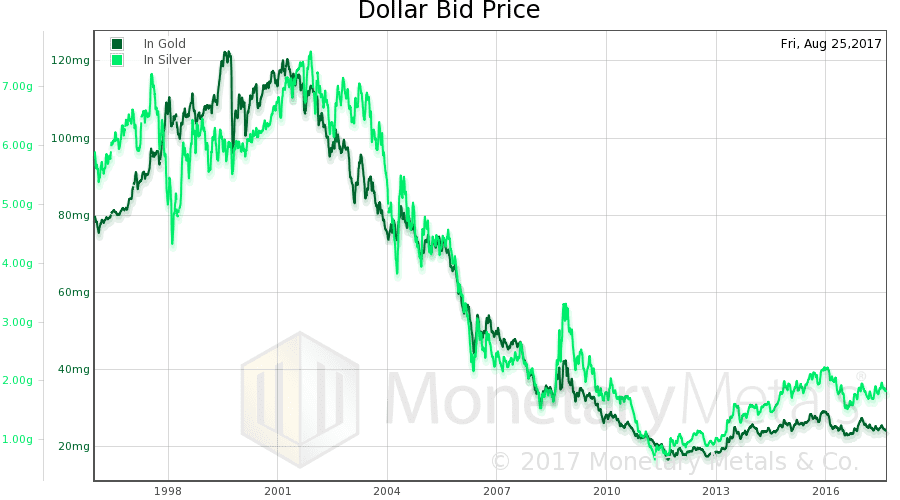
The US dollar certainly fluctuates wildly in both directions. Look at this graph of the price of the dollar. The dollar goes up from 80mg gold to 120mg, then down to 16mg then up to 29.27mg on Dec 3, 2015. Since then, it’s been choppy.

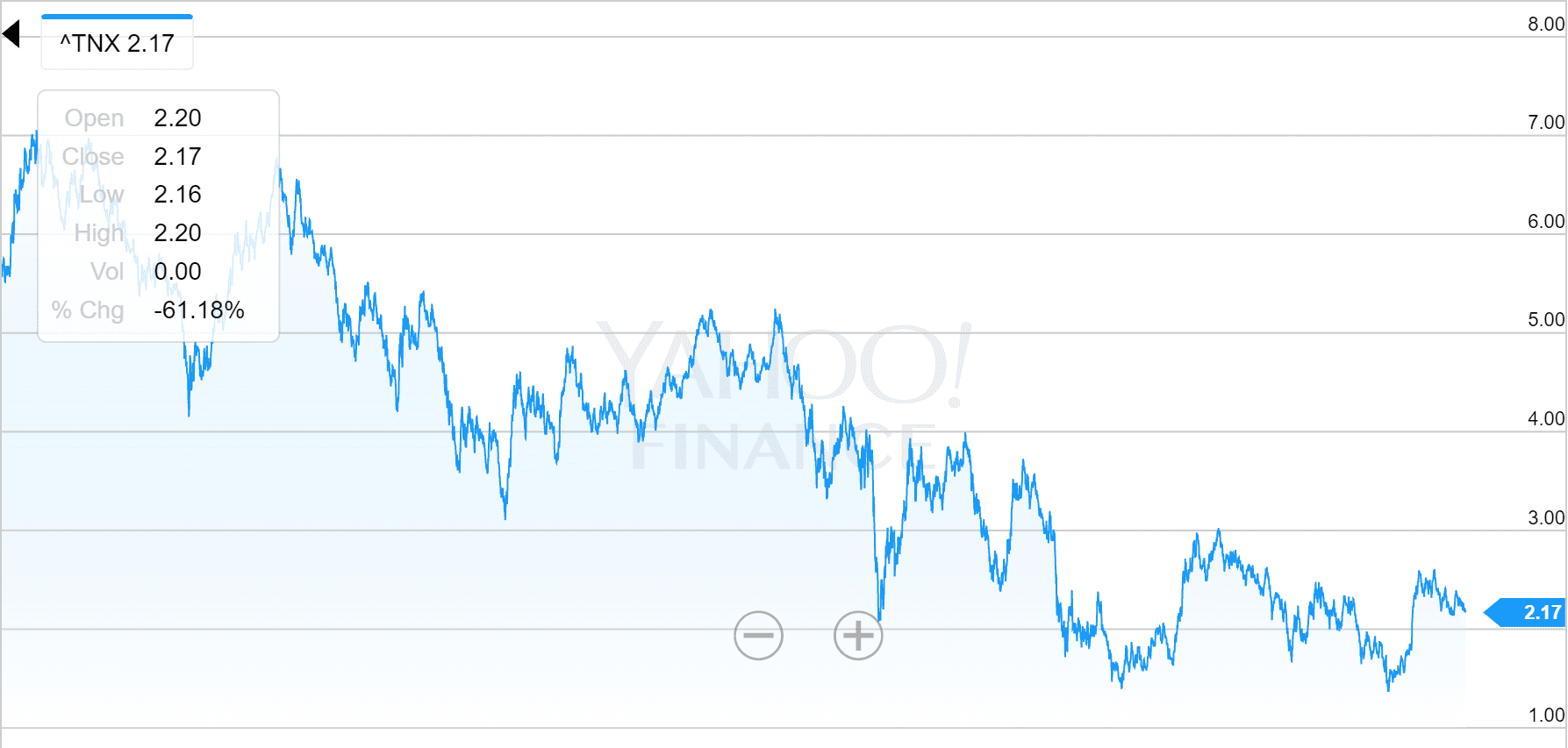
The price of the dollar is not the only thing that fluctuates wildly. The interest rate also fluctuates wildly. In the same period, the interest rate on the benchmark 10-year Treasury has fluctuated from 7% to 1.4%.

This is important because the net present value of a long-term loan or bond fluctuates (inversely) with the interest rate. As the rate falls, the net present value rises. This is an example of “permanent relations between debtors and creditors … becom[ing] so utterly disordered as to be almost meaningless”.

We refer to the capital gains that go to bond speculators, and corresponding capital losses that go to bond issuers (though conventional accounting does not recognize it). Keynes described this perfectly too, “this arbitrary rearrangement of riches strikes not only at security but [also] at confidence in the equity of the existing distribution of wealth”.

When bond prices rise and bond yields fall, then by a process of arbitrage stock prices rise and stock yields fall. And the same for real estate. When bonds, stocks, and real estate are rising then all assets experience upward pressure.

And how do most people feel about this? Keynes nailed this too. “Those to whom the system brings windfalls … are the object of the hatred of the bourgeoisie, … not less than of the proletariat.” On the one hand, wages are under downward pressure and jobs are being replaced with capital assets. On the other hand, a few get richer such asset owners and those whose income is tied to asset prices such as CEOs and brokers. This partly explains the rise of Trump.

And it brings us back to bitcoin. Bitcoin’s fluctuations are so wild, that by comparison the value of the dollar looks like a flatline. And its arbitrary enrichment of a few is correspondingly greater (the impoverishment of others will not be obvious until the price collapses).

We have seen some comments from readers and in bitcoin discussions elsewhere, that strike us as pugnacious. A chip-on-the-shoulder pseudo-pride, that practically sneers “I got mine, suckaaah!” Most bitcoin millionaires aren’t like this. And we do not begrudge anyone his trading gain. One should not hate the player, but the gamemaster who forces us to play. The Fed.

However, this is an important phenomenon. We bring it up as the flip side of the “hatred of the bourgeoisie and the proletariat”. Both sides know that something is screwy.

Everyone knows that money does not grow on trees. You do not normally get rich quick by betting on some Internet scheme. Yet, bitcoin seems to say, “Oh yes it does! Oh yes you do!”

We offer this insight: speculation converts one person’s wealth into another’s income. No one wants to spend his wealth. But they are happy to spend other people’s wealth—when it comes to them in the form of income.

Andy Appleton buys $10,000 worth of bitcoin. Later, he sells it for $20,000 to Bill Baker. Andy takes his original capital back plus 10%, or $11,000. That leaves him $9,000 of Bill’s wealth to spend, to consume. Bill of course bought it, hoping it would go up. And indeed it does. He sells it for $40,000 to Charlie Chilton. He reserves $22,000 of capital, leaving $18,000 of Charlie’s life savings to spend. Charlie forked it over to Bill, in the hopes of spending $36,000 of David Dalton’s wealth. And so on. Until the scheme hits the wall.

Bitcoin is a promoted as an alternative to fiat currency. However, it “engages all the hidden forces of economic law on the side of destruction” the same as the dollar. At an even faster rate. And this is promoted as a feature, not a bug.

The gold standard does not provide a mechanism to convert your wealth to someone else’s income. In our view, this is a feature, not a bug.


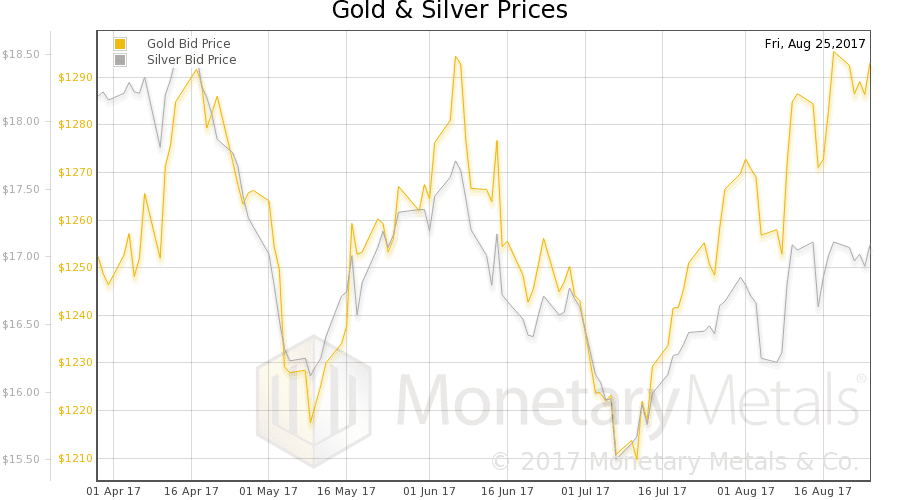
The price of gold dropped two bucks, and silver two cents. However, it was a pretty wild ride around the time when some information came out from our monetary masters at their annual boondoggle at Jackson Hole. We will show some charts of Friday’s intraday action, below.

As always, the question is which moves are driven by fundamentals, and which by speculation? We will show graphs of the basis, the true measure of the fundamentals.

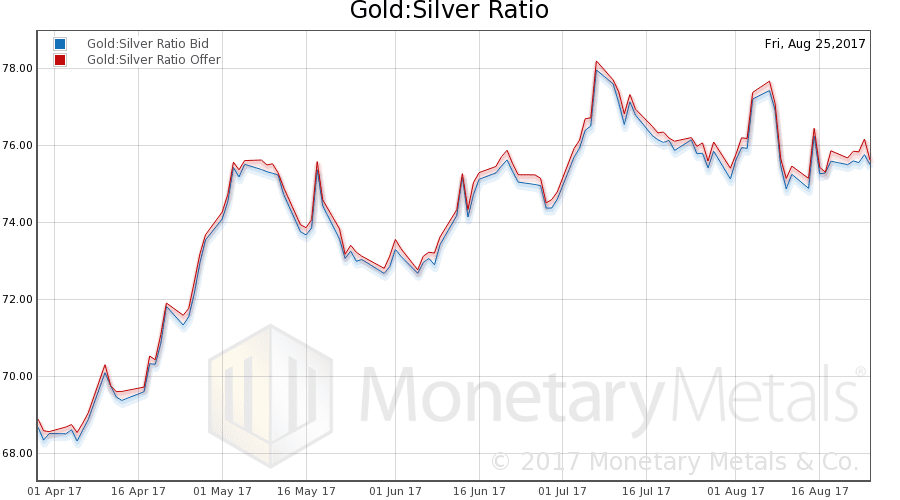
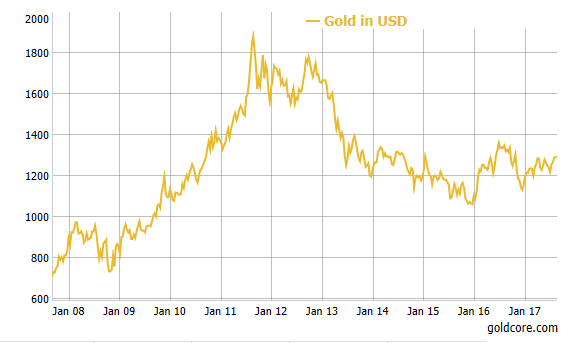
But first, here are the charts of the prices of gold and silver, and the gold-silver ratio.

Next, this is a graph of the gold price measured in silver, otherwise known as the gold to silver ratio. The ratio barely budged.

In this graph, we show both bid and offer prices for the gold-silver ratio. If you were to sell gold on the bid and buy silver at the ask, that is the lower bid price. Conversely, if you sold silver on the bid and bought gold at the offer, that is the higher offer price.

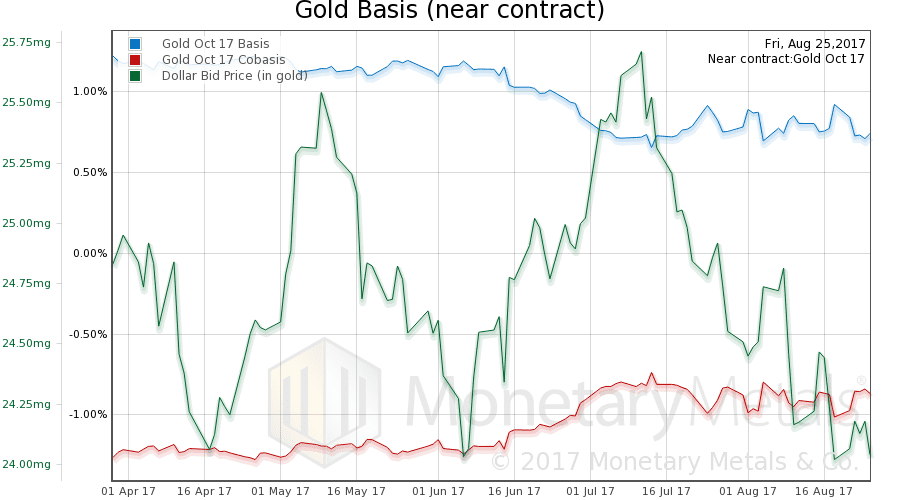
For each metal, we will look at a graph of the basis and cobasis overlaid with the price of the dollar in terms of the respective metal. It will make it easier to provide brief commentary. The dollar will be represented in green, the basis in blue and cobasis in red.

Here is the gold graph.

The price didn’t move much, and neither did the basis.

So our calculated gold fundamental price was up $5, to $1,330.

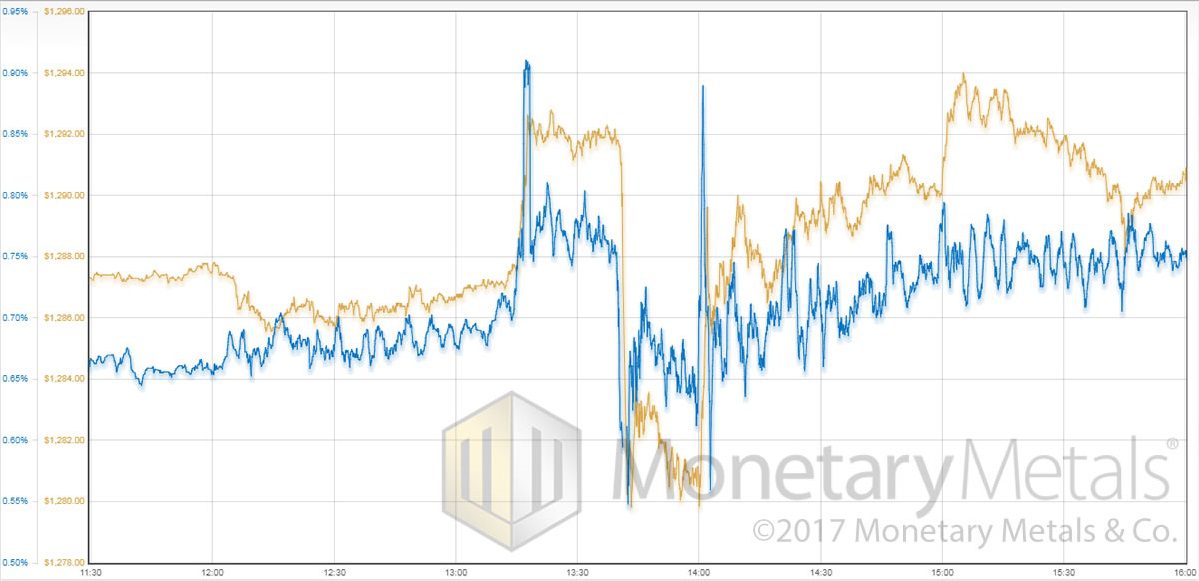
More interestingly, let’s look at the basis action when the price was gyrating on Friday.

The correlation between basis and price is uncanny, isn’t it? And it works in both directions. Manipulators speculators were buying paper gold from around 13:15 GMT (which is 14:15 BST or 9:15 NY time). Then these same manipulators speculators—or was it a different group, who overpowered the first, hm?—started selling at around 13:40. Then buying resumed at 14:00.

We are joking about the manipulation, of course. In our view, superstition thrives where people struggle to explain what they see without a scientific theory. Once upon a time, they saw thunder and lightning and thought the gods were having battle, or perhaps expressing anger at some sin of man. Such mythology could not survive the advent of the field meteorology (if even that long).

The manipulation myth similarly does belong in a world where there is an arbitrage theory of markets, and daily pictures of the basis and cobasis.

Note also the rise in price at 15:00, without a rise in basis. That is likely some buying of physical metal.

Now let’s look at silver.

The basis fell and the coabsis rose. Not a lot, but it did lift our calculated silver fundamental price $0.20 to $17.18.

Here is the intraday price and basis graph for silver during Friday’s rollercoaster.

As with gold, the basis tracks the price. The moves in both directions were speculative.


© 2017 Monetary Metals

Buy Gold As Washington "Stumbles" Advise Blackrock

Published here: http://www.zerohedge.com/news/2017-08-28/buy-gold-washington-stumbles-advise-blackrock

Buy Gold As Washington "Stumbles" Advise Blackrock

- Gold set to shine as Washington stumbles
- "Bet on gold’s diversifying properties rather than political stability"

- World's largest asset manager believes Trump and political drama in the U.S. means gold likely to rise
-  Real rates flattening out and rising political instability - Blackrock’s Koesterich
- “For now my bias would be to stick with gold” - Blackrock

- U.S. debt ceiling issue to be fractious as bankrupt U.S. hits $20 trillion debt
- Investors will again turn to gold in coming political strife

http://maxpixel.freegreatpicture.com/Election-Politics-Donald-Trump-Presidential-1757583

"For now I would prefer to bet on gold’s diversifying properties rather than political stability" - Russ Koesterich, Blackrock.

Not for the first time this year, Blackrock's Koesterich has spoken about his faith in gold during times of both financial and political instability.

Those times are now, the world's largest money manager believes. Since the beginning of the year Koestrich has been adding to the gold position of the $39bn  Global Allocation Fund. Gold is now the fund's second-largest position.

Gold’s performance, up 12% year-to-date, is particularly interesting. A hard-to-define asset, gold is often thought to perform best when either inflation and/or volatility is rising. This year has been notable for both falling inflation and record low volatility, raising the question: What is powering gold’s ascent and can it continue? Two trends stand out:

Real rates have flattened out

Political uncertainty has risen

Real rates - plateauing and boosting gold

Gold is most correlated with real interest rates (in other words, the interest rate after inflation), not nominal rates or inflation. While real rates rose sharply during the back half of 2016, the trend came to an abrupt halt in early 2017. U.S.10-year real rates ended July exactly where they began the year, at 0.47%. The plateauing in real yields has taken pressure off of gold, which struggled in the post-election euphoria.

Heightened political uncertainty

Koesterich said earlier this month that

“There has been a Pavlovian response by investors to disregard any piece of bad news or any spike in volatility, and that has been a very profitable strategy but we do think that there are risks in the world that are not being priced in.”

Currently there is heightened geopolitical risk across the world, with a focus on how the US will manage. Investors will no doubt be looking to reduce their risk exposure as events unfold between the US and North Korea as well as Venezuela's chaos which shows no sign of dissipating.

The VIX index is often referred to as the 'Fear Index'. Many believe this is a misnomer and does not portray  what is really going on. The index has been trading at historically low levels. Apparently investors continue to bet that the index will remain low if money keeps pouring into markets and the global economy carries on improving.

Koesterich doesn't think this will be the case. For him political risk has not yet been reflected in the markets.

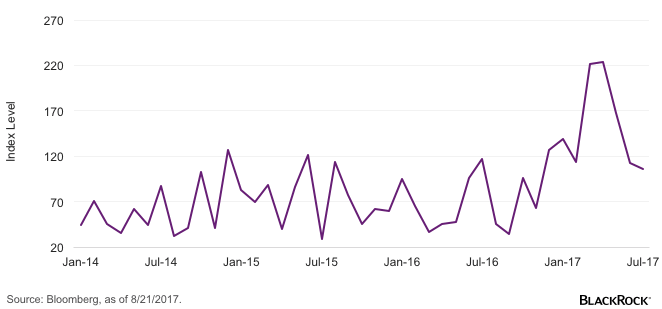
Although market volatility has remained muted, albeit less so the past week, policy uncertainty has risen post-election (see the accompanying chart, above). This is important. Using the past 20 years of monthly data, policy uncertainty, as measured by the U.S. Economic Policy Uncertainty Index, has had a more statistically significant relationship with gold prices than financial market volatility. In fact, even after accounting for market volatility, policy uncertainty tends to drive gold prices.

To a large extent, both trends are related. Investors came into 2017 expecting a boost from Washington in the form of tax cuts and potentially infrastructure spending—resulting in the so-called “reflation” trade. Thus far neither has materialized. While economists can reasonably debate whether either is actually needed, lower odds for tax reform and stimulus have resulted in a modest drop in economic expectations. This, in turn, has caused a reversal in many reflation trades, a development that has allowed gold to rebound.

Going forward, gold’s performance may be most closely linked with what happens in D.C. Absent fiscal stimulus, the U.S. economy appears to be in a state of equilibrium: modest but stable growth. In this environment, gold should continue to be supported by historically low real rates and continued political uncertainty. Alternatively, if Congress does manage to enact a tax cut or other stimulus, we are likely to see some, albeit temporary, reassessment of growth and a corresponding backup in real rates, a scenario almost certainly negative for gold.

Conclusion - No crystal ball but stick with gold

Koesterich does not claim to 'have any special insight into the Greek drama that is modern day Washington.' But he is clear in his conviction that a 'bet on gold’s diversifying properties rather than political stability' is the way to trade right now.

Whilst Koesterich's blog has made headlines and been featured on a range of sites, there should really be no surprise over his comments. All he is saying is that gold will continue to perform well thanks to a series of unknowns in the political and economic sphere.

It will act as a form of financial insurance and safe haven. This is no real news given history has demonstrated this as has the performance of gold in the last 10 years and as a hedge in the long term.

Most importantly the money manager is saying that he has little faith in the performance and abilities of the US government. In turn this means he is concerned for the strength of their currency and economy.

Individual savers and investors should take note - gold's safe haven properties will be coming into their own as Washington continues to bicker and stumble.


News and Commentary

Gold steady ahead of central bank speeches at Jackson Hole (Reuters.com)

Gold price remains dull on futures correction (DailyTimes.com.pk)

Gold settles lower as investors look to Jackson Hole (MarketWatch.com)

U.S. Stocks Fluctuate Before Yellen; Oil Declines (Bloomberg.com)

Dixons Carphone Plunges as Mobile Slowdown Leads to Warning (Bloomberg.com)

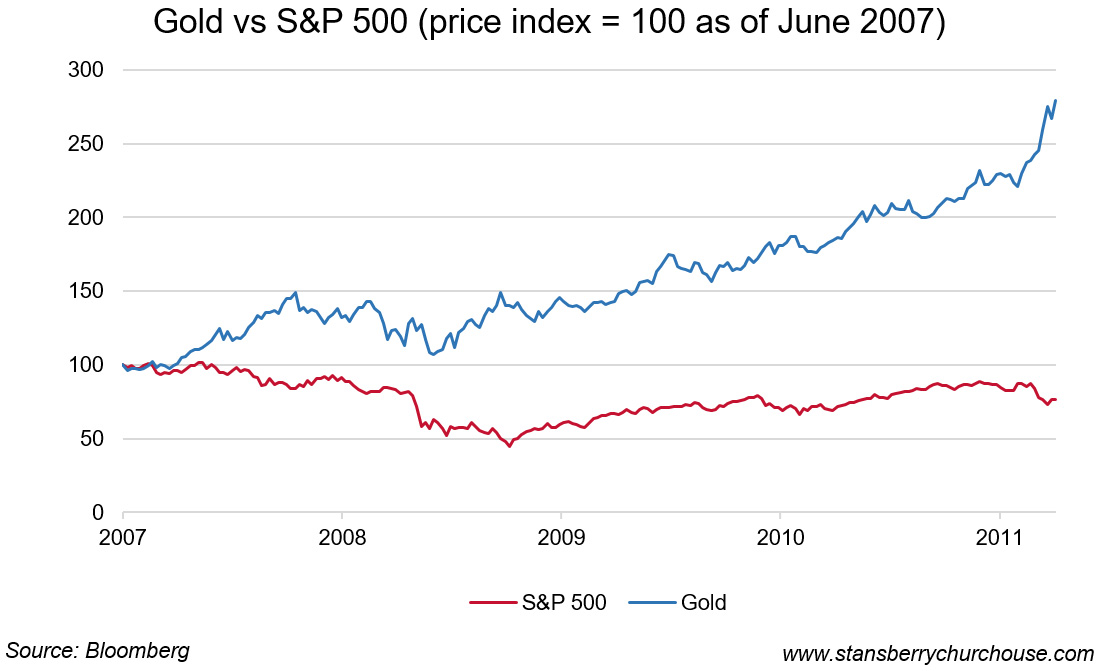
Gold's out performance of S&P500 in 10 years - Bloomberg via Stansberrychurchouse.com

Gold outperforms US stocks in 10 years since financial crisis (Stansberrychurchouse.com)

U.S. stocks haven’t been this extreme since 1929 and 2000 (MarketWatch.com)

Did The Economy Just Stumble Off A Cliff? (ZeroHedge.com)

Epsilon Theory: Always Go To the Funeral (EpsilonTheory.com)

Jackson Hole: Yellen to play safe and not warn of asset bubbles (MoneyWeek.com)

Gold Prices (LBMA AM)

28 Aug: No LBMA prices today as UK holiday 
25 Aug: USD 1,287.05, GBP 1,003.90 & EUR 1,090.90 per ounce
24 Aug: USD 1,285.90, GBP 1,003.26 & EUR 1,090.44 per ounce
23 Aug: USD 1,286.45, GBP 1,004.33 & EUR 1,091.68 per ounce
22 Aug: USD 1,285.10, GBP 1,000.71 & EUR 1,091.95 per ounce
21 Aug: USD 1,287.60, GBP 999.82 & EUR 1,096.52 per ounce
18 Aug: USD 1,295.25, GBP 1,004.34 & EUR 1,102.65 per ounce

Silver Prices (LBMA)

28 Aug: No LBMA prices today as UK holiday 
25 Aug: USD 17.02, GBP 13.26 & EUR 14.40 per ounce
24 Aug: USD 16.93, GBP 13.20 & EUR 14.36 per ounce
23 Aug: USD 17.06, GBP 13.32 & EUR 14.48 per ounce
22 Aug: USD 17.02, GBP 13.27 & EUR 14.48 per ounce
21 Aug: USD 17.02, GBP 13.20 & EUR 14.48 per ounce
18 Aug: USD 17.15, GBP 13.30 & EUR 14.60 per ounce


Recent Market Updates

- Cyberwar Risk – Was U.S. Navy Victim Of Hacking?
- Global Financial Crisis 10 Years On: Gold Rises 100% from $650 to $1,300
- Mnuchin: I Assume Fort Knox Gold Is Still There
- Buffett Sees Market Crash Coming? His Cash Speaks Louder Than Words
- Gold, Silver Consolidate On Last Weeks Gains, Palladium Surges 36% YTD To 16 Year High
- Must See Charts – Gold Hedges USD Devaluation, Rise in Oil, Food and Cost of Living Since Nixon Ended Gold Standard
- World’s Largest Hedge Fund Bridgewater Buys $68 Million of Gold ETF In Q2
- Diversify Into Gold Urges Dalio on Linkedin – “Militaristic Leaders Playing Chicken Risks Hellacious War”
- Gold Has Yet Another Purpose – Help Fight Cancer
- Gold Up 2%, Silver 5% In Week – Gundlach, Gartman and Dalio Positive On Gold
- Great Disaster Looms as Technology Disrupts White Collar Workers
- Gold Sees Safe Haven Gains On Trump “Fire and Fury” Threat
- Silver Mining Production Plummets 27% At Top Four Silver Miners

Important Guides

For your perusal, below are our most popular guides in 2017:

Essential Guide To Storing Gold In Switzerland

Essential Guide To Storing Gold In Singapore

Essential Guide to Tax Free Gold Sovereigns (UK)

Please share our research with family, friends and colleagues who you think would benefit from being informed by it.

Saturday, August 26, 2017

Trump Presidency Is Over - Bannon Is Right

Published here: http://www.zerohedge.com/news/2017-08-25/trump-presidency-over-bannon-right

Trump Presidency Is Over - Bannon Is Right

“‘The Donald’ has been White House-broken,” writes Bill Bonner in his must read daily missive on Bonner and Partners

“‘The Donald’ has been White House-broken,” was what we were trying to say, translating the phrase into something that may make sense to a French listener.

But it was too clever and complicated.

“Well, let’s just say the president has been brought into line,” we simplified.

Social Season

This is the social season in the French countryside.

Weddings, cocktails, receptions – people use the month of August to reconnect with friends before returning to work, school, and retirement in the fall.

Yesterday, we drove about a half hour over country lanes to a gracious 18th-century farmhouse. There, about 100 people had gathered on the lawn.

“You are American?” we were asked several times. “What do you think of Trump?”

We dodged as best we could. Inevitably, we were forced to explain that, yes, he is a disgrace… but, no, we would not prefer Ms. Clinton… and, no, we do not like [French president] Mr. Macron, either:

“None of them has the strength or independence you would need to buck the trend.”

“What trend is that…?”

“Oh, it’s a long story… and it is such a beautiful evening…”

The guests were a wide assortment of local farmers and Paris-based hedge fund managers. The former complain about the weather. The latter complain about the markets. Both complain about the government.

But here at the Diary… we don’t complain. We just want to know when to pack an umbrella.

Payoffs and Pimping

Yesterday, we looked at how Washington insiders have brought President Trump to heel.

He said so himself: “Decisions are much different when you sit behind the desk in the Oval Office.”

Many people believe the White House elevates its occupants so they become better people and make better decisions.

Candidate Trump may be a scoundrel or a scalawag, lusting for fame and fortune, when he announces his candidacy, they say. But when he enters the White House, the slime, incompetence, and corruption are washed down the drain. The man is born again… as POTUS.

If this were true, the Pennsylvania Avenue sewer would clog up after each election. Instead, it runs clear… because the wheeling and dealing… the payoffs and pimping… are still going on!

Alas, the White House elevator goes in both directions.

This week, President Trump hit the “down” button. Against his own “instincts”… reneging on his promises to the people who voted for him… he agreed to go along with the generals in their plan to kill more people… and spend more money… so as to make their crony friends richer and advance their own careers.

That is how things work in the “swamp.”

Today and tomorrow, we connect the dots back to the financial world.

End of an Era

Win-win deals increase prosperity. Win-lose deals reduce it.

The swamp is where the win-lose deals breed. Since the 1970s, it has grown to cover half the U.S. economy.

There, wasteful spending, stifling regulations, phony money, misleading financial signals, zombies – corporate and individual – and all the many excesses and absurdities we watch daily here at the Diary are warping honest price signals, destroying real output, and transferring real Main Street wealth to the swamp’s insiders.

Donald J. Trump promised to pull the plug. But he couldn’t even if he wanted to. And now his decisions are Oval Office decisions… that is to say, those that suit the Deep State.

He cannot drain the swamp; he is now a part of it.

There will be no cutback in domestic spending (no genuine or important reform of O’care, for example)… and no cutback in the empire’s wars abroad.

That still leaves the possibility of tax reform. But even that is extremely unlikely. The last major tax reform program was 35 years ago. The president has neither the political skills nor the ideological commitment needed to pull off another one.

No “skinny budget”… no spending cuts… no tax reform… no relief from the swamp.

And that, friends (and we don’t have to spell it out), is why Breitbart’s Steve Bannon is right: The Trump presidency is over.

Where to next?

Tune in tomorrow…

Since founding Agora Inc. in 1979, Bill Bonner has found success in numerous industries. His unique writing style, philanthropic undertakings and preservationist activities have been recognized by some of America's most respected authorities. With his friend and colleague Addison Wiggin, he co-founded The Daily Reckoning in 1999, and together they co-wrote the New York Times best-selling books Financial Reckoning Day and Empire of Debt. His other works include Mobs, Messiahs and Markets (with Lila Rajiva), Dice Have No Memory, and most recently, Hormegeddon: How Too Much of a Good Thing Leads to Disaster. His most recent project is The Bill Bonner Letter.


Gold Prices This Week (LBMA AM)

25 Aug: USD 1,287.05, GBP 1,003.90 & EUR 1,090.90 per ounce
24 Aug: USD 1,285.90, GBP 1,003.26 & EUR 1,090.44 per ounce
23 Aug: USD 1,286.45, GBP 1,004.33 & EUR 1,091.68 per ounce
22 Aug: USD 1,285.10, GBP 1,000.71 & EUR 1,091.95 per ounce
21 Aug: USD 1,287.60, GBP 999.82 & EUR 1,096.52 per ounce

Silver Prices This Week (LBMA AM)

25 Aug: USD 17.02, GBP 13.26 & EUR 14.40 per ounce
24 Aug: USD 16.93, GBP 13.20 & EUR 14.36 per ounce
23 Aug: USD 17.06, GBP 13.32 & EUR 14.48 per ounce
22 Aug: USD 17.02, GBP 13.27 & EUR 14.48 per ounce
21 Aug: USD 17.02, GBP 13.20 & EUR 14.48 per ounce


Market Updates This Week

- The Truth About Bundesbank Repatriation of Gold From U.S.
- Mnuchin: I Assume Fort Knox Gold Is Still There
- Buffett Sees Market Crash Coming? His Cash Speaks Louder Than Words
- Gold, Silver Consolidate On Last Weeks Gains, Palladium Surges 36% YTD To 16 Year High
- Must See Charts – Gold Hedges USD Devaluation, Rise in Oil, Food and Cost of Living Since Nixon Ended Gold Standard
- World’s Largest Hedge Fund Bridgewater Buys $68 Million of Gold ETF In Q2


Important Guides

For your perusal, below are our most popular guides in 2017:

Essential Guide To Storing Gold In Switzerland

Essential Guide To Storing Gold In Singapore

Essential Guide to Tax Free Gold Sovereigns (UK)

Please share our research with family, friends and colleagues who you think would benefit from being informed by it.

Friday, August 25, 2017

The Truth About Bundesbank Repatriation of Gold From U.S.

Published here: http://www.zerohedge.com/news/2017-08-25/truth-about-bundesbank-repatriation-gold-fort-knox

The Truth About Bundesbank Repatriation of Gold From U.S

- Bundesbank has completed a transfer of gold worth €24B from France and U.S.
- Germany has completed domestic gold storage plan 3 years ahead of schedule
- In the €7.7 million plan, 54,000 gold bars were shipped and audited
- In 2012 German court called for inspection of Germany’s foreign gold holdings
- Decision to repatriate from Paris and New York was ‘to build trust and confidence domestically’
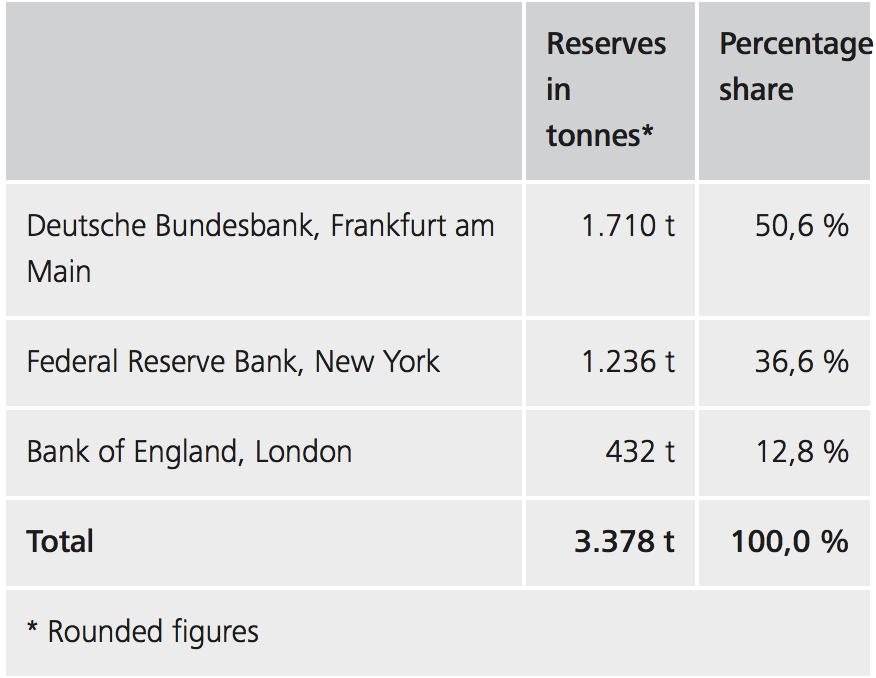
- 1,236t or 37% of German holdings remain in New York Fed facility
- Bundesbank wants to hold gold bullion
- U.S. government declines to audit gold reserves ... doesn't want world to realise gold's importance in the global monetary system

Editor: Mark O'Byrne

Last Monday, U.S. Treasury Secretary Mnuchin feigned to inspect the U.S. gold reserves in Fort Knox and joked flippantly that he assumed it was there.

A day later the Bundesbank, announced that they had repatriated much of their gold reserves from the U.S. and France. Coincidence or coordination?

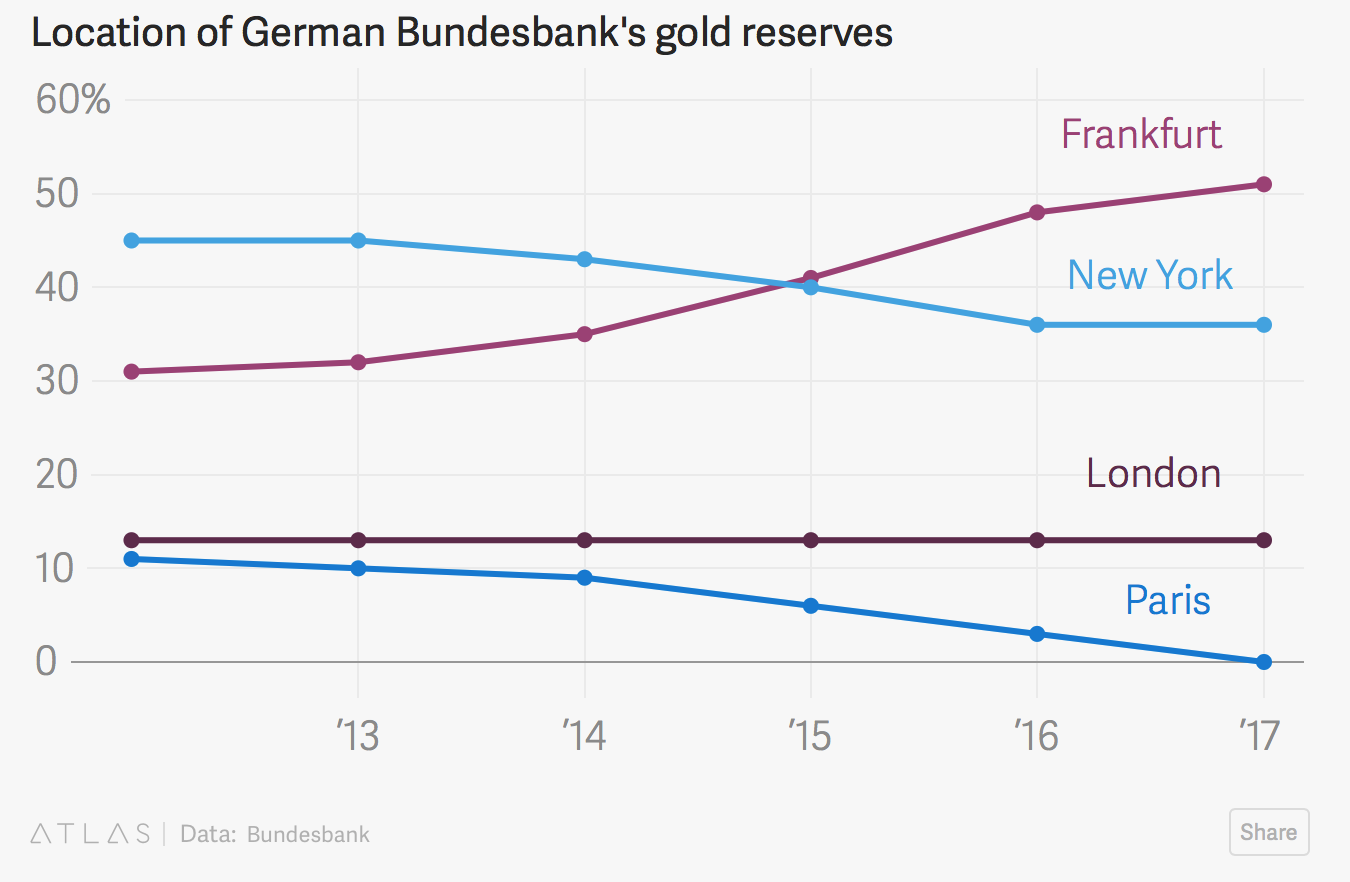
In 2013 the Deutsche Bundesbank announced plans to store half of its gold reserves in Germany. At the time, only 31% was stored in the country. The Gold Storage Plan involved bringing gold home from both Paris and New York.

The plan was expected to take seven years. At the time many asked why it would take so long to return just 674t of gold. The Bundesbank has completed the plan three years ahead of schedule.

The German gold repatriation was in response to the critics and or in order to safeguard the German gold reserves and ensure they are owned in a safe, allocated and segregated manner by the Bundesbank.

In the last five years the German central bank has 374t and 300t from Paris and New York, respectively. The Bundesbank opted to keep 432t in the Bank of England vaults.


Whilst the tables above (from the Bundesbank) show the repatriation of gold was ultimately successful, it has promoted much discussion about the security of gold in central banks.

The decision to move the gold back to home soil has also vindicated many who have long argued about the murky gold reserve dealings of the United States.

Why was the gold abroad and why move it?

Many countries choose to hold proportions of their gold on foreign soil for both security and practical reasons.

Practical reasons as it makes sense to have reserves in diversified locations so you have access to markets should you need to trade the reserves.

In 2013 a Bundesbank spokesman said “we have no intention to sell gold” adding that the decision to relocate the foreign held gold “is in case of a currency crisis."

This leads on to security reasons. During the Cold War the Bundesbank wanted to keep its gold in the West in case of an invasion from the Soviet Union. It was also a way of supporting the country’s currency knowing there were reserves held securely abroad, should the country need to use them.

Campaigns and concerns in the last decade have made the German population and central bank rethink what the modern security and practical threats are, prompting them to bring some of the gold home.

It was in the wake of the U.S. subprime crisis, the Lehman collapse and then the ensuing eurozone and global debt crisis in 2012, that prompted voices in Germany to call for an audit of the precious metal held abroad.

Campaigners also suspected the gold might have been tampered with or not be fully allocated and non leased. In response to the calls for greater transparency the Bundesbank agreed to hold 50% of the gold in Germany.

When the Bundesbank announced their plans to keep 50% of the gold at home it came just three months after they had defended their reasons for keeping the gold on foreign soil:

‘To function as reserve assets, it would have to be possible for the gold holdings to be exchanged, if necessary, into a commonly used reserve currency without any logistical constraints. That is the reason for storing parts of the gold reserves at partner central banks in other countries.’

Then, in early 2013 the central bank announced:

‘By 2020, the Bundesbank intends to store half of Germany’s gold reserves in its own vaults in Germany. The other half will remain in storage at its partner central banks in New York and London. With this new storage plan, the Bundesbank is focusing on the two primary functions of the gold reserves: to build trust and confidence domestically, and the ability to exchange gold for foreign currencies at gold trading centres abroad within a short space of time.’

It is also worth mentioning that in 2012 the German Court of Auditors ordered an audit of the gold reserves. The court clearly wanted to ensure that the nearly 3,400 tons of gold existed - 'because stocks have never been checked for authenticity and weight'. 

Why were the Germans worried about the safety of their gold?

Few people have raised eyebrows about Germany’s decision to bring gold back from Paris. The Bundesbank gave the following reason for doing so:

‘Given that France, like Germany, also has the euro as its national currency, the Bundesbank is no longer dependent on Paris as a financial centre in which to exchange gold for an international reserve currency should the need arise. As capacity has now become available in the Bundesbank’s own vaults in Germany, the gold stocks can now be relocated from Paris to Frankfurt.’

However, no specific reason was given for the US, other than the need to ‘build trust and confidence domestically.’ 

The announcement by the Bundesbank to move 300t of gold from New York sent ripples through the gold community. Many wondered if the plan was expected to take seven years because New York did not have Germany’s gold. Was this where the need to build trust and confidence came from?

More recently, with the election of President Trump, there might have been more cause for concern when it comes to the safety of a country’s gold.

"We have a lot of discussions about (U.S. President Donald) Trump, regarding implications on monetary policy, macroeconomics, etc., but we trust the central bank of the U.S.," Bundesbank board member Carl-Ludwig Thiele told a news conference in February of this year. But, "Trump has not triggered a discussion about the storage facility in New York."

The Gold Anti-Trust Action Committee (GATA) and Germany’s homegrown ‘Repatriate our Gold’ movement have been the loudest voices when it comes to concerns over the existence of gold and the nature of that gold's ownership in the US Treasury’s possession.

In 2017 Sputnik News reported on the successful repatriation of Germany’s gold from the US. In the report, a Russian commentator suggested Germany had received the wrong gold.

Russian economist Vladimir Katasonov, a professor at the International Finance Department at the Moscow State Institute of International Relations, told Sputnik that the U.S. had not been ready to give the bullion back. The professor suggested Germany's gold bars had been disposed of at the United States’ own discretion.

"There are a lot of signs that the gold was not physically present in the New York vaults when Germany called it back. Of course, the U.S. began to return it to Germany but there is one interesting detail. When you leave your suitcase in the luggage storage, you expect to get back the same suitcase. But Germany took the wrong 'suitcase,'" Katasonov told Radio Sputnik.

According to the economist, the gold bars that Bundesbank repatriated have different labels. He suggested that the U.S. might have replaced the German bullion with different gold bars bought from the market.

Katasonov explained that the U.S. managed to return the yellow metal thanks to favorable conditions in the precious metal market.

"I think there was a favorable environment in the market and the Americans managed to quickly buy the gold and give it back to Germany. They were not ready for this, but finally managed this replacement," he concluded.

It is worth mentioning that Carl-Ludwig Thiele told journalists that there were no issues with the gold received, ”We've checked every ingot against authenticity, fineness, and weight. We have nothing to complain about.”

Why did it take so long?

The Banca d’Italia, the Bundesbank and the International Monetary Fund make up the three largest gold holders at the New York Federal Reserve. Together they account for over 4,000 tonnes.

However, there has not been (to our) knowledge an audit to confirm that this is the case. There is no evidence these holdings have changed or been audited since the 1970s.

When it came to the 374t to be repatriated from New York many asked ‘If you have the gold why would you not just return it all in one ago, straight away?’ Why was it expected to take seven years? Previously Germany had repatriated 940 tons of its gold from the Bank of England without delays.

Theories abound as to why this could not happen. But they all centre around the theory that the gold is not there or if it is it may have two or more owners in gold leasing arrangements.

This is something we briefly mentioned earlier in the week. The move to repatriate the gold to Germany was partly driven by rumours that much of the gold held offshore may have been “rehypothecated” as suggested by GATA.

In fact, the US has appeared to have repatriated all of the requested gold to Germany three years ahead of schedule.

If the gold not been in the vaults then the US would have had to buy the gold or unravel gold leasing contracts.

Was there reason to be concerned?

Earlier this week we reported on the US Treasury Secretary’s visit to Fort Knox. His jokes about the existence of the gold prompted much coverage about the debate surrounding this very issue.

In response, respected commentator Jim Rickards argued that ‘all the evidence tells me that the gold is in Fort Knox and at West Point.’

‘Let me say it right now: Yes, the gold is there. I actually have some evidence that the gold is there from military sources.’

Now, some people like billionaire precious metals trader Eric Sprott argue that the gold could very well be at Fort Knox, but it’s been leased out to commercial banks. And yes, it could very well be leased. But leasing is a paper transaction. It doesn’t mean the government surrenders possession of the gold.

And what about the lack of audit?

If you are the Fed or the Treasury and you want people to think that gold is unimportant — which they do — why would you audit it?

You audit things that are important. You do not audit things that are unimportant. If the Fed doesn’t want you to think that gold is important, it follows that they would not audit it. Auditing it pays gold too much respect.

I am in favor of an audit, just to be clear. But the fact that the government does not audit the gold does not tell you that the gold is not there. They just do not want you to pay any attention to it.

Audit or no audit, gold or no gold, the fact is the Germans felt the need to bring back some of their gold.

Conclusion: Protect your gold 

The move by the Bundesbank was a prudent one, whether there was ever any real cause for concern or not. The fact is the US may well have all the gold that was ever stored there, or they may not.

It is also true that the eurozone is near breaking point and the continent is increasingly under threat from various geopolitical forces. It makes sense to have the gold in a place where they can audit and access it.

When you own gold you should expect to have access to it whenever you so wish. You should not expect others to have access to it and you should certainly expect to receive regular reports on its existence, security and your outright ownership of individual coins and bars that can be taken delivery of with a phone call.

All reports suggest that this was not the case.

It suits the majority of countries to avoid pushing the debate on the existence of gold holdings. Should a country like the US be unable to meet requirements when Germany demands its gold back in one go then it could place the two major world currencies (USD and Euro) at risk. The whole world would wonder what farce had been going on all this time.

However, Germany clearly wanted their gold back because of concerns about both how the US were looking after it and the future of global stability both politically and financially.

Individual investors should take the same approach. The main lesson of note here is that central banks want to own gold. They see it as the ultimate safe haven. Because of this Germany want to hold it in a segregated and allocated manner. Luckily for savers, that secure bullion storage option is readily available.

Related Content

Germany to Review Bundesbank Gold Reserves in Frankfurt, Paris, London and Federal Reserve Bank of New York

Bundesbank Announces Repatriation of 120 Tonnes of Gold from Paris and New York Federal Reserve

Bundesbank “Reassures” Re. Gold Bullion Reserves as Deutsche Bank Shocks With €6 Billion Loss Warning

News and Commentary

Gold steady ahead of central bank speeches at Jackson Hole (Reuters.com)

Gold price remains dull on futures correction (DailyTimes.com.pk)

Gold settles lower as investors look to Jackson Hole (MarketWatch.com)

U.S. Stocks Fluctuate Before Yellen; Oil Declines (Bloomberg.com)

Dixons Carphone Plunges as Mobile Slowdown Leads to Warning (Bloomberg.com)

Gold's out performance of S&P500 in 10 years - Bloomberg via Stansberrychurchouse.com

Gold outperforms US stocks in 10 years since financial crisis (Stansberrychurchouse.com)

U.S. stocks haven’t been this extreme since 1929 and 2000 (MarketWatch.com)

Did The Economy Just Stumble Off A Cliff? (ZeroHedge.com)

Epsilon Theory: Always Go To the Funeral (EpsilonTheory.com)

Jackson Hole: Yellen to play safe and not warn of asset bubbles (MoneyWeek.com)

Gold Prices (LBMA AM)

25 Aug: USD 1,287.05, GBP 1,003.90 & EUR 1,090.90 per ounce
24 Aug: USD 1,285.90, GBP 1,003.26 & EUR 1,090.44 per ounce
23 Aug: USD 1,286.45, GBP 1,004.33 & EUR 1,091.68 per ounce
22 Aug: USD 1,285.10, GBP 1,000.71 & EUR 1,091.95 per ounce
21 Aug: USD 1,287.60, GBP 999.82 & EUR 1,096.52 per ounce
18 Aug: USD 1,295.25, GBP 1,004.34 & EUR 1,102.65 per ounce
17 Aug: USD 1,285.90, GBP 998.12 & EUR 1,096.74 per ounce

Silver Prices (LBMA)

25 Aug: USD 17.02, GBP 13.26 & EUR 14.40 per ounce
24 Aug: USD 16.93, GBP 13.20 & EUR 14.36 per ounce
23 Aug: USD 17.06, GBP 13.32 & EUR 14.48 per ounce
22 Aug: USD 17.02, GBP 13.27 & EUR 14.48 per ounce
21 Aug: USD 17.02, GBP 13.20 & EUR 14.48 per ounce
18 Aug: USD 17.15, GBP 13.30 & EUR 14.60 per ounce
17 Aug: USD 17.02, GBP 13.23 & EUR 14.55 per ounce


Recent Market Updates

- Cyberwar Risk – Was U.S. Navy Victim Of Hacking?
- Global Financial Crisis 10 Years On: Gold Rises 100% from $650 to $1,300
- Mnuchin: I Assume Fort Knox Gold Is Still There
- Buffett Sees Market Crash Coming? His Cash Speaks Louder Than Words
- Gold, Silver Consolidate On Last Weeks Gains, Palladium Surges 36% YTD To 16 Year High
- Must See Charts – Gold Hedges USD Devaluation, Rise in Oil, Food and Cost of Living Since Nixon Ended Gold Standard
- World’s Largest Hedge Fund Bridgewater Buys $68 Million of Gold ETF In Q2
- Diversify Into Gold Urges Dalio on Linkedin – “Militaristic Leaders Playing Chicken Risks Hellacious War”
- Gold Has Yet Another Purpose – Help Fight Cancer
- Gold Up 2%, Silver 5% In Week – Gundlach, Gartman and Dalio Positive On Gold
- Great Disaster Looms as Technology Disrupts White Collar Workers
- Gold Sees Safe Haven Gains On Trump “Fire and Fury” Threat
- Silver Mining Production Plummets 27% At Top Four Silver Miners

Important Guides

For your perusal, below are our most popular guides in 2017:

Essential Guide To Storing Gold In Switzerland

Essential Guide To Storing Gold In Singapore

Essential Guide to Tax Free Gold Sovereigns (UK)

Please share our research with family, friends and colleagues who you think would benefit from being informed by it.

Litecoin Price Forecast and Analysis – August 25, 2017

Published here: http://www.profitconfidential.com/cryptocurrency/litecoin/litecoin-price-forecast-and-analysis-august-25-2017/

Litecoin is often referred to as “the silver to Bitcoin’s gold,” yet it has fallen out of sync with BTC prices in recent months. This divergence—which started in mid-July and festered through August—is creating tons of slack in the Litecoin price forecast.

For example, the LTC/USD exchange rate fell 1.67% yesterday, while the LTC/BTC exchange rate fell 4.89% by comparison. The disparity reflects greater pessimism among investors that already have money in the crypto market.

Many of them rotated funds from LTC to BTC in the weeks running up to the Bitcoin August 1 fork. As a result, Bitcoin appreciated considerably against Litecoin.

However, Litecoin recently became.

The post Litecoin Price Forecast and Analysis – August 25, 2017 appeared first on Profit Confidential.