Wednesday, September 27, 2017

The ONLY Variable That Matters To The Price Of Gold

Published here: http://www.zerohedge.com/news/2017-09-27/only-variable-matters-price-gold

The ONLY Variable That Matters To The Price Of Gold

Written by Jeff Nielson, Sprott Money News


There are all sorts of positive fundamentals when it comes to the price of gold. There are the positive supply/demand fundamentals. The gold market is in a supply deficit. Mine reserves are at a 30-year low. The price of gold is below what is necessary to sustain the gold mining industry.


There are the positive geopolitical fundamentals. The world’s two most-unstable leaders – Kim Jong-un and Donald Trump – have been constantly trading threats and insults. And both of these people have nuclear weapons at their disposal. There is the endless “War on Terror”.


There are the positive economic fundamentals. Western real estate bubbles in major urban centers are at never-before-seen levels of insanity. Western markets are generally also at bubble levels, with U.S. markets representing bubbles on steroids. Western governments are bankrupt.


In relative terms, none of these fundamentals count.


There is one more important fundamental for the price of gold. Not only is it the most important fundamental, but it involves a variable which dwarfs all other fundamentals in magnitude -- combined.


Regular readers have heard many times before that gold (and silver) is “a monetary metal”. The definition is simple. Gold is money. Therefore the price of gold must change proportionate to changes in the supply of other forms of “money” (i.e. currency).


This is not a theory. It is a function of simple arithmetic. An elementary numerical example will illustrate this principle.


Suppose (in the entire world) there was a total of 10 ozs of gold. Suppose also (in this hypothetical world) that there was a total of only $10,000 U.S. dollars. And in this hypothetical world, the price of gold is $1,000/oz.


Let us suppose the supply of U.S. dollars increases by a factor of five, and thus there are now $50,000 USD’s. What happens to the price of gold? All other things being equal, the price of gold must increase by a factor of five (in this case, to $5,000/oz), to keep our hypothetical world in equilibrium.


Now let’s return to the real world. What happened in the real world? The supply of U.S. dollars did increase by a factor of five. This was the most reckless money-printing binge since Germany’s hyperinflation during the 1920’s. Regular readers know this monetary orgy as “the Bernanke Helicopter Drop”.


Over a span of 50 years from 1920 through 1970 (while we still had a gold standard), the supply of U.S. dollars was virtually unchanged. In five years, 2009 – 13, B.S. Bernanke quintupled the U.S. money supply.


Did the price of gold quintuple? No, not even close. At the time that Bernanke began his money-printing orgy, the price of gold was roughly $800/oz. That was right after, the price had been driven roughly 30% lower by the banking crime syndicate. And even before that point, the price of gold wasn’t close to reflecting its full value.


At a minimum, the Bernanke Helicopter Drop should have propelled gold to $4,000/oz (USD), concurrent with that money-printing. Arguably, the price should have gone much higher than that. In actual fact, as we all know, the price never even reached $2,000/oz: less than half of the absolute minimum price.


That should have been the base price for gold in 2013: $4,000/oz USD. The supply of U.S. dollars has never shrunk. Forget about “tapering”. It never happened.


How do we know? B.S. Bernanke told us so. From 2009 – 13, virtually every week Bernanke boasted about “the wealth effect” from his money-printing: how U.S. stock markets were being pumped higher and higher and higher.


Obviously if quintupling the supply of U.S. dollars pushed U.S. markets up to their bubble levels, then withdrawing dollars would cause those markets to fall from their all-time highs. What have we seen? Instead, the bubbles have gotten bigger and bigger and bigger.


Obviously the U.S. money supply hasn’t shrunk, it has continued to grow. Bernanke and the Fed lied when they claimed they were reducing the supply of U.S. dollars. And as we also all know, the Federal Reserve absolutely refuses to allow any outside auditing.


Nobody knows what are on its books, we only know what the Fed-heads claim is on their books. And what they claim is not remotely plausible.


The U.S. market bubbles keep expanding, ergo the U.S. money supply keeps expanding. There is no other possibility. Yet the price of gold isn’t at $6,000/oz. It isn’t at $4,000/oz. It isn’t at $2,000/oz. It has been falling for most of the last six years.


During those six years, no one in the mainstream media (and very few in the Alternative Media) has made any mention of the gigantic disconnect with U.S. money-printing and the price of gold. The reason why the mainstream media propaganda machine has ignored this fundamental is obvious. Their job is to suppress the price of gold.


Why have practically no commentators in the Alternative Media been banging the drum on this subject? Ignorance. Sadly, few of these gold “experts” have a correct understanding of gold market fundamentals. They dwell on trivia.


Look at what we see around us today. These self-proclaimed experts debate whether or not the price of gold should rise above $1,300/oz. They point to North Korea. They point to incremental changes in demand for some of the major gold-consuming nations. Irrelevant.


The fact is that thanks to the success of the banking crime syndicate in discouraging the buying of (real) gold in the Western world, total gold demand hasn’t increased by that much. The largest, single incremental change was the switch by central banks from being net-sellers to net-buyers of gold. That was a very significant change, but it has flattened out and there is no indication that this will change further over the short term.


The fact is that (despite all the rhetoric) there is very little chance of any actual hostilities between the United States and North Korea. Discounted for this small probability, this is not a major driver of the price of gold.


The most ludicrous influence – and distraction – to the price of gold has been U.S. interest rates. High interest rates are a negative driver for the price of gold. The reasoning goes like this.


If savers can obtain a positive interest rate on their savings then they have an incentive to hold paper instead of gold. What is a “positive interest rate” in this context? If the interest rate on their savings is higher than the rate of inflation, then that is a positive interest rate.


If the savings rate is lower than the rate of inflation, savers lose money by putting it in the bank, and they are much better off holding gold instead.


Are current interest rates high? No, they are the lowest rates in history. This is despite the fact that B.S. Bernanke and all the other central bank liars promised to immediately normalize interest rates in 2009 – meaning in the range of 3% - 5%.


Today, after nearly nine years, the U.S. interest rate is at 1%. Meanwhile, real U.S. inflation has hovered between 4 – 8%, according to John Williams of Shadowstats. U.S. interest rates would have to rise by at least another 3%, just to begin to be a negative driver for the price of gold.


Current interest rates are a mildly positive driver for the price of gold. Otherwise, for the last nine years, everything said and done by the Federal Reserve with respect to U.S. interest rates has been totally irrelevant to the gold market.


If we combine every other variable that influences the price of gold, even put together they don’t come close to equaling the impact of the Bernanke Helicopter Drop. The U.S. dollar is now worthless.


It is backed by nothing. It has been diluted more than any other major currency going back a hundred years. The U.S. government is bankrupt. The U.S. dollar is currently being phased out as reserve currency – meaning the demand for U.S. dollars is shrinking to a fraction of previous levels.


What is the price of gold (or any hard asset), denominated in a worthless currency? The price is infinite. What is the current price for gold, denominated in worthless U.S. dollars? $1,300. The Crime of the Millennium.


For those readers who are still not convinced, just listen to Bernanke’s own words.


U.S. dollars have value only to the extent that they are strictly limited in supply.

- B.S. Bernanke, November 21, 2002 


Strictly limited in supply.


According to the former Chairman of the Federal Reserve, the Bernanke Helicopter Drop rendered the U.S. dollar worthless. That is why the Federal Reserve has falsified more recent versions of the chart above – to hide the dollar’s worthlessness. The phony chart produced by the Federal Reserve today bears no resemblance to what has actually happened to the U.S. dollar.


The U.S. government, the Federal Reserve, and the mainstream media pretend that the U.S. dollar still has value. They pretend that the price of gold should be at $1,300/oz (or less).


Ignore the trivia. Ignore the liars and idiots in the media. Ignore the Federal Reserve and all of its utterly pointless “meetings” about the U.S.’s irrelevant interest rates. Follow the money. It leads up – way, way up.


Questions or comments about this article? Leave your thoughts HERE.


The ONLY Variable That Matters To The Price Of Gold

Written by Jeff Nielson, Sprott Money News


Litecoin Price Forecast: LTC Picks Up Steam as China Worries Start to Fade

Published here: https://www.profitconfidential.com/cryptocurrency/litecoin/litecoin-price-forecast-ltc-picks-steam-china-worries-start-fade/

With the end of September in sight, the Litecoin to USD exchange rate is slowly gathering momentum. It is currently up roughly 1.28% in the last 24 hours, sitting pretty at around $53.67.

At the same time, LTC prices are down about 2.06% against Bitcoin.

This resurgence in Litecoin price prediction is not a standalone feature. It has long been hailed as “the silver to Bitcoin’s gold,” meaning that the two cryptocurrencies rise and fall in sync.

We have seen that description come to life in the last few weeks and play out with stunning.

The post Litecoin Price Forecast: LTC Picks Up Steam as China Worries Start to Fade appeared first on Profit Confidential.

Financial Advice From Man Who Made $1+ Billion in 1929 - Importance Of Being Patient and "Sitting"

Published here: http://www.zerohedge.com/news/2017-09-27/financial-advice-man-who-made-1-billion-1929-importance-being-patient-and-sitting

Financial Advice From Man Who Made $1+ Billion in 1929 - Importance Of Being Patient and "Sitting" 

 - Listen to Jesse Livermore and ignore the noise of short term market movements, central bank waffle and daily headlines  

- Stock and bond markets are overvalued but continue to climb... for now
- What goes up must come down and investors should diversify and rebalance portfolios despite market noise
- Behavioural biases currently drive markets, prompting legendary investors to be confused and opt out
- Lesson is to prepare portfolios for long-term and invest in assets that will act as hedge in next market correction or crash
- Gold performs well over the long-term and delivers to those "sitting" and being patient

When it comes to your investment portfolio it is harder than ever to sift through market and central bank noise and focus on the fundamental drivers and long-term strategy.

Take for example a quick glance at financial news pages this morning:

  • A story about bitcoin's rise from $200 in 2013 to $5000 just three weeks ago -  a gain of 2,400%
  • Fed rate hike odds in December have soared to 78% thanks to Yellen's "noisy" comments yesterday
  • Luxury homes in London’s best neighborhoods are set to rise by 20.3% over next five years - allegedly
  • Warnings of supply gap in oil production next year

Meanwhile, we look at more quiet, conservative gold and it has varied no more than $200/oz over the last four years.

It can be difficult to correlate this with a background of markets that are teeming with behavioural biases. Market reactions are short-tempered thanks to this age of instant information... and disinformation.

Greed and fear become more exaggerated than ever and greed is currently dominant.

The most recent individual to get frustrated with this state of affairs is money manager Hugh Hendry. Hendry recently decided to close his hedge fund, after 15 years. Hendry joined the likes of Eric Mindich, Leland Lim and John Burbank all of whom have shuttered hedge funds this year.

Market frustrations make us want to jump on money making bandwagon

In his round of send-offs Hendry explained how frustrating he had found markets. By nearly every measure they are over-priced, but few seem to care.

Hendry told Bloomberg:

“To my great, great, great horror, I became deeply correlated to the travails of President Trump’s presidency and of course these geopolitical events, which were sparked off in the Korean peninsula."

Markets are reacting to short-termisms and click-bait headlines.

Consider this: stocks, bonds and property prices are at all-time highs. They're not alone, private equity and some collectibles (considered alternative assets) are also at all time highs.

But they keep on going.

Occasionally it can feel as though nothing will take the steam out of the sails of markets which by all measures should be dramatically faltering.

Momentum is a powerful thing ... especially in the short term.

At the end of H1 2017 the S&P500, the Dow and Nasdaq Composite posted their biggest gains in recent years.

Stock prices fluctuate on a daily, monthly and even quarterly basis. These fluctuations often have very little to do with the fundamental value of the business.

Short-termism, speculation and stock buy backs are the main drivers of stocks today.

In 1960 the average period for holding a NYSE stock was eight years and four months. Today, according to Credit Suisse, the average period for holding a stock across the broader US stock market is four months.

We know from experience that this kind of trading behaviour and pricing activity cannot continue.

What goes up must come down. But obviously no-one knows when.

This is frustrating in this day and age. At a time when information is at my fingertips it can be infuriating to not have an answer.

But, we must be patient.

Importance of patience - a time-old skill

We were reminded of one of the greatest examples of investing with patience by Tim Price of Price Value International.

Price tells the story of Jesse Livermore, a legendary trader.

Livermore was extraordinary. Born in 1877, Livermore ran away from home as a child and soon began trading stocks.

By the time he was 20, he had already amassed a fortune of $3 million, more than $75 million in today’s money.

Livermore sold short, i.e. bet that stock prices would fall, just prior to the 1907 crash, as well as the 1929 crash.

His bets were so lucrative that, going into the Great Depression, Livermore had a fortune of more than $100 million, or about $1.4 billion today.

But Livermore wasn’t just great at making money from overheated markets. He was also a master of losing money.

This book is widely and rightly regarded as an investment classic. It is also crammed with valuable observations about the practice of speculation and successful trading.

Among them, the importance of being patient and disciplined:

“After spending many years in Wall Street and after making and losing millions of dollars I want to tell you this: It never was my thinking that made big money for me. It was always my sitting.”

The success of long-term investing and damage of short-term reactions is not just anecdotal.

In its 2016 Quantitative Analysis of Investor Behaviour,  US investment firm Dalbar found the leading cause of 20 years of diminished returns was investors’ own behaviour.

They tended to indulge in ‘panic selling, excessively exuberant buying and attempts at market timing’.

Time pressures of thinking 

We shouldn't be surprised that investors struggle to take a Jesse Livermore approach these days. Not only are we surrounded by instant news but we are also pressured into delivering regular results.

Hedge fund managers such as Hendry have to give their clients regular updates. All of us who hold investments with managers receive quarterly or annual reports. Money managers must report their results.

Of course, this is good for transparency but can you imagine how most people these days would feel if they thought money managers were telling them their investments hadn't done very much? They would want to move their money, they're not seeing much change which in today's minds means their is little value.

This is why we like gold

For precisely this point, we like gold. It requires patience, over the long-term it likes to filter out the noise that comes from the likes of Trump tweets and pumped up stocks.

Gold has performed extremely well since 1999. During the tech-fuelled stock market collapse of 2000-2003 gold stood strong. It made further gains during the disaster of the Iraq war, further boosted by the likes of Enron-esque scandals.

Following the financial crisis in 2007/ 2008, it posted some of its biggest gains.

Not bad for something that has just sat in the background for the last near-twenty years.

Regardless of how much gold you choose to hold in your portfolio the main message is clear: do not manage your portfolio on a daily basis, consider it as something which requires care over the long-term. This is why gold serves a portfolio so well.

This is something those who are just beginning to consider their long-term finances should seriously pay attention to.

Millennials take note

Earlier this year The World Gold Council’s John Reade, chief market strategist and head of research (and former managing partner at Paulson & Co.) spoke about the need for millennials to consider not only long-term investing and diversification but how gold played a key role.

“Millennials are an interesting case study; they are going to be working and investing a long time so you need to think about more than just the short term … Gold is a great diversifier for a portfolio but it is more than that. It is a source of returns that is commiserate with equities over the last 10, 20 years.”

Investing in gold is a commitment for the long-term. In order to enjoy long-term investing, participants must have both patience and an ability to tolerate periods of less-than-desireable performance.

It is vital millennials consider the performance of an asset over a long-period of time, as they are just starting to build their portfolios and need to prepare for the next 20, 30, 40 years or more.

The most prominent financial event in millennial's memory is the collapse of Lehman brothers. Those who invested in gold before or soon after the financial crash have fared well.

Gold is the true reward of patient investing 

Investing expert Warren Buffet famously stated that his preferred time to hold a stock is “forever.”

We know that equities are different to gold bullion but there is some transferable knowledge here.

The precious metal has delivered solid returns on a long-term basis. Investors must not be put off by the weaker performance of  the last four years. Instead they should ask what has driven the price over the last ten, twenty and forty years since the end of the Gold Standard.

Those long-term drivers have not suddenly disappeared. Currencies continue to be devalued, savers continue to earn very little on their savings and uncertainty is ever-growing in the political and economic worlds.

Gold is a proven hedge against instability and market turmoil. In recent years it has gained in popularity thanks to  low interest rates and financial uncertainties.

In the long-term, holding on to gold has been shown to be quite lucrative for many investors. But the key is a long-term focus,  patience and "sitting" ...

News and Commentary

Gold prices steady after Hawkish Yellen comments (Reuters.com)

Stocks Mixed in Asia as Consolidation Continues (Bloomberg.com)

Hedge fund Paulson & Co calls for joint shareholder action vs gold miners (Reuters.com)

Billionaire John Paulson Targets Gold CEOs Over Pay (Bloomberg.com)

Gold settles lower after back-to-back daily gains (MarketWatch.com)

 Bullion surges as North Korea tensions resurface. Source: Bloomberg

U.S. Dollar No Longer the Dominant 'Haven' Currency - BOAML (Gata.org)

Thoughts on global gold mine supply (Gold.org)

If China links oil to gold, the world will change (Plata.com)

Economic Winter Is Coming: Recap of My Experience at Nexus Crypto / Blockchain Conference (GoldSeek.com)

What Would Happen If the Moon Was Made of Gold? (HuffingtonPost.com)

Gold Prices (LBMA AM)

27 Sep: USD 1,291.30, GBP 963.83 & EUR 1,099.54 per ounce
26 Sep: USD 1,306.90, GBP 969.59 & EUR 1,105.38 per ounce
25 Sep: USD 1,295.50, GBP 957.89 & EUR 1,089.26 per ounce
22 Sep: USD 1,297.00, GBP 956.15 & EUR 1,082.09 per ounce
21 Sep: USD 1,297.35, GBP 960.56 & EUR 1,089.00 per ounce
20 Sep: USD 1,314.90, GBP 970.53 & EUR 1,094.79 per ounce

Silver Prices (LBMA)

27 Sep: USD 16.89, GBP 12.58 & EUR 14.38 per ounce
26 Sep: USD 17.01, GBP 12.67 & EUR 14.43 per ounce
25 Sep: USD 16.95, GBP 12.57 & EUR 14.27 per ounce
22 Sep: USD 16.97, GBP 12.52 & EUR 14.18 per ounce
21 Sep: USD 16.95, GBP 12.58 & EUR 14.24 per ounce
20 Sep: USD 17.38, GBP 12.84 & EUR 14.48 per ounce


Recent Market Updates

- “Gold prices to reach $1,400 before the end of the year” – GoldCore
- Commodities King Gartman Says Gold Soon Reach $1,400 As Drums of War Grow Louder
- Bitcoin “Is A Bubble” but Gold Is Money Says World’s Biggest Hedge Fund Manager
- Pensions and Debt Time Bomb In UK: £1 Trillion Crisis Looms
- Gold Investment “Compelling” As Fed May “Kill The Business Cycle”
- “This Is Where The Next Financial Crisis Will Come From” – Deutsche Bank
- Global Debt Bubble Understated By $13 Trillion Warn BIS
- Bitcoin Price Falls 40% In 3 Days Underlining Gold’s Safe Haven Credentials
- Gold Up, Markets Fatigued As War Talk Boils Over
- Oil Rich Venezuela Stops Accepting Dollars
- Massive Equifax Hack Shows Cyber Risk to Deposits and Investments Today
- British People Suddenly Stopped Buying Cars
- Buy Gold for Long Term as “Fiat Money Is Doomed”


Important Guides

For your perusal, below are our most popular guides in 2017:

Essential Guide To Storing Gold In Switzerland

Essential Guide To Storing Gold In Singapore

Essential Guide to Tax Free Gold Sovereigns (UK)

Please share our research with family, friends and colleagues who you think would benefit from being informed by it.

Tuesday, September 26, 2017

"Gold prices to reach $1,400 before the end of the year" - GoldCore

Published here: http://www.zerohedge.com/news/2017-09-26/gold-prices-reach-1400-end-year-goldcore

"Gold prices to reach $1,400 before the end of the year" - GoldCore

by MarketWatch

Gold finished sharply higher on Monday, recouping roughly half of last week’s loss, as declines in the U.S. stock market and growing tensions between the U.S. and North Korea lifted prices for the yellow metal to the highest settlement in more than a week.

December gold rose $14, or 1.1%, to settle at $1,311.50 an ounce. Prices, which lost about 2.1% last week, saw their highest finish since Sept. 15, according to FastSet data as reported by Marketwatch.

“The backdrop for gold today is as bullish as it has been in a long time,” said Mark O’Byrne, research director at GoldCore in Dublin.

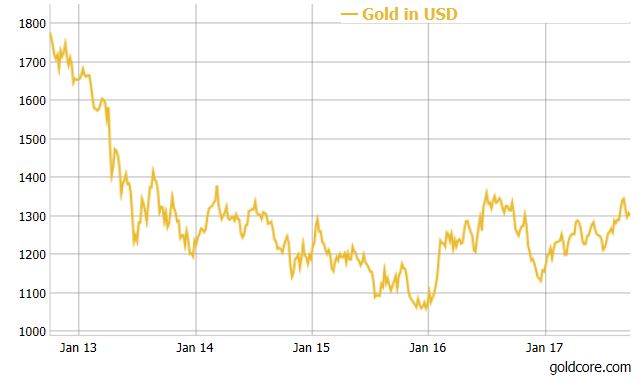
Gold in USD (5 years) 

He expects gold prices to reach $1,400 before the end of the year.

With President Donald Trump “in the White House and the political situation in the U.S. and globally more uncertain than it has been in many years, gold will almost certainly continue to see robust safe-haven demand,” he said.

“This should push gold higher in the coming months.”

Recent military tensions between North Korea and the U.S. and its allies has helped to underpin gold’s haven status as a hedge against a sudden escalation in geopolitical tension.

According to media reports Monday, North Korean Foreign Minister Ri Yong Ho told reporters that Trump’s tweet that leader Kim Jong Un “won’t be around much longer” was a declaration of war, and Japanese leader Shinzo Abe on Monday called a snap general election in a bid to consolidate power in the midst of a diplomatic crisis with North Korea.

Gold is “coming out of a bear market, and “the technical position looks better and better after gold bottomed in December 2015,” said O’Byrne.

“Since then, we have seen a series of higher lows and higher highs.”

“Global demand remains robust with strong demand being seen in many sectors—especially in the ETFs and also in Chinese demand", he said.

Gold is also considered a counter to what some market participants have described as lofty levels for U.S. equities potentially ripening for a correction.

The Dow Jones Industrial Average DJIA, -0.24% and the S&P 500 index SPX, -0.22% recently touched all-time highs, but traded broadly lower to start the week.

Gold gained even as the ICE U.S. Dollar Index DXY, +0.24% which measures the buck against a half-dozen currencies, was up 0.5%.

The two markets often move inversely as a weaker dollar can make commodities pegged to the currency, including most of the world’s gold, more appealing to buyers using weaker monetary units.

The dollar strengthened against the euro, which was under pressure after a heavy drop in support for mainstream parties in Germany’s general election on Sunday left the way forward in doubt for German Chancellor Angela Merkel’s conservative alliance.

News and Commentary

GoldCore expect "gold prices to reach $1,400 before the end of the year" (MarketWatch.com)

North Korea Tensions Drives Gold up 1.2% (Bloomberg.com)

Tech stocks, North Korea tensions drag Asian markets down (MarketWatch.com)

Fed’s Kashkari again says more Fed rate hikes are a bad idea (MarketWatch.com)

Euro Drops, Stocks Mixed as Korean Crisis Simmers: Markets Wrap (Bloomberg.com)

 Bullion surges as North Korea tensions resurface. Source: Bloomberg

Video: We’re Reaching Peak Gold (Bloomberg.com)

It makes sense to invest in gold now (Rediff.com)

It's the Debt Stupid! (Campaigner.com)

Here's how indoor farming can help feed 9.1 billion people by 2050 (MarketWatch.com)

Investors Take Cover in Gold as North Korea Threatens War: Chart (Bloomberg.com)

Gold Prices (LBMA AM)

26 Sep: USD 1,306.90, GBP 969.59 & EUR 1,105.38 per ounce
25 Sep: USD 1,295.50, GBP 957.89 & EUR 1,089.26 per ounce
22 Sep: USD 1,297.00, GBP 956.15 & EUR 1,082.09 per ounce
21 Sep: USD 1,297.35, GBP 960.56 & EUR 1,089.00 per ounce
20 Sep: USD 1,314.90, GBP 970.53 & EUR 1,094.79 per ounce
19 Sep: USD 1,308.45, GBP 969.30 & EUR 1,091.25 per ounce
18 Sep: USD 1,314.40, GBP 970.16 & EUR 1,100.68 per ounce

Silver Prices (LBMA)

26 Sep: USD 17.01, GBP 12.67 & EUR 14.43 per ounce
25 Sep: USD 16.95, GBP 12.57 & EUR 14.27 per ounce
22 Sep: USD 16.97, GBP 12.52 & EUR 14.18 per ounce
21 Sep: USD 16.95, GBP 12.58 & EUR 14.24 per ounce
20 Sep: USD 17.38, GBP 12.84 & EUR 14.48 per ounce
19 Sep: USD 17.15, GBP 12.70 & EUR 14.31 per ounce
18 Sep: USD 17.53, GBP 12.94 & EUR 14.66 per ounce


Recent Market Updates

- Commodities King Gartman Says Gold Soon Reach $1,400 As Drums of War Grow Louder
- Bitcoin “Is A Bubble” but Gold Is Money Says World’s Biggest Hedge Fund Manager
- Pensions and Debt Time Bomb In UK: £1 Trillion Crisis Looms
- Gold Investment “Compelling” As Fed May “Kill The Business Cycle”
- “This Is Where The Next Financial Crisis Will Come From” – Deutsche Bank
- Global Debt Bubble Understated By $13 Trillion Warn BIS
- Bitcoin Price Falls 40% In 3 Days Underlining Gold’s Safe Haven Credentials
- Gold Up, Markets Fatigued As War Talk Boils Over
- Oil Rich Venezuela Stops Accepting Dollars
- Massive Equifax Hack Shows Cyber Risk to Deposits and Investments Today
- British People Suddenly Stopped Buying Cars
- Buy Gold for Long Term as “Fiat Money Is Doomed”
- Conor McGregor – Worth His Weight In Gold?

Important Guides

For your perusal, below are our most popular guides in 2017:

Essential Guide To Storing Gold In Switzerland

Essential Guide To Storing Gold In Singapore

Essential Guide to Tax Free Gold Sovereigns (UK)

Please share our research with family, friends and colleagues who you think would benefit from being informed by it.

Monday, September 25, 2017

Is Bitcoin a Commodity, Gold & Silver Report 24 Sep 2017

Published here: http://www.zerohedge.com/news/2017-09-25/bitcoin-commodity-gold-silver-report-24-sep-2017

Carl Menger, father of the Austrian School of Economics, showed the world that money is not the product of the state. He did not mean that government is intrinsically incapable of decreeing something to be money while other groups, organized for different purposes, could do it. He described how money emerges as the commodity which is most marketable (“absatzfähigkeit” in German).

He discusses factors that limit marketability including to whom you can sell a particular good, where you can sell it, when you can sell it, etc. The most marketable is the one anyone can buy or sell anywhere at any time, with no limitations on quantity.

Picture the problems with fresh oysters, crude oil, winter woolens, and iron ingots. Oysters spoil very quickly, crude oil has to be stored in a specialized tank, no one wants wool mittens in the summer, and iron is heavy. Only a dealer in seafood could buy oysters. Oil can only be bought up to the buyer’s storage capacity. No clothing retailer wants to buy merchandise that will sit in a warehouse for a year until next winter. Moving iron any great distance is expensive.

At one time, cattle was money. A big cause of this is that cattle move under their own power. For nomadic societies, everyone thought of livestock as wealth and pastureland was not a limitation. However, as people settled into cities and agriculture, animals didn’t work so well any more. What would a blacksmith or weaver do with a few cows in the workshop? And what will it cost to feed them? They needed something more convenient.

Gold emerged as the most marketable commodity. It does not have any of the above problems. Anyone can accept gold anywhere at any time, and bring it anywhere else to anyone else.

It is important to ask why a commodity. Why not love? “I will trade you two acres of farmlands for love (or a kiss)” Why not chiseled carvings on a stone at the city temple, kept in absolute trust by the priests? Why not pieces of paper? The first is a frivolous question to make a point. Love or a kiss cannot be exchanged with a third party.

But the other two are nontrivial, and deserve a serious answer. The answer is not: because price inflation. Or, at least, that is only one potential risk among others that lead to a more general problem and the full answer. Nor is it about collapse and the end of the world, what will people barter with (e.g. bullets, cigarettes, or dried food). It is about a universal concern in the human condition.

Trust.

Obviously if you think someone is a cheat, then you will not extend him credit. Or if you don’t like the balance of risk and reward, you will want to withdraw credit. But the issue is much broader than these two simple cases. In the market, it is not usually black and white. There are degrees. In other words, you may want to keep a certain fraction of your wealth in the system, where it earns a return and is easy to use in exchange.

At the same time, you may also want to keep some portion at home in the sock draw or under the floor boards. Everyone must decide for himself what portion to hoard. Yes, we use the word hoarding, though we know that most economists were dismissive of it if not derisive. In his book Human Action, economist Ludwig von Mises called it, “…a deus ex machina, the much talked about hoards…” (though in other places, he treated hoarding more dispassionately).

In fact, there is an arbitrage between hoarding and—to coin a verb word here—crediting. Hoarding is less convenient. Handling and trading physical pieces of metal such as coins has a cost in time spent and often a wider bid-ask spread. However, crediting incurs the risks of default, fraud, and even honest error.

Spread is always a motivator. In this case, there are two spreads. One is convenience, ease of use, time saved. The other is interest. The higher the yield on gold that one can earn, the greater the incentive to dishoard and put one’s money to work. The lower the return, or the higher the risk, the greater the incentive to hoard.

Hoarding is the only alternative to crediting. Whether you put the gold in your pocket, store it in a safe, or contract with a professional vaulting service, you are withdrawing your gold, refusing to grant credit, not allowing your gold to be used by anyone for any reason, and not being in a position to depend on a third party to return your gold (which is somewhat ambiguous in the case of a depository).

This illustrates why money is a physical commodity. Everything else is a form of credit. With any other monetary asset, you are granting credit to someone. Your asset is represented by a number on a ledger of a debtor, or at least an issuer. For purposes of extricating yourself from risk, for purposes of having something in hand, only taking home a physical commodity will do.

Note that not just any commodity suffices. If you buy a warehouse full of lumber, palettes full of copper bars, or a tank full of crude, these have storage costs. And you are speculating. You cannot rest easy so long as you have these goods, because the prices are always moving either up or down. If up, then you are getting richer. If down, then you are getting sweatier.

All the discussion of price in the gold community aside, this is not true for gold. People put gold into intergenerational trusts, with good reason. When you hold the monetary commodity, you are safe. The purpose is not to sell it for a higher price, but to hold it for its own sake, for the reasons we cited for hoarding earlier.

Leaving aside the question of whether price is determined subjectively, we now raise the following question. Is the definition of commodity subjective? Is a thing a commodity, or not a commodity, based on personal preference? Can one person just say that a number on a ledger is a commodity, while it is equally true for another to say no, that only a thing you can hold in your hand is a commodity?

This is no mere argument over what to include in a word’s definition. This is an argument over what sort of thing serves for that portion of one’s wealth that one does not wish to be crediting.

Where one needs hoarding, a number on someone else’s ledger will not do.

We began with Menger. Above we discussed the properties of the monetary commodity and hoarding vs. crediting. Now our discussion of money-is-commodity inevitably leads to Mises’ famous regression theorem.

Mises argues:

“Thus the demand for a medium of exchange is the composite of two partial demands: the demand displayed by the intention to use it in consumption and production and that displayed by the intention to use it as a medium of exchange. With regard to modern metallic money one speaks of the industrial demand and of the monetary demand. The value in exchange (purchasing power) of a medium of exchange is the resultant of the cumulative effect of both partial demands.”

Regression refers to the fact that the monetary demand of today is based on the monetary demand of yesterday. But yesterday’s monetary demands only existed because of last week’s monetary demand, and so on. Is this an infinite regression, or does it go back only so far and end at some point?

Mises argues it’s not infinite. Demand for the monetary good consists of two components, but only one of them depends on yesterday’s demand. Therefore, if you go back far enough, you will find a day when the good was not a monetary good—when its demand was exclusively for consumption and production.

One is, of course, free to argue that Mises was wrong. In such view, money does not have its origin as a good used in production and consumption. And money could be whatever anyone says it is. Or perhaps not just anyone has the power to deem something money, only a government has that power.

However, if one accepts Mises’ argument, then one has to address bitcoin. We have seen many papers contending that bitcoin meets the requirements of Mises’ regression theorem. Without singling anyone out for our scathing argument, let us just summarize them as: bitcoin has utility apart from its use in exchange. The bitcoin network solves certain problems, the blockchain is elegant and scalable, etc.

Our criticism of this logic is that bitcoin, the monetary thing itself, is demanded for some reason. Bitcoin proponents will tell you why. Its purchasing power is rising. One needs no abstract thought experiment to trace back to the origins of bitcoin in the mists of antiquity. It began ex nihilo in 2009.

Since then, its demand for use as a medium of exchange—we will be generous and concede for purposes of this argument that its speculative demand is merely demand for medium of exchange—has risen. However, what is its use—and by this we mean a bitcoin as such—for any kind of consumption or production?

Mises was clear in referring to a thing’s use “in consumption and production.” One cannot change the context and say the bitcoin blockchain, technology, network, or ecosystem have value. They do, but that does not change the nature of the value of a bitcoin. One does not buy a bitcoin to eat, nor to melt and combine with bytecoins and kilocoins, and manufacture into candlesticks, mirrors, electrical conductors.

Bitcoin is no commodity. Bitcoin does not pass Mises’ regression test. Bitcoin has no demand other than demand for medium of exchange.

However, for now it does substitute for gold in one important regard. It meets the need for speculation, for capital gains.


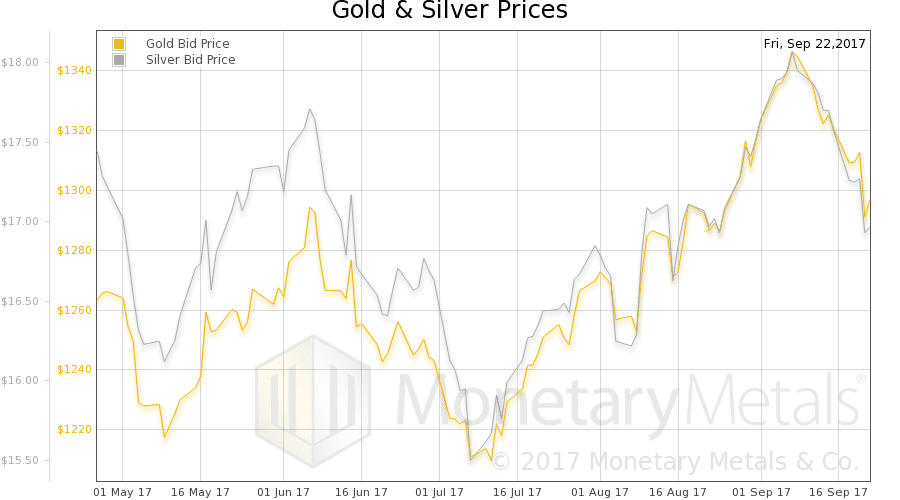
The price of gold dropped $24, and that of silver 60 cents this week. This is a far cry from Sep 8, when the price of silver hit $18.21. Since then, it’s been almost all downhill. What happened? Since the beginning of last month, the price of silver had been rising and at the basis along with it. Basis is future price minus spot price. A rising price and basis is telling us that buyers are pushing up the price—of futures. By arbitrage, the price of the metal is pulled up too, but it trails.

Another way to describe this is to say that the marginal buyer of silver metal is the market maker, who warehouses it for the futures buyer. If this is the marginal demand, then it’s a bearish indicator because it could disappear and become the marginal supply.

That is what has happened for the last two weeks. The closing price peaked on Sep 7, and has been dropping since then. Along with it, the basis has been falling. Both the August through Sep 7 trend of rising price and basis, and the Sep 8 through present trend of falling price and basis show us something clearly that cannot be seen on other graphs. These moves are caused by speculators positioning and then depositioning themselves.

Two facts in this round trip are unfortunate for silver speculators. One, when the price was rising, the basis was rising. Real demand dropped off while speculative demand is only temporary. Two, when the price came back down the basis did not fall that much. The fundamental silver price that we calculate daily began falling after 8 September.

One might wish for the price to skyrocket, but one must respect the data. The data does not guarantee that the price could not hit $20 or $22 perhaps. But it shows that there is no reason for it, and the more the price rises, the stronger are the forces pulling it down.

We are not in the same short-term interest environment that existed during most of the last 9 years. This is reflected in the cost of carry for all trades. In the case of silver, the silver forward rate shows that the offered rate (what a trader would pay to carry silver for 6 months) was around 0.5% at the end of 2015, but has since gone up to about 2%.

We assume that silver speculators are more mindful of the cost, and likely to close positions sooner at this higher rate. If that is so, then expect speculative moves to end sooner and maybe even silver to spend more time trading below its fundamentals than previously.

We will look at an updated picture of the fundamentals of supply and demand of both metals. But first, here are the charts of the prices of gold and silver, and the gold-silver ratio.

Next, this is a graph of the gold price measured in silver, otherwise known as the gold to silver ratio. The ratio rose.

In this graph, we show both bid and offer prices for the gold-silver ratio. If you were to sell gold on the bid and buy silver at the ask, that is the lower bid price. Conversely, if you sold silver on the bid and bought gold at the offer, that is the higher offer price.

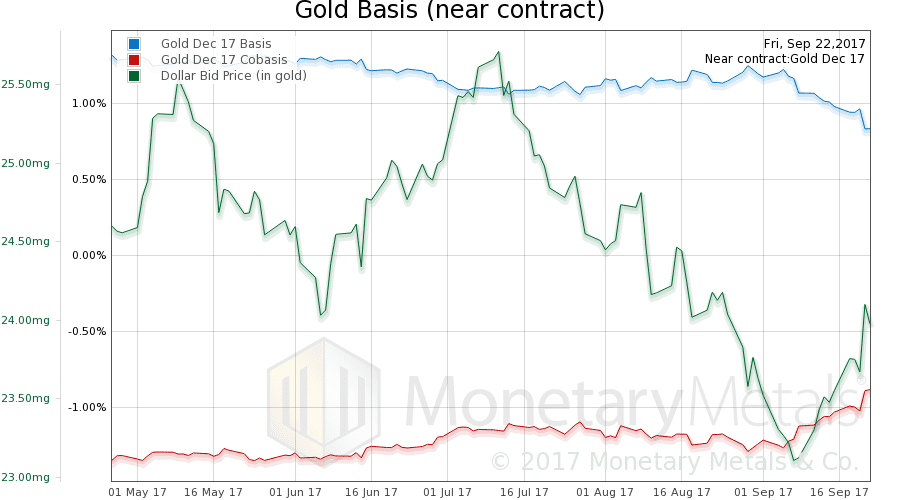
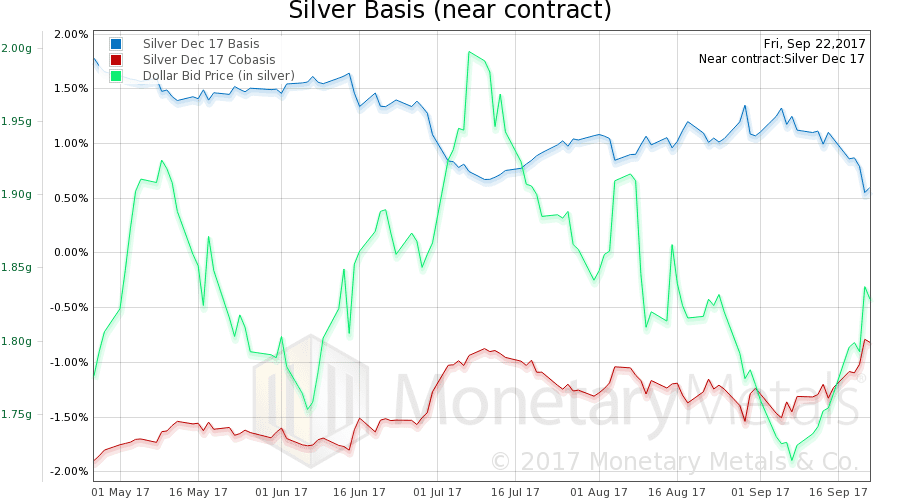
For each metal, we will look at a graph of the basis and cobasis overlaid with the price of the dollar in terms of the respective metal. It will make it easier to provide brief commentary. The dollar will be represented in green, the basis in blue and cobasis in red.

Here is the gold graph.

The dollar is up some more (the inverse of the falling price of gold). The cobasis (red line, scarcity) is up a bit.

Our calculated Monetary Metals gold fundamental price actually increased $8 to $1,378.

Now let’s look at silver.

This is the time of year when both metals have the same active contract month, December. This means the near contract basis has the same duration, and we can make a direct comparison. The gold cobasis is -0.88%, and for silver it is -0.82%.

This would paint a picture of silver being the scarcer metal. However, with silver’s poorer liquidity, we generally see a lower basis / higher cobasis in the near contract. The fact that they are so close actually indicates that gold is likely to be scarcer.

This is why we calculate a continuous basis, to take out the propensity to fall inherent in the near contract. The continuous gold cobasis is -1.24% and for silver it is -1.38%.

Our calculated Monetary Metals silver fundamental price fell $0.06 to $17.32 (recall from gold above, the fundamental price is up $8).

For whatever reason, call it “risk off”, call it “no one wants silver in a potential war with a nuclear power”, call it “soft industrial demand for metals”, silver is weaker than gold at this time.

We calculate a fundamental gold-silver ratio of around 79.5


© 2017 Monetary Metals

Commodities King Gartman Says Gold Soon Reach $1,400 As Drums of War Grow Louder

Published here: http://www.zerohedge.com/news/2017-09-25/commodities-king-gartman-says-gold-soon-reach-1400-drums-war-grow-louder

Commodities King Gartman Says Gold Soon Reach $1,400 As Drums of War Grow Louder

- 'Commodities King' Gartman sees $1,400 gold surge in months
- "Gold is the one currency that will do the best of all..."

- Pullback below $1300 "is relatively inconsequential"
- Use gold price weakness to be a buyer "no question"

- Bullish on gold due to central banks and easy monetary policy and gold will be even higher in euro terms
- Gold will be the best of all, as a result of QE and expansionary policies
- Dalio reconfirms belief that 'gold serves a purpose' and portfolios should have exposure
- 'Gold is a diversifying asset' says Dalio
- Own allocated, segregated gold in Zurich or Singapore

Editor Mark O'Byrne


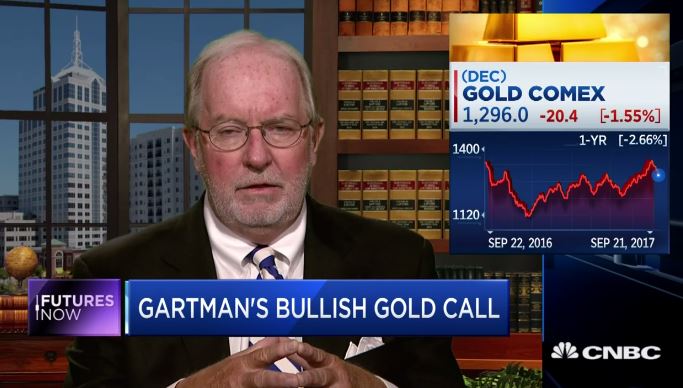
Dennis Gartman has called 2017’s gold rally and he is now forecasting gold will be "demonstrably higher" rising to $1,400/oz in the coming months and rise by even more in euro terms.

In an interview on CNBC, he said that the recent correction in gold is but a mere pullback prior to much higher prices and "gold is the one currency that will do the best of all."

Earlier this year Dennis Gartman, of the Gartman Letter, successfully called this year's gold rally. In the year-to-date the precious metal is up by nearly 13%, thus outperforming the S&P 500 which is 12% higher.

"A year from now, gold will be demonstrably higher than it is right now...I would certainly think we could see $1400 [an ounce] in dollar terms."

Gartman's prediction comes a few days after another respected investor, Ray Dalio, called for gold to be held in portfolios.

Both Gartman and Dalio encourage gold investment as they believe it is an excellent diversifier and will be among the best performing currencies.

Their comments came following an intense week both political and economic developments, across the globe.

Signals from central banks - nothing to see here?

Last week the U.S. Fed made clear that it is still on track to raise interest rates by the end 2017.

Gold stumbled as tighter monetary policy is seen to raise the opportunity cost of holding bullion.

This is not a cause for concern, says Gartman:

"This is a correction but let's understand the last rally that we had took off from $1200 to $1370. The fact that we've fallen back below $1300 I think is relatively inconsequential,"

Why is Gartman so bullish on gold?

"The monetary authorities are all still remaining expansionary...In that instance, the one currency that will probably do the best of all is gold."

Gartman says this despite the announcement by the U.S. Federal Reserve and previous comments from other central banks. Clearly, he argues, balance sheet unwinding is not going to happen immediately.

"[It] is going to take five or six years. This is not something that will occur overnight,"

As we explained last week following the Fed's announcement, the plan to hike interest rates and reduce the size of its balance sheet does not make for a happy ending.

According to 100 years’ worth of data (provided by Incrementum Capital Partners via Frank Holmes), increased rates and a reduction in the balance sheet has historically preceded recessions.

A recession would likely kill the business cycle. Frank Holmes explains why this makes a case for holding gold in your portfolio:

Gold has historically shared a very low to negative correlation with stocks. Consider 2008, the height of the financial crisis: US stocks ended the year down more than 37 percent, while gold held its value, returning 3.4 percent.

So it is not surprising that Dennis Gartman remains bullish on gold. For the next five-to-six years the Federal Reserve, along with the Bank of England and European Central Bank (to name a few), will be seeking to do the impossible - undo all of their decade-long decisions without screwing up the economy even more.

The case for gold is clearly strong in the long-term, and just as much so in the short-term thanks to a certain 'dotard' and 'Rocket Man'.

North Korea thinks Donald Trump is mentally deranged...

“Just heard Foreign Minister of North Korea speak at U.N. If he echoes thoughts of Little Rocket Man, they won’t be around much longer!” 

Whilst markets' concerns over North Korea have apparently lessened over the weekend, the last week has been full of machismo demonstrations from both sides.

Gold had a bit of a take-down following the Federal Reserve meeting however North Korea's threats to test another hydrogen bomb, promptly increased support for the safe haven.

President Trump unimpressed UN attendees last week, referring to Kim Jong-Un as a the 'Rocket Man on a suicide mission'. In response the North Korean Foreign Minister told the UN Trump was "mentally deranged person full of megalomania" and also on a "suicide mission".

The U.S. decided a fly by of U.S. bombers would be a good way to demonstrate 'strength' whilst the North Koreans marched on Pyongyang against President Trump.

Gold plays a significant role during times of political and economic uncertainty. Whilst many argue that the war-of-words between the US and North Korea is nothing new, this is the first time we have seen actions escalate to this level.

Those who believe this is nothing new are perhaps assume things will ease off between the American 'dotard' and the North Korean despot.

When you look back at various events between 1976 and 2009 that have prompted a cause for concern for regarding North Korea, the gold price has declined.

This year however we have seen the price rally. This is because there are many positive factors in the gold market but also because the stakes are higher.  With each tweet, statement, military demonstration and rocket test, the uncertainty increases significantly.

We have not been in a situation when a U.S. President is able to broadcast his thoughts with immediate effect to the world (including his enemy). Nor have we ever known North Korea to have the military capabilities it is so keen to demonstrate.

Gold thrives on uncertainty.

We are certain about the uncertainty 

We are at an interesting juncture.

Data tells us that it is highly unlikely that central banks will successfully unwind without causing harm to the global economy.

Data also tells us that gold performs well as a safe haven during times of war and geopolitical upheaval.

However, there is no data to tell us how everything will play out. This is where uncertainty comes in.

Central banks are going to start unwinding, but we do not know how badly it will go wrong. North Korea will continue to try to destabilise the region and the U.S. but we do not know how far they will be allowed to get.

Gold will perform well in the coming months. If you want to be certain of its protection in a world of uncertainty, then you should own physical gold - allocated and segregated coins and bars - in the safest vaults, in the safest jurisdictions in the world.

Important guides to storage in Singapore and Switzerland:

Essential Guide to Storing Gold In Singapore
Essential Guide to Storing Gold In Switzerland

News and Commentary

Euro, Stocks Drops After German Vote; Oil Dips: Markets Wrap (Bloomberg.com)

Gold prices looking for support (BullionDesk.com)

Trump slaps travel restrictions on North Korea, Venezuela in sweeping new ban (Reuters.com)

Gold companies take a shine to China’s Silk Road (Reuters.com)

Sri Lankan arrested with nearly 1kg of gold in his rectum (BBC.com)

 European stock volumes lowest since tech bubble. Source: Bloomberg

'Commodities king' Gartman sees gold surging to $1400 within months (CNBC.com)

After 2-Week Takedown In Gold And Silver, Here Is The Big Surprise - Turk (KingWorldNews.com)

Bitcoin Is A Bubble says Rickards but What Causing and For How Long? (DailyReckoning.com)

Should you be worried about the “October effect”? (StansBerryChurcHouse.com)

If Amazon Takes Over The World... (ZeroHedge.com)

Gold Prices (LBMA AM)

25 Sep: USD 1,295.50, GBP 957.89 & EUR 1,089.26 per ounce
22 Sep: USD 1,297.00, GBP 956.15 & EUR 1,082.09 per ounce
21 Sep: USD 1,297.35, GBP 960.56 & EUR 1,089.00 per ounce
20 Sep: USD 1,314.90, GBP 970.53 & EUR 1,094.79 per ounce
19 Sep: USD 1,308.45, GBP 969.30 & EUR 1,091.25 per ounce
18 Sep: USD 1,314.40, GBP 970.16 & EUR 1,100.68 per ounce
15 Sep: USD 1,325.00, GBP 977.32 & EUR 1,109.16 per ounce

Silver Prices (LBMA)

25 Sep: USD 16.95, GBP 12.57 & EUR 14.27 per ounce
22 Sep: USD 16.97, GBP 12.52 & EUR 14.18 per ounce
21 Sep: USD 16.95, GBP 12.58 & EUR 14.24 per ounce
20 Sep: USD 17.38, GBP 12.84 & EUR 14.48 per ounce
19 Sep: USD 17.15, GBP 12.70 & EUR 14.31 per ounce
18 Sep: USD 17.53, GBP 12.94 & EUR 14.66 per ounce
15 Sep: USD 17.70, GBP 13.03 & EUR 14.81 per ounce


Recent Market Updates

- Bitcoin “Is A Bubble” but Gold Is Money Says World’s Biggest Hedge Fund Manager
- Pensions and Debt Time Bomb In UK: £1 Trillion Crisis Looms
- Gold Investment “Compelling” As Fed May “Kill The Business Cycle”
- “This Is Where The Next Financial Crisis Will Come From” – Deutsche Bank
- Global Debt Bubble Understated By $13 Trillion Warn BIS
- Bitcoin Price Falls 40% In 3 Days Underlining Gold’s Safe Haven Credentials
- Gold Up, Markets Fatigued As War Talk Boils Over
- Oil Rich Venezuela Stops Accepting Dollars
- Massive Equifax Hack Shows Cyber Risk to Deposits and Investments Today
- British People Suddenly Stopped Buying Cars
- Buy Gold for Long Term as “Fiat Money Is Doomed”
- Conor McGregor – Worth His Weight In Gold?
- Gold Has 2% Weekly Gain,18% Higher YTD – Trump’s Debt Ceiling Deal Hurts Dollar

Important Guides

For your perusal, below are our most popular guides in 2017:

Essential Guide To Storing Gold In Switzerland

Essential Guide To Storing Gold In Singapore

Essential Guide to Tax Free Gold Sovereigns (UK)

Please share our research with family, friends and colleagues who you think would benefit from being informed by it.