Tuesday, November 28, 2017

Bitcoin $10,000 - Huge Volatility of Cryptocurrencies and Risky Fiat Making Gold Attractive

Published here: http://www.zerohedge.com/news/2017-11-28/bitcoin-10000-huge-volatility-cryptocurrencies-and-risky-fiat-making-gold-attractive

Bitcoin $10,000 - Huge Volatility of Cryptocurrencies and Risky Fiat Making Gold Attractive

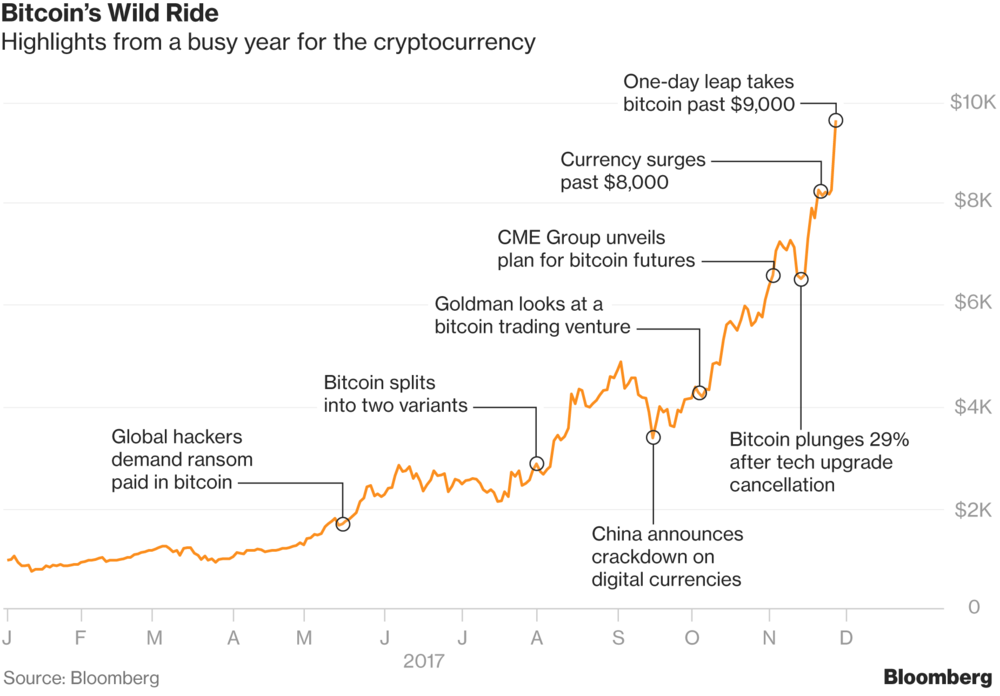
 - Bitcoin tops $10,000, soaring more than 850% since beginning of 2017
- Irrational exuberance arguably main driver of price performance
- Google Trends shows search for ‘Bitcoin Bubble’ hit highest level this morning

- Buyers need to be aware of hacking and security risks
- Other primary risks to widespread adoption is volatility and liquidity risk
- World's largest online trading platform IG Markets suspends BTC trading

- Volatility of cryptocurrencies and risky world of fiat make gold attractive
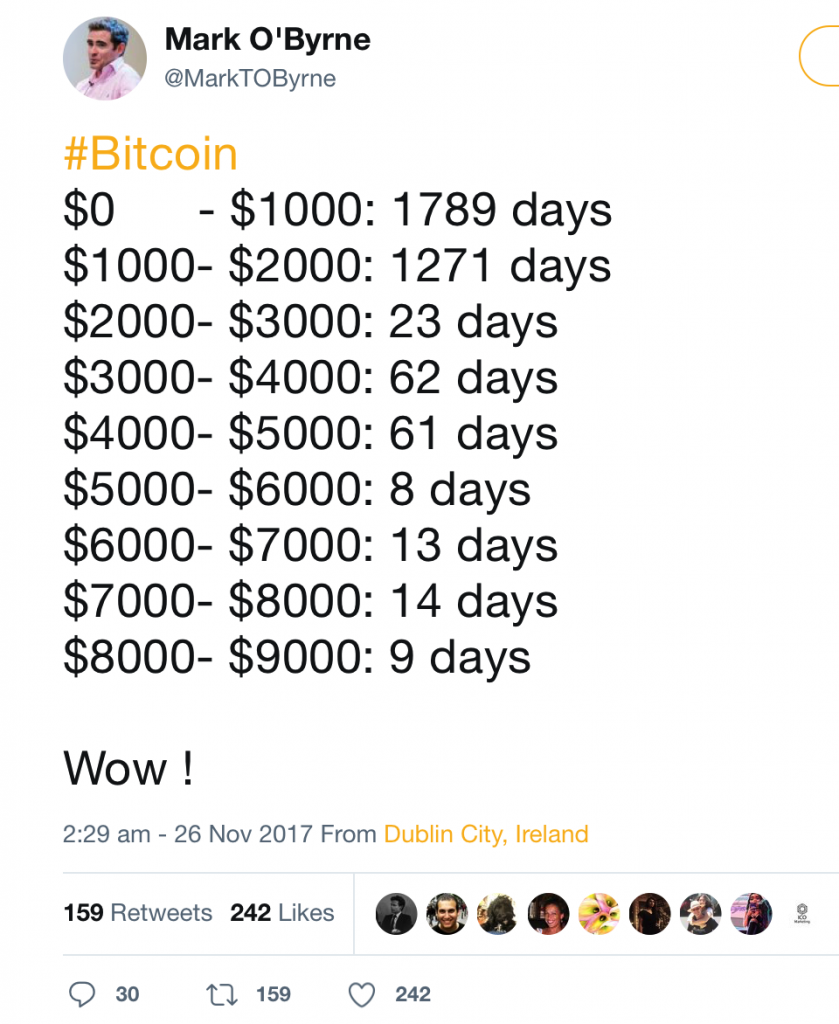
 

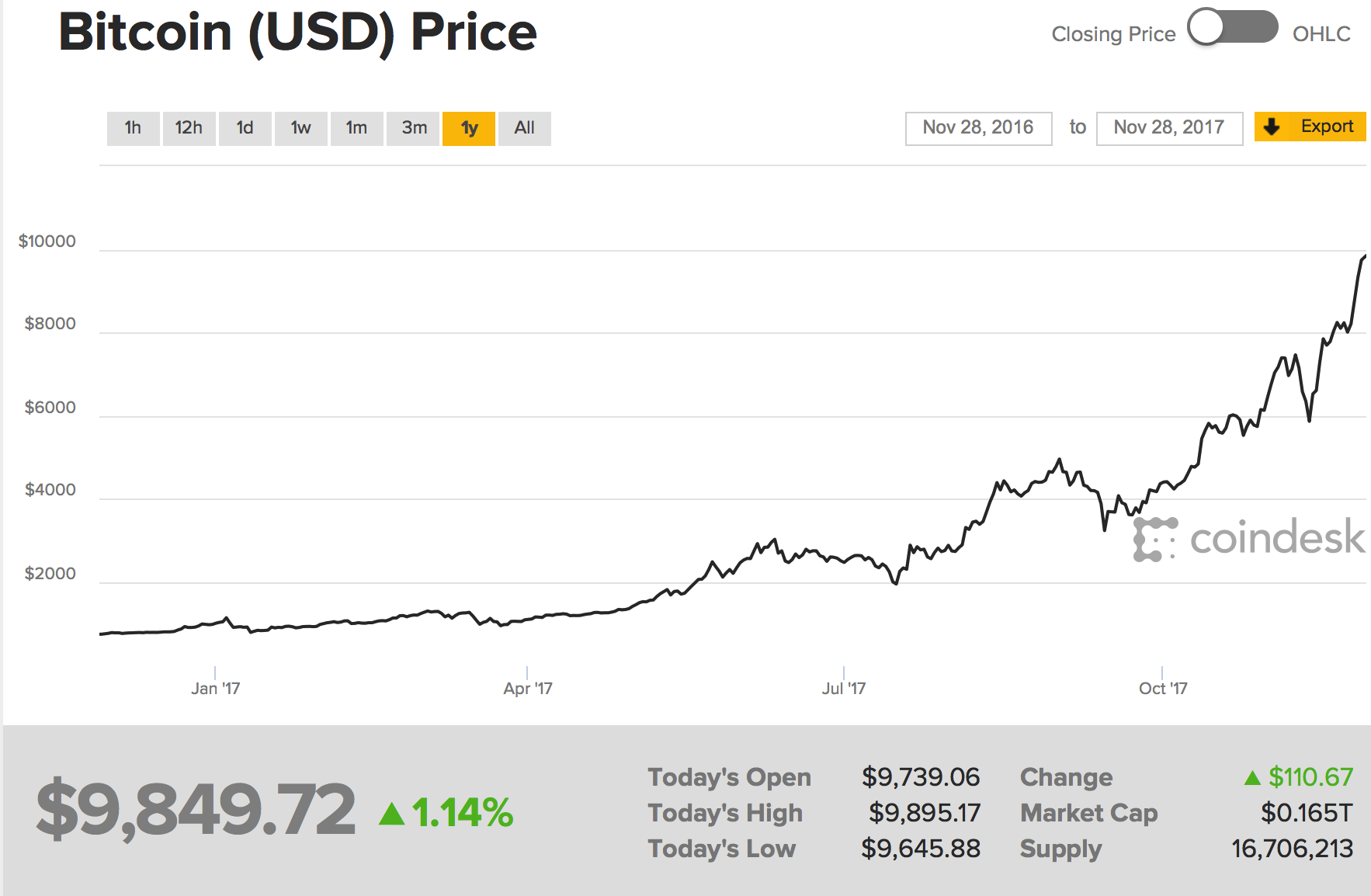
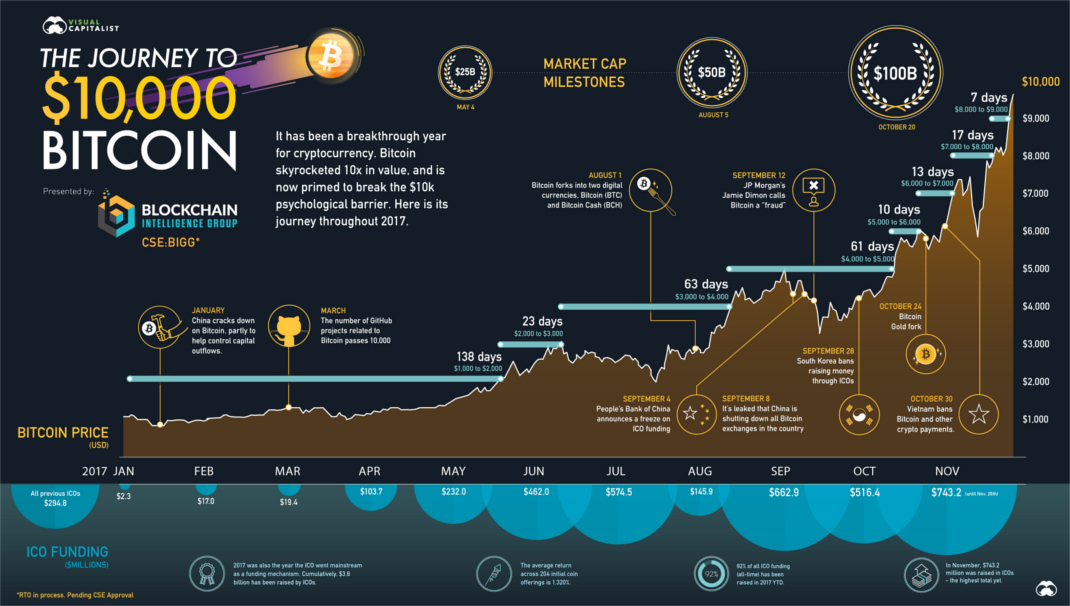
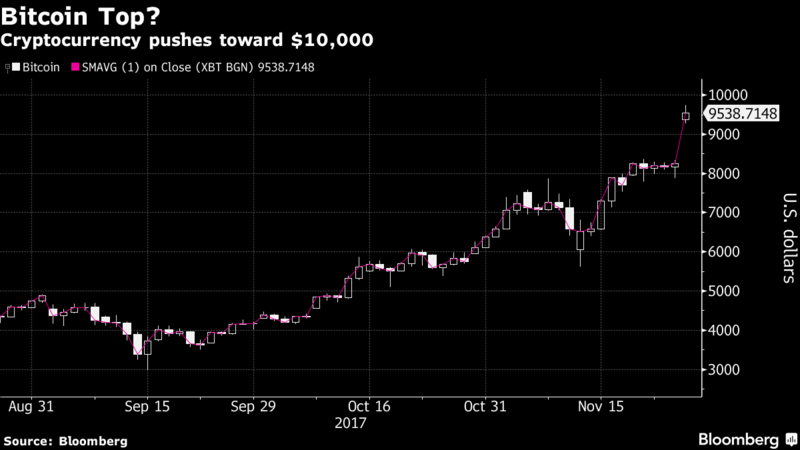
Bitcoin topped $10,000 on some exchanges yesterday to much fanfare and animal spirits internationally.

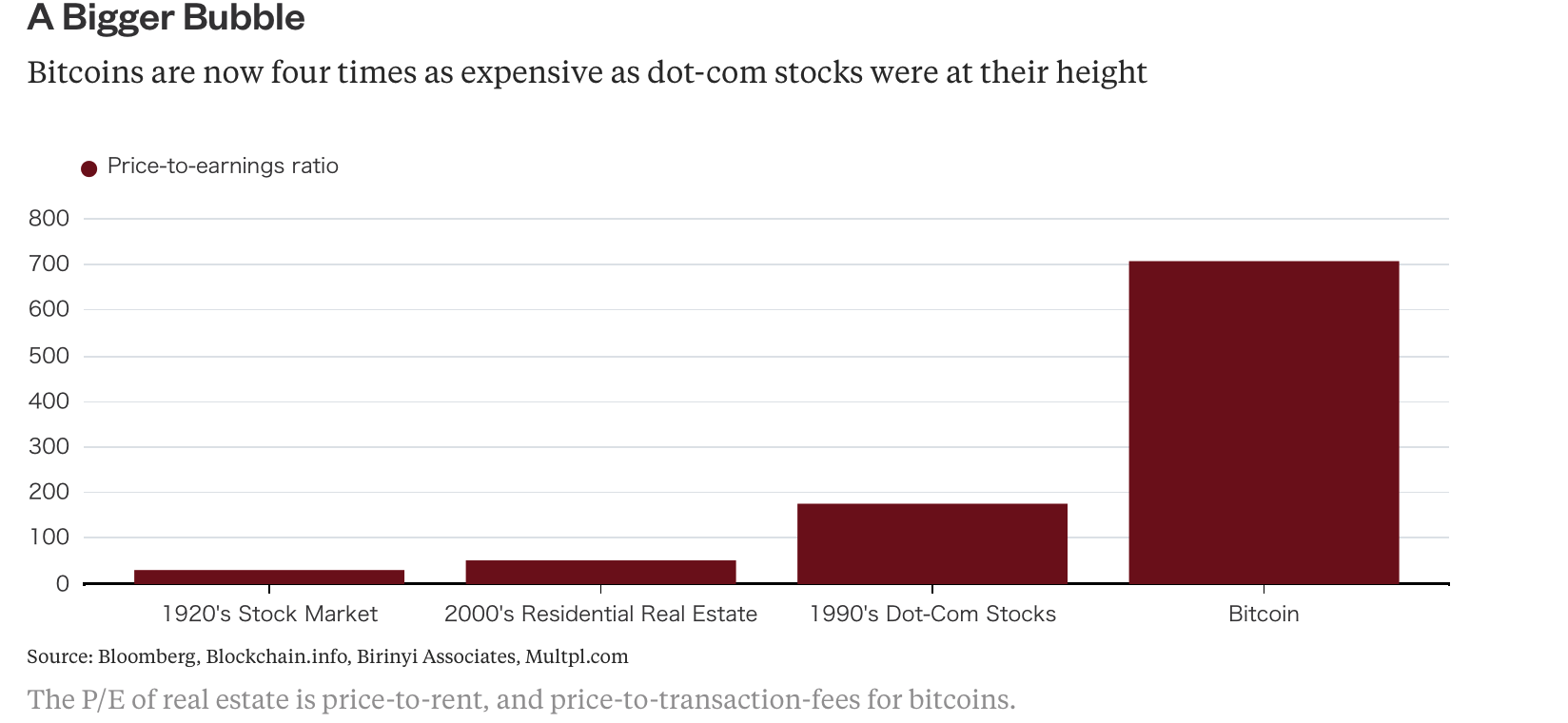
With a 850% surge in less than a year, bitcoin has seen gains that are four times more than dot-com stocks gains at their height in the late 1990s. This is making the first and arguably the best cryptocurrency look like it is an ever-growing bubble which will no doubt hurt many speculative punters when it finally goes 'pop'.

Bitcoin's market cap is over $160 billion and more than that of General Electric, a company that has been in existence since 1892 and has nearly 250,000 employees.

When you look on Google Trends and see the search for 'Bitcoin Bubble' reach a peak as the price probes $10,000 then you know that many owners and non owners of the cryptocurrency are beginning to get worried. Although a contrarian might say that the widespread concerns of a bubble mean that we may be in the early stages of the bubble.


Bitcoin has many factions concerned. Central bankers are worried about its impact on financial markets, merchants are confused if they should be accepting it or not, exchanges are terrified they'll get a large sell order and some gold investors are even wondering if they should have invested in Nakamoto's invention rather than the world's oldest form of money.

Jitters are seriously beginning to show and yet the price keeps climbing. However high price does not necessarily equal validation. High price in this case is partly a sign of irrational exuberance. It is a sign of a market that is playing a short-game, blinkered by the mounting risks to which the bitcoin and cryptocurrency markets are exposed.

Bubblecious Bitcoin

Dr Constantin Gurdgiev, finance professor, respected market commentator and former non-executive adviser to GoldCore warned of a speculative bubble:

...at this point in time, bitcoin price can be potentially driven solely by expectations held by its enthusiasts, plus the incentives by the predominantly China-based investors to avoid extreme risks of capital controls and expropriations. If so, both drivers would make it a speculative bubble.


The problem with bitcoin is not that they are worth nothing. They are clearly worth something, if anything just because of the work that goes into creating them but also because there are people willing to make an economic exchange for them.

The problem with bitcoin is that while adoption is surging, it is still amongst a tiny section of the population - primarily the tech community and millennials. There are varied estimates but is believed that only 0.01% of the world's population holds a bitcoin wallet (not even bitcoin as many have wallets and accounts but have not bought).

The case for its potential is utterly compelling but it is as yet unproven with many potential competing digital currencies - state and private.

So what we are left with is a cycle of irrational exuberance, speculation and FOMO (fear of missing out).

There is some value to bitcoin and the tech is excellent and compelling. The dot com bubble did not burst because dot com stocks were completely useless, it burst because everyone became overexcited and a highly speculative "get rich" scheme. The same can be send for tulip mania.

As evidenced by our publishing and trading online and the growth of social media and e-commerce in recent years, there was some value and great tech in the dot com era. The same will be seen with bitcoin, but most likely once the bubble has burst and the FOMOs have scarpered and moved onto the next great think ... possibly gold and silver bullion. Only then will we see it's true potential.

As Michael J.Casey explained, the current bitcoin market has the hallmarks of a bubble now because of its immaturity. It needs to grow up quickly in order to move past this bubble phase.

The problem I have with the immaturity of bitcoin’s investing culture is not that it’s setting the market up for a correction. It’s that it constrains progress toward attaining the technology’s more fundamental social value.

Speculation is unavoidable, even useful in bootstrapping innovation. But if bitcoin is to change billions of lives, it needs to become a more mainstream asset class, one that’s connected to the real world that those people occupy. As much as we might all love this quirky, abnormal "honeybadger of money," bitcoin needs to become more normal.

It needs more stability. It needs a two-way market.

The lack of a two-way market means there is increased volatility and a significant lack of liquidity. This can even create security risks for even the most professional of platforms.

On Monday IG Group told the Financial Times it had 'suspended trading of some of its bitcoin derivatives on Monday after roaring demand for the products left the company facing a high security risk.'

This is an asset-class which does not have years of data for analysts and investors to find support and understanding for their trading decisions. This makes the market nervous especially with such low liquidity. Hence this is a speculators game at present and one which makes even the most professional of platforms run scared.

Should gold investors be crying themselves to sleep?

Inevitably, bitcoin's performance results in many commentators declaring that gold is dead and bitcoin has replaced it. This is only based on the cryptocurrency's price action. In reality there is little to compare between the two.

If the bitcoin price action and its mere existence have any impact on gold then it can only be a good thing.

The birth of cryptocurrency in the last decade has caused many to realise that fiat currency does not have to be the only way in which one stores their wealth. Indeed it is not an optimal way to save for the long term - especially in these era of low to negative interest rates.

Like gold, bitcoin threatens central bankers' control of the banking system and money supply, which could undermine the monetary policies they use to manage inflation. These same policies which so many savers and investors lose out from.

It has also made people aware of the risks they are exposed to when investing. These means they are looking for further diversification in their portfolios, to be found with both gold and cryptocurrencies.

It is probably a good idea to have a small exposure to bitcoin, after all it is proving to be a worthy hedge against geopolitical upset this year. If nothing else, it makes sense as the technology is powerful and will be used in some form in the coming years and it makes sense to get familiar with the technology.

The main sources of concern and risks with bitcoin are the low liquidity and the high security risks. Neither of these exist with physical, allocated and segregated gold bullion bars and or coins. Current gold investors are well aware of this. Soon others will be too.

Many who get out of bitcoin as the bubble springs a leak will be putting that capital into gold as they seek an alternative to the volatility of cryptocurrencies and the dangerous world of fiat.

This is not an unhackable bubble

Low liquidity and security risks are at the forefront of the bitcoin bubble. IG Group's decision to suspend trading of bitcoin derivatives was a direct result of these two issues.

The more cryptocurrency IG, or any broker. holds, the greater the security risk for them. They are exposed on two fronts.

Firstly hackers are circling such exchanges like sharks around a dying whale calf. Secondly, in order to meet bids, exchanges have to go out into the market and buy the underlying asset. This exposes them to often unregulated exchanges given the lack of availability of bitcoins.

So suddenly you have two major counterparty risks. Two risks that bitcoin (as a 'digital gold') was apparently designed to avoid.

With risks such as these one has to ask if investors are holding them for security of diversification out of the fiat system, or for speculation. If it is the latter, as we suspect, then we are facing bubble with very significant security risks.

We have seen multiple hacking attempts and successes in the bitcoin space. There have been some major disasters and some major saves. However, this bubble is growing which arguably exposes the exchanges to the risk of low liquidity and counterparties, more than it does security.

Markets could go haywire once sellers realise they can no longer exit their positions, i.e. this is not a two-way system.
Buy gold and bitcoin, but only expect the grown-up to protect you

When you invest in physical, allocated and segregated gold you can be sure that the above scenario is not the case. The gold market is a several-century old set-up. One which has moved with the times in terms of security but kept to old-school beliefs when it comes to keeping counterparties to an absolute minimum.

We often discuss the risks of 'digital gold', pooled gold which is exposed to risks on a number of levels. Bitcoin has different but similar risks - how to own it in a safe way.

It is these risks which should stop people from rushing into bitcoin and from comparing it to gold.

As we concluded in our recent coverage of the ongoing bitcoin versus gold debate:

The debate is not about bitcoin versus gold but instead about investors and savers protecting themselves from the rapid devaluation of fiat currencies.

Bitcoin is new and volatile, with much to prove. Gold has been in existence as money and a store of value for millennia, not to mention all of it’s other roles.

Investors should continue to pay attention to the bitcoin chatter due to the narrative it offers around changing attitudes to money and the economy. However, they must remember that the debate is about security of savings and value. This is where gold is currently the only real contender for protecting your diversified portfolio.


Related reading

Gold Versus Bitcoin: The Pro-Gold Argument Takes Shape

Wozniak and Thiel Fuel Bitcoin-Gold Debate: Gold Comes Out On Top

Gold Is Better Store of Value Than Bitcoin – Goldman Sachs

Bitcoin “Is A Bubble” but Gold Is Money Says World’s Biggest Hedge Fund Manager


News and Commentary

Asian shares fall from decade peak as China falters (Reuters.com)

Gold settles higher to recoup most of last week’s loss (MarketWatch.com)

Gold rises, hits 6-week high, on lift from weaker dollar (Reuters.com)

U.S. Stocks Give Up Early Gains as Crude Retreats (SwissInfo.ch)

Bitcoin 10,000 as it rockets to new record high (Reuters.com)

Source: Bloomberg

Central bankers fear cryptos could cost them control of the world (Gata.org)

Bitcoin could devour the financial world - Keiser (RT.com)

The Dumbest Dumb Money Finally Gets Suckered In (DollarCollapse.com)

This is what Asia’s middle class is buying (StansBerryChurcHouse.com)

Now Accepting Visa, Bitcoin and Gold By Lionel Laurent (Bloomberg.com)

Gold Prices (LBMA AM)

28 Nov: USD 1,293.90, GBP 972.75 & EUR 1,088.95 per ounce
27 Nov: USD 1,294.70, GBP 969.73 & EUR 1,084.83 per ounce
24 Nov: USD 1,289.15, GBP 967.89 & EUR 1,086.37 per ounce
23 Nov: USD 1,290.15, GBP 969.93 & EUR 1,089.40 per ounce
22 Nov: USD 1,283.95, GBP 969.25 & EUR 1,092.51 per ounce
21 Nov: USD 1,280.00, GBP 967.04 & EUR 1,090.69 per ounce
20 Nov: USD 1,292.35, GBP 974.82 & EUR 1,096.43 per ounce

Silver Prices (LBMA)

28 Nov: USD 17.07, GBP 12.84 & EUR 14.36 per ounce
27 Nov: USD 17.10, GBP 12.81 & EUR 14.32 per ounce
24 Nov: USD 17.05, GBP 12.80 & EUR 14.38 per ounce
23 Nov: USD 17.10, GBP 12.84 & EUR 14.43 per ounce
22 Nov: USD 16.97, GBP 12.81 & EUR 14.44 per ounce
21 Nov: USD 17.00, GBP 12.85 & EUR 14.50 per ounce
20 Nov: USD 17.15, GBP 12.94 & EUR 14.56 per ounce


Recent Market Updates

- Financial Advice from Dr Wayne Dyer
- Buy Gold As Fed Shows Uncertainty And Concern Over Financial ‘Imbalances’
- Brexit Budget – Grim Outlook As UK Economy Downgraded
- Geopolitical Risk Highest “In Four Decades” – Gold Demand in Germany and Globally to Remain Robust
- Gold Versus Bitcoin: The Pro-Gold Argument Takes Shape
- Money and Markets Infographic Shows Silver Most Undervalued Asset
- Is New Fed Chief A “Swamp Critter Extraordinaire”?
- Deepening Crisis In Hyper-inflationary Venezuela and Zimbabwe
- UK Debt Crisis Is Here – Consumer Spending, Employment and Sterling Fall While Inflation Takes Off
- Protect Your Savings With Gold: ECB Propose End To Deposit Protection
- Internet Shutdowns Show Physical Gold Is Ultimate Protection
- Gold Coins and Bars Saw Demand Rise 17% to 222T in Q3
- Prepare For Interest Rate Rises And Global Debt Bubble Collapse


Important Guides

For your perusal, below are our most popular guides in 2017:

Essential Guide To Storing Gold In Switzerland

Essential Guide To Storing Gold In Singapore

Essential Guide to Tax Free Gold Sovereigns (UK)

Please share our research with family, friends and colleagues who you think would benefit from being informed by it.

The Dumbest Dumb Money Finally Gets Suckered In

Published here: http://www.zerohedge.com/news/2017-11-27/dumbest-dumb-money-finally-gets-suckered-0


The Dumbest Dumb Money Finally Gets Suckered In

Posted with permission and written by John Rubino, Dollar Collapse


The Dumbest Dumb Money Finally Gets Suckered In - John Rubino


Corporate share repurchases have turned out to be a great mechanism for converting Federal Reserve easing into higher consumer spending. Just allow public companies to borrow really cheaply and one of the things they do with the resulting found money is repurchase their stock. This pushes up equity prices, making investors feel richer and more willing to splurge on the kinds of frivolous stuff (new cars, big houses, extravagant vacations) that produce rising GDP numbers.


For politicians and their bureaucrats this is a win-win. But for the rest of us it’s not, since the debts corporations take on to buy their own stock at market peaks tend to hobble them going forward, leading eventually to bigger share price declines than would otherwise be the case.


The ultimate loser? The only people traditionally willing to buy in after corporations are finished overpaying for their stock: Retail investors, of course.


Let’s see how it’s playing out this time.


First, corporations spent several years elevating stock prices with share repurchases. Note the near perfect correlation between the two lines:


Now they’re scaling back their purchases:


Saying Bye to Buybacks

(Wall Street Journal) – Companies in the S&P 500 are on pace to spend the least on buybacks since 2012

Large companies are repurchasing their shares at the slowest pace in five years, as record U.S. stock indexes and an expanding economy propel more money out of flush corporate coffers into capital spending and mergers.

Companies in the S&P 500 are on pace to spend $500 billion this year on share buybacks, or about $125 billion a quarter, according to data from INTL FCStone. That is the least since 2012 and down from a quarterly average of $142 billion between 2014 and 2016.

Buyback activity among top-rated nonfinancial debt issuers, many of which have regularly borrowed money to finance share repurchases, declined for the third straight quarter in the July-to-September period, according to Bank of America Merrill Lynch. Meanwhile, mergers and acquisitions among that group of companies had their biggest quarter of the year, analysts at the bank said.

Factors including high stock price, historically high share valuations and uncertainty over the future shape of the tax code mean that “companies may be less likely to favor buybacks over other uses of cash in 2018,” analysts at Goldman Sachs Group Inc. said in a report this week.

And – here’s the really sad part – individual investors are taking up the slack:


The emboldened retail investor may be a new catalyst to help take stocks higher — for now.


(CNBC) – “The level of enthusiasm about the market … has been building. We’re seeing more individuals come in,” said Liz Ann Sonders, chief investment strategist at Charles Schwab.
Sonders said she’s anecdotally seeing signs of more individuals putting money to work in the stock market in the last several months, after years of skepticism and concerns about “every variety of doom and gloom.”

She says she is getting fewer investors asking about bubbles or about what’s the next shoe to drop.

“I think it’s finally starting to suck people in … emotionally, and actually it’s hard to judge why now all of a sudden, but maybe it’s because of how persistent the move has been with so little volatility on the upside and on the downside,” Sonders said. “This year has been different. This kind of year pulls people in.”

Retail brokers have been reporting an influx of accounts. Charles Schwab, in its earnings release, said clients opened more than 100,000 new brokerage accounts a month in the third quarter, making for a record-breaking 10-month streak of new accounts topping 100,000. Its rival, TD Ameritrade, said on its earnings call last month that new accounts, asset inflows and other indicators are at the highest since the financial crisis.

What’s frustrating about this is the repeating pattern of government creating conditions in which smart money (that is, the guys who donate big to political campaigns) is allowed to get in early, make huge profits, and then hand the bag to regular people who aren’t connected or sophisticated enough to see what’s happening. The rich, who are or will soon be shorting the hell out of this market, get richer and the rest see their hopes for a decent (or any) retirement dashed one more time.


And the political class wonders why voters don’t like them anymore.


Questions or comments about this article? Leave your thoughts HERE.


The Dumbest Dumb Money Finally Gets Suckered In

Posted with permission and written by John Rubino, Dollar Collapse


Check out these other articles by our contributors:


Steve St. Angelo - EXAMINING SILVER MANIPULATION: What Some Analysts Miss

Rory Hall - BRICS Gold Trade Settlement To Begin in 2018?

Keith Weiner - The Hyperinflation That Was Not

Ask The Expert: Jim Willie

Monday, November 27, 2017

The Hyperinflation That Was Not, Report 26 Nov 2017

Published here: http://www.zerohedge.com/news/2017-11-27/hyperinflation-was-not-report-26-nov-2017

Last week, we made a very controversial statement. We are happy to write the truth, and let the chips fall where they may (e.g. our thoughtful disagreement with Ted Butler about price manipulation). We can accept the flak that we get for this, so long as our position is understood. Some criticized our approach as mere technical analysis, and therefore insufficient to the task of explaining the dynamics of the gold and silver markets. But whether we quibble with this characterization of our work or not, we believe that the points we made and the unique data we published stand. No one, including Mr. Butler, responded substantively to our data or logic. People can read and choose sides, and we’re OK with that.

But last week, we said something that we feel was not well understood. And it is one of the most important ideas in monetary economics, and the key to understanding banking.

The Federal Reserve, of course, is a key participant in this monetary inflation scheme. Does the Fed have a printing press? Does the Fed print?

Like any bank, the Fed borrows to fund its purchases of interest-paying assets. It earns a spread between what it pays (currently about 1.25%) and what its asset portfolio pays (over 2%)… Unlike any commercial bank, there is a law that obligates us to treat the Fed’s liabilities as if they were money.

Borrowing is pretty close to the opposite of printing. So how is it possible that there is so much contention on this issue? Perhaps it would be more accurate to say that, in Austrian circles, there is little contention: Monetary Metals are just heretics!

If the Fed printed, then hyperinflation would have come, and this is what many Austrians predicted. For example, one famous personality predicted at FreedomFest in July 2009, that we would have hyperinflation by the end of that year.

Printing would create a flood of worthless paper. Apart from the sheer quantity of it (trillions), would be the absurdity, the meaninglessness of it. Though many call the dollar “worthless paper”, it is not worthless. It is still quite worthful—a dollar can buy over 24 milligrams of gold, not to mention food, fuel, housing, artwork, and laptops on which we can pontificate about matters monetary.

But suppose an organized crime ring printed up $3,500,000,000,000, and went on a shopping spree. These forgers begin buy everything from cases of Cristal to paintings by Cézanne, from Maybach cars to Malibu homes. What would happen?

They would push up the prices of everything. Relentless buying by price-insensitive purchasers lifts all offers and keeps moving them up. Of course, if you have a printing press then it does not matter to you if Cristal is $200 or $20,000. You can easily print more. Price only matters to those who have to earn before they spend (or liquidate the family estate).

So the net result of printing would be relentlessly but probably steadily rising prices. At first. Until people begin to see the game and look forward to its inevitable denouement. Then something happens. Economist Ludwig von Mises described the “Crack Up Boom”:

But then finally the masses wake up. They become suddenly aware of the fact that inflation is a deliberate policy and will go on endlessly. A breakdown occurs. The crack-up boom appears. Everybody is anxious to swap his money against “real” goods, no matter whether he needs them or not, no matter how much money he has to pay for them. Within a very short time, within a few weeks or even days, the things which were used as money are no longer used as media of exchange. They become scrap paper. Nobody wants to give away anything against them.

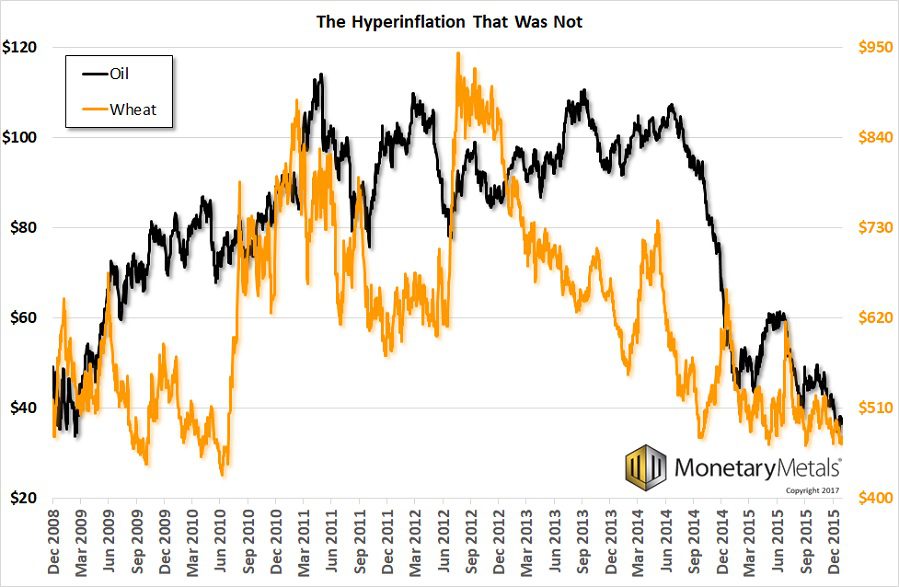
We must reckon with the fact that this did not happen. Here is a graph showing the prices of crude oil and wheat from the start of the first “quantitative easing” to the end of “zero interest rate policy”.

Both commodities go up, though wheat went down first. They end lower than they start. Notably, wheat (and other commodities) began to fall by late 2012. Oil was last to join the party (due, we believe, to geopolitical risks rather than monetary effects) in mid-2014.

We don’t want to quibble here. The question is not: “did oil go up proportionally to the increase in the quantity of dollars?” Oil went up about 133% from start to peak in April 2011, while M1 measure of money supply went up 20% during the same period. Then as M1 increased by an additional 63%, oil went sideways before declining 69% from its peak.

The question is: “what did the Fed do?” Obviously, it did not print and buy wheat or oil (nor give the dollars to someone else who did).

The Fed exchanged dollars for bonds (Treasury and mortgage). This leads to two questions. One, what is the nature of a dollar and of a bond? Two, what does it mean for the Fed to make such an exchange?

There is much confusion today because we call the dollar “money”. In the classical gold standard, the paper dollar was redeemable. That is, anyone could bring dollar bills to a bank and exchange them for gold coins. The bill, or note, is a credit instrument. It is paper evidencing an obligation to pay money on demand. The gold is the money.

Now that the dollar is irredeemable, there is a temptation to use shorthand and say that the dollar itself is money, to define money as just a medium of exchange. But if the dollar is money, what is the difference between the dollar and the bond? Both are forms of credit.

The difference is duration.

The dollar is a current asset, whereas the bond matures sometime in the future. It is interesting how much debate occurs over the question of how to define and measure the money supply. This debate occurs because everything in our monetary system is credit, and it’s hard to find a clear place to draw a line and say “this credit is money, but that credit is not money.” (One measure is called MZM—money of zero maturity.)

The dollar is the liability issued by the Fed. It issues this liability to fund its purchase of longer-duration credit assets. Why? As we said last week, the Fed earns the spread between the cost of issuing its liability and the yield it earns on its assets. This is what any bank does.

The issue of printing reminds us of those brain teaser paradoxes. Seven people go out to dinner at a restaurant, and the tab is $300. The first person puts in five tens, the second person puts in three twenties and takes a ten, etc. Somehow after the last person puts his dollars on the table, the pile of cash comes up short. Where did the money go? The key to understanding the paradox is that there is always a rhetorical sleight of hand.

It is the same with the key question of the fractional reserve debate: a bank takes in $1,000 and lends $2,000. Where did it get the money? The Fed buys a trillion worth of bonds, where did it get the money?

It is crucial to understand the nature of the dollar. It is not a positive value, an entity in existence. Like a lump of metal. A dollar is a relationship between two parties, one of owing. One party owes the other.

When the Fed issues a dollar, it is a debt owed to the recipient. The Fed is borrowing from the recipient. When the Fed buys a Treasury bond from someone with newly-issued dollars, that party is exchanging one kind of credit for another. It exchanges one debtor party (the US government) for another (the Fed). It is exchanging a longer-duration asset for a current asset. It is exchanging yield for liquidity.

Long-duration assets have duration risk. That is, the price varies inversely with the interest rate. The shorter the duration, the less the risk, and the dollar is the shortest with zero duration risk.

The Fed increases its balance sheet. That is, it has a new liability and a new asset. But it has no free “spending money”. It does not gain any equity in the bond-buying transaction.

The seller of the bond does not get free money, either. It exchanges one kind of credit paper for another. It likely does gain a small amount of equity, as the Fed is typically paying the offer price which is likely above what the seller paid for the bond originally.

We can look at the net result, and say it is printing and it is increasing the quantity of money. But that’s not useful, either as a description of what happened and certainly not as a predictor of what will happen next.

This is why we say the net result is that the Fed increases its balance sheet, the Fed takes on more duration risk, the Fed pushes interest rates down, and the seller gives up the yield it had. Most likely, the next step is for the bond seller to buy another asset, to invest and not hold cash.

There are two differences between the Fed and any commercial bank in a free market. We discussed one last week: the government forces us to treat the Fed’s credit as if it were money. Government schools and regulators strongly induce everyone to think in those terms.

The other is that the Fed is not a market actor, motivated to seek arbitrage opportunities to make a profit. It is a non-economic actor, imposing monetary policy to achieve political goals (based on rubbish economic theories).

A commercial bank could not buy bonds without limit. Its cost of credit would rise, while the yield it could obtain on bonds is falling. The compression of this spread is the signal to stop.

When a bank issues its credit paper to buy an asset, the seller is expressing a preference for the liquidity and lack of duration risk of a current asset. The bank is expressing a preference for assets that will earn it a yield. The seller gives up the yield, and the bank gives up some capacity for funding balance sheet expansion (i.e. takes on some liquidity risk).

It is counterintuitive to say it this way, but it’s vitally important to see the essence of it: the bank is borrowing from the seller of the bond. It is borrowing and buying, borrowing while buying. Borrowing to buy.

The above description should not be taken as a defense of the Fed, nor of the practice of duration mismatch by the banks. If we are to be monetary pathologists, we need to begin by correct observation. We must be able to look through a microscope at a slide of diseased tissue and saying “nope, it’s not cancer. It’s a different kind of tumor, and it will kill you in a different way.”

We live under an absurd monetary system. It is designed to sacrifice the savers—who don’t realize they are creditors—to the debtors. Savers cannot escape the credit pen, not even when they hold what they think of as money. They are disenfranchised. They can gnash their teeth as the interest rate falls to zero and beyond, but their protests are toothless. Meanwhile, debtors can borrow to repay principal when due.

Credit should be redeemable. And there is precisely one commodity which works better than all others for redemption. Indeed few others would even come close to working at all. Can you imagine crude oil? A week’s wages for the average person in America is about 850 gallons of oil. Would you like a driveway slick, a dead lawn, or do you have a big tank?

This is the argument for why we need the gold standard. The whole point of a Yield on Gold, Paid in Gold®, is to lead towards the gold standard. A yield on paper, paid in paper sure isn’t working any more.


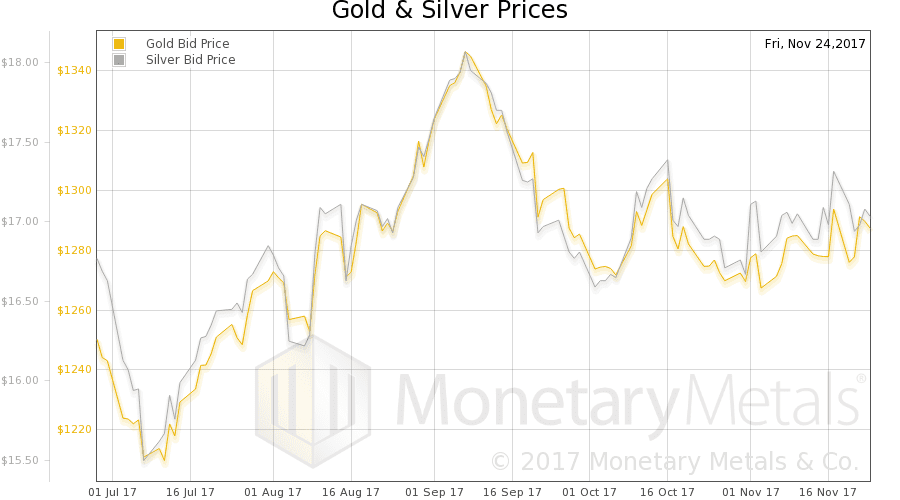
The price of gold fell $7, and that of silver 24 cents. This was a holiday shortened week, due to Thanksgiving on Thursday in the US (and likely thin trading and poor liquidity on Wednesday and Friday). So take the numbers this week, including the basis, with a grain of that once-monetary commodity, salt. We will keep the market action commentary brief.

Here are the charts of the prices of gold and silver, and the gold-silver ratio.

Next, this is a graph of the gold price measured in silver, otherwise known as the gold to silver ratio. The ratio rose.

In this graph, we show both bid and offer prices for the gold-silver ratio. If you were to sell gold on the bid and buy silver at the ask, that is the lower bid price. Conversely, if you sold silver on the bid and bought gold at the offer, that is the higher offer price.

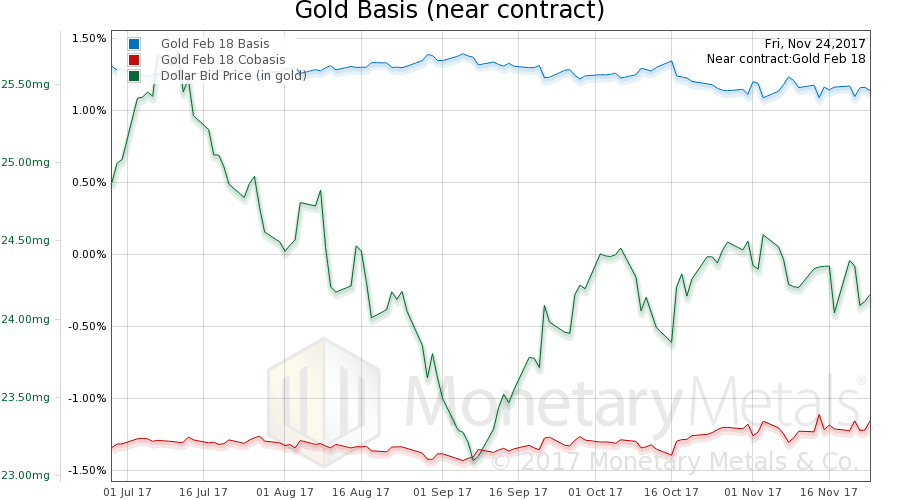
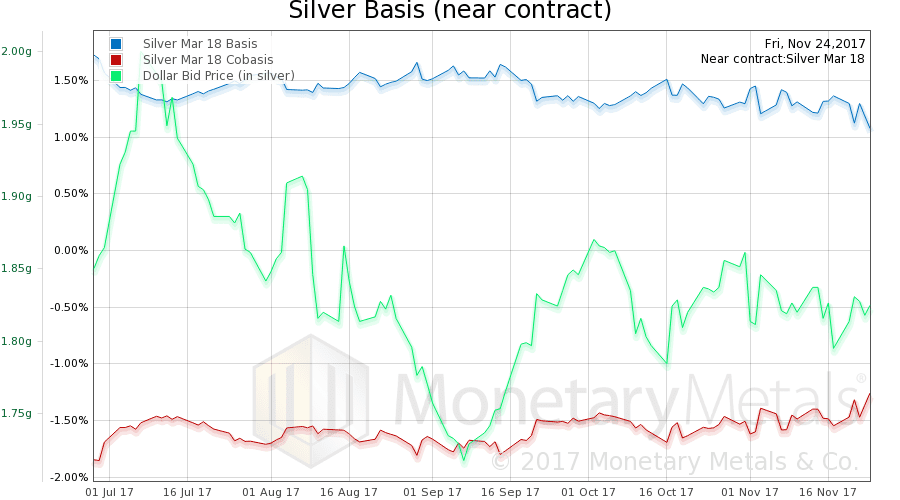
For each metal, we will look at a graph of the basis and cobasis overlaid with the price of the dollar in terms of the respective metal. It will make it easier to provide brief commentary. The dollar will be represented in green, the basis in blue and cobasis in red.

Here is the gold graph showing gold basis and cobasis with the price of the dollar in gold terms.

The cobasis (our measure of scarcity) of the Feb contract rose slightly, as the price of gold fell slightly.

The Monetary Metals Gold Fundamental Price is up 8 bucks.

Now let’s look at silver.

The story is the same in silver, with a bit larger rise in the cobasis.

The Monetary Metals Silver Fundamental Price is up 22 cents.


© 2017 Monetary Metals

Financial Wisdom from Dr Wayne Dyer

Published here: http://www.zerohedge.com/news/2017-11-27/financial-wisdom-dr-wayne-dyer

Financial Wisdom from Dr Wayne Dyer

- Don’t make money the guiding principle for what you have or do
- Avoid debt, focus on value rather than price in $, € & £
- Do everything you can to eschew debt
- Finding the inherent value in everything

- A dollar does not determine worth
- The 12-step program to simplicity


Source @TheWealthChef

DR WAYNE DYER was an American philosopher, self-help author and a motivational speaker. Dyer was an internationally renowned author and speaker in the fields of self-development and spiritual growth. Over the four decades of his career, he wrote more than 40 books, including 21 New York Times bestsellers.

Dyer created many audio and video programs, appeared on thousands of television and radio shows and starred in 10 National Public Television specials—featuring his books Manifest Your Destiny, Wisdom of the Ages, There’s a Spiritual Solution to Every Problem, and the New York Times bestsellers 10 Secrets for Success and Inner Peace, The Power of Intention, Inspiration, Change Your Thoughts—Change Your Life, Excuses Begone!, Wishes Fulfilled, and I Can See Clearly Now.

HayHouse.com sent us an email last week which contained some financial and spiritual wisdom from the late Wayne Dyer which we thought worth sharing. In honor of his memory, Wayne’s Hay House family continue to share his advice and wisdom in their weekly newsletter, which shares excerpts pulled directly from Wayne’s published works and is well worth a read:

THE 12-STEP PROGRAM TO SIMPLICITY by Dr Wayne Dyer

Here are 12 very specific tools for simplifying your life. Begin using them today if you’re serious about hearing that ultimate call to inspiration.

1. Unclutter your life.

You’ll feel a real rush of inspiration when you clear out stuff that’s no longer useful in your life:

  • If you haven’t worn it in the past year or two, recycle it for others to use.
  • Get rid of old files that take up space and are seldom, if ever, needed.
  • Donate unused toys, tools, books, bicycles, and dishes to a charitable organization.

Get rid of anything that keeps you mired in acquisitions that contribute to a cluttered life. In the words of Socrates, “He is nearest to God who needs the fewest things.” So the less you need to insure, protect, dust, reorganize, and move, the closer you’ll be to hearing inspiration’s call.

2. Clear your calendar of unwanted and unnecessary activities and obligations.

If you’re unavailable for Spirit, you’re unlikely to know the glow of inspiration. God will indeed work with you and send you the guidance—and the people—you need, but if you’re grossly overscheduled, you’re going to miss these life-altering gifts. So practice saying no to excessive demands and don’t feel guilty about injecting a dose of leisure time into your daily routine.

3. Be sure to keep your free time free. 

Be on the lookout for invitations to functions that may keep you on top of society’s pyramid, but which inhibit your access to joyful inspiration. If cocktail parties, social get-togethers, fund-raising events, or even drinking-and-gossiping gatherings with friends aren’t really how you want to spend your free time, then don’t. Begin declining invitations that don’t activate feelings of inspiration.

4. Take time for meditation and yoga.

Give yourself at least 20 minutes a day to sit quietly and make conscious contact with God. I’ve written an entire book on this subject called Getting in the Gap, so I won’t belabor it here.

I also encourage you to find a yoga center near you and begin a regular practice. The rewards are so powerful: You’ll feel healthier, less stressed, and inspired by what you’ll be able to do with and for your body in a very short time.

5. Return to the simplicity of nature.

There’s nothing more awe inspiring than nature itself. The fantasy to return to a less tumultuous life almost always involves living in the splendor of the mountains, the forests, or the tundra; on an island; near the ocean; or beside a lake. These are universal urges, since nature is created by the same Source as we are, and we’re made up of the same chemicals as all of nature (we’re stardust, remember?).

Your urge to simplify and feel inspired is fueled by the desire to be your natural self—that is, your nature self. So give yourself permission to get away to trek or camp in the woods; swim in a river, lake, or ocean; sit by an open fire; ride horseback through trails; or ski down a mountain slope. This doesn’t have to mean long, planned vacations that are months away—no matter where you live, you’re only a few hours or even moments away from a park, campground, or trail that will allow you to enjoy a feeling of being connected to the entire Universe.

6. Put distance between you and your critics.

Choose to align yourself with people who are like-minded in their search for simplified inspiration. Give those who find fault or who are confrontational a silent blessing and remove yourself from their energy as quickly as possible. Your life is simplified enormously when you don’t have to defend yourself to anyone, and when you receive support rather than criticism.

You don’t have to endure the criticism with anything other than a polite thank-you and a promise to consider what’s been said—anything else is a state of conflict that erases the possibility of your feeling inspired. You never need to defend yourself or your desires to anyone, as those inner feelings are Spirit speaking to you. Those thoughts are sacred, so don’t ever let anyone trample on them.

7. Take some time for your health.

Consider that the number one health problem in America seems to be obesity. How can you feel inspired and live in simplicity if you’re gorging on excessive amounts of food and eliminating the exercise that the body craves? Recall that your body is a sacred temple where you reside for this lifetime, so make some time every single day for exercising it. Even if you can only manage a walk around the block, just do it.

Similarly, keep the words portion control uppermost in your consciousness—your stomach is the size of your fist, not a wheelbarrow! Respect your sacred temple and simplify your life by being an exerciser and a sensible eater. I promise that you’ll feel inspired if you act on this today!

8. Play, play, play!

You’ll simplify your life and feel inspired if you learn to play rather than work your way through life. I love to be around kids because they inspire me with their laughter and frivolity.

Get back in touch with your real, playful self, and take every opportunity to play! Notice how it makes everything so sweet, and so simple.

9. Slow down.

One of Gandhi’s most illuminating observations reminds us that “there is more to life than increasing its speed.” This is great advice for simplifying your life—in fact, slow everything way down for a few moments right here and now. Slowly read these words. Slow your breathing down so that you’re aware of each inhalation and exhalation...

When you’re in your car, downshift and relax. Slow down your speech, your inner thoughts, and the frantic pace of everything you do. Take more time to hear others. Notice your inclination to interrupt and get the conversation over with, and then choose to listen instead. Stop to enjoy the stars on a clear night and the cloud formations on a crisp day. Sit down in a mall and just observe how everyone seems in a hurry to get nowhere.

By slowing down, you’ll simplify and rejoin the perfect pace at which creation works. Imagine trying to hurry nature up by tugging at an emerging tomato plant—you’re as natural as that plant, so let yourself be at peace with the perfection of nature’s plan.

10. Do everything you can to eschew debt.

Remember that you’re attempting to simplify your life here, so you don’t need to purchase more of what will complicate and clutter your life. If you can’t afford it, let it go until you can. By going into debt, you’ll just add layers of anxiety onto your life. That anxiety will then take you away from your peace, which is where you are when you’re in-Spirit.

When you have to work extra hard to pay off debts, the present moments of your life are less enjoyable; consequently, you’re further away from the joy and peace that are the trademarks of inspiration. You’re far better off to have less and enjoy the days of your life than to take on debt and invite stress and anxiety where peace and tranquility could have reigned. And remember that the money you have in your possession is nothing but energy—so refuse to plug in to an energy system that’s not even there.

11. Forget about the cash value.

Do what your heart tells you will bring you joy, rather than determining whether it will be cost-effective. Don’t base your purchases on getting a discount, and don’t rob yourself of a simple joy because you didn’t get a break on the price. You can afford a happy, fulfilling life, and if you’re busy right now thinking that I have some nerve telling you this because of your bleak financial picture, then you have your own barrier of resistance.

Make an attempt to free yourself from placing a price tag on everything you have and do—after all, in the world of Spirit, there are no price tags. Don’t make money the guiding principle for what you have or do; rather, simplify your life and return to Spirit by finding the inherent value in everything. A dollar does not determine worth, even though you live in a world that attempts to convince you otherwise.

12. Remember your spirit.

When life tends to get overly complex, too fast, too cluttered, too deadline oriented, or too type A for you, stop and remember your own spirit. You’re headed for inspiration, a simple, peaceful place where you’re in harmony with the perfect timing of all creation. Go there in your mind, and stop frequently to remember what you really want.

With thanks to HayHouse.com and DrWayneDyer.com

News and Commentary

European Stocks Gain; Dollar Slips With Treasuries: Markets Wrap (Bloomberg.com)

BRICS Countries Considering Creation of ‘Single Gold Trading System’ (SputnikNews.com)

BRICS to form own gold trading system (PressTV.com)

Gold trader’s trial strains U.S.-Turkey relations (Reuters.com)

Bitcoin Guns for $10,000 as Cryptocurrency Mania Defies Skeptics (Bloomberg.com)


Source: Bloomberg

Gold Industry at "edge of a cliff by 2020 as supply tightens" - Gold CEO (Bloomberg.com)

Life under silver manipulation - Butler (SilverSeek.com)

What happens when you don’t have cash (CApitalAndConflict.com)

The Great Bitcoin Bull Market Of 2017 (GoldSeek.com)

Here’s What the World's Central Banks Really Think About Bitcoin (Bloomberg.com)

Gold Prices (LBMA AM)

27 Nov: USD 1,294.70, GBP 969.73 & EUR 1,084.83 per ounce
24 Nov: USD 1,289.15, GBP 967.89 & EUR 1,086.37 per ounce
23 Nov: USD 1,290.15, GBP 969.93 & EUR 1,089.40 per ounce
22 Nov: USD 1,283.95, GBP 969.25 & EUR 1,092.51 per ounce
21 Nov: USD 1,280.00, GBP 967.04 & EUR 1,090.69 per ounce
20 Nov: USD 1,292.35, GBP 974.82 & EUR 1,096.43 per ounce
17 Nov: USD 1,283.85, GBP 969.31 & EUR 1,088.19 per ounce

Silver Prices (LBMA)

27 Nov: USD 17.10, GBP 12.81 & EUR 14.32 per ounce
24 Nov: USD 17.05, GBP 12.80 & EUR 14.38 per ounce
23 Nov: USD 17.10, GBP 12.84 & EUR 14.43 per ounce
22 Nov: USD 16.97, GBP 12.81 & EUR 14.44 per ounce
21 Nov: USD 17.00, GBP 12.85 & EUR 14.50 per ounce
20 Nov: USD 17.15, GBP 12.94 & EUR 14.56 per ounce
17 Nov: USD 17.09, GBP 12.95 & EUR 14.49 per ounce


Recent Market Updates

- Buy Gold As Fed Shows Uncertainty And Concern Over Financial ‘Imbalances’
- Brexit Budget – Grim Outlook As UK Economy Downgraded
- Geopolitical Risk Highest “In Four Decades” – Gold Demand in Germany and Globally to Remain Robust
- Gold Versus Bitcoin: The Pro-Gold Argument Takes Shape
- Money and Markets Infographic Shows Silver Most Undervalued Asset
- Is New Fed Chief A “Swamp Critter Extraordinaire”?
- Deepening Crisis In Hyper-inflationary Venezuela and Zimbabwe
- UK Debt Crisis Is Here – Consumer Spending, Employment and Sterling Fall While Inflation Takes Off
- Protect Your Savings With Gold: ECB Propose End To Deposit Protection
- Internet Shutdowns Show Physical Gold Is Ultimate Protection
- Gold Coins and Bars Saw Demand Rise 17% to 222T in Q3
- Prepare For Interest Rate Rises And Global Debt Bubble Collapse
- Platinum Bullion ‘May Be One Of The Only Cheap Assets Out There’

Important Guides

For your perusal, below are our most popular guides in 2017:

Essential Guide To Storing Gold In Switzerland

Essential Guide To Storing Gold In Singapore

Essential Guide to Tax Free Gold Sovereigns (UK)

Please share our research with family, friends and colleagues who you think would benefit from being informed by it.

Saturday, November 25, 2017

SELLING OUT OF PRECIOUS METALS & BUYING BITCOIN.... Very Bad Idea

Published here: http://www.zerohedge.com/news/2017-11-25/selling-out-precious-metals-buying-bitcoin-very-bad-idea

SRSrocco

By the SRSrocco Report,

There is a new trend by individuals in the alternative media community who are now selling out of precious metals and buying into Bitcoin and cryptocurrencies.  While this may seem like a good idea, especially when Bitcoin and the cryptocurrencies reach new all-time highs, it is likely a big mistake.  Now, I am not saying that individuals shouldn't invest in cryptocurrencies.  Rather, it's a lousy idea to sell all of one's precious metals holdings and put it all into Bitcoin and cryptocurrencies.

Recently, Sean at SGTReport published a short video in which part of the headlined was titled as "SILVER BULL CAPITULATES."  In the video, Sean explains how past frequent guest and precious metal analyst, Andy Hoffman, has sold out of all his silver and is now only in Bitcoin and gold.  Andy explains in his interview on Crush The Street that he sold all of his silver this summer as he really has no interest in it.  He goes on to say, "Because, in a digital age, I just don't believe people are going to store thousands of pounds of silver hoping that the gold-silver ratio is going to come down."

I have to tell you, not only do I find this sort of thinking, utterly preposterous, I also find it quite troubling that analysts who have been promoting precious metals for the past decade are now implying that gold and silver are no longer high-quality stores of value.  I disagree entirely with this faulty and superficial analysis.

There are several reasons why I believe it is essential to hold most of one's wealth in precious metals than in Bitcoin and cryptocurrencies.  However, the most important factor has to do with the fragile nature of a highly technical complex system that allows Bitcoin and cryptocurrencies to function.  It takes a tremendous amount of energy to maintain and power the internet, servers and computer systems that give life to Bitcoin and cryptocurrencies.

Unfortunately, the majority of the alternative and mainstream media analysts believe in the ENERGY TOOTH FAIRY ( a term coined by Louis Arnoux).  What do I mean by the ENERGY TOOTH FAIRY?  It is the belief by a significant portion of the public and analyst community that the advanced world economies and markets will continue to prosper and grow forever.  Moreover, some analysts, such as Harry Dent, believe that if we got rid of the corrupt bankers and politicians and allow people to have a lot more babies, then economic growth will continue indefinitely.

For some odd reason, Harry Dent totally omits the impact of energy in his demographic analysis of the markets.  Does ole Harry not realize that the exponential increase in global oil production has coincided with the exponential growth in human population???  Of course not.  If he did, he would stop focusing on demographics and place his attention on what is happening in the global energy industry.

Regardless, selling out of one's precious metals holdings might be unwise if we consider that the price of gold and silver are closer to their lows, and Bitcoin and the cryptos are reaching new highs.

PRECIOUS METALS PRICES NEAR LOWS vs. BITCOIN AT RECORD HIGHS

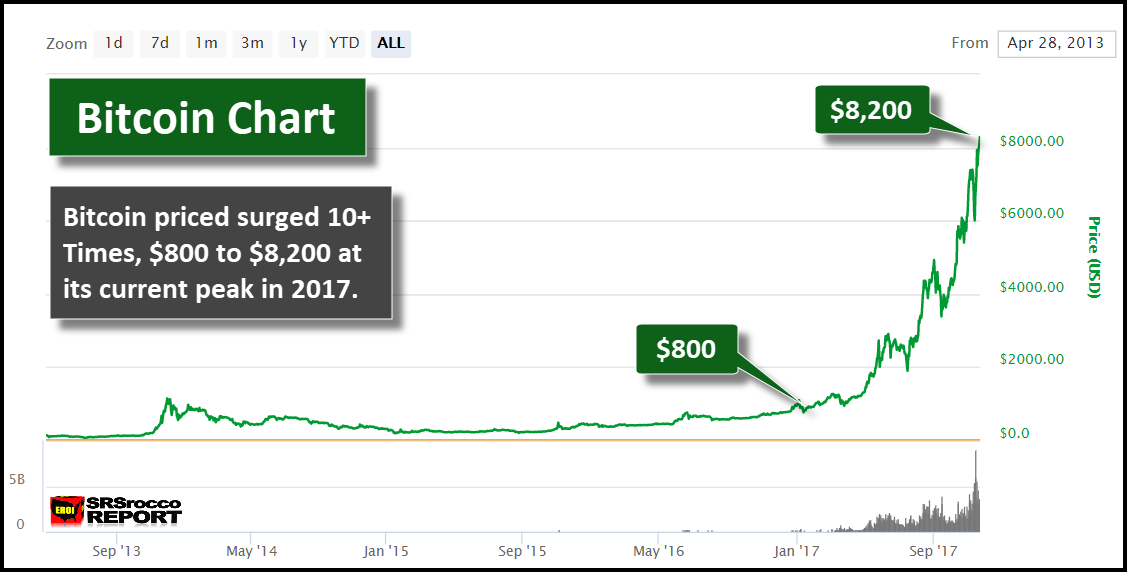
For example, the current gold price at $1,280 is only 10% above its annual average low of $1,160 set in 2015, while silver at $17 is only 8% higher than its average yearly low of $15.68 during the same year.  However, if we look at Bitcoin, the price is near its current high of $8,200:

Here we can see that Bitcoin has increased more than ten times from $800 at the beginning of 2017 to over $8,000 currently.  While Bitcoin traders and speculators with Dollar signs in their eyes are betting on much higher prices, let me show you another chart.  This is the first Bitcoin price spike that skyrocketed to over $1,000 in 2013:

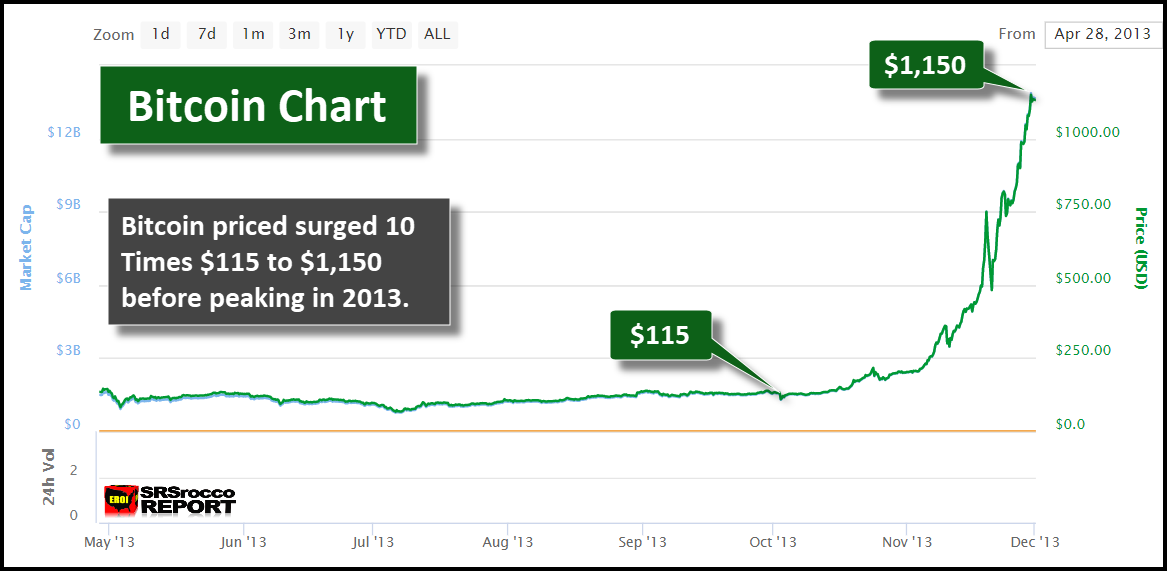
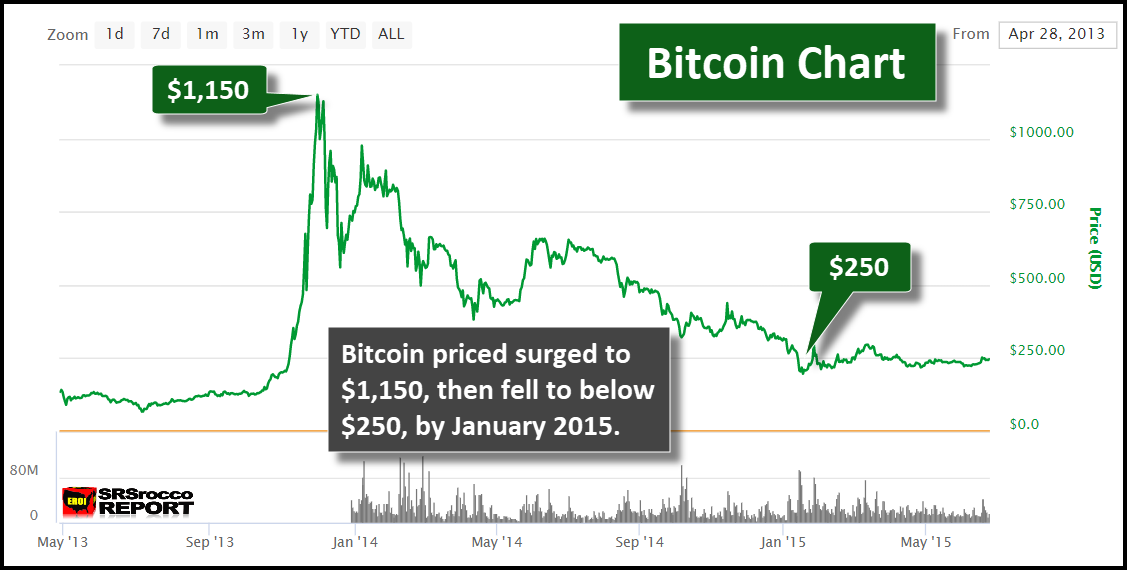
As we can see in the chart, Bitcoin's price surged ten times from $115 in October 2013 to $1,150 at the end of December.  If we went back to this exact time, it looked like Bitcoin's price was going to continue higher.  However, if we see what happened after Bitcoin spiked to $1,000, there was a huge consolidation period:

One year after Bitcoin hit $1,150, it was trading at $250.  It took nearly three more years before Bitcoin surpassed its previous high.  Will this happen to Bitcoin again?  Who knows?  It is almost impossible to gauge the value of Bitcoin and the cryptocurrencies.  Yes, we could see Bitcoin continue towards $10,000.  However, we must realize that most people are not getting into Bitcoin because they understand the potential benefits of blockchain technology, but rather because the price is surging higher and higher.  There's nothing like a skyrocketing price to bring in the speculators in huge numbers.

Recently, Mike Maloney of GoldSilver.com stated in a video that he took some Bitcoin profits and purchased silver.  He believed that it was smart to take profits from Bitcoin as it looked like it was potentially overvalued and buy silver as it was undervalued.  I agree.

Those Who Sold Their Precious Metals For Bitcoin Forgot About Our Dire Energy Predicament

As I stated at the beginning of the article, individuals who believe in a new high-tech world with Bitcoin and cryptocurrencies running the monetary system must have forgotten about our dire energy predicament we are facing.  This baffles me.  The U.S. infrastructure is falling apart while North American suffers from over 250,000 water main breaks a year, and we are going to transition into a new high-tech world of robots and cyborgs?  Who are we fricken kidding?

Has anyone taken a good look at what happened to the Great Egyptian, Mayan and Roman Empires???  They PEAKED and DECLINED... LOL.  And it was all based on their Falling EROI - Energy Returned On Investment.  The more advanced and complex a society becomes, the more energy it takes to run and maintain it.  Folks, we have run out of our CHEAP, ABUNDANT ENERGY.

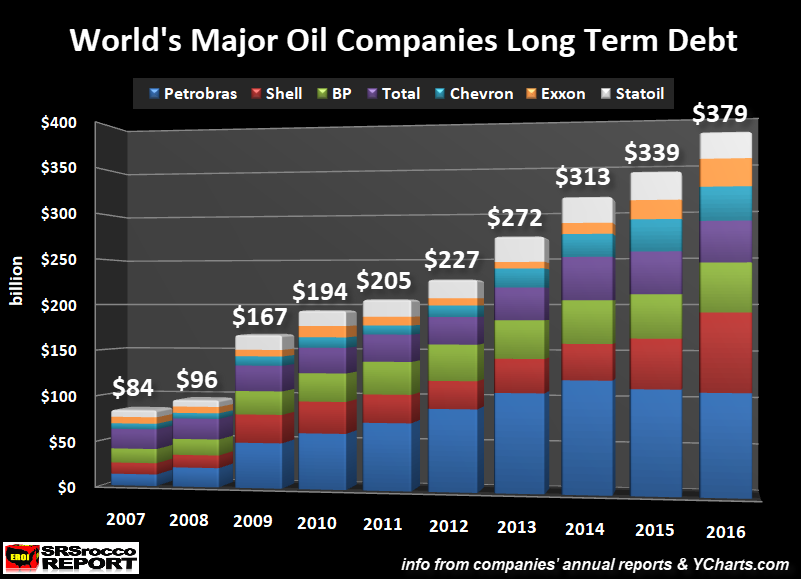
I have provided many clues in previous articles, but I believe it's a good idea to present a few charts once again.  The Global Oil Industry is cannibalizing itself just to stay alive.  We know this is happening by looking at the massive increase in long-term debt:

The global major oil companies long-term debt quadrupled from $84 billion in 2007 to nearly $380 billion last year.  Why did their long-term debt increase when they were enjoying $100 a barrel of oil from 2011-2014??  The problem is that Falling EROI is now pushing costs higher as the net energy in a barrel of oil declines.  Thus, we have a double-edged sword.

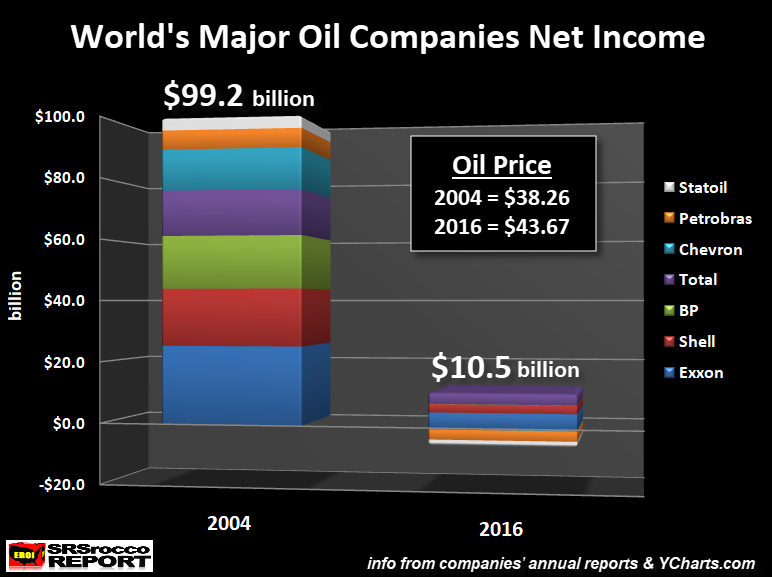
For example, these top seven major global oil companies enjoyed a combined net income profit of $100 billion in 2004 when the price of oil was $38 a barrel.  However, even though the price was higher at $44 last year, their combined net income fell nearly 90% to $10.5 billion:

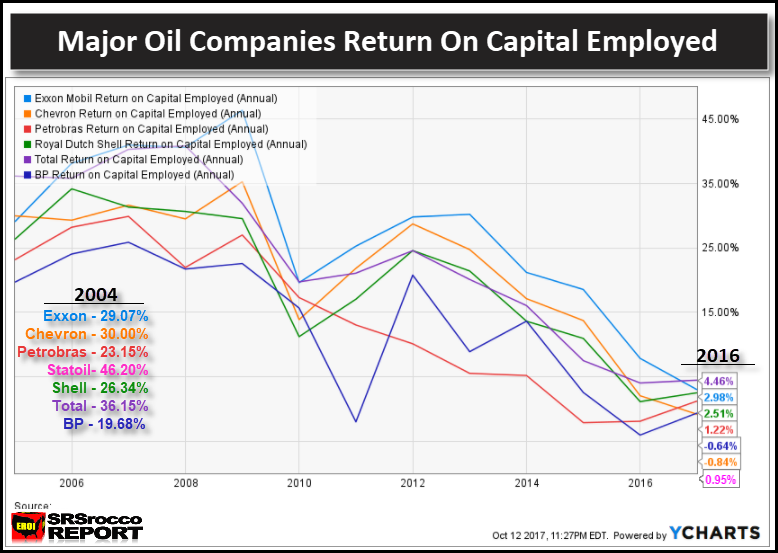
So, the BIG PROBLEM now is that the world market can't really afford high oil prices and the oil companies can't produce oil at a lower cost.  Furthermore, if we take a look at this last chart, we can see just how bad the situation has become for the world's major oil companies:

In 2004, these top seven global oil companies enjoyed a Return On Capital Employed (ROCE) between 20-40%.  We must remember, that year the price of oil was $38.  However, when the oil price was higher at $44 last year, these companies ROCE fell to the low single digits.  Thus, they return on capital employed collapsed.

These three charts paint a very grim future for the global oil industry.  Without the burning of oil, our economy grinds to a halt.  I would like to remind those who believe WIND, SOLAR, and ELECTRIC VEHICLES are going to save us... they are nothing more than fossil fuel derivatives.  The world needs to burn a lot of oil, natural gas and coal to produce the so-called renewable green technologies.

So, when oil and natural gas supply declines, so will the delusion of renewable energy.  Now, I am not saying it isn't wise to own solar panels on one's home or to have an electric car.  Instead, it's unwise to believe solar, wind, electric vehicles, and a new high-tech world is our future.

It isn't.

I believe we are going to experience one hell of a market crash and deflation.  Not only will the oil price drop like a rock, but so will the value of most STOCKS, BONDS, and REAL ESTATE.  If you have sold your precious metals for cryptos at this time, you may find out that it was a big mistake.

Check back for new articles and updates at the SRSrocco Report