Wednesday, April 26, 2017

Gold Imports Into China via Hong Kong Double

Published here: http://www.zerohedge.com/news/2017-04-26/gold-imports-china-hong-kong-double

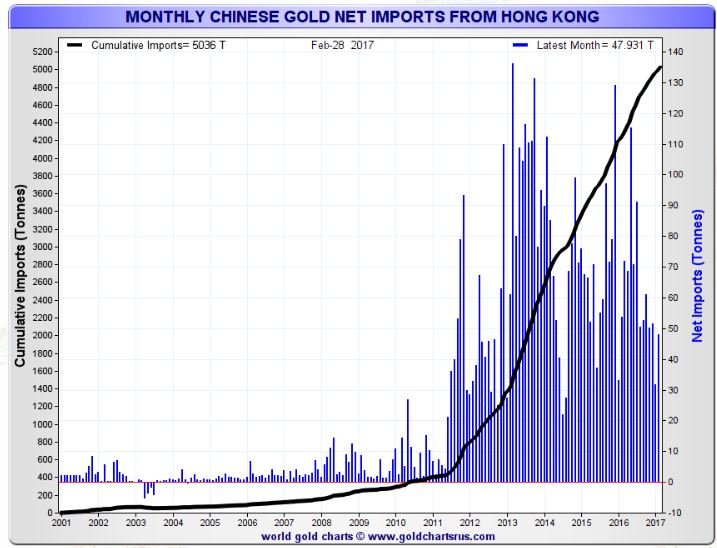
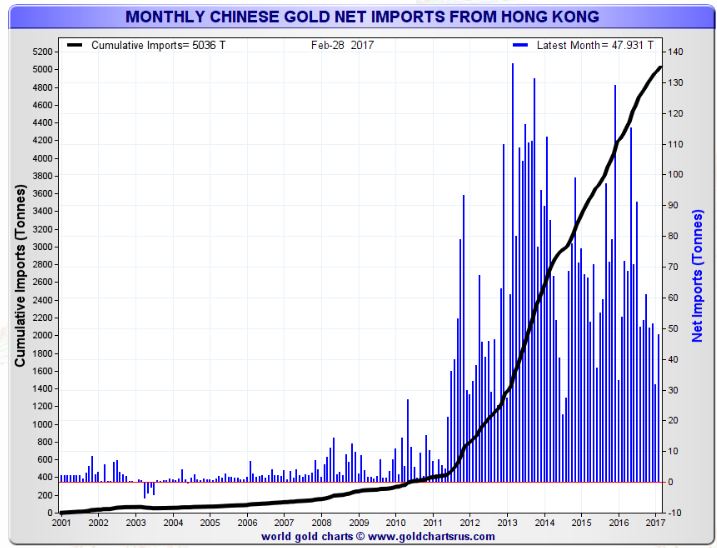
China's net-gold imports via Hong Kong more than doubled in March to 111.6 tonnes. Chart not updated as official data not publicly available yet. Source: Goldchartsrus.com 

Net-gold imports by the world's top gold consumer through the port of Hong Kong rose to 111.647 tonnes in March from 47.931 tonnes in February, according to data emailed to Reuters by the Hong Kong Census and Statistics Department.

China's net-gold imports rose to its best since May 2016. Total gold imports rose to 116.68 tonnes in March from 49.026 tonnes in February.

Both total and net imports in March rose for a second straight month.

Gold has risen over 10 percent so far this year, driven by geopolitical worries.


Source: Goldchartsrus.com 

Gold bullion is often seen as an alternative investment during times of political and financial uncertainty.

Gold prices eased on Tuesday as investor sentiment remained skewed towards riskier assets in the wake of the French election results last weekend, though concerns over tensions on the Korean peninsula limited the safe-haven metal's losses.

Full article on Reuters here

Related content:
- Switzerland’s Gold Exports To China Surge In December

- Gold Flows East – China, India Import Massive Quantities of Gold from Switzerland
- Shanghai Becoming Global Gold Hub And Gold Price Discovery Centre
- Gold Demand in China Heading For Record and Reserves Increase 14 Tonnes In October


News and Commentary

GOLD PRICES HOLD UP RELATIVELY WELL, WEAKER DOLLAR (BullionDesk.com)

Gold slips to 2-wk lows as rallying equities boost risk appetite (Reuters.com)

Nasdaq Composite Tops 6,000, Tariff Sinks Loonie (Bloomberg.com)

Indian physical gold buying may be behind Dubai tightness: sources (Platts.com)

London house prices post most dramatic annual fall since financial crisis (CNBC.com)

Global Silver Mining Industry Productivity Falls To Lowest In History (SRSRoccoReport.com)

Peak Gold, The Debt Pil and Exter's Pyramid (GoldSeek.com)

Hyperinflation around the Globe (24HGold.com)

Is Trump Any Closer to Fiscal Reform? - Holmes (GoldSeek.com)

Stock Bubble On Margin Debt - Powerful Time Bomb (BusinessInsider.com)

7RealRisksBlogBanner

Gold Prices (LBMA AM)

26 Apr: USD 1,264.95, GBP 986.79 & EUR 1,160.21 per ounce
25 Apr: USD 1,270.50, GBP 990.48 & EUR 1,165.81 per ounce
24 Apr: USD 1,271.80, GBP 991.11 & EUR 1,169.42 per ounce
21 Apr: USD 1,281.50, GBP 1,000.85 & EUR 1,197.31 per ounce
20 Apr: USD 1,279.90, GBP 996.91 & EUR 1,188.00 per ounce
19 Apr: USD 1,282.05, GBP 999.74 & EUR 1,196.79 per ounce
18 Apr: USD 1,285.00, GBP 1,025.82 & EUR 1,205.46 per ounce

Silver Prices (LBMA)

26 Apr: USD 17.59, GBP 13.72 & EUR 16.15 per ounce
25 Apr: USD 17.84, GBP 13.92 & EUR 16.40 per ounce
24 Apr: USD 17.81, GBP 13.90 & EUR 16.40 per ounce
21 Apr: USD 17.98, GBP 14.05 & EUR 16.80 per ounce
20 Apr: USD 18.19, GBP 14.21 & EUR 16.91 per ounce
19 Apr: USD 18.22, GBP 14.19 & EUR 16.99 per ounce
18 Apr: USD 18.42, GBP 14.56 & EUR 17.27 per ounce


Recent Market Updates

- LePen Euro Frexit Panic Over – “For Now”
- Gold Sovereigns – ‘Treasure’ Trove Found In UK – Don’t Be The Piano Owner
- Silver, Platinum and Palladium as Investments – Research Shows Diversification Benefits
- When Trump Turns On “Enemy Within” Fed It May Create 1970s Style Stagflation
- Silver Production Has “Huge Decline” In 2nd Largest Producer Peru
- Gold Erases Post- Election Fall as Trump Wrong on Dollar
- Perth Mint Silver Bullion Sales Rise 43% In March
- Gold Surges Above Key 200 Day Moving Average $1270 Level
- Bank of England Rigging LIBOR – Gold Market Too?
- Pension Crisis In U.S. and Globally Is Unavoidable
- Gold, Silver and Oil Spike After U.S. Bombs Syria
- Why Now Is The Time To Invest In Gold and Silver – Schroders
- Heraeus Gold Refinery Buys Swiss Refiner Argor-Heraeus

Access Award Winning Daily and Weekly Updates Here

Tuesday, April 25, 2017

King Dollar; Attempting to break 3-year rising support

Published here: http://www.zerohedge.com/news/2017-04-25/king-dollar-attempting-break-3-year-rising-support

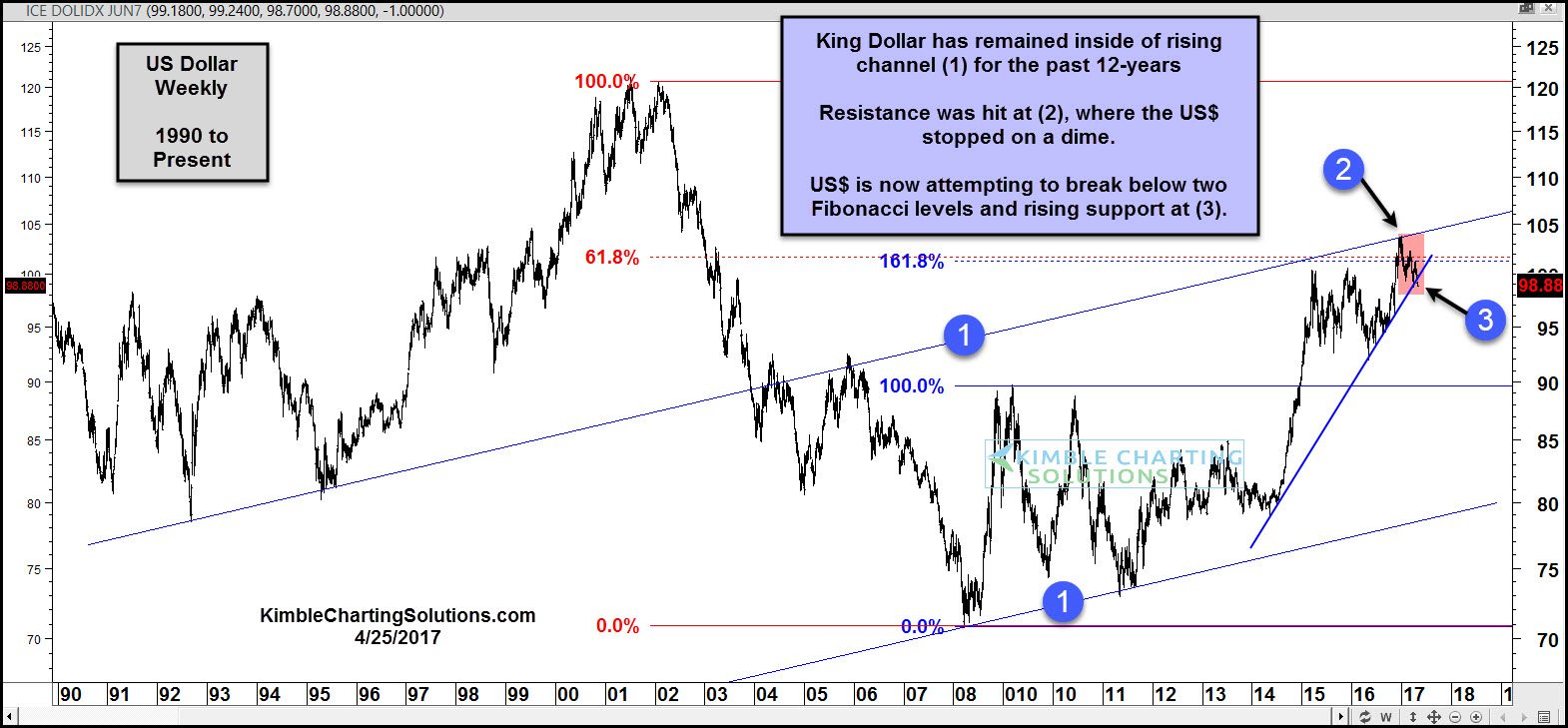
Below looks at a long-term chart of the US Dollar, that was shared on 12/30/16. This chart highlighted that King Dollar was facing two long term resistance lines, at the 104 zone. (See Post Here). Joe Friday was pointing out this was a rare test of resistance and could be the price zone, where a major top could take place.

US dollar monthly (DXY)

CLICK ON CHART TO ENLARGE

Since Joe Friday pointed out this resistance zone, King$ has declined around 5%, which could be a good reason that Gold, Silver and Mining stocks have done very well so far this year. Below looks at an update on the price action of the US$.

US dollar monthly Weekly (DXY)

CLICK ON CHART TO ENLARGE

Line (1) has been support and resistance over the past 20-years. US$ hit the underside of this 20-year resistance line at (2), near the 104 zone highlighted in the top chart, where it stopped on a dime. Since hitting resistance line (1), it has declined around 5% and is back below two key Fibonacci levels.

King$ is now testing 3-year rising support at (3). A break of support at (3), could cause more selling pressure to come forward, causing the US$ to further weaken. The Power of the Pattern feels the US$ has to close on a weekly basis below the 93 level, before strong selling pressure would take place. If the 93 level would be taken out to the downside, suspect metals would attract buyers.


Website: KIMBLECHARTINGSOLUTIONS.COM

Blog:  KIMBLECHARTINGSOLUTIONS.COM/BLOG


Questions: Email services@kimblechartingsolutions.com or call us toll free 877-721-7217 international 714-941-9381

Sweden’s Gold Reserves: 10,000 gold bars (pet rocks) shrouded in Official Secrecy

Published here: http://www.zerohedge.com/news/2017-04-25/sweden%E2%80%99s-gold-reserves-10000-gold-bars-pet-rocks-shrouded-official-secrecy

Submitted by Ronan Manly, Bullionstar.com

In February 2017 while preparing for a presentation in Gothenburg about central bank gold, I emailed Sweden’s central bank, the Riksbank, enquiring whether the Riksbank physically audits Sweden’s gold and whether it would provide me with a gold bar weight list of Sweden’s gold reserves (gold bar holdings). The Swedish official gold reserves are significant and amount to 125.7 tonnes, making the Swedish nation the world’s 28th largest official gold holder.

Before looking at the questions put to the Riksbank and the Riksbank’s responses, some background information is useful. Sweden’s central bank, Sveriges Riksbank aka Riksbanken or Riksbank, has the distinction of being the world’s oldest central bank (founded in 1668). The bank is responsible for the administration of Swedish monetary policy and the issuance of the Swedish currency, the Krona.

Since Sweden is a member of the EU, the Riksbank is a member of the European System of Central Banks (ESCB), but since Sweden does not use the Euro, the Riksbank is not a central bank member of the European Central Bank (ECB). Therefore the Riksbank has a degree of independence that ECB member central banks lack, but still finds itself under the umbrella of the ESCB. Since it issues its own currency, the Riksbank is responsible for the management of the Swedish Krona exchange rate against other currencies, a task which should be borne in mind while reading the below.

On 28 October 2013, the Riksbank for the first time revealed the storage locations of its gold reserves via publication of the following list of five storage locations (four of these locations are outside Sweden) and the percentage and gold tonnage stored at each location:

  • Bank of England               61.4 tonnes (48.8%)
  • Bank of Canada               33.2 tonnes (26.4%)
  • Federal Reserve Bank   13.2 tonnes (10.5%)
  • Swiss National Bank        2.8 tonnes (2.2%)
  • Sveriges Riksbank         15.1 tonnes (12.0%)

The storage locations of Sweden’s official Gold Reserves: Total 125.7 tonnes

Nearly half of Sweden’s gold is stored at the Bank of England in London.

Another quarter of the Swedish gold is supposedly stored with the Bank of Canada. The Bank of Canada’s gold vault was located under it’s headquarters building on Wellington Street in Ottawa. However, this Bank of Canada building has undergone a complete renovation and has been completely empty for a number of years, so wherever Sweden’s gold is in Ottawa, it has not been in the Bank of Canada’s gold vault for the last number of years.

Three other central banks claim to hold gold with the Bank of Canada. Thes are the central banks of Switzerland, the Netherlands and Belgium. The Swedish gold in Canada (along with gold holdings owned by the Swiss, Dutch and Belgians) could, however, have been moved to the Royal Canadian Mint’s vault which is also in Ottawa. Bank of Canada staff are now moving back into the Wellington Street building this year. But is the Swedish (and Swiss, Dutch and Belgian) gold moving back also or does it even exist? The location of the Swedish gold in Ottawa is therefore a mystery and is something the Swedish population should be concerned about.

Just over 10% of the Swedish gold is supposedly held in the famous (infamous) Manhattan gold vault of the Federal Reserve Bank of New York (FRBNY) under the 33 Liberty building. Given the complete lack of cooperation of the FRBNY in ever answering any questions about foreign gold holdings in this vault, then good luck to Swedish citizens in trying to ascertain that gold’s whereabouts or even convincing the Riksbank to repatriate that gold.

A very tiny 2% of Swedish gold is also listed as being held with the Swiss National Bank (SNB). The SNB gold vault is in Berne under its headquarters building on Bundesplatz.

The Riksbank also claims to hold 15.1 tonnes of its gold (12%) in its own storage, i.e. stored domestically in Sweden. Interestingly, on 30 October 2013, just two days after the Riksbank released details of its gold storage locations, Finland’s central bank in neighbouring Helsinki, the Bank of Finland, also released the storage locations of its 49 tonnes gold reserves in a move which looks to have been coordinated with the Riksbank. The Bank of Finland claims its 49 tonnes of gold is spread out as follows: 51% at the Bank of England, 20% at the Riksbank in Sweden, 18% at the Federal Reserve Bank of New York, 7% in Switzerland at the Swiss National Bank and 4% held in Finland by the Bank of Finland. This means that not only is the Riksbank supposedly storing 15.1 tonnes of Swedish gold, it also apparently is also storing 9.8 tonnes of Finland’s gold, making a grand total of 24.9 tonnes of gold stored with the Riksbank. The storage location of this 24.9 tonnes gold is unknown, but one possibility suggested by the Swedish blogger Cornucopia (Lars Wilderäng) is that this gold is being stored in the recently built Riksbank cash management building beside Stockholm’s Arlanda International Airport, a building which was completed in 2012.

On its website, the Riksbank states that its 125.7 tonnes of gold “is equivalent to around 10,000 gold bars”. A rough rule of thumb is that 1 tonne of gold consists of 80 Good Delivery Bars. These Good Delivery Gold gold bars are wholesale market gold bars which, although they are variable weight bars, usually each weigh in the region of 400 troy ounces or 12.5 kilograms. Hence 125.7 tonnes is roughly equal to 125.7 * 80 bars = 10,056 bars, which explains where the Riksbank gets its 10,000 gold bar total figure from.

Swedish Riksbank

Using Gold for Foreign Exchange Interventions

On another page on its web site titled ‘Gold and Foreign Currency Reserve’, the Riksbank is surprisingly open about the uses to which it puts its gold holdings, uses such as foreign exchange interventions and emergency liquidity:

“The gold and foreign currency reserve can primarily be used to provide emergency liquidity assistance to banks, to fulfil Sweden’s share of the international lending of the International Monetary Fund (IMF) and to intervene on the foreign exchange market, if need be.”

This is not a misprint and is not a statement that somehow only applies to the ‘foreign currency reserve’ component of the reserves, since the same web page goes on to specifically say that:

The gold can be used to fund emergency liquidity assistance or foreign exchange interventions, among other things.”

Therefore, the Riksbank is conceding that at least some of its gold is actively used in central bank operations and that this gold does not merely sit in quiet unencumbered storage. On the contrary, this gold at times has additional claims and titles attached to it due to being loaned or swapped.

When the Riksbank revealed its gold storage locations back in October 2013, this news was covered by a number of Swedish media outlets, one of which was the Stockholm-based financial newspaper Dagens Industri, commonly known as DI. DI’s article on the topic, published in Swedish with a title translated as “Here is the Swedish Gold“,  also featured a series of questions and answers from personnel from the Riksbank asset management department. Some of these answers are worth highlighting here as they touch on the active management of the Swedish gold and also the shockingly poor auditing of the Swedish gold.

In the DI article, Göran Robertsson, Deputy Head of Riksbank’s asset management department, noted that historically the Swedish gold was stored at geographically diversified locations for security reasons, but that this same geographic distribution is now primarily aimed at facilitating the rapid exchange of Swedish gold for major foreign currencies, hence the reason that nearly half of the Swedish gold is held in the Bank of England gold vaults – since the Bank of England London vaults are where gold swaps and gold loans take place.

Robertsson noted that over the 2008-2009 period, 50 tonnes of gold Swedish gold located at the Bank of England was exchanged for US dollars: 

“London is the dominant international marketplace for gold. We used the gold 2008-2009 during the financial crisis when we switched it to the dollar we then lent to Swedish banks”

One of these Riskbank gold-US Dollar swap transaction was also referenced in a 2011 World Gold Council report on gold market liquidity. This report stated that in 2008 following the Lehman collapse:

“In order to be able to provide liquidity to the Scandinavian banking system, the Swedish Riksbank utilised its gold reserves by swapping some of its gold to obtain dollar liquidity before it was able to gain access to the US dollar swap facilities with the Federal Reserve.” 

In the October 2013 DI interview, Göran Robertsson also noted that at some point following this gold – dollar exchange, “the size of the reserve was restored“, which presumably means that the Riksbank received back 50 tonnes of gold. As to whether the restoration of the gold holdings was the exact same 50 tonnes of gold as had been previously held (the same  gold bars) is not clear.

Sophie Degenne, Head of the Riksbank’s asset management department, also noted that:

“The main purpose of the gold and foreign exchange reserves is to use it when needed, as in the financial crisis”

Auditing of the Swedish Gold

On the subject of so-called transparency and auditing of the gold, Sophie Degenne said the following in the same DI interview:

“Why do you reveal at which central banks the gold is located? 
It is a part of the Riksbank endeavours to be as transparent as we canWe have engaged in dialogue with the relevant central banks”

How do you verify that the gold is really where it should be? 
“We have our own listings of where it is. We reconcile these against extracts that we receive once a year. From now on, we will also start with our own inspections.”

Therefore, the Riksbank gold auditing procedure at that time was one of merely comparing one piece of paper to another piece of paper and in no way involved physically auditing the gold bars in any of the foreign locations. These weak audit methods of the Swedish gold were first highlighted by Liberty Silver CEO, Mikael From in Stockholm-based news daily Aftonbladet’s coverage of the Swedish gold storage locations in an article in early November 2013 titled “Questions about Sweden’s gold reserves persist“.

In Aftonbladet’s article, Mikael From stated that while it was welcome that the Riksbank was at that point signalling an ambition to inspect the Swedish gold reserves, it was not clear that the Riksbank would be conducting a proper audit of the gold reserves at the time of inspection, although such a proper audit would be highly desirable. Mikael stated that without such a proper audit, and without witnessing the gold with their own eyes, the Riksbank and the Swedish State could not be certain that the Swedish gold actually existed.

He also called for the Riksbank to provide information proving that the Swedish gold actually exists in its claimed storage locations. This was particulaly important due to a portion of the Swedish gold supposedly being stored at the gold vault of the Federal Reserve Bank of New York (NYFED), a storage location which had in the past been non-cooperative and problematic for the German Federal Court of Auditors when they tried to examine the NYFED’s storage arrangements in 2011/2012.

Questions to the Swedish Riksbank – February 2017

Turning now to the questions which I posed to the Swedish Riksbank in early February 2017 about its gold reserves. I asked the Riskbank two basic and simple questions as follows:

“I am undertaking research into central bank gold reserves, including the gold reserves held by the Riksbank at its 5 storage facilities. 

1. Are the gold bars held by the Riksbank in its foreign storage facilities physically audited by the Riksbank (i.e. stored at Bank of England, Bank of Canada, Federal Reserve New York and Swiss National Bank)? In other words, does the Riksbank have a physical audit program for this gold?

2. Secondly, would the Riksbank be able to send me a gold bar weight list which shows the gold bar holdings details for the 125.7 tonnes of gold held by the Riksbank. A weight list being the industry standard list showing bar brand (refiner), serial number, gross weight, fineness, fine weight etc.

A few days after I submitted my questions, the Presschef/Chief Press Officer of the Riksbank responded as follows. On the subject of auditing:

“Answer 1: Yes, the Riksbank performs regularly physical audits of its gold.

In response to the question about a gold bar weight list, the Chief Press Officer said:

Answer 2: The Riksbank publishes information about where the gold is stored and how much in tonnes is at each place. See table (same distribution table as above). However, the Riksbank does not publish weight lists or other details of the gold holdings.

So here we have the Riksbank claiming that it personally now performs physical audits of its gold on a regular basis. This is the first time in the public domain, as far as I know, that the Riksbank is claiming to have undertaken physical gold audits of its gold holdings, and it goes beyond the 2013 statement from the Riksbank’s Sophie Degenne when she said “we will also start with our own inspections“.

But critically ,there was zero proof offered by the Riksbank to me, or on its website, that it has undertaken any physical gold audits. There is no documentation or evidence whatsoever that any physical audits have ever been conducted on any of the 10,000 gold bars in any of the 5 supposed storage locations that the Riksbank claims to store gold bars at. Contrast this to the bi-annual physical audits which are carried out on the gold bars in the SPDR Gold Trust (GLD) which are published on the GLD website.

In any other industry, there would be an outcry and court cases and litigation if an entity claimed it had conducted audits while offering no proof of said audits. However, in the world of central banking, perversely, this secrecy is allowed to persist. This is outrageous to say the least and Swedish citizens should be very concerned about this lack of transparency of the Swedish gold reserves.

Official Secrecy about Swedish Gold Reserves

Given the brief and not very useful Riksbank responses to my 2 questions above, I sent a follow on email to the Riksbank asking why the Swedish central bank did not publish a gold bar weight list. My question was as follows:

Is there any specific reason why the Riksbank does not publish a gold bar weight list in the way, for example, that a gold-backed ETF does publish such a weight list every trading day?

i.e. Why is the Riksbank not transparent about its gold bar holdings?”

This second email was answered by the Riksbank Head of Communications, as follows:

“This kind of information is covered by secrecy relating to foreign affairs, as well as security secrecy and surveillance secrecy in accordance with the relevant provisions in the Swedish Public Access to Information and Secrecy Act.

As far as we are aware of, the Riksbank is among the most transparent central banks, being public with information about the storage locations and volumes, but do let us know if any other central banks are offering the level of transparency you are asking for (except for Germany of course, which we are aware about).”

So here you can see here that gold, which in the words of the Wall Street Journal is just a ‘Pet Rock’, is covered by some very strong secrecy laws in Sweden. Why would a pet rock need ultra strong secrecy laws?

An explanatory document on Sweden’s “Public Access to Information and Secrecy Act” can be accessed here. In Sweden, the rules governing public access to official documents are covered by the Freedom of the Press Act. While its beyond topic to go into the details of Swedish secrecy laws right now, there is a short section in the document titled “What official documents may be kept secret?” (Section 2.2) which includes the following:

“The Freedom of the Press Act lists the interests that may be protected by keeping official documents secret:

  • National security or Sweden’s relations with a foreign state or an international organisation;
  • The central financial policy, the monetary policy, or the national foreign exchange policy;
  • Inspection, control or other supervisory activities of a public authority;
  • The interest of preventing or prosecuting crime;
  • The public economic interest;
  • The protection of the personal or economic circumstances of private subjects; or
  • The preservation of animal or plant species.

Given that the Riksbank stated that the information in its gold bar weight lists was “covered by secrecy relating to foreign affairs, as well as security secrecy and surveillance secrecy”, I would hazard a guess that the Riksbank would try to reject Freedom of Information requests in this area by pointing to central bank gold storage and gold operations as falling under points 1 or 2, i.e. falling under national security or relations with a foreign state or international organisation, or else monetary policy / foreign exchange policy (especially given that the Riksbank uses gold reserves in its foreign currency interventions). Perhaps the Riksbank would also try to twist point 5 as an excuse, i.e. that it wouldn’t be in the public economic interest to release the Swedish gold bar details.

As to why the Riksbank and nearly all other central banks are ultra secretive about gold bar weight lists and even physical auditing of gold bar holdings usually boils down to the fact that, like the Riksbank, these gold bar holdings are actively managed and are often used in gold loans, gold swaps and even gold location swaps. If identifiable details of the gold bars of such central banks were in the public domain, given that these bars are involved in loans, currency swaps and location swaps, these gold bar details could begin to show up in the gold bar lists of other central banks or of the gold bar lists of publicly listed gold-backed Exchange Traded Funds. This would then blow the cover of the central banks which continue to maintain the fiction that their loaned and swapped gold is still held in unencumbered custody on their balance sheets, and would blow a hole in their contrived and corrupt accounting policies.

A Proposal to the Oldest Central Bank in the World

Since the Riksbank happened to ask me were there any central banks “offering the level of transparency [I was] asking for” i.e. providing gold bar weight lists, I decided to send a final response back to the Riksbank in early March highlighting the central banks that I am aware of that have published such gold bar weight lists, and I also took the opportunity of proposing that the Riksbank should follow suit in publishing its gold bar weight list. My letter to the Riksbank was as follows:

“You had asked which central banks offered a level of transparency on their gold holdings that include publication of a gold bar weight list. Apart from the Deutsche Bundesbank, which you know about, I can think of 3 central banks which have released weight lists of their gold bar holdings.

The 3 examples below (together with the Bundesbank) show that some of the most important central banks and monetary authorities in the world have now deemed it acceptable to include the release of gold bar weight lists as part of their gold communication transparency strategies. 

The 4 sets of weight lists below include gold bar holdings at the Bank of England (stored by Mexico, Australia, Germany), and at the Federal Reserve Bank of New York (stored by the US Treasury and Bundesbank). Together these two storage locations account for 60% of the Riksbank’s gold holdings (74.6 tonnes).

The Riksbank is the world’s oldest central bank and has a long track record of being progressive and transparent. By releasing the Riksbank’s gold bar weight lists for the gold bars stored over the 5 storage locations (London, New York, Ottawa, Berne and in Sweden), the Swedish central bank would be joining an elite group of central banks and monetary institutions that could be considered the early stage adopters of much needed transparency in this area.”

1. Bank of Mexico

Most recently in 2017, Bank of Mexico has released a weight list of its earmarked gold bars stored at the Bank of England. This list in pdf format can be downloaded here – > http://www.guillermobarba.com/assets/uploads/2017/03/LT-BM-18703-ok.pdf

The Mexican list details 7265 gold bars held (about 90 tonnes), and includes bank of England internal sequence number, refiner brand, gross weight, assay (fineness), and fine weight.

See also https://www.bullionstar.com/blogs/ronan-manly/mexicos-earmarked-gold-bars-bank-englands-vaults/

 2. Reserve Bank of Australia

In July 2014, the Reserve Bank of Australia (RBA) released a weight list of 6313 gold bars (about 79 tonnes) that it has stored at the bank of England in London. See  http://www.rba.gov.au/information/foi/disclosure-log/rbafoi-131418.html

The weight list in Excel format can be downloaded here http://www.rba.gov.au/information/foi/disclosure-log/xls/131418.xls

The RBA list includes refiner brand, gross weight, assay (fineness), and fine weight, as well as bank of England account number.

3. US Treasury

In 2011, the US Treasury’s full detailed schedules of gold bars was published by the US House Committee on Financial Services as part of submissions for its hearing titled “Investigating the Gold: H.R. 1495, the Gold Reserve Transparency Act of 2011 and the Oversight of United States Gold Holdings”.

These US Treasury weight lists are as follows, and are downloadable from the financial services section of the “house.gov” web site.

  • Weight list of all Treasury gold held at Fort Knox, Denver and West Point – 699,515 bars  – pdf format

http://financialservices.house.gov/uploadedfiles/attachment_4_mints_schedule_of_inventory_of_deep_storage_gold_reserves.pdf

  • Weight list of all Treasury gold held at Fort Knox, Denver and West Point – 699,515 bars – xlsformat

http://financialservices.house.gov/uploadedfiles/mints_schedule_of_inventory_of_deep_storage_gold_reserves.xls

Deutsche Bundesbank

The Bundesbank weight list which you know about. The most recent version of this list was published on 23rd February 2017 and can be downloaded here http://www.bundesbank.de/Redaktion/EN/Downloads/Bundesbank/Organisation/bar_list.pdf?__blob=publicationFile

The Bundesbank list show all the German gold bars held at the Bank of England, NY fed and Banque de France as well as in Frankfurt.”

Conclusion

As of now, the Swedish Riksbank has a) not published a gold bar weight list of any of its gold bar holdings and b) not acknowledged my follow up email where I listed the central banks that have produced such lists and suggested that the Riksbank do likewise.

The Swedish Riksbank claims to hold 10,000 large Good Delivery gold bars in 5 locations across the world and now claims to have conducted physical gold audits of this gold. Yet it has never published any physical gold audit results of any of these gold bars nor published any of the serial numbers of any of the 10,000 gold bars it claims to have in storage. For a so-called progressive democracy this is shocking, although not surprising given the arrogance and unaccountability of central bankers.

If someone with time on their hands, ideally a Swedish citizen, has an interest in this area, it would be worthwhile for them to research the rules of the Swedish Freedom of Information Act, and then craft a few carefully worded Freedom of Information requests to the Riksbank requesting physical audit documents and gold bar weight lists of Sweden’s 125.7 tonnes of gold that is supposedly held in London, New York, Ottawa, Berne and in Sweden. 

While these Freedom of Information requests would probably get rejected due a some spurious secrecy excuse and thrown back at the applicant in short order, at least its worth trying, and might even make a good story for the Swedish media to cover.

This article was first published on the BullionStar website as "Sweden’s Gold Reserves: 10,000 gold bars shrouded in Official Secrecy".

LePen Euro Panic Over – “For Now”

Published here: http://www.zerohedge.com/news/2017-04-25/lepen-euro-panic-over-%E2%80%93-%E2%80%9C-now%E2%80%9D

by John Stepek, Editor of Money Week

OK, drama’s over.

The French election has turned out pretty much exactly as expected.

For all that some of the papers are leading with “French revolution” headlines, the reality is that a face-off between the right-wing Marine Le Pen of the Front National and independent/socialist candidate Emmanuel Macron of En Marche! has been on the cards for months now.

So what happens now? And what does it mean for your money?

Looks as though Macron will win the French presidency

Emmanuel Macron, the French Tony Blair, won about 24% of the votes in yesterday’s first round of the French presidential election. Marine Le Pen, the French Nigel Farage, won around 22%.

They go through to the final round on 7 May. The rest of the candidates are out of the race.

Who will win?

The polls say Macron. The markets also say Macron. The euro has leapt to a five-month high this morning. Bond markets are calming down – spreads across the eurozone region are tightening (for example, the gap between what it costs France to borrow money, compared to what it costs Germany to borrow money, is shrinking).

Stocks are likely to go higher too.

You might say: “Ah, but what about Trump?” and plenty of people have. I take your point – I’m a sceptic by nature, I don’t have a particular dog in this fight, and I’d never say never.

But sometimes the market and pollsters do get things right. And it does look highly likely that Macron will beat Le Pen in the second round.

Firstly, polls suggest a large gap. He’s on 62% versus 38% for her, and this sort of gap has been consistent across the election process. Secondly, the other candidates have largely now said: “Back Macron”.

Things can change, of course. Macron might not come across well during the debates. He might take all this for granted and be surprised on the night. His policies aren’t all that well defined, for a start.

Then again, Le Pen might be good on the rhetorical side, but she’s got her own tricky policy questions to answer. The sticky issue of currency is one that has derailed nationalist ambitions in the past (the Scottish independence referendum is a good example), and Le Pen’s idea of taking France out of the euro will give a lot of her own supporters pause.

So as it stands, I don’t think the market’s view of their relative chances is wildly complacent in the way that it was about the odds of Brexit and Donald Trump winning. That doesn’t mean that Le Pen can’t or won’t win. It just means that the odds look realistic, rather than overly discounting one outcome.

It’s also worth noting that at one point, both Le Pen and Macron would have been viewed as political “surprises”. Neither are mainstream candidates. I know I’ve compared Macron to Tony Blair, but Blair led a traditional party. Macron has created his own party (and I’m sure some of Jeremy Corbyn’s beleaguered New Labour hostages must be looking at him and thinking hard).

So regardless of who wins, this is an anti-establishment vote. France has voted for change. The big theme running through financial markets and political circles hasn’t stopped here – it’s just that in France, an anti-establishment globalist looks likely to win, rather than an anti-establishment nationalist.

Wider market doesn’t really care about French election details

Of course, whoever wins, they might struggle to get their agendas heard. The French parliamentary election in June comes hot on the heels of the presidential second round. As anti-establishment candidates, neither Le Pen nor Macron have particularly large power bases within the establishment.

So what does this mean? Well, it’s the usual story. You might have someone who’s ostensibly in charge, but has to make so many compromises with parliament, that any reforms are kept watery and weak.

But putting it bluntly, how France is governed is neither here nor there to most of the rest of the world, as long as it remains, broadly speaking, “business as usual”.

Stick with the euro, play nice with Germany, and the rest will take care of itself.

So as long as Macron does win come 7 May – and it seems likely that he will – then the biggest (currently scheduled) political frightener of the year is over.

Italy could still throw a few spanners in the works, and that would certainly rattle markets, but the biggest systemic risk now looks as though it’s on its way to being put aside.

That is all likely to mean a rebound for the euro (which we’ve seen already), a rally for eurozone stocks (which fund managers are itching to buy at the moment in any case), and attention returning to the US economy, and Trump’s travails.

On Trump, apparently we’ll be hearing the outlines of a big tax reform in the US on Wednesday – according to a weekend Tweet.

If we do, then combined with the market-friendly French election result, it could be just what we need to get us over the current wobble and onto the next round of the bull market.

If not – well, US markets will have to start justifying their valuations somehow. But that’s a topic for another morning.

John Stepek, is the editor of the best selling financial publication in the UK, MoneyWeek, and the full article can be read here


News and Commentary

Gold eases in French election afterglow; N.Korea woes limit losses (Yahoo.com)

Galantas Gold puts expansion plans in Tyrone on hold (IrishTimes.com)

London Metal Exchange to delay launch of precious metal contracts (Reuters.com)

Gold slides after French election revives risk appetite (Reuters.com)

Gold and Bullion Miners Tumble as French Vote Cuts Haven Demand (Bloomberg.com)

Frexit Panic Over – For Now (MoneyWeek.com)

UK election is about far more than just Brexit (MoneyWeek.com)

11 Facts That Prove The 2017 US Economy Is In Far Worse Shape Than It Was In 2016 (ZeroHedge.com)

Don’t Let This Happen To Your Gold and Silver (DollarCollapse.com)

Trump’s Big Fat Ugly Bubble Is Ready to Pop (DailyReckoning.com)

7RealRisksBlogBanner

Gold Prices (LBMA AM)

25 Apr: USD 1,270.50, GBP 990.48 & EUR 1,165.81 per ounce
24 Apr: USD 1,271.80, GBP 991.11 & EUR 1,169.42 per ounce
21 Apr: USD 1,281.50, GBP 1,000.85 & EUR 1,197.31 per ounce
20 Apr: USD 1,279.90, GBP 996.91 & EUR 1,188.00 per ounce
19 Apr: USD 1,282.05, GBP 999.74 & EUR 1,196.79 per ounce
18 Apr: USD 1,285.00, GBP 1,025.82 & EUR 1,205.46 per ounce
13 Apr: USD 1,286.10, GBP 1,025.28 & EUR 1,208.42 per ounce

Silver Prices (LBMA)

25 Apr: USD 17.84, GBP 13.92 & EUR 16.40 per ounce
24 Apr: USD 17.81, GBP 13.90 & EUR 16.40 per ounce
21 Apr: USD 17.98, GBP 14.05 & EUR 16.80 per ounce
20 Apr: USD 18.19, GBP 14.21 & EUR 16.91 per ounce
19 Apr: USD 18.22, GBP 14.19 & EUR 16.99 per ounce
18 Apr: USD 18.42, GBP 14.56 & EUR 17.27 per ounce
13 Apr: USD 18.56, GBP 14.80 & EUR 17.45 per ounce


Recent Market Updates

– Gold Sovereigns – ‘Treasure’ Trove Found In UK – Don’t Be The Piano Owner
– Silver, Platinum and Palladium as Investments – Research Shows Diversification Benefits
– When Trump Turns On “Enemy Within” Fed It May Create 1970s Style Stagflation
– Silver Production Has “Huge Decline” In 2nd Largest Producer Peru
– Gold Erases Post- Election Fall as Trump Wrong on Dollar
– Perth Mint Silver Bullion Sales Rise 43% In March
– Gold Surges Above Key 200 Day Moving Average $1270 Level
– Bank of England Rigging LIBOR – Gold Market Too?
– Pension Crisis In U.S. and Globally Is Unavoidable
– Gold, Silver and Oil Spike After U.S. Bombs Syria
– Why Now Is The Time To Invest In Gold and Silver – Schroders
– Heraeus Gold Refinery Buys Swiss Refiner Argor-Heraeus
– Invest In Gold – 46 Trillion Reasons Why

Access Award Winning Daily and Weekly Updates Here

Monday, April 24, 2017

Gold Sovereigns - 'Treasure' Trove Found In UK - Don’t Be The Piano Owner

Published here: http://www.zerohedge.com/news/2017-04-24/gold-sovereigns-treasure-trove-found-uk-don%E2%80%99t-be-piano-owner

Gold Sovereigns - 'Treasure' Trove Found In UK - Don’t Be The Piano Owner

The gold sovereigns – semi-numismatic gold coins made up of both gold sovereigns and half gold sovereigns dating from the reigns of Victoria, Edward VII and George V – were discovered inside an old piano after it was donated to a school last year.


A gold sovereign from that period is currently valued at between £200-250, with a half sovereign worth between £100-200. A pouch contains just a sampling of the 913 coins composing the hoard.  Image © Trustees of the British Museum via Coin World

The largest ‘hoard’ of gold sovereigns found in the UK ever has been declared ‘treasure’.

A piano tuner who discovered £500,000 (€590,000 or $640,000) worth of semi numismatic gold coins, gold sovereigns (0.2354 troy ounce) and half gold sovereigns (0.1167 troy ounces) inside the piano will get to keep half the cash – but the couple who owned the piano for 33 years won’t get a penny.

The piano’s new owners, Bishop’s Castle Community College, Shropshire which is near Birmingham, will split the £500,000 with the piano tuner Martin Backhouse.

The gold sovereigns are expected to be claimed by the British Museum, but the cash will be split between the school and Mr Backhouse, a inquest has ruled.

Meg and Graham Hemmings, who owned the piano for 33 years before donating it when they downsized, won’t get any of the money.

John Ellery, Shropshire’s Coroner, used an inquest to seek the original owners of the gold sovereigns, but despite more than 40 people claiming the gold sovereigns, none could prove they belonged to them.

The coroner said the gold sovereign hoard qualifies as ‘treasure’ because:

(1)?It is substantially made of gold or silver
(2)?It was deliberately concealed by the owner with a view to later recovery
(3)?The owner, or his or her present heirs or successors, remain unknown

The story clearly shows the value of gold coins and the financial benefit and financial security they can bring to their owners – providing they are owned in the safest way possible.

Conclusion
Owning and taking possession of physical gold and silver coins and bars brings its own set of risks and should only be done by those who feel secure in their own home and or are very sure of the non vault place where they hide their gold coins or bars.

If storing at home rather than in the some of the securest vaults in the world as provided by GoldCore, you need to consider the risks.

These risks are that you may forget where you have hidden your coins or bars – unlikely though this may sound it has happened – that you may lose access to their hiding place or indeed that you may have them stolen. Informing loved ones and next of kin by way of a solicitor or lawyer, trusted bullion dealer or other trusted counter party would be a way of addressing this.

We encourage clients to take delivery of some of their bullion coins and bars providing they feel secure in their own home and have given some thought to these risks. The majority of a precious metal allocation is safer owned in the allocated and segregated storage in some of the safest vaults in some of the safer jurisdictions in the world.

Having the option to take delivery within days is vital in this regard. This means that you can take possession in the event of a worst case scenario of a collapse of the banking, financial and or monetary system – for whatever reason.

Possession is nine tenths of the law and hence the need to always consider how securely you own your gold and silver investments and how you maintain that possession and ownership.

This interesting story shows how gold and silver buyers and investors need to give serious consideration as to how securely their safe haven coin and bar assets are held.

Don’t be the piano owner …

www.GOLDCORE.com

Executive Order From Trump Will Change The US Commodity Sector

Published here: http://www.zerohedge.com/news/2017-04-24/executive-order-trump-will-change-us-commodity-sector

trump-infrastructure

Last week, a request from the Uranium Producers of America (‘UPA’) grabbed the headlines, as the organization was asking the US Department of Energy (DOE) to suspend the sale of (physical) uranium on the spot market. The UPA correctly described the status of the US based Uranium producers as ‘fragile’, and it’s pretty clear the DOE has been a huge ‘help’ in destroying America’s domestic uranium market.

UPA says ‘ the uranium market is oversupplied in the short term, and the DOE material continues to overwhelm the market with large quantities of price insensitive supply’, and this statement is absolutely correct. The DOE has been selling yellowcake no matter what price it was receiving for it, but by doing so, the collateral damage in the sector was (and is) huge.

Whether the DOE receives $25 per pound of uranium or $35 won’t make or break the government’s budget, but would make a huge difference for the domestic producers. Just to give you an example, in the second half of 2016, the DOE has dumped 3.4 million pounds of uranium on the open market, whilst the total uncommitted utility demand for the same period was just 0.3 million pounds. Indeed, the DOE is dumping 11 times more uranium on the market than strictly necessary to fill a demand.

The idea of selling ‘excess’ uranium has historically grown and was re-confirmed in 2015 by the Secretary of Energy under the Obama regime. According to Energy Secretary Moniz, it wouldn’t harm the market I if the USA would dump in excess of 5 million pounds of uranium on the open market in 2016, but in hindsight, this has definitely aggravated the existing issues and as you can see on the next image, most uranium producers haven’t been able to generate a profit in the past six years.

URA 1

Source: energy.gov

Whilst there’s absolutely no urgent need to sell the stockpiled uranium, the government might actually be better off by waiting another 5 years. The tipping point of the US uranium production (and demand) is expected to be reached in the early 2020’s, when a high level of uncommitted demand will go on the market to discuss offtake agreements with producers. A low uranium price won’t help anyone (and might destroy jobs as several companies are now doing the bare minimum in order to survive for a few more years), whilst there’s additional upside for the DOE as well. Any business man with the ability to think reasonable will agree that selling uranium at $40 in five years from now is a superior plan compared to selling at $25 per pound right now. And if it helps to save jobs and companies, then that’s an additional bonus.

However, fortunately for the uranium producers, the new president seems to understand that the first step to make sure the USA has a buoyant mining and commodity sector is to make sure that any government intervention does not harm the free market. And in this case, the government intervention (dumping uranium on the market definitely counts as an intervention) has had a huge negative impact on the average spot price, as you can see in the next image:

URA 2

Source: energy.gov

In the executive order, dated March 28, President Trump seems to be willing to push the domestic mining industry forward. And for the uranium market, even simple measures like not dumping excess supply on the market would already have a huge impact without incurring a negative financial impact on the government finances level.

Most people (correctly) interpreted that executive order to be a first step to resuscitate the US coal sector, but one part of the EO could also be seen as important for the uranium sector:

“President Trump’s Executive Order directs all agencies to conduct a review of existing actions that harm domestic energy production and suspend, revise, or rescind actions that are not mandated by law.

Within 180 days, agencies must finalize their plans.“

Could this mean the DOE will revise its policy to dump uranium on the open markets before the end of this year? We think that’s very likely, and this should give the entire US uranium sector more oxygen and keep all projects in good standing until the (long-term) uranium prices pick up again.

And this could be the first step to a new US-focused and US-centered resources program.

>>>  Click here to read our Guide to Gold, and protect your wealth!

Secular Investor offers a fresh look at investing. We analyze long lasting cycles, coupled with a collection of strategic investments and concrete tips for different types of assets. The methods and strategies are transformed into the Gold & Silver Report and the Commodity Report.

Follow us on Facebook @SecularInvestor [NEW] and Twitter @SecularInvest

To Frexit or Not to Frexit, Report 23 April, 2017

Published here: http://www.zerohedge.com/news/2017-04-24/frexit-or-not-frexit-report-23-april-2017

This was also a holiday-shorted week.

As we write this, the big news comes from the election in France. The leading candidate is a banker named Emmanuel Macron, with about 24% of the vote in a 4-candidate race. The anti-euro Marine Le Pen came in second with just over 21%. From the sharp rally in the euro, which was up about 2% at one point, we assume that observers believe the odds of France leaving the euro have just gone down.

Of course, France (and the other European countries) faces a false alternative (well they ought to consider Keith’s gold bonds proposal, but that is not on the table). Staying with the euro means ongoing wealth destruction, and a downward slope that leads to nowhere good. However, that raises the question. What would happen if they were to try to leave?

We believe that no matter which theory prevails, and what measures are taken by les dirigistes (central planners), all roads lead to an accelerated default of trillions in bad credit. To understand why, consider the balance sheets of the banks and other financial intermediaries in France.

Suppose the new French franc goes down relative to the euro (we won’t address here whether it is likely to go up or down). This means that any French entity who had borrowed from a bank in Germany or Italy or Spain now sees its liabilities spike up relative to its assets which are now redenominated in francs. It would not take that much leverage or a very large decline in the franc to cause some major bankruptcies. The initial round of bankruptcies could cascade causing yet other bankruptcies in a highly interconnected financial system.

On the other hand, suppose the franc rises. Then the French banks get hit the other way. Their euro-denominated assets outside France are going down, but their domestic liabilities to depositors and bondholders are firm.

A regime of floating currencies sounds good in Milton Friedman’s argument about being an easy way to adjust wages downwards which are otherwise sticky. However, an actual currency revaluation means a wealth transfer from parties A, B, and C to parties X, Y, and Z. That may seem to be good for the latter, until you realize that they are creditors of the former. And the former were already leveraged, and already surviving on thin margins compressed after decades of falling interest rates. There is scant capital to absorb such a shock.

Then there is the question of who will buy French government or corporate bonds? No matter how you slice it, inserting a new currency into a block that currently has one adds friction, which means trade and production will further slow. The market will shrink (and this could in itself push some marginal corporations under).

And there are other serious problems. One is the intra-euro balances. Will these be redenominated? Another is the political response by the European Central Bank and the members of the European Union. What will they do? Will they try to shut off funds flowing to and from France? It would be naïve to assume there will be no response, and France will get away with it consequences-free.

The euro patient may have cancer, and the cancer may be terminal. But that does not mean blowing up the patient with dynamite is going to help.

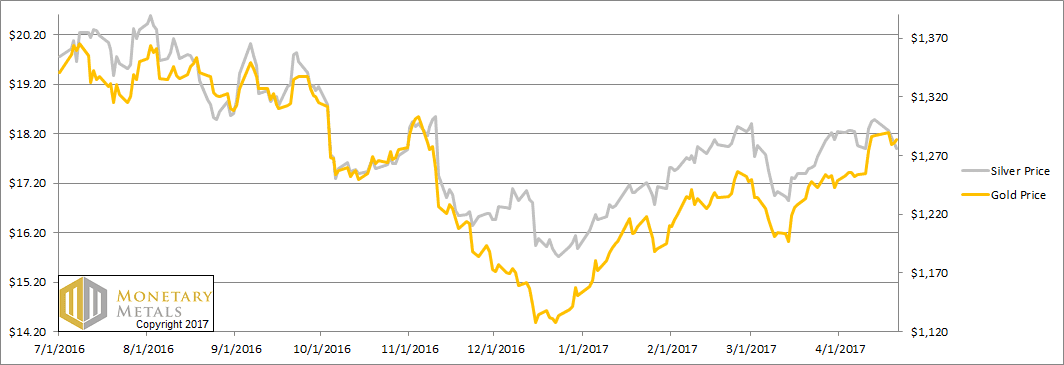
Of course, traders want to know how this will affect gold and silver. As we write this, we see that silver went down 30 cents before rallying back up to where it closed on Friday. Gold went down about $20, and then half way back up.

At this point, we are not sure if the metals are supposed to go up because more printing. Or go down because the euro constrains France from printing. Or silver at least should go up because the economy is going to be better with France remaining in the Eurozone. Or go down because the ongoing malaise will only progress as it has been. Or some other logic… and the price gyrations this evening show that traders don’t agree either.

Of course in an actual credit default (i.e. deflation) one may choose to hold paper, as there is a shrinking quantity of it. But the problem is that one may find that the shrink comes out of your balance! We think it may be better to sell the paper and hold money (gold or silver) as money cannot default, unlike credit.

In any case, we are interested in watching what the fundamentals of the metals are doing. We will take a look at the graphs below, but first, the price and ratio charts.

The Prices of Gold and Silver

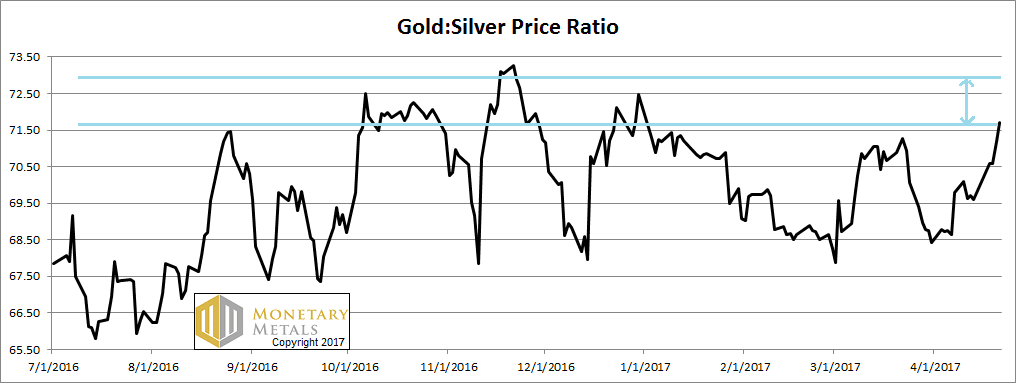
Next, this is a graph of the gold price measured in silver, otherwise known as the gold to silver ratio. It had a major move up this week. That is, the price of gold didn’t change much, but that of silver fell from $18.49 to $17.91.

The ratio made a fresh high (you would have to go back before the new year to see this level). So we drew in a line showing this level going back many months. We are not too focused on charts, preferring to understand the fundamentals, but in a case like this we think it’s worth looking.

The fundamentals are well above the current market level. If prior peaks are an indication, there may be a spot of resistance at 72.5 (+0.8 above Friday’s close) and another at 73.25. If the ratio should go over these levels, then it may go all the way to its fundamental level (discussed below).

The Ratio of the Gold Price to the Silver Price

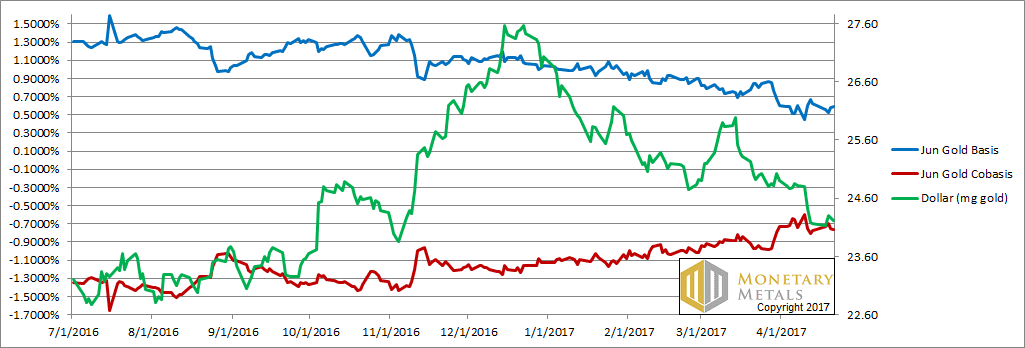
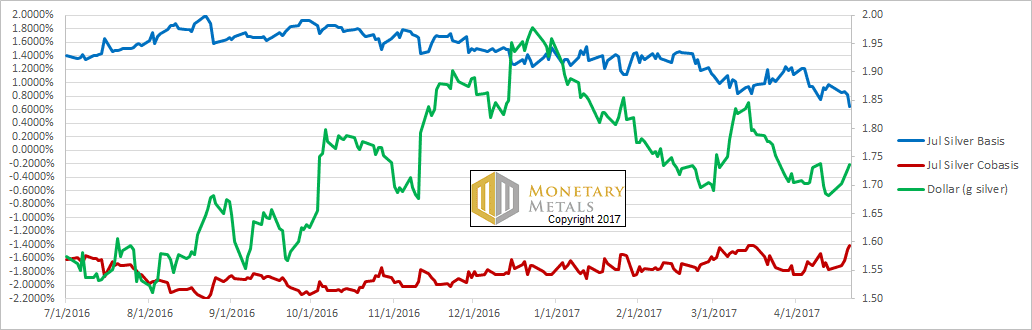
For each metal, we will look at a graph of the basis and cobasis overlaid with the price of the dollar in terms of the respective metal. It will make it easier to provide brief commentary. The dollar will be represented in green, the basis in blue and cobasis in red.

Here is the gold graph.

The Gold Basis and Cobasis and the Dollar Price

The scarcity (i.e. the cobasis, the red line) fell slightly this week. This occurred as the price of gold fell a few dollars (i.e. the price of the dollar, which is the mirror image, rose).

Therefore, it should be no surprise that our calculated fundamental price fell a few bucks, to just under $1,290.

Now let’s look at silver.

The Silver Basis and Cobasis and the Dollar Price

In silver, the price fell a lot. So we are not surprised to see that the basis fell and cobasis rose (i.e. abundance dropped and scarcity increased). Some speculators definitely got flushed. However, the question is how many and how much?

Our calculated fundamental price of silver fell over 50 cents, down to $15.92. This is quite a lot in two weeks (recall that it had been over $16.80 on April 7).

Our calculated fundamental gold-silver ratio is now up to about 81. Frexit or no Frexit, is not the question. The question is ratio to hit or not to hit 80.

© 2017 Monetary Metals

Friday, April 21, 2017

The Government Made a Mess They Can’t Clean Up

Published here: http://goldsilverworlds.com/gold-silver-experts/government-made-mess-cant-clean/

When I was a boy, I remember watching Richard Nixon on August 15, 1971 announce a complete “freeze” on “all wages and prices.” In today’s terms that’s what I’d call an attack on the free market.

At first, his price freeze sounded quite generous for consumers. You’d not see the price of your gas or milk creep up. Sounded like a win-win. At the time, 75% of Americans, including my mother, thought price controls were a wonderful idea. She changed her mind only a few weeks later.
During his speech that August night, Nixon severed ties between gold and the dollar. The gold standard ended. No longer would dollars need to be backed by gold.

Well, the results have been disastrous ever since then as price levels skyrocketed.

Oh, and as for his price freeze, my mother discovered her favorite brands stopped showing up in stores. Farmers stopped processing crops in the field. Manufacturers laid off workers and cut output.

Venezuela tried a similar price freeze for a decade. The results were no different than the US. For a decade, imagine shortages of food and medicine for you and your family. That’s what happened in Venezuela.

Today, here in the United States, you and I still feel the effects of Nixon’s fateful announcement. The Federal Reserve now controls the money supply in place of an objective gold standard. They print as much money as they want at any time.

The Fed’s policymaking decisions are made in periodic meetings of its “Open Market Committee.” The committee consists of 12 members – the seven members of the Fed’s Board of Governors; the president of the Federal Reserve Bank of New York; and four of the other 11 other Reserve Bank presidents.

In other words, the monetary policy of the US – the world’s largest economy – is effectively controlled by 12 people.

Before, the value of the dollar was determined in terms of gold. Anyone who had dollars could exchange for gold and vice versa. The US dollar wasn’t “legal tender” as it is today – if you didn’t want to accept dollars as payment for your goods or services, you didn’t have to. You could demand payment in gold, silver, or even accept payment in private currencies issued by many of the country’s banks.

There was competition for money. Competition makes a free market work. The Fed has abolished this competition, turning the money supply into a monopoly.

Look at this chart:

Source: Oregon State University

Before the Fed came into existence on December 13, 1913, price levels stayed steady since colonial times. Every minor price jump eventually came back down.

However, since the Fed got their paws on the money supply in 1913, we’ve seen a dramatic rise in prices.

They claim their “monetary policy objective” mission, according to the Federal Reserve Act, is to:

… promote effectively the goals of maximum employment, stable prices, and moderate long-term interest rates.

All good things for you and I. But, that’s not what we’ve seen.

Look at 2007, when the Fed turned into a backstop for failing companies. Rather than face the consequences any small business or average American would have to as a result of poor financial decisions, the Fed handed the banks free money.

They printed hundreds of billions of dollars – essentially your money – to act as the “last resort” to help companies and banks. Institutions that the Fed, themselves, deemed too big to fail.

As the graph above demonstrates, once a committee of 12 started calling the shots, inflation began to rise at almost an exponential rate.

For decades, discussion of a return to the gold standard has been mostly restricted to earnest discussions among libertarians. But that’s starting to change. President Donald Trump commented on the return of the gold standard last year, saying:

“We used to have a very, very solid country because it was based on a gold standard… Bringing back the gold standard would be very hard to do, but boy, would it be wonderful. We’d have a standard on which to base our money.”

His statement is factually correct. Bringing back the gold standard would be an incredibly difficult, but wonderful, task.

In fact, two things would need to occur to bring back the gold standard:

  • First, Congress would need to abolish the Fed. There’s little political will to do that now, other than a few Tea Party Republicans willing to at least entertain the idea.
  • Second, Congress would also need to redefine the dollar in terms of a unit of gold – establish a price point at which the Treasury would be obligated to exchange gold for dollars.

The biggest political obstacle to overcome, though, will be the ingrained belief that in a financial crisis, there must be a lender of last resort. To that, I would simply say, “Why?”

Critics say that in a world with a gold standard, insurance giant AIG would have collapsed. So would nearly all of Wall Street’s mega-banks, most US auto manufacturers, and many other companies. The recession would have quickly turned into a depression, with cataclysmic results for the economy.

But that’s missing the point. In a world with a gold standard, the financial excesses that brought about the events beginning in 2007 would never have occurred. If your business isn’t expecting a handout if and when times get rough, you tend to operate it more prudently.

Perhaps the best argument for a gold standard came from former Fed Chairman Ben Bernanke, who, paradoxically, opposes it. In testimony before Congress in 2011, he was asked, “Why do people buy gold?”

Bernanke’s reply: “As protection against of what we call tail risks: really, really bad outcomes.”

Indeed. I couldn’t have said it better myself.

Protecting your assets (and yourself) against any threat – from the government, the IRS or a frivolous lawsuit – is something The Nestmann Group has helped more than 15,000 Americans do over the last 30 years.

Feel free to get in touch at service@nestmann.com or call +1 (602) 688-7552 to learn how we can help you.

Want to learn more about us first?

Why not get a free copy of my very popular report – The Top 10 Asset Protection Mistakes. There’s a 90% chance you’re making at least one of them… maybe more.

Click here to learn more and claim your copy.

The post The Government Made a Mess They Can’t Clean Up appeared first on Gold Silver Worlds.

Silver, Platinum and Palladium as Safe Haven Investments

Published here: http://www.zerohedge.com/news/2017-04-21/silver-platinum-and-palladium-safe-haven-investments

Silver, Platinum and Palladium as Safe Haven Investments 

 - Silver, platinum and palladium see increased role as investment vehicles
- Increase in academic output on the white precious metals is in line with this
- Silver and particularly gold are safe haven assets
- Silver was a safe haven at times during which gold failed to be
- Platinum and palladium less so but have diversification benefits
- Silver manipulation is possible and indications of, if not legal proof
- Benefits platinum and palladium could provide as money not been fully addressed
- Main focus in investment drivers is price - not on drivers of physical demand
- Platinum, palladium and silver have different relationships with other assets and divergent abilities in hedging risk
- White precious metal investors should employ a buy-and-hold strategy
- Silver markets have become more efficient since 1977
- White precious metals are increasing in investment importance
- Research shows hedging role and diversification benefits of precious metals

by Jan Skoyles, Editor Mark O'Byrne

A review of the academic literature on the financial economics of silver, platinum and palladium has recently been conducted by Vigne, Lucey, O’Connor and Yarovaya.

The review surveys and covers the findings on a wide variety of topics in relation to the White Precious Metals including Market Efficiency, Forecast-ability, Behavioral Findings, Diversification Benefits, Volatility Drivers, Macroeconomic Determinants, and their relationships with other assets.

For those asking whether or not they should invest in precious metals or to increase their allocation, it can be of use to read some academic research into the role the white metals can play in hedging risk in their investment and pension portfolios. There are many strongly held opinions regarding gold and silver and precious metals and some mathematical and economic analysis can go a long way in helping us to understand how and why we should consider investing in these less popular precious metals.

How efficient are the white metal markets?

Given that silver is traded 24 hours a day, across the globe one would, argue the authors, expect to find a market that is ‘constantly involved in price discovery and adhere closely to the Efficient Markets Hypothesis’. This expectation has lead to a number of studies seeking to address this question.

Below we summarise the authors’ findings. The papers featured look at not only the efficiencies of the markets but the effectiveness of futures markets at predicting spot prices and also market manipulation.

Key findings across the literature, relevant for investors include:

  • Speculation in silver
    Solt and Swanson’s (1981) research - soon after silver's massive bull market in the 1970s which propelled prices from below $1.50/oz to nearly $50/oz - led them to conclude that silver markets are more speculative than other investment markets
  • What role do futures markets play in making predictions?
    Varela’s (1999) regression model finds closest to delivery silver futures are a good predictor of the future cash price, showing efficient links between these markets
  • Mutafoglu et al.’s (2012) work looks at whether open futures positions can predict platinum and silver spot prices movements. They find that white precious metal market returns explain trader’s positions
  • How efficient? More efficient
    Charles et al. (2015) looks at the efficiencies of both the daily spot prices of platinum and silver between 1977 and 2013. They find that that the markets have gradually become more efficient during this period
  • Silver price manipulation
    Silver price manipulation is a hot topic among investors and banks have been guilty of manipulating the gold and silver markets in recent years and so it is something important for academics to study. Batten et al. (2016), looking at the 5 minute tick data between the 1st of January 2010 and the 30th of April 2015, finds evidence of ‘possible manipulation’ but warns that the ‘evidence provided is merely indicative and not a legal prove for foul play'
  • Exogenous shocks - gold or silver?
    Looking at silver prices between 1975 and 2013, Gil-Alana et al. (2015a), find shocks send silver higher but ‘exogenous shocks will affect real silver prices less intensely than gold prices'
  • The impact of ETPs and precious metal and gold ETFs.
    Fassas (2012) finds a significant correlation between silver returns and the flows into silver Exchange-Traded Products exists and further find that ETP flows are a driving factor for platinum and palladium prices
  • When it comes to the Global Financial Crisis, we know that gold deviated from its fundamentals but Figuerola-Ferretti and McCrorie (2016) find that in the same period silver and palladium were rather affected by the launch of ETFs rather than the financial crisis as such.
  • Which trading strategy should I use?
    By examining the daily price of silver between January 1968 and March 2016 and the daily price observations of platinum and palladium between April 1990 and March 2016, Almudhaf and Al Kulaib (2016) conclude that a traditional buy-and-hold strategy outperforms an attempted market timing strategy

Pricing data

 There has been a lot of work done by academics trying to model price data. For some investors it will not add much to the conversation. However there are a couple of key takeaways from the review:

  • Silver twice as volatile as gold; gold not that volatile
    Morales and Andreosso-O’Callaghan (2011) ‘the standard deviation of daily silver returns is more than twice the standard deviation of gold and if the precious metals only palladium has a higher standard deviation than silver.’
  • Caporin et al. (2015) find that ‘platinum is found to be the least liquid and least volatile metal of the precious metals considered.’

How should I split my portfolio?

Since 2003, we have recommended that investors hold precious metals as part of a balanced, diversified portfolio. But that doesn’t mean there is a simple answer for how much you should hold.

  • Silver low correlation with stocks
    Jaffe (1989) finds that silver prices between 1971 to 1987 had a "very low correlation of 0.134" with stocks showing its "usefulness in a diversified portfolio.’
  • Silver as a portfolio hedge
    Kocagil and Topyan (1997) uncover ‘a positive relationship between risk premium and daily futures trading and to a negative relation- ship with the S&P 500, pointing towards silver’s role as an portfolio hedge.’
  • A long-term portfolio hedge
    McCown and Zimmerman (2007) find that ‘silver is a less volatile investment than the market in the short- run, and that it moves in opposite direction than the market on the long-run - arguments in support of silver’s ability to be used as a hedging tool against stock markets.’
  • Platinum or silver?
    Belousova and Dorfleitner (2012) conclude that ‘Adding silver or platinum to a portfolio [of stocks, sovereign bond and the money market instruments] during bull markets reduces volatility and enhances return. During bear markets silver only reduces portfolio risk…but platinum loses its diversifying ability.’
  • A higher proportion to gold
    Hammoudeh et al. (2013) when looking at different make-ups of portfolio decides ‘an optimal portfolio should hold a higher proportion of gold than any other asset (even though silver was the best performing asset over the time frame observed), and that overall, the pure precious metal portfolio proved to be the least efficient’
  • During tough times hold silver, gold and platinum
    When looking at periods of high volatility and poor returns of stock markets, Hillier et al. (2006) concludes ‘silver’s hedging abilities were found to be to be stronger than those of platinum.’ But this was not the recommendation ‘when looking at what metals to optimally hold in a portfolio, silver did not perform as well as both gold and platinum which scored higher returns over the period.’
  • Financial stress
    Reboredo and Uddin (2016) when looking at the impact of financial stress and policy uncertainty finds that ‘financial stress has a positive effect on gold and silver prices, in contrary to platinum and palladium’
  • Which one is the safe haven?
    When looking at all four precious metals’ role as a safe haven between 1989 and 2013, against the S&P 500 and US 10 year bonds, Lucey and Li (2015) find that ‘silver was a safe haven at times during which gold failed to be, but also during far more quarters than both platinum and palladium. Empirically however, gold should be considered the better safe haven investment for it acts as one more often than white precious metals.’

What happens when there is volatility?

  • Silver is sensitive in the short-run
    Hammoudeh and Yuan (2008) find that between 1990 and 2004 ‘silver is found to have a low sensitivity to bad news in the short run, giving it safe haven like qualities. Increases in interest rates reduce silver price volatility. Oil price shocks have the effect of cooling precious metals volatility, making them good diversifiers in a commodity portfolio.’
  • Are macroeconomic factors important?
    Chen (2010) finds that ‘the importance of global macroeconomic factors in explaining silver and platinum price volatility has increased over the time period observed…A similar picture is observed for platinum.’
  • The metals affect one another
    Sari et al (2007) finds that ‘over the long run gold accounts for 16% of silvers variance’ in a similar vein Lucey and Tully (2006) find ‘silver is found to explain 23% of gold price volatility. In the short-run, unexpected shocks to gold, platinum and palladium prices have a positive and significant impact on the price of silver and vice versa. Silver explains about 10% of the variations of both platinum and palladium prices, while platinum and palladium explain about 22% of their respective price fluctuations.’
  • The silver price means little to platinum and palladium
    However Balcilar et al. (2015) disagree with Sari et al (2007), they find ’the impact of change of the gold price on silver is about 1.25%; against an impact of about 0.07% from silver on gold. The impact of change of the gold price on both platinum and palladium is of about 0.8%, while the impact of change of silver prices is practically non-existent for both platinum and palladium prices.’

How does the macroeconomy affect the white precious metals?

  • Platinum and palladium in the long-run
    Using data from 1914 to 1996 to assess the inflation hedging ability of the white precious metals Taylor (1998) finds that platinum and palladium ‘served as a long-run inflation hedge, while evidence also points towards the short-run hedging abilities of platinum.’
  • Silver good in the long and short-run
    Adrangi et al. (2003) finds there is ‘a positive relationship between silver and the CPI in the long-run and the short-run is observed.’
  • Two factors driving the silver price before 1989
    Radetzki (1989) concludes ‘that two factors drive the price of silver: demand from industry and private inventories. Oil prices and official inventories are not believed to be amongst the major driving forces of the silver price, even though they are seen here as important in determining the price of gold.’
  • Negative impact on silver prices
    Elder et al. (2012) look at the impact of US macroeconomic news announcements on the return, volatility and trading volume of gold, silver and copper futures. ‘Advance retail sales, changes in nonfarm payrolls, durable goods orders, business in- ventories, construction spending, and new home sales announcements have a statistically significant negative influence on silver futures prices; only trade balance announcements are positively associated with silver futures prices.’
  • Silver doesn’t worry about monetary nor financial market variables
    Batten et al (2010) ’neither monetary nor financial market variables are significant for silver price volatility. Instead, the volatility from the other precious metals markets has an effect on silver price volatility.’
  • Silver has a strong relationship with US factors
    Fernandez (2017) On a monthly basis, a strong relationship is identified between white precious metals and US industrial production as well as US monetary supply…a very strong relationship is identified between the prices of gold and silver on a weekly basis during bullish environments, while platinum and palladium have a strong relationship with silver during bearish periods.’
  • The white precious metals are increasing in importance
    Fernandez (2017) also finds that the rise in importance of the price of white precious metals and consumer confidence and exchange rates in the United States, [is] in line with the rise in importance of white precious metals as an investments asset.’

Conclusion - White metals have a key role to play

When we are told that we should invest in precious metals then we primarily think of gold and silver. The truth is, that we should consider platinum and palladium which are, like silver, industrial commodities and can play a significant and beneficial role in portfolio diversification.

As we have seen, there is not as much research into the white precious metals and their role as investments as there is for gold. However, given the increasing demand for them we are now reading far more research. This suggests that they will continue to play not only a key role in investment portfolios but in the wider macro-economy.

There is a strong case for having an allocation of some 20% to 30% of an investment or savings portfolio in physical precious metals. The majority of this should be in gold and silver but as we have seen the academic research shows that having smaller allocations - maybe 5% and 5% - to platinum and palladium - will also have diversification benefits.

Investors would be prudent to consider an allocation to all four precious metals, and rebalance when there is outperformance, in order to maximise the safe have aspect and return of their portfolio.

Download and Read 'The Financial Economics of White Precious Metals - A Survey' here


News and Commentary

Gold prices consolidate as high prices attract profit-taking (BullionDesk.com)

Paris Shooting Leaves Policeman Dead Three Days Before Election (Bloomberg.com)

Gold steady as investors cautious ahead of French polls (Reuters.com)

Gold bond scheme to open on April 24 (TheHinduBusinessLine.com)

Investors Propel Purchases of Gold ETF on Geopolitics `Trigger’ (Bloomberg.com)

Larry Fink: ‘Warning Signs Are Getting Darker’ for the U.S. Economy (Bloomberg.com)

Ron Paul's IMF question emerges in sharp relief in the era of Trump (NySun.com)

How Western Civilisation Could Collapse (BBC.com)

How Miners Dig for Gold Miles Underground (Bloomberg.com)

Alarm Bells Start Ringing for U.K. Economy (BloombergQuint.com)

7RealRisksBlogBanner

Gold Prices (LBMA AM)

21 Apr: USD 1,281.50, GBP 1,000.85 & EUR 1,197.31 per ounce
20 Apr: USD 1,279.90, GBP 996.91 & EUR 1,188.00 per ounce
19 Apr: USD 1,282.05, GBP 999.74 & EUR 1,196.79 per ounce
18 Apr: USD 1,285.00, GBP 1,025.82 & EUR 1,205.46 per ounce
13 Apr: USD 1,286.10, GBP 1,025.28 & EUR 1,208.42 per ounce
12 Apr: USD 1,272.30, GBP 1,018.22 & EUR 1,199.02 per ounce
11 Apr: USD 1,255.70, GBP 1,011.47 & EUR 1,183.75 per ounce

Silver Prices (LBMA)

21 Apr: USD 17.98, GBP 14.05 & EUR 16.80 per ounce
20 Apr: USD 18.19, GBP 14.21 & EUR 16.91 per ounce
19 Apr: USD 18.22, GBP 14.19 & EUR 16.99 per ounce
18 Apr: USD 18.42, GBP 14.56 & EUR 17.27 per ounce
13 Apr: USD 18.56, GBP 14.80 & EUR 17.45 per ounce
12 Apr: USD 18.31, GBP 14.65 & EUR 17.27 per ounce
11 Apr: USD 17.94, GBP 14.44 & EUR 16.91 per ounce


Recent Market Updates

- When Trump Turns On “Enemy Within” Fed It May Create 1970s Style Stagflation
- Silver Production Has “Huge Decline” In 2nd Largest Producer Peru
- Gold Erases Post- Election Fall as Trump Wrong on Dollar
- Perth Mint Silver Bullion Sales Rise 43% In March
- Gold Surges Above Key 200 Day Moving Average $1270 Level
- Bank of England Rigging LIBOR – Gold Market Too?
- Pension Crisis In U.S. and Globally Is Unavoidable
- Gold, Silver and Oil Spike After U.S. Bombs Syria
- Why Now Is The Time To Invest In Gold and Silver – Schroders
- Heraeus Gold Refinery Buys Swiss Refiner Argor-Heraeus
- Invest In Gold – 46 Trillion Reasons Why
- Gold and Silver Best Performing Assets In Q1, 2017
- Irish Government To Issue Free Gold Coin To Protect Citizens From Brexit’s Impact On Euro and EU

Access Award Winning Daily and Weekly Updates Here